Written by: Mariana Fonseca, Editorial Team, AI Growth Agent
Key Takeaways for 2026 AI Search
- AI search traffic has surged in 2026, with referral visits up 357% year over year and zero-click rates now dominating major platforms.
- Visibility has decoupled from clicks. Citation context inside AI answers now drives brand discovery more than traditional rankings.
- Brands must cover the full query universe, including long-tail terms, and publish living content that self-heals as models retrain.
- Agencies and DIY approaches both break at scale. A headless engine that ships validated, structured content with full technical SEO is the only sustainable path.
- Traditional search tools show you where your brand stands. AI Growth Agent makes your brand the answer. Book a kickoff and see your first article live within a week.
2026 AI Search Traffic Benchmarks and What They Mean
The table below shows how quickly AI search has grown and how deeply zero-click behavior has taken over, so you can see why citation frequency, not click volume, now defines visibility. The table draws on verified primary-source data published through mid-2026, and every figure is cited inline.
| Metric | Figure | Source |
|---|---|---|
| AI platform referral visits, monthly | 1.13 billion | Similarweb via TechCrunch |
| Growth in AI referral visits vs. prior year | +357% | Similarweb via TechCrunch |
| LLM-sourced traffic surge, early 2024 to mid-2025 | +527% YoY | Previsible AI Traffic Report |
| Google AI Mode monthly active users | 1 billion | Digital Applied, Q1 2026 |
| Queries triggering an AI Overview (Q1 2026) | approximately 47% | Presenc AI |
| Zero-click rate, AI Mode queries | 93% | Digital Applied / Loamly |
| Zero-click rate, AI Overview queries | 83% | LLMrefs, 2026 |
| Users who click sources inside AI Overviews | small percentage | Semrush 2025 zero-click study |
| Organic CTR drop when AI Overview present | significant reduction | Keyword analysis |
| Brands cited inside AI Overviews: click uplift | +35% organic clicks | Digital Applied, 2026 |
| B2B buyers starting research in AI chatbot | 51% of B2B software buyers now start their research with an AI chatbot more often than with Google | G2 Research |
| Skeptical of AI answers yet never verify | 83% skeptical / ~8% verify | AI Growth Agent Manifesto |
Semrush projects that traffic from AI-powered search will overtake traditional organic search by 2028, and Gartner predicts traditional search engine volume will drop 25% by 2026 due to AI chatbots and other virtual agents. The leaderboard is being written now.
Core Concepts for Winning AI Citations
The universe is the full set of queries and prompts that describe a brand’s market, head terms and long tail together. Most brands track a handful of head terms and lose the rest of the conversation by default. AI Growth Agent maps universes of 1,600+ queries for mature clients and runs 3,000+ searches every week just to refresh the snapshot.
Seed terms are the strategic anchor topics that organize the universe. Each seed term spawns dozens of long-tail queries underneath it. The long tail is where the vast majority of actual customer queries live. Robots search the long tail. Brands that focus only on head terms stay blind to most of their own market.
Citation context replaces the ranking number as the primary visibility signal. It describes where a brand appears in an AI answer, who it is grouped with, and what claim it is cited for. AI visibility and citation share are replacing traditional rankings as the new KPIs, with synthetic share of voice measuring how often and how prominently a brand is cited in AI responses.
Large language model optimization (LLMO) is the discipline of writing and structuring content so that AI surfaces find it, trust it, and cite it. Content must feature structured information with logical headings, precise context-rich answers, unique information outside training data, strong E-E-A-T signals, and semantic depth to succeed in this environment.
Living content is content that updates and self-heals over time so a brand’s presence does not decay as the world changes. ChatGPT shows the strongest recency bias among AI platforms, with 76.4% of its most-cited pages updated in the last 30 days, which makes freshness a citation prerequisite, not a nice-to-have.
Incremental visibility is reporting that isolates the visibility a new effort actually generated, separate from the visibility a brand already had. Without this isolation, leaders cannot tell whether their content investment is working or whether they are simply taking credit for existing brand equity.
Market Findings: How ChatGPT, Claude, Gemini, and Perplexity Share Traffic
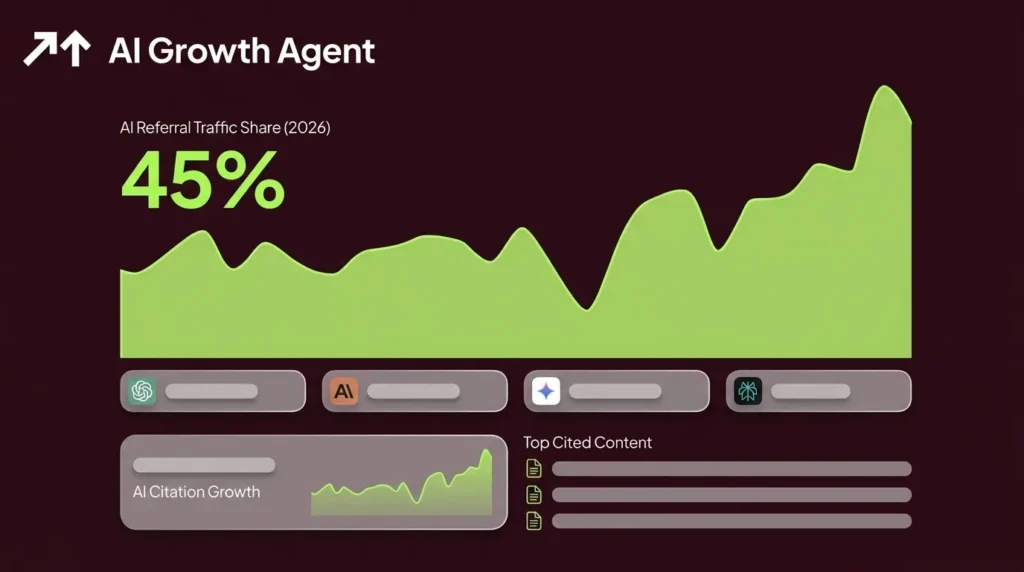
Goodie’s Wave 2 AI Search Market Share Report (May 2026) found that ChatGPT, Claude, Gemini, and Perplexity together accounted for 99% of measurable B2B AI referrals in the March-April 2026 period. The distribution has shifted materially in twelve months. ChatGPT declined from 89.1% of B2B AI referrals in mid-2025 to 62.6% by early 2026, while Claude reached 18.5%, Gemini 10.6%, and Perplexity 7.3%. The market has moved from one-engine dominance to four-engine plurality in under a year.
Raw platform visits do not predict referral output. Claude generated 18% of B2B referrals, which shows that citation behavior and referral intent vary significantly by platform and query type. Brands that focus only on ChatGPT already leave a substantial share of AI-driven discovery on the table.
The qualified-intent signal from AI referrals is measurable and consistent. AI referral sources produced roughly 30% longer engagement than Google Organic. Users arriving from AI citations come in with context and intent already formed by the AI answer. This compresses the consideration phase and accelerates conversion.
The zero-click offset math is stark. ChatGPT Search sends roughly 190 times less referral traffic to websites than Google despite handling an estimated 12% of Google’s search volume. The implication is not that AI search is unimportant. It is that citation frequency and brand mention rate are the leading indicators of downstream revenue, not click volume. Leva Sleep closed $40,000 to $50,000 in deals in under three weeks from buyers who walked into the store carrying AI Growth Agent content and asking about specific features they had discovered through it, a conversion path that never registered as a click in any analytics dashboard.
Stop letting AI define your brand at random. Control the narrative across online search and book a kickoff with AI Growth Agent.
Business Implications: Why Agencies and DIY Both Stall Out
CMOs and founders who take AI search seriously usually see two options, and both fail at scale.
The first is the agency route. An RFP runs approximately three months, followed by three more months to produce the first assets. It is close to a year before anything is in motion, and the entire period is spent briefing, onboarding, and chasing. Agencies are too slow, too expensive, and too disconnected from AI surfaces to keep pace. The AI search leaderboard is being written in months, not years.
The second is the DIY chatbot path. Producing one good article is possible. Producing the second means running the entire process again, with more rounds of review, schema to maintain, legal language to get right, and quality that drifts from one piece to the next. One company produced roughly 300 articles this way and not one was cited. The articles were full of errors and gaps because no system validated claims, structured content for AI parsing, or managed technical SEO end to end.
These two doors look like opposites, but they share a fatal flaw. Both depend on stitching together a stack of agencies, tools, and people, which means no single system owns content freshness or quality over time. The result is content that goes stale the day it ships, because no one is responsible for keeping it current. This staleness is not just a maintenance problem. AI systems increasingly prioritize credible, historically consistent sources over frequent updates for non-news queries, favoring long-standing domains with coherent narratives. Stale, inconsistent content becomes an active liability in citation-based search.
The only scalable response is a headless engine that maps the full universe, produces authoritative living content, and reports the incremental visibility it generates, without adding headcount or relying on capped monitoring tools.
7-Step Migration Checklist for AI-First Search
This checklist walks through the migration from traditional SEO dependency to an owned, self-healing AI search presence. Each step is sequenced for execution within a standard three-month pilot.
- Map your full universe. Identify every seed term and the long-tail queries beneath it using real-time Google AI Overview and ChatGPT search data as the objective function. Most brands track fewer than 50 head terms and miss the majority of their own market.
- Stand up an owned AI-optimized surface within one week. AI Growth Agent stands up a fully optimized site the client owns within the first week, with the first article live in about one week and content indexing in as little as ten days. The site connects through a reverse proxy rewrite under a subdirectory or subdomain, leaving the existing main site untouched.
- Deploy agentic technical SEO from day one. Every surface must ship with Blog MCP, llms.txt and llms-full.txt, agent discovery via /.well-known/, natural language query parameters, Markdown served to agent crawlers, OpenAI discovery, and Agent Card guidance. These are baseline requirements for AI surface readability.
- Implement traditional technical SEO at the article and site level. Use rich schema markup across article, author, FAQ, product, and organization types, proper sitemaps, a detailed robots.txt, automated web stories, instant indexing, autoredirects, and 404 tracking. Structured data and llms.txt will move from experimental to essential for AI visibility in 2026.
- Produce authoritative, validated content at scale against the long tail. Use a multi-agent orchestration that validates every claim and source against primary evidence, never relying on a model’s training data. Apply brand voice rules, legal disclaimers, and anti-hallucination controls from the first article. AI Growth Agent clients average more than 12,000 additional AI citations and mentions and over 100,000 additional bot visits across the first twelve weeks.
- Implement living content protocols. Configure automatic refresh cycles so articles update when Google Search Console signals stale performance or when the calendar year turns. Nearly 90% of AI bot hits occur on content from the last three years, with the strongest recency bias concentrated in the last 30 days. Content that goes stale loses citation eligibility.
- Measure incremental visibility, not vanity metrics. Publish into a separate environment so reporting isolates exactly what the new effort generated. Cross-reference bot tracking, Google Search Console, and citation data weekly. Track brand mention rate and citation rate as leading indicators, and capture AI source at the conversion moment to connect citations to revenue.
Ready to implement this playbook? Book a kickoff with AI Growth Agent and see your first article live within a week.
Forward-Looking Outlook: Training the Next Generation of Models
The AI search leaderboard keeps shifting. Models are retrained, updated, and fine-tuned continuously, and the content they find during crawl and citation passes shapes what they say in future answers. By 2026, content that is not designed to be cited will not appear where decisions are being made, as AI systems synthesize answers from publisher content, brand-owned assets, and third-party references.
Brands that establish authoritative, structured, living content now feed their own narrative into the next training cycle. Brands that wait feed the next cycle with whatever their competitors, review platforms, and forum threads happen to contain. Publishers with original data, in-depth analysis, and expert commentary that AI cannot easily replicate will win in citation-based search.
Citation frequency, model recall rates, excerpt usage patterns, structured data adoption, and share of answers relative to competitors will emerge as key performance indicators as traditional click-based attribution breaks down. Brands that invest in measurement infrastructure now, isolating incremental visibility from existing brand equity, will be the ones that can prove ROI when the board asks why organic spend increased.
Breadless achieved a 30x lift in Google Search Console impressions over six months and is now the most recommended healthy franchise in the US ahead of CAVA, Rush Bowls, and Sweetgreen, with ChatGPT citing eatbreadless.com over 45,000 times per month. That citation volume acts as a compounding asset that trains future model outputs with Breadless’s own narrative, at a scale no agency retainer could replicate.
Frequently Asked Questions
What is the current zero-click rate for AI search queries, and how does it differ from traditional search?
Zero-click rates vary significantly by query type and surface. Traditional Google searches without AI features average approximately 60% zero-click rates. When AI Overviews are present, that rate rises to 83%. AI Mode queries reach 92% to 94% zero-click rates on informational queries such as “what is” and “how to” questions. Approximately 65% of Google searches in 2026 end without a click, up from about 58.5% in 2024. The practical implication is that citation frequency inside AI answers, not click volume, is the leading indicator of brand visibility. Brands cited inside AI Overviews earn 35% more organic clicks than non-cited pages, which reverses the typical CTR penalty. The goal is to be named in the answer, not merely to rank beneath it.
How is AI referral traffic share distributed across platforms in 2026?
The B2B AI referral market has shifted from one-engine dominance to four-engine plurality between mid-2025 and early 2026. ChatGPT leads at approximately 62.6% of B2B AI referrals, followed by Claude at 18.5%, Gemini at 10.6%, and Perplexity at 7.3%, with Copilot accounting for approximately 4.0%. Referral output does not track platform visit share, as shown by Claude’s 18% contribution to B2B referrals. Brands that optimize exclusively for ChatGPT already miss a substantial and growing share of AI-driven discovery. The distribution continues to shift, with Claude gaining approximately 7 percentage points in brand-level share in the most recent 30-day period versus the trailing 90 days across the Goodie panel.
How do I measure incremental visibility from AI search separately from existing brand traffic?
Incremental visibility measurement requires publishing AI-optimized content into a separate, trackable environment so that new citations and impressions can be isolated from the brand’s existing organic baseline. In GA4, a custom channel group using regex filters matching known AI referrer domains isolates AI referral sessions. Google Search Console provides an AI Mode filter added in June 2025 that surfaces impressions, clicks, CTR, and average position for content cited in AI-generated responses. Bot tracking at the article level captures every crawl and citation pass, including the specific bot ChatGPT uses to cite sources. Cross-referencing these three data streams, bot traffic, Search Console impressions, and GA4 referral sessions, produces a defensible incremental visibility report. AI Growth Agent publishes into a separate environment by design, so reporting attributes only what the engine generated, never riding existing brand visibility.
What technical requirements must content meet to be cited by AI surfaces in 2026?
AI surfaces evaluate content across both traditional and agentic technical signals. On the traditional side, highly structured HTML, rich schema markup across article, author, FAQ, product, and organization types, proper sitemaps, a detailed robots.txt, and fresh content with automatic updates are baseline requirements. On the agentic side, Blog MCP with schema, manifest, discovery, and capability guidance exposed to agents, llms.txt and llms-full.txt so AI surfaces can read the brand in their preferred format, OpenAI discovery and Agent Card guidance served via /.well-known/, natural language query parameters that return personalized responses to agents, and Markdown served to agent crawlers are all necessary for full AI surface readability. Structured data has moved from a ranking enhancer to a baseline retrieval qualifier for eligibility in AI-driven search. Content that lacks these signals is readable to humans and invisible to the systems doing the citing.
Why does content quality matter more than content volume in AI citation-based search?
AI indexers distinguish between quality content and prompt-generated text, and the signals they use include claim validation, source credibility, structural clarity, and consistency of narrative over time. One company produced approximately 300 articles using a DIY chatbot approach and achieved zero citations, because no system validated claims, structured content for AI parsing, or managed technical SEO end to end. AI systems increasingly prioritize credible, historically consistent sources over frequent updates for non-news queries, favoring long-standing domains with coherent narratives. The brand manifesto and journalist-led validation layer that AI Growth Agent applies create differentiation a generic content tool cannot replicate. Long-tail strategies also differ even within the same sector, so two competitors running AI content do not converge on the same answer. The brands that win are the ones controlling their narrative deliberately, not the ones generating the most text.
Conclusion: Turning AI Search into a Compounding Asset
AI search traffic growth in 2026 is not a trend to monitor. It is a structural shift in how brands are discovered, evaluated, and recommended, and the window to establish authoritative presence before the next model generation is measured in months. Zero-click answers now resolve the majority of queries. Citation context has replaced the ranking number. The brands cited inside AI answers earn more clicks, close more deals, and train future models with their own narrative. The brands absent from those answers cede the conversation entirely.
Agencies are too slow. DIY chatbot approaches produce inconsistent, uncited content at scale. Monitoring tools report the problem without solving it. The only scalable response is a headless engine that maps the full query universe, produces authoritative living content validated against primary sources, deploys the complete traditional and agentic technical SEO stack from day one, and reports the incremental visibility it generates week over week, without adding headcount or relying on capped prompt counts. AI Growth Agent is that engine, delivering results like Breadless’s 30x impression lift and 45,000 monthly citations, with an average of 12,000+ additional AI citations, 100,000+ additional bot visits, and a 20%+ lift in impressions across the first twelve weeks, with the first article live within a week of kickoff.
Traditional search tools show you where your brand stands. AI Growth Agent makes your brand the answer. Book a kickoff and see your first article live within a week.