Written by: Mariana Fonseca, Editorial Team, AI Growth Agent
Key Takeaways
-
Modern B2B keyword research starts with real buyer language from Gong transcripts, CRM notes, and sales calls, not tool-generated volume data.
-
Teams organize those phrases into a living pain-point library before opening any keyword tool so every term connects to real problems and deal stages.
-
Each term gets mapped to problem-aware, solution-aware, or product-aware stages so content meets buyers across the full journey instead of clustering at the top.
-
Zero-volume terms stay in scope when they align with high-value deals, because pipeline impact, not search volume, determines content priority.
-
AI Growth Agent turns these insights into an autonomous Content Topology and self-healing publishing engine so you can see how the system works for your specific market.
1. Extract Buyer Language from Gong and CRM Transcripts
B2B keyword research in 2026 starts with the exact words buyers use to describe their problems. Marketing teams no longer guess which phrases to defend. They listen to the language a procurement lead uses halfway through a discovery call when explaining why the last vendor failed.
Platforms like Gong, ZoomInfo Chorus, and Fireflies AI automatically transcribe sales calls, generate summaries with action items, and sync structured insights to Salesforce or HubSpot CRM records without extra work for reps. Gong maintains a content library where managers save call snippets as coaching examples or competitive intelligence. Fireflies topic tracking flags recurring themes such as pricing discussions or competitor mentions across transcripts. Chorus connects first-party conversation data with third-party B2B intelligence from 500 million contacts, which surfaces objection patterns and competitor mentions at scale.
The extraction process stays simple and direct. Teams pull verbatim phrases from closed-deal notes, lost-deal post-mortems, objection logs, and discovery call summaries. Brady Bateman, Senior Digital Strategist at Konstruct Digital, recommends pulling exact phrases from sales call recordings, support tickets, and closed-deal notes because those verbatim quotes reflect how buyers actually describe their problems. An engineering manager searching for “precision machining vendor quality problems” uses language that came from a frustrated buyer on a recorded call, not from a keyword tool suggestion.
This extraction step turns keyword research into a steering-wheel system instead of a rearview-mirror report. Volume metrics describe what buyers searched in aggregate. Transcript mining captures what your specific buyers said at the moment they recognized a problem worth solving.
2. Build a Pain-Point Library Before Using Keyword Tools
Teams organize extracted language into a pain-point library before opening Ahrefs, SEMrush, or any other keyword platform. The library becomes a living document of exact customer phrasing, grouped by problem type, objection category, and deal stage. This structure prevents volume chasing from the start.
Internal conversations about lost deals, repeated objections, and ideal customer profiles supply the context that makes the library useful. Sales, customer success, and product teams contribute examples that rarely appear in generic keyword tools.
The library serves two core functions. First, it anchors every downstream keyword decision to real buyer intent instead of tool-generated suggestions. Second, it acts as a quality filter for every term surfaced later by tools. If a keyword does not map to a phrase or problem pattern already documented in the library, it needs explicit justification before it enters the topology.
B2B content teams in 2026 build living content systems by mining first-party data sources including sales team interviews on common objections, customer support tickets, product reviews, and CRM platforms to identify category-level and problem-driven topics that buyers actively research. The pain-point library captures those signals in one place.
3. Map Library Terms to Buyer Awareness Stages
Every term in the library gets assigned to one of three buyer stages before content planning begins. The stage assignment controls content format, depth, and CTA structure. Teams that skip this step usually over-invest in awareness content and under-invest where conversion happens.
High-performing B2B teams often allocate about 40% of effort to top-of-funnel content, 35% to middle-of-funnel, and 25% to bottom-of-funnel. Middle- and bottom-funnel investments show the highest direct pipeline attribution because they meet buyers who already entered an active buying cycle.
Problem-Aware stage captures buyers who recognize a symptom but have not named a solution category. At this stage, buyers ask diagnostic questions such as “why our sales cycle keeps stalling,” “how to reduce manual reporting in operations,” or “signs your CRM data is unreliable.” Content format focuses on educational guides, diagnostic frameworks, and explainer posts that help buyers name and frame their problem.
Once buyers understand their problem, they move into the Solution-Aware stage. Here they know a category of solution exists and start evaluating different approaches. Now they search for “revenue intelligence platform comparison,” “B2B content automation vs. agency,” or “best tools for sales call analysis.” Content format shifts to comparison guides, ROI playbooks, and alternative roundups that help buyers choose an approach. Comparison pages often drive more conversions than generic category pages because they match how buyers think.
After buyers select an approach, they enter the Product-Aware stage and evaluate specific vendors. They search for “[brand] pricing,” “[brand] vs. [competitor],” or “implementation timeline for [product].” Content format now centers on pricing transparency pages, case studies, and demo landing pages. Bottom-funnel keywords such as “[tool] pricing” frequently convert well to trials in B2B SaaS and can outperform top-funnel keywords.
B2B buyers conduct numerous searches across multiple sites during their journey. Adobe’s survey of 1,526 senior B2B leaders found that buyers now engage in around 14 meaningful touchpoints before a decision. Stage mapping keeps the content program present across those touchpoints instead of clustering at a single stage.
4. Score Zero-Volume Terms by Deal Size and Pipeline Value
Standard keyword tools discard zero-volume terms, but B2B teams keep them when they align with high-value deals. The volume estimate reflects sampling methodology, not actual search frequency inside a narrow ICP.
Zero-volume keywords can lead to seven-figure deals in B2B industrial markets, making them more valuable than high-volume terms that attract unqualified traffic such as job seekers or students. A term like “titanium machining services aerospace defense” may show zero volume in Ahrefs or SEMrush yet generate multiple six-figure deals per year when it matches ICP pain points precisely.
Teams use four scoring criteria when deciding whether to retain a zero-volume term. The term appears in sales call transcripts or CRM records. Competitors have created content targeting the term. The associated deal size justifies content investment even at low conversion volume. Paid search data on adjacent terms shows conversion despite low impressions. A single $100K+ enterprise deal can offset months of content effort, so a 50-search-per-month term that generates one SQL per quarter can outperform a 5,000-search-per-month term that only attracts unqualified readers.
In enterprise B2B markets, niche terms might receive only 50 searches per month yet represent the entire addressable market, making every click highly valuable. Pipeline impact, not volume, becomes the scoring unit that matters.
5. Turn Validated Terms into a Weekly-Refreshed Content Topology
Once you have extracted buyer language, organized it into a pain-point library, mapped terms to buyer stages, and scored zero-volume opportunities, the next step is to structure all of these validated terms into a system that can scale: a Content Topology.
The extracted, validated, and stage-mapped terms populate a Content Topology, which is a structured map of the brand’s search universe. The map organizes around 9–15 seed terms, and each seed term spawns dozens of long-tail queries beneath it. A new account typically starts with 300–400 prompts and expands as it captures more of the search universe. Mature deployments reach 1,500 or more queries.
Building content for keyword clusters rather than individual terms creates a more durable and scalable content topology that captures dozens of related low-volume queries. B2B teams build topic clusters around revenue-driving pillars such as core services, solution categories, industries, and high-intent problems, then interlink supporting content to reinforce authority and conversion paths.
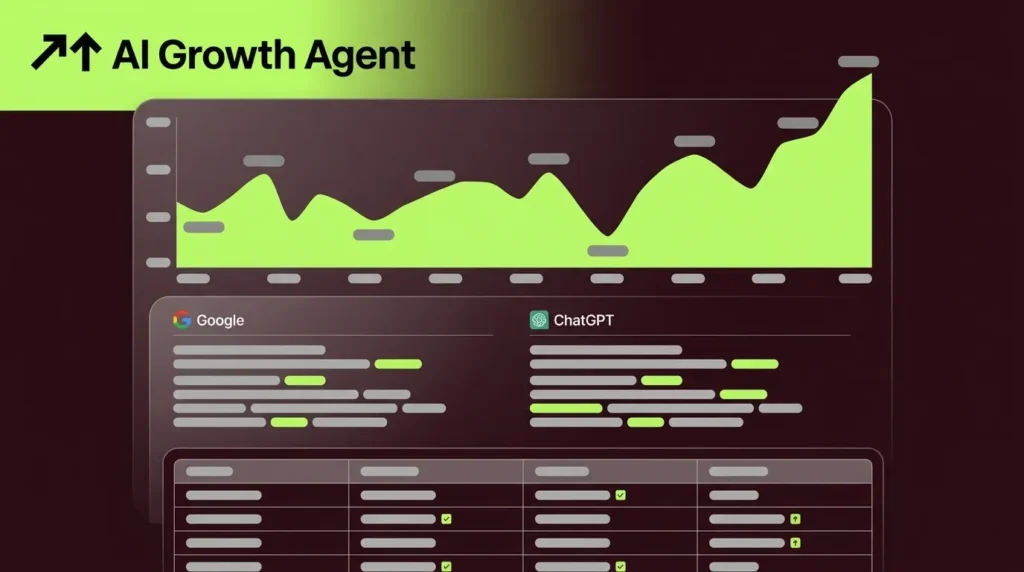
The topology functions as a living system, not a static spreadsheet. It refreshes weekly from real-time Google and ChatGPT data so it can capture new buyer language as it appears. When a competitor launches a new product and buyers start asking comparison questions, those prompts surface in the weekly refresh and enter the production queue. The system runs more than 3,000 searches per week to keep the universe snapshot current.
B2B keyword research now operates as an ongoing conversation with the market that continuously incorporates insights from sales calls, support tickets, industry changes, and customer feedback loops rather than a quarterly spreadsheet exercise. The weekly refresh turns that principle into a repeatable workflow.
6. Run Living, Self-Healing Content That Compounds Authority
A Content Topology creates value only when it drives consistent, high-quality publishing. The topology feeds an autonomous engine that writes, validates, adds schema, and publishes content, then refreshes articles in batches so authority compounds instead of decaying.
Pages updated recently can earn more AI citations, and many clients see meaningful traffic lifts after refreshing existing posts. Living content systems rely on monthly refresh cycles. Teams update high-impression pages with added depth and proof, consolidate overlapping posts into a single best-in-class resource with redirects, and upgrade internal links so authority flows into money pages.
The self-healing mechanism operates at two levels. When a brand updates a rule, CTA, or link, the engine syncs and updates all affected live articles automatically overnight. The weekly topology refresh then identifies content gaps and decay signals and queues updates before rankings slip. Advanced SEO content platforms use multi-factor algorithms that evaluate semantic keyword distribution, LSI term inclusion, content depth, and natural language processing patterns. The engine applies those signals continuously instead of waiting for quarterly reviews.
Every article ships with full schema coverage, including article, FAQ, organization, author, product, and local business schemas where they apply. The system also maintains a proper sitemap.xml, advanced robots.txt, MCP endpoints, and an LLM.txt file. These elements now function as table stakes. Most unbranded prompts in AI search are fulfilled by third-party sources, and the brands that earn those citations publish content in formats AI systems can parse, trust, and cite.
7. Track Incremental AI Citations, Bot Traffic, and Impressions
Measurement in this system separates new visibility from what the brand already had. Blending both into one number looks impressive but does not prove impact.
The weekly incremental-visibility checklist covers five measurement layers.
AI citation rate: Teams track appearance in Google AI Overviews and ChatGPT responses for topology prompts, recorded separately from existing brand mentions. Semrush reports that AI search visitors convert 4.4 times better than traditional organic search visitors, so citation rate becomes a leading pipeline indicator instead of a vanity metric.
Bot traffic: Teams identify every crawler hitting the blog by name, including GPTBot, Googlebot, ClaudeBot, and others, using WordPress plugin tracking. Volume and frequency of AI training agent visits signal how aggressively models index the content for future citations.
Google Search Console impressions: Analysts measure week-over-week impression lift attributed to AI Growth Agent URLs, separated from primary domain pages and overlapping pages. Across the first three months, clients often see a lift of more than 20% in impressions.
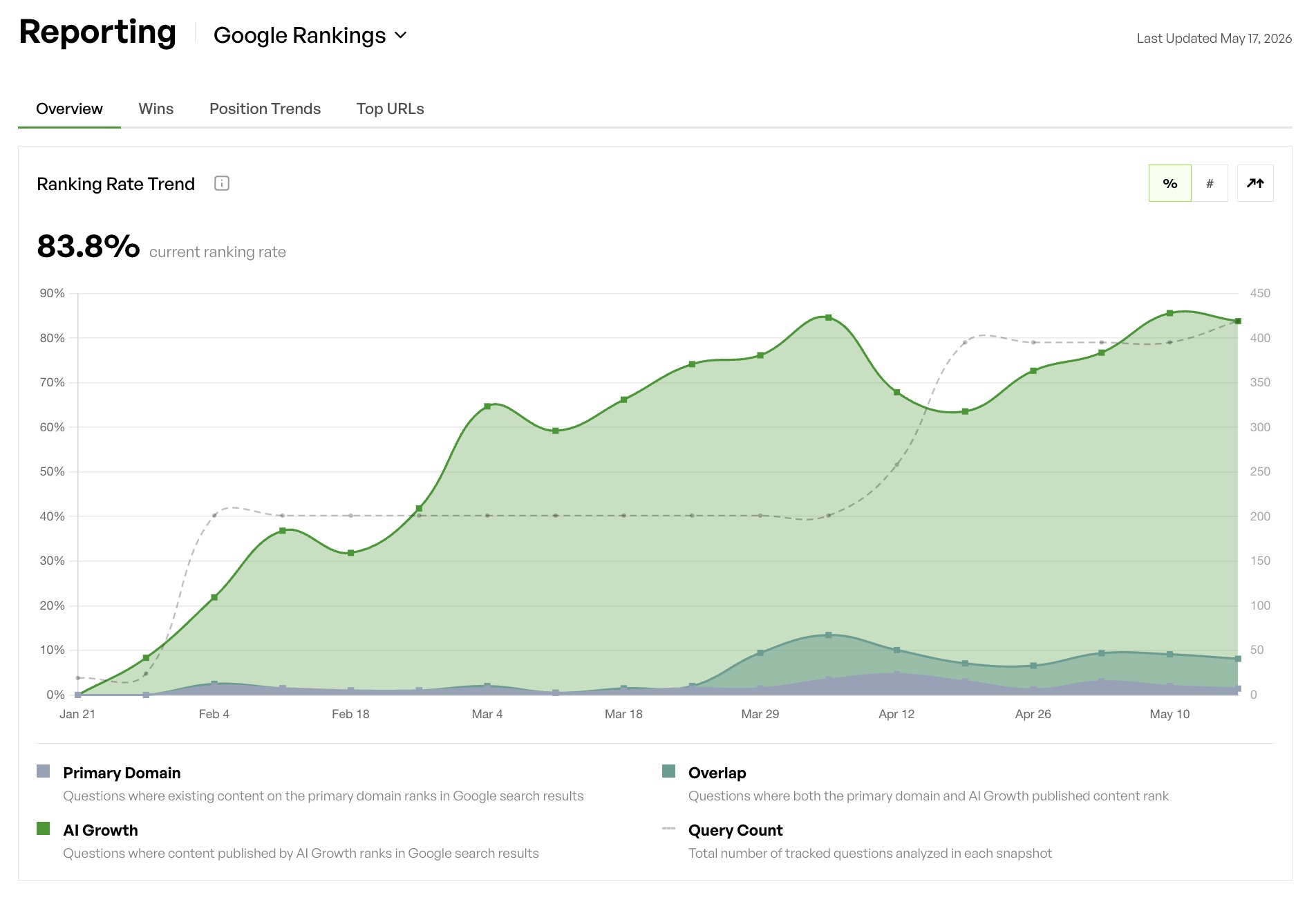
Traditional organic rank: Teams track seed term and long-tail prompt positions against named competitors, updated weekly from real-time search data instead of relying only on delayed GSC reporting.
Incremental citation and mention count: Analysts count new AI citations and brand mentions generated by the content program during the measurement period. Across the first twelve weeks, clients average more than 12,000 additional AI citations and mentions and over 100,000 additional bot visits.
In the AI search era, B2B marketing ROI depends more on relevance, identity accuracy, and verified intent signals than on classic SEO and paid placement alone. Incremental measurement connects content investment to those signals in a week-over-week format that a CMO can present confidently to a CEO.
Conclusion: Use Keyword Research to Control the Narrative
This playbook replaces the old model instead of slightly improving it. Volume-chasing tools and quarterly keyword audits produce rearview-mirror data that ignores the full search universe and fails to earn AI citations. The seven-step system here, covering transcript extraction, pain-point libraries, stage mapping, zero-volume scoring, topology construction, living content, and incremental measurement, creates a steering-wheel system that shapes what AI says about a brand when a buyer asks.
51% of B2B software buyers now start their research with an AI chatbot more often than with Google (G2, April 2026). If a vendor’s brand does not appear in the first AI-generated list, it may never reach the validation stage. The leaderboard is being written now. Brands that establish authoritative, structured, living content in this window train the next generation of models with their own narrative. Brands that wait allow the models to train on whatever happens to be sitting on the open web.
AI Growth Agent acts as the autonomous engine that executes this entire system, from Company Manifesto through Content Topology through living, self-healing content, without adding headcount or stitching together a stack of agencies and tools.
See how your sales conversations become AI citations that control your buyer’s consideration set.
Frequently Asked Questions
What makes B2B keyword research different from B2C keyword research in 2026?
B2B keyword research operates on different economics than B2C. In B2B, a single keyword that generates one qualified enterprise deal can justify months of content investment, even when that keyword shows zero search volume in standard tools. The buying committee is larger, the sales cycle often runs 12–18 months, and buyers conduct extensive independent research using AI tools before they ever engage a sales rep.
This reality means B2B keyword strategy must map terms across problem-aware, solution-aware, and product-aware stages so content meets buyers at every touchpoint, not only at the moment of highest search volume. It also means zero-volume terms sourced from sales call transcripts and CRM records often outperform high-volume head terms on pipeline impact.
The shift to AI-driven discovery surfaces amplifies this difference. Buyers now use LLMs to build vendor shortlists before visiting any brand website, so the content that earns AI citations, which is structured, validated, and topically authoritative, controls the consideration set.
How does a Content Topology differ from a standard keyword list or content calendar?
A standard keyword list is a static spreadsheet of terms ranked by volume. A content calendar is a publishing schedule. A Content Topology functions as a living map of the brand’s search universe, organized around seed terms that each spawn dozens of long-tail queries, refreshed weekly from real-time search data, and connected to a production engine that acts on what the map shows.
The topology captures what buyers search, the intent behind each query, the competitive landscape for each prompt, and the stage in the buying journey each term represents. It expands as the brand captures more of its search universe, starting at 300–400 prompts and scaling to more than 1,500. It also updates automatically when new buyer language appears in sales calls, when competitors launch new products, or when AI surfaces begin showing new question patterns.
A keyword list tells a team what to write. A Content Topology tells an autonomous engine what to produce, validate, publish, and refresh without manual intervention.
Why do AI citations matter more than traditional search rankings for B2B pipeline in 2026?
Traditional search rankings measure position on a static list. AI citations measure whether a brand is named, grouped with credible peers, and cited for a specific claim when a buyer asks a conversational question. These outcomes differ and create different pipeline effects.
A brand ranked third organically for a head term may now receive far fewer clicks than it did before AI Overviews appeared in search results. A brand cited first in a ChatGPT response to “what is the best solution for [specific B2B problem]” reaches a buyer who already framed their need in natural language and is actively building a consideration set.
AI-referred visitors tend to spend longer on-page and submit longer, more specific, purchase-adjacent queries than traditional organic visitors. For B2B brands, where the buyer’s first AI-generated shortlist often determines which vendors reach the validation stage, earning citations becomes upstream pipeline control rather than a vanity metric.
Can a B2B company run this system without a large marketing team or technical staff?
Mid-market and enterprise companies can run this system without expanding their teams. The autonomous engine handles transcript extraction workflows, topology construction, content production, schema and technical SEO, publishing cadence, and self-healing updates.
The brand’s role focuses on an initial interview to produce a Company Manifesto, review of the first batch of articles, and plain-language feedback. The engine saves that feedback as a memory so teams never repeat the same note. No code is written or maintained by the client.
The WordPress plugin provisions bot tracking, MCP endpoints, robots.txt, sitemaps, and schemas automatically. The blog connects to the client’s domain through a reverse proxy rewrite or subdomain without changes to the existing site structure. The client owns the blog outright, with no agency dependency, and tracks results through a proprietary dashboard, the WordPress plugin, and Google Search Console.
How quickly can a B2B company expect to see AI citations and measurable pipeline impact?
The first article can go live within one week of kickoff. Content has indexed in as little as two weeks. AI citations usually begin appearing within the first three to four weeks as crawlers and AI training agents index the new content.
Pipeline impact timelines vary by industry, deal size, and sales cycle length. In markets with shorter cycles, some clients have reported closed deals directly attributed to AI Growth Agent content within three weeks of the first articles going live. In enterprise markets with longer sales cycles, the compounding nature of living content builds a durable citation presence that continues generating pipeline long after the initial articles publish.
The standard engagement runs as a three-month pilot. This window provides enough indexing time to establish a clear baseline of incremental visibility that separates new performance from existing brand presence.