Written by: Mariana Fonseca, Editorial Team, AI Growth Agent
Key Takeaways
- B2B SaaS marketing automation in 2026 relies on autonomous engines that run content production, lead nurturing, and revenue operations across AI-driven discovery channels.
- Legacy platforms and monitoring tools fall short because they lack integrated content generation, schema provisioning, and incremental visibility reporting for AI search environments.
- Key evaluation factors include data integration, full schema coverage, bot tracking, incremental visibility measurement, and fixed pricing models that align vendor incentives with client growth.
- Successful implementation follows a structured workflow from brand positioning and search universe mapping through content generation, lifecycle alignment, and ongoing self-healing content updates.
- AI Growth Agent provides an autonomous engine that maps your full search universe and compounds visibility on autopilot. Schedule a demo to see how it fits your stack.
Core Concepts That Power AI-Driven B2B SaaS Growth
Intent signals are behavioral and contextual data points, such as web visits, product usage thresholds, forum activity, and AI query patterns, that show where a buyer sits in their decision process. B2B SaaS buyers complete 70% of their learning before engaging sales and interact with numerous marketing and product touchpoints before closing. Teams must capture and act on intent before a prospect raises their hand.
AI lead scoring applies machine learning to firmographic, technographic, and behavioral data to rank accounts by conversion likelihood. Predictive scoring combined with real-time intent signals streamlines lead routing and nurturing but requires a connected data and automation layer to function effectively across CRM and marketing platforms.
Lifecycle automation sequences move customers from trial through activation, expansion, and renewal using behavior-triggered communications. Lifecycle automation sequences in B2B SaaS should include trial nurture flows, onboarding sequences, feature education triggers, renewal reminders, and usage-based expansion offers.
RevOps (Revenue Operations) aligns marketing, sales, and customer success around shared data and pipeline metrics. Significant work time can be reduced through automation and behavior change in revenue processes, which frees teams for strategic analysis rather than manual data reconciliation.
These four concepts form the operational backbone of any modern B2B SaaS automation strategy. Intent signals, lead scoring, lifecycle sequences, and RevOps alignment all depend on one upstream input: the content that makes your brand discoverable in the first place. The missing layer in most stacks is the one that feeds them, which is authoritative, AI-optimized content that makes the brand the answer before a buyer reaches a sales workflow.
See how AI Growth Agent plugs into your existing CRM and lifecycle tools in a live demo.
Current Market Pressures Shaping B2B SaaS Automation
Customer acquisition costs for B2B SaaS have risen 60% in competitive markets over the past five years and as much as 222% over eight years, which makes paid media an increasingly unsustainable primary channel. The economics favor organic growth because it compounds over time in a channel the brand controls, while paid visibility disappears the moment spend stops.
Zero-click search accelerates this shift. B2B SaaS companies are supplementing traditional SEO with Answer Engine Optimization (AEO) by structuring content with direct authoritative answers, comprehensive schema markup, conversational query optimization, and entity-based authority so AI systems such as ChatGPT, Claude, and Perplexity cite their information when responding to buyer queries. Brands that do not actively shape their AI-search narrative leave it to outdated training data, competitor content, or hallucinations.
By 2026, B2B SaaS buyers spend less than 20% of their purchase journey time in direct conversations with vendors. This self-directed research behavior makes educational content and authority-driven discovery the primary mechanisms for trust-building and differentiation. At the same time, marketing automation is evolving into autonomous AI systems that orchestrate entire campaigns, including content creation, audience targeting, budget allocation, and real-time optimization, with minimal human intervention.
HubSpot’s 2026 State of Marketing Report, surveying 1,505 marketing professionals globally, found that many leaders cite leveraging AI in their marketing strategy as a major challenge because teams lack a clear framework for what to adopt and how it fits existing workflows. The result is tool sprawl, and many leaders report too many tools that do not work well together as a top challenge.
Replace your fragmented stack with one autonomous engine in a tailored consultation.
Four Automation Approaches B2B SaaS Teams Use Today
Four broad approaches exist for B2B SaaS marketing automation in 2026. The table below compares them on speed to first results, schema and bot tracking capability, and incremental visibility reporting. These qualitative assessments reflect documented capabilities and structural limitations of each category.
| Approach | Speed to First Results | Schema & Bot Tracking | Incremental Visibility Reporting |
|---|---|---|---|
| Legacy platforms (Marketo, Salesforce Marketing Cloud, HubSpot) | Strong for email and CRM workflows, with weeks required for configuration | No native bot tracking or AI-citation schema, which requires third-party tooling | Channel-level attribution only, and many leaders struggle to form a complete performance picture from siloed data |
| GEO/AI search monitors (Profound, Athena, Peec AI) | Monitoring begins immediately, but no content production exists to drive results | Prompt tracking only with capped prompt sets defined by the client and no site-level schema provisioning | Rearview mirror reporting that shows where the brand stands in a limited prompt set but does not act on data |
| DIY agents and AI content tools (Claude, Jasper) | One article is possible quickly, yet scaling isolated tests into repeatable workflows is a documented challenge for many marketing leaders | No schema, no bot tracking, and no technical SEO provisioning | No reporting layer, so the client must assemble and reconcile all measurement tools independently |
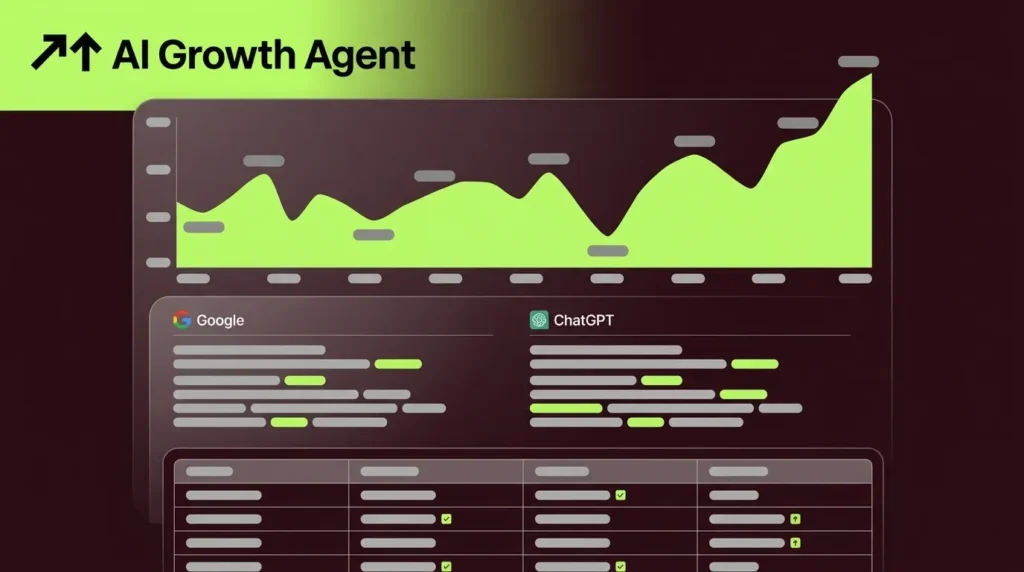
| Autonomous engine (AI Growth Agent) | First article can go live in as early as one week, with content indexing in as early as two weeks | Full schema suite (article, FAQ, product, author, local business, organization), bot tracking via proprietary WordPress plugin, MCP for Blog and Web, robots.txt, and sitemap.xml, all provisioned automatically | Incremental visibility isolated week over week, with Google AI Overviews, ChatGPT citations, Google Search Console impressions, and bot traffic unified in one dashboard |
The structural gap is clear. Legacy platforms handle lifecycle and CRM workflows but do not produce or refine content for AI-native discovery. Monitoring tools report on a narrow slice of the search universe without acting on it. DIY tools produce individual assets without the embedded intelligence, schema infrastructure, or measurement layer required at scale. An autonomous engine covers the full stack from discovery through reporting.
Compare your current approach against the autonomous engine model in a live demo.
Key Technical and Economic Factors When Choosing a Solution
Data integration. Limited data integration is a primary challenge in inbound marketing automation, resulting in fragmented lead data, incomplete profiles, and poor prioritization. Any approach must connect search intelligence, bot traffic, impressions, and CRM signals into a single operational layer, not four separate dashboards.
Schema coverage. Google’s ranking systems evaluate content using E-E-A-T signals, which are Experience, Expertise, Authoritativeness, and Trustworthiness, with trust as the most important factor. Schema markup, including article, FAQ, product, author, and organization, is the machine-readable layer that communicates these signals to both traditional crawlers and AI training agents. Approaches that omit schema provisioning leave citations and visibility on the table.
Bot tracking. AI training agents such as GPTBot and ClaudeBot crawl content differently from traditional SEO spiders. Knowing which bots hit which pages, and how often they do so, provides a leading indicator of future AI citations. Most platforms do not track this behavior at all.
Incremental visibility. The measurement focus should be whether the automation caused visibility to improve, not just whether visibility improved. Any credible approach must isolate what it generated versus what the brand already had, week over week, across Google AI Overviews, ChatGPT, and Google Search Console.
Fixed pricing. Monitoring tools that cap prompts and charge more for broader coverage create a structural misalignment because the vendor profits from the client seeing less of their search universe. Every additional prompt the client wants to track becomes a revenue opportunity for the vendor, which reduces the incentive to reveal the full query landscape. A flat-fee model with no per-prompt or per-article billing removes this conflict and aligns incentives correctly.
Audit your stack against these five criteria in a 30-minute consultation.
Seven Stages of Implementing an Autonomous Engine
The following seven-step workflow shows how a mid-market or enterprise B2B SaaS company moves from kickoff to compounding organic visibility using an autonomous engine.
- Brand interview and manifesto production. A journalist-led interview captures the brand’s positioning, product features, target audiences, and approved claims. The output is an AI-optimized Company Manifesto that serves as the anti-hallucination foundation for all content generation.
- Search universe mapping (Content Topology). The engine extracts seed terms and hundreds of long-tail queries from real-time Google and ChatGPT data. Autonomous AI marketing systems enable predictive content planning based on market trends and buyer intent signals. The Content Topology operationalizes this by mapping specific questions and intent behind each real user search, not just surface-level keywords.
- Blog infrastructure setup. A fully optimized, branded blog is launched within the first onboarding week and connected to the client’s domain via reverse proxy rewrite or subdomain. The WordPress plugin provisions schema, bot tracking, MCP, robots.txt, and sitemap.xml automatically.
- AI lead scoring and intent signal integration. A modern B2B SaaS marketing stack combines CRM and marketing automation tools such as HubSpot or Salesforce with product analytics and attribution tools to route high-intent accounts. The autonomous content engine feeds this layer by generating the authoritative content that surfaces those intent signals in the first place.
- Content generation and review. Research agents analyze current Google and ChatGPT results, competitor signals, People Also Ask boxes, and forum discussions for each prompt. The first batch of articles is reviewed by the client, and feedback is saved as persistent memory so the same note is never needed twice.
- Lifecycle automation alignment. Autonomous AI systems allow lean B2B SaaS marketing teams to scale operations and handle repetitive multistep workflows without increasing headcount. Published content is mapped to lifecycle stages such as awareness, evaluation, and expansion, then connected to existing CRM nurture sequences via UTM parameters.
- Incremental visibility reporting and iteration. Every Monday, the dashboard updates with a fresh snapshot of the search sector, including AI citation rates, bot traffic, Google Search Console impressions, and traditional rank. The same data that proves results also determines what gets produced next.
Walk through this seven-step workflow with your specific use case in a demo.
How to Run Ongoing Management and Measurement
Content that is published and forgotten decays. B2B companies generate twice as much revenue from organic search compared to all other marketing channels combined, yet that advantage compounds only when content stays current, indexed, and authoritative. Living, self-healing content addresses this directly because every article is refreshed in batches, and any change to a rule, CTA, or link propagates automatically across all affected live articles overnight.
The search universe is refreshed weekly across seed terms and hundreds of derived prompts. Mature clients reach universes of more than 1,500 queries. When a competitor spams thousands of pages to manipulate rankings, the engine detects the movement in real time and the content strategy responds faster than any team using traditional tools.
Measurement operates across four unified pillars rather than four disconnected dashboards. Search Intelligence tracks traditional rank and competitive positioning. AI Analytics monitors brand appearance and sentiment across Google AI Overviews and ChatGPT. Bot Tracking captures every crawl by traditional SEO spiders and AI training agents, including GPTBot. AI Ranking measures order of mention and citation context in AI-generated answers, which is the new ranking metric for zero-click search.
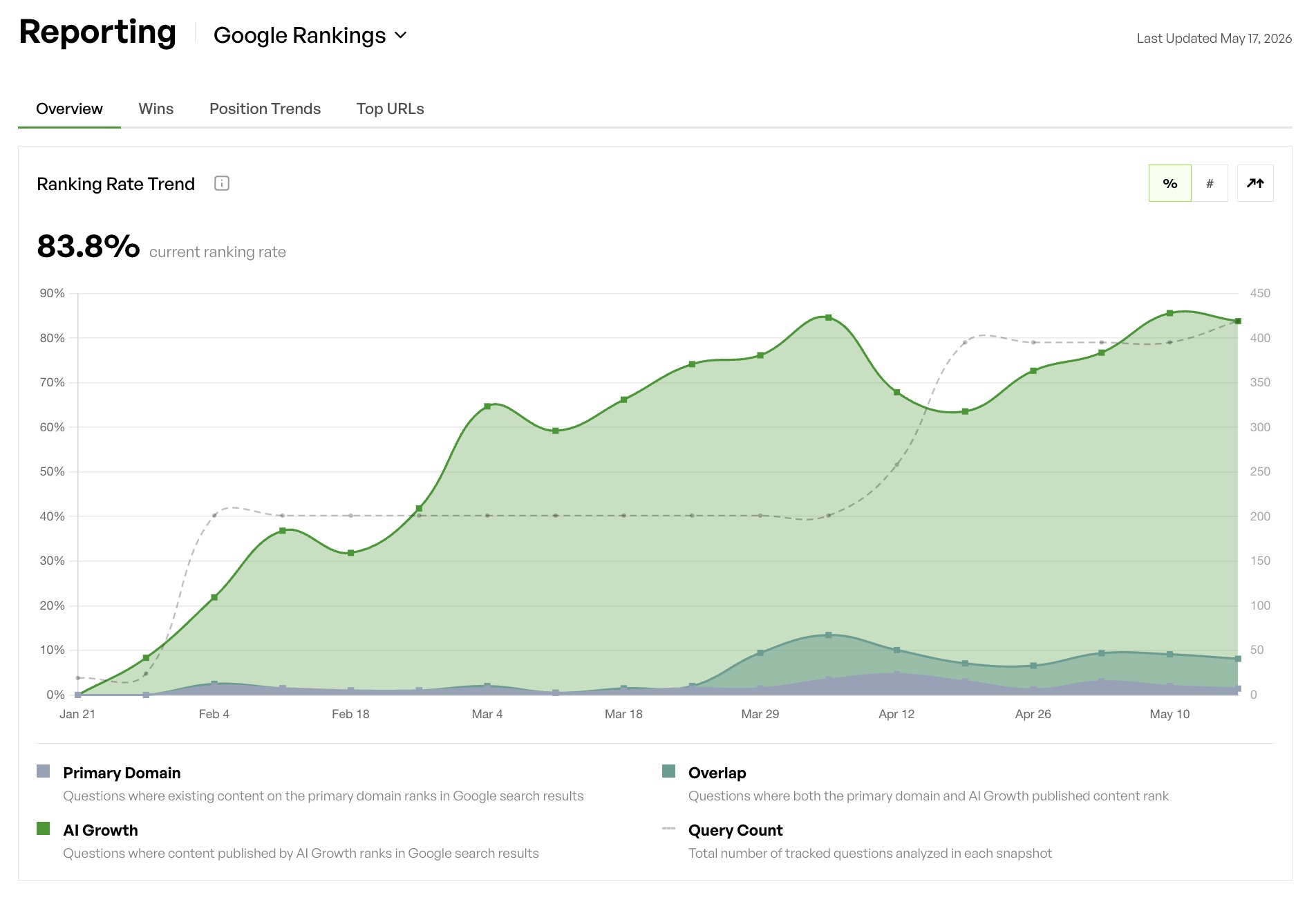
Effective ongoing performance evaluation requires identity resolution, consistent UTM standards, and monthly data completeness audits. These elements are built into the engine’s reporting infrastructure rather than left to the client to assemble. Across the first three months, clients average more than 12,000 additional AI citations and mentions, over 100,000 additional bot visits, and a lift of more than 20% in impressions in Google Search Console.
See the full measurement framework in action during a consultation.
Risks, Limitations, and Common Mistakes to Avoid
Tool sprawl. As noted earlier, the proliferation of disconnected tools creates operational drag, weaker attribution, and manual reconciliation work. This pattern matches the challenge HubSpot identified as a top concern for marketing leaders in 2026. Adding a rank tracker, a separate AI-answer monitor, crawler-log tooling, and Google Search Console, none of which talk to each other, is the most common mistake in modernizing a B2B SaaS automation stack.
Capped prompts. Monitoring tools that track only the prompts a client already thought to ask about produce a structurally incomplete picture of the search universe. Strategic narrative decisions made on a capped prompt set rely on partial information and often miss emerging queries.
Stale content. Around 57% of B2B sellers feel the content their marketing team produces is generic and unresponsive, and content that was authoritative at publication loses ground as competitors publish, search intent evolves, and AI training data updates. Without a self-healing layer, every article becomes a depreciating asset.
Lack of narrative control. Brands that do not actively shape their AI-search narrative cede it to competitors, outdated training data, or hallucinations. AI-powered onboarding and intelligent expansion in SaaS use behavior and usage signals to customize experiences, yet those signals reach the right accounts only when the brand already appears as the answer those accounts encounter during discovery.
Misattributing existing visibility. Adopting better attribution models can prompt reallocation of budget from paid search toward organic content and product-led growth, which often reduces CAC. Taking credit for visibility the brand already had inflates reported ROI and misallocates budget away from the channels actually driving incremental growth.
See how AI Growth Agent eliminates tool sprawl and capped prompts in a focused demo.
Summary and Decision Support for Marketing Leaders
The B2B SaaS marketing automation landscape in 2026 has a clear structural divide. Legacy platforms handle CRM and lifecycle workflows but do not produce or refine content for AI-native discovery. Monitoring tools report on a narrow, self-selected slice of the search universe without acting on it. DIY tools produce individual assets without the embedded intelligence, schema infrastructure, or measurement layer required at scale. Agencies remain slow, expensive, and structurally behind on AI search.
The autonomous engine is the recommended solution for mid-market and enterprise B2B SaaS companies that need compounding organic visibility without added headcount or tool sprawl. It maps the full search universe from real-time data, ships living self-healing content with full schema coverage, tracks bot traffic and AI citations across major platforms, and reports incremental visibility in isolation from existing brand equity, week over week, from the first article forward.
According to a Backlinko study, only 0.78% of users visit a website on the second page of Google results, and the equivalent threshold in AI-generated answers is even more concentrated. The brands that win AI citations at scale in 2026 treat content as infrastructure, not as a campaign. The autonomous engine provides that infrastructure.
AI Growth Agent makes your brand the answer. Schedule a demo to see the autonomous engine in action.
Frequently Asked Questions
What makes B2B SaaS marketing automation different in 2026 compared to previous years?
The discovery channel has changed. Prior to 2024, marketing automation primarily meant email sequences, CRM workflows, and paid media retargeting. In 2026, a significant and growing share of B2B buyer research happens inside AI systems such as ChatGPT, Google AI Overviews, and Perplexity before a prospect visits a vendor’s website. The automation stack must now include a content and visibility layer that makes the brand the answer inside those AI systems, not just a destination after a click. Brands that treat AI search as a monitoring problem rather than a content infrastructure problem will continue to lose discovery share to competitors that have built autonomous content engines.
What are the biggest implementation challenges when modernizing a B2B SaaS marketing automation stack?
Three challenges dominate most implementations. First, data fragmentation persists because stacks accumulate tools over time, which leaves search data, CRM data, bot traffic, and attribution in separate systems that do not communicate. Forming a complete picture of performance requires either a custom integration build or a unified infrastructure. Second, scaling content quality is difficult because producing one authoritative article with a chatbot is straightforward, while producing hundreds of brand-consistent, schema-optimized, source-validated articles per month requires a system with embedded intelligence at every stage, including keyword selection, research, writing, review, publishing, and self-healing. Third, measurement clarity is often missing because teams cannot distinguish between visibility the brand already had and visibility their new automation generated, which makes it impossible to defend ROI or reallocate budget correctly. Incremental visibility reporting that isolates new results from existing brand equity solves this third challenge.
How should marketing leaders measure the ongoing performance of an AI-driven content and automation system?
Measurement should operate across four layers simultaneously. Bot traffic, tracked at the server level via a WordPress plugin or equivalent, shows which AI training agents crawl content and at what frequency, which serves as a leading indicator of future citations. AI citation rates in Google AI Overviews and ChatGPT show where the brand currently appears as the answer for target queries. Google Search Console impressions provide an independent audit of indexing progress and organic reach. Traditional rank tracking against competitors anchors the picture in the search landscape the brand’s buyers still use. These four layers must be unified in a single infrastructure rather than read as four separate dashboards, and all reporting must isolate incremental results from pre-existing brand visibility to produce a defensible ROI narrative for leadership.
How is AI Growth Agent different from AI search monitoring tools like Profound or Athena?
Monitoring tools tell you where your brand stands in a capped set of prompts that you define yourself, which makes them a rearview mirror. AI Growth Agent functions as a steering wheel because it maps the brand’s full search universe from real-time Google and ChatGPT data, not from a self-selected list, and then acts on that data by producing authoritative, schema-optimized, self-healing content that changes what appears in AI-generated answers. Monitoring is one component of AI Growth Agent’s measurement layer, not the product itself. The product is the autonomous engine that produces the content, provisions the technical infrastructure, tracks the results across bot traffic, impressions, and AI citations, and reports only the incremental visibility it generated. Other monitoring tools show you the problem, while AI Growth Agent solves it.
AI Growth Agent makes your brand the answer. Schedule a demo to explore fit with your stack.