Written by: Mariana Fonseca, Editorial Team, AI Growth Agent
Key Takeaways
- ChatGPT leads as the most versatile platform for text and coding, while Claude excels at nuanced writing with context windows up to 1M tokens.
- Midjourney v6.1 delivers the strongest photorealistic images, beating DALL-E 3 and FLUX.2 Pro on consistency and fine detail.
- Runway Gen-4 Turbo currently sets the bar for video AI, combining high realism with fast generation for professional B-roll.
- Enterprises now prioritize SOC2/HIPAA compliance and programmatic scale, rather than manual workflows, to win AI search visibility.
- AI Growth Agent’s Programmatic SEO Agent scales content authority; explore how it automates rankings here.
Top 5 Generative AI Platforms for 2026
The 2026 generative AI landscape features specialized leaders across distinct content categories. Enterprise AI content generators now cover text generation, image creation, video production, code assistance, and business automation. ALM Corp’s March 2026 analysis identifies ChatGPT as the strongest all-around tool, while focused platforms dominate specific use cases. The table below compares the top five platforms on features, pricing, and trade-offs so you can match tools to your content goals.
| Rank/Category | Key Features | Pricing | Pros/Cons |
|---|---|---|---|
| 1. ChatGPT (Text) | Multimodal, coding, memory | Plus $20/mo | Versatile, can hallucinate |
| 2. Claude (Text) | Long-context reasoning | Pro $20/mo | Safe, nuanced, slower |
| 3. Midjourney (Image) | Photorealism v6.1 | $10/mo | High-quality, Discord-only |
| 4. Runway (Video) | Gen-4 Turbo, high realism | Credits-based | Fast editing, can be costly |
| 5. Copilot (Code) | IDE integration | $10/user/mo | Productive, tied to MS ecosystem |
See how to deploy these platforms programmatically for content authority at scale
How We Evaluate 2026 Generative AI Platforms
Effective platform selection starts with clear evaluation criteria. Teams need to weigh performance benchmarks, cost efficiency, security compliance, API capabilities, and real-world scalability. 2026 token pricing analysis shows wide cost differences across models, which matter at scale. Enterprise adoption also demands SOC2, HIPAA, and related compliance standards. The most critical success factor is programmatic velocity, meaning the ability to ship high-quality content at scale for AI search visibility.
Best Text Generative AI for 2026 (ChatGPT vs. Claude vs. Gemini)
Text generation remains the most widely adopted enterprise AI application. Recent comparisons rate ChatGPT at 5/5 for coding assistance, Claude at 5/5 for writing quality, and Gemini at 5/5 for research support. Context windows differ sharply across tools. The Claude API supports 200K+ tokens for most models, while Claude Opus 4.6 and Sonnet 4.6 support 1M tokens. ChatGPT Pro and Enterprise GPT-5.3 Instant provide a 128K token context window, and Gemini reaches 1M tokens.
The next table focuses on how these text platforms compare on pricing, security, and core use cases so you can align them with your workflows.
| Tool | Pros/Cons | Pricing | Use Cases | Security |
|---|---|---|---|---|
| ChatGPT | Versatile, can hallucinate | $20/mo | Marketing, coding | SOC2 |
| Claude | Nuanced, fewer tools | $20/mo | Long-form writing | SOC2 |
| Gemini | Research leader, inconsistent | Gemini Priority model output price is $21.60 per 1M tokens (prompts ≤ 200k tokens) in the Paid Tier. | Google Workspace | ISO 27001, HIPAA |
Top Image Generators for 2026 (Midjourney, DALL-E 3, FLUX.2 Pro)
Image generators now specialize in either photorealism, text rendering, or advanced editing. Midjourney v6.1 ranks #1 for photorealism in February 2026 reviews, with standout skin texture and natural lighting. FLUX.2 Pro delivers studio-grade photorealism and costs $0.03 for the first megapixel of output, plus $0.015 per extra megapixel of input and output, rounded up to the nearest megapixel. Ideogram 3.0 leads for text rendering in marketing visuals, which helps for ad creatives and social graphics.
The table below highlights strengths, pricing, and resolution so creative teams can match tools to brand and budget needs.
| Tool | Strengths | Pricing | Resolution |
|---|---|---|---|
| Midjourney v6.1 | Photorealism, consistency | $10/mo | Variable |
| DALL-E 3 | Text integration, safety | $20/mo (ChatGPT) | High resolution |
| FLUX.2 Pro | Multi-reference editing | FLUX.2 Pro costs $0.03 for the first megapixel of output, plus $0.015 per extra megapixel of input and output, rounded up to the nearest megapixel. | Up to 4 megapixels native resolution (e.g., 2048×2048) |
Leading Video AI Tools for 2026 (Runway and Qwen Wan)
Video AI now supports realistic B-roll and short-form content for marketing and product teams. Runway Gen-4 Turbo delivers high realism, producing 10-second clips in about 30 seconds with detailed textures. Alibaba’s Qwen Wan 2.7 also earns strong realism scores, with physics-aware motion that suits professional B-roll.
Best Code AI Platforms for 2026 (Copilot vs. Alternatives)
Developer teams gain the most from tools that sit directly in their IDEs. GitHub Copilot leads as the top generative AI coding tool, combining code suggestions with repository context. Mistral’s Codestral offers competitive pricing for teams that prefer open-weight models. xAI’s Grok Code Fast 1 focuses on code generation at $1.50 per 1M output tokens, which suits high-volume engineering teams.
Enterprise Generative AI Adoption and Scale
Enterprise adoption of generative AI has moved from experimentation to measurable impact. Deloitte’s 2026 State of AI report shows that 66% of organizations report productivity gains from enterprise AI. This broad success encourages investment in more advanced capabilities, with 23% now using agentic AI. Half of enterprises already run agentic AI agents in production or pilots, which marks a shift from simple chatbots to autonomous task execution across workflows.
Best-Fit Use Cases and Programmatic Stacks
Different teams require different AI stacks to perform at a high level. Developers benefit most from GitHub Copilot’s IDE integration, while marketers rely on image and video generators for visual content. Enterprise teams also need secure, compliant platforms with strong APIs so they can scale content programmatically.
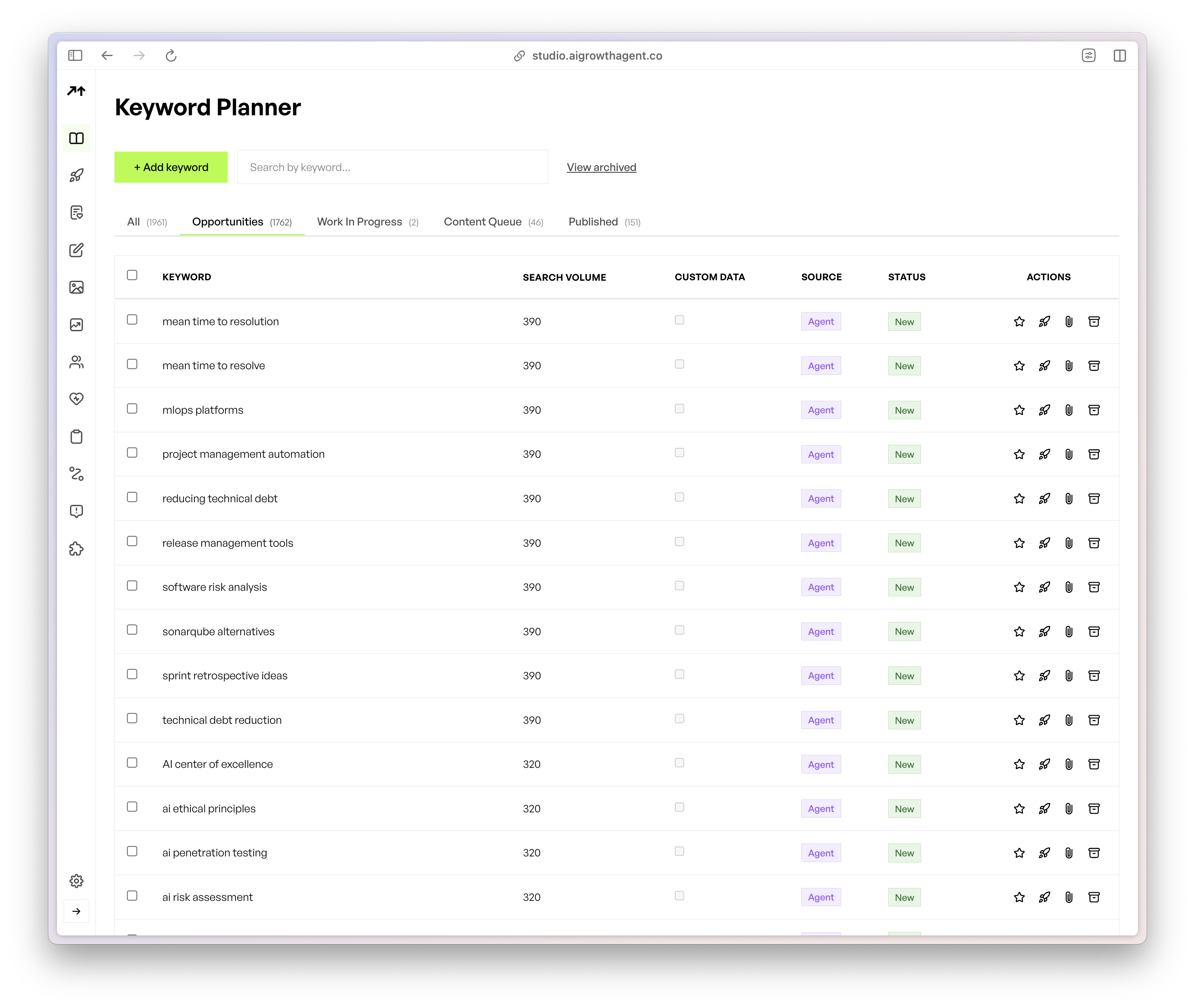
Even with the right tools, manual content creation where humans trigger each output still limits growth. Programmatic approaches that automate research, drafting, optimization, and publishing unlock the velocity required for AI search visibility. AI Growth Agent’s Programmatic SEO Agent automates this full lifecycle, helping companies like Exceeds AI reach #1 rankings within weeks through systematic content architecture and technical SEO.
Review real programmatic SEO workflows and see how they apply to your stack
Risks, Limitations, and 2026 Generative AI Trends
Generative AI platforms still face challenges such as hallucinations, rising costs, and vendor lock-in. 2026 trends highlight rapid growth in multimodal and agentic capabilities, with AI embedding directly into core enterprise systems as automatic copilots. AI Growth Agent’s Manifesto, Studio, and MCP technologies respond to these shifts by enabling autonomous content engineering and rigorous technical SEO, which reduce risk while increasing output.
Decision Framework for Choosing Your AI Stack
Platform selection should reflect your business model, budget, and integration needs. Budget-conscious teams can start with free or low-cost tiers, while enterprises need secure, scalable platforms combined with programmatic content strategies to compete in AI search.
| If… | Then… |
|---|---|
| Budget-limited | Start with free tiers or Rytr from $9/mo |
| Enterprise scale | Use secure platforms plus AI Growth Agent pSEO |
| Developer focus | Adopt GitHub Copilot with code automation |
| Content authority | Combine a multi-platform stack with programmatic SEO |
Premium brands ready to automate content authority can explore deployment options here
Frequently Asked Questions
What are the top 5 generative AI platforms for 2026?
The leading generative AI platforms for 2026 are ChatGPT for versatile text generation and coding, Claude for high-quality writing and long-form content, Midjourney for photorealistic image generation, Runway for professional video creation, and GitHub Copilot for code assistance. Each platform excels in specific use cases, and ChatGPT offers the broadest coverage across content types, while focused tools like Midjourney deliver superior results in their niches.
Which AI platform is better than ChatGPT for business use?
Claude often outperforms ChatGPT for business writing, with stronger tone control, nuance, and instruction following. It also supports very large context windows, with capacities up to 1M tokens for the latest models, which handle long documents effectively. Gemini suits Google Workspace users through tight integration with Gmail, Docs, and Sheets. The best choice depends on your priorities, since ChatGPT leads for coding and general versatility, while Claude stands out for writing quality and document analysis.
What are the best free generative AI tools in 2026?
Top free generative AI options include ChatGPT’s free tier with GPT-4 access, Claude’s free version with daily message limits, and Google’s Gemini with Workspace integration. Leonardo AI offers 150 daily tokens for image generation, and Rytr provides 10,000 characters monthly for text. These free tiers work well for light use, while paid plans unlock higher limits, advanced features, and priority access that businesses usually require.
How do enterprise security features compare across AI platforms?
Enterprise AI platforms differ in security certifications and compliance coverage. ChatGPT Enterprise provides SOC 2 Type 2 certification and HIPAA compliance. Claude Team offers SOC 2 certification. Gemini for Workspace supports ISO 27001, SOC 2, and HIPAA BAA, along with data residency options. Major providers exclude business data from model training on enterprise plans, although exact guarantees depend on the vendor and plan tier.
What is the ROI of implementing generative AI platforms for content creation?
Organizations report strong ROI from generative AI, with 66% seeing productivity and efficiency gains, 53% improving insights and decision-making, and 40% reducing costs. Manual, one-off AI usage rarely reaches the scale required for AI search visibility. The highest returns come from programmatic approaches that automate content creation, technical optimization, and publishing, which build durable content authority that drives AI citations and organic traffic growth.