Written by: Mariana Fonseca, Editorial Team, AI Growth Agent
Key Takeaways
- Perplexity processed 780 million queries in May 2025, while 58–60% of Google searches ended in zero-clicks, so proactive search-universe mapping now drives visibility.
- Referral traffic from Perplexity converts at 12.4% versus Google’s 2.8%, giving brands that focus on AI search a clear conversion advantage.
- This five-phase workflow turns Perplexity research into a self-updating content engine that maps seed terms, validates claims, and publishes with full technical SEO.
- AI Growth Agent removes manual handoffs by turning Perplexity outputs into living, technically sound content that covers your full search universe.
- Ready to map your search universe? Book a demo to see how the workflow maps to your content strategy.
Prerequisites for Running the AI Growth Agent Workflow
Confirm these inputs before you run the workflow so the engine can operate end to end.
- Brand documentation. A Company Manifesto or equivalent, which is a structured document covering your positioning, product features, target audiences, and approved claims. AI Growth Agent produces this through a journalist-led interview in the first onboarding week.
- SEO tooling. Access to Surfer, Frase, Ahrefs, or Semrush for volume and difficulty validation after Perplexity surfaces seed terms.
- Google Search Console. Connected and verified for your domain, used as an independent audit layer for impressions and indexing confirmation.
- PerplexityBot access. Your robots.txt must include an explicit
Allow: /rule underUser-agent: PerplexityBot, with firewall and CDN rules verified to return 200 status codes for the PerplexityBot user-agent string. Without this configuration, Perplexity cannot crawl or cite your content. - Schema readiness. FAQPage, HowTo, Article, and Organization schema either already implemented or delegated to an autonomous engine.
Five-Phase Workflow From Perplexity Research to Autonomous Engine
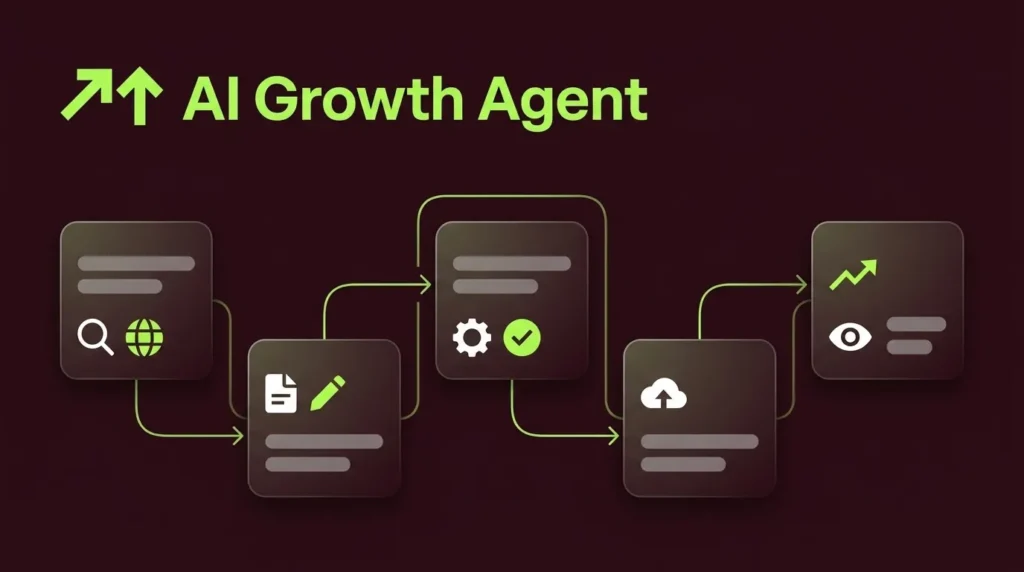
This workflow runs in five sequential phases that build on each other.
- Phase 1 – Research & Seed Term Mapping. Use Perplexity to surface the questions your market actually asks and map them into seed terms and long-tail queries.
- Phase 2 – Prompt-Based Content Planning & Competitor Gap Analysis. Validate intent, expand into “People Also Ask” territory, and identify citation gaps competitors currently own.
- Phase 3 – Technical Optimization, Claim Validation & Schema. Fact-check every claim against live sources, fill semantic gaps, and generate structured markup.
- Phase 4 – Autonomous Publishing & Technical SEO. Feed validated outputs into a publishing engine that handles robots.txt, sitemaps, MCP, and reverse-proxy deployment.
- Phase 5 – Measurement, Incremental Visibility & Weekly Refresh. Track AI citation rate, bot visits, and impression lift, then trigger a self-healing loop every seven days.
Phase 1 – Research & Seed Term Mapping with Perplexity
Perplexity’s core SEO value lies in clarifying topics before writing, finding authoritative sources, and surfacing questions your target audience asks, not in generating content directly. Treat it as a structured discovery layer at this stage.
Prompt 1 – Seed Term Discovery:
“List the 15 most common questions a [target persona] asks when researching [category]. Group them by intent: informational, commercial, and transactional. Cite your sources.”
Prompt 2 – Long-Tail Expansion:
“For the topic ‘[seed term]’, generate 20 long-tail query variations that reflect how users phrase this in conversational AI search. Include question-format variants and comparison queries.”
Prompt 3 – Semantic Gap Identification:
“What subtopics and related concepts are consistently covered by top-cited sources on ‘[seed term]’? Identify any concepts that appear in cited content but are rarely addressed together in a single source.”
Expected outputs include a structured list of seed terms, 50–100 long-tail queries per seed, and a semantic gap map that shows where your content can differentiate. Cited Perplexity content often contains more explicit concepts than uncited content, so the gap map directly informs content density targets.
This research phase produces actionable intelligence, but it only creates impact when it reaches your content production system. In a manual workflow, this output sits in a document until someone briefs a writer. AI Growth Agent converts it into a living Content Topology, which is a complete portrait of your search universe with seed terms and hundreds of derived prompts tracked weekly from real-time data. The manual handoff disappears.
Phase 2 – Prompt-Based Content Planning & Competitor Gap Analysis
Prompt 4 – Intent Validation:
“For the query ‘[long-tail query]’, what is the dominant search intent? What format does the top-cited Perplexity answer use, such as definition, list, comparison, or how-to? Which sources are cited most frequently?”
Prompt 5 – People Also Ask Expansion:
“What follow-up questions do users typically ask after searching for ‘[seed term]’? List 15 conversational follow-up queries and the intent behind each.”
Prompt 6 – Competitor Citation Audit:
“Search ‘[target query]’ and list every source Perplexity cites. For each cited source, note the content format, approximate word count, and the specific claim or section that appears to have triggered the citation.”
Prompt 7 – Uncertainty Measurement:
“Where does Perplexity express uncertainty or hedge its answer on the topic ‘[seed term]’? List the specific claims it qualifies and identify which of those gaps your brand can answer with proprietary data or first-hand expertise.”
Export these outputs into Surfer or Frase to cross-reference semantic coverage scores and content briefs. Supplement keyword tool data by reviewing Perplexity’s “Related” questions section and tracking which conversational queries drive citations to competitor content. AI Growth Agent runs this competitor signal analysis automatically across every prompt in the Content Topology, so you avoid spreadsheet exports and manual query-by-query reviews.
See how AI Growth Agent automates competitor signal analysis for your brand.
Phase 3 – Technical Optimization, Claim Validation & Schema
Prompt 8 – Fact and Source Validation:
“Verify the following claim: ‘[specific statistic or assertion]’. Provide the original source, publication date, and any contradicting data from credible sources published in the last 12 months.”
Prompt 9 – Structural Extractability Audit:
“Review this content section: ‘[paste section]’. Does it follow a direct answer in the first 50 words, followed by supporting evidence? Identify any claims that lack a cited source and any structural elements that would reduce AI extractability.”
Prompt 10 – Schema Generation Brief:
“Based on this article outline on ‘[topic]’, list every schema type that applies, including FAQPage, HowTo, Article, and Organization, and specify which content sections map to each schema property.”
Implementing FAQPage, HowTo, Article with dateModified, and Organization schema improves Perplexity’s ability to extract and verify content for citations. 90% of winning Perplexity citations provide a direct definition or answer within the first 100 words using Bottom Line Up Front formatting. AI Growth Agent applies all four schema types automatically through its WordPress plugin, with no technical input required from the client team. Once content passes validation and schema is applied, it is ready for deployment.
Phase 4 – Autonomous Publishing & Technical SEO
With validation complete and schema in place, the publishing engine takes over. Perplexity outputs validated in Phase 3 feed directly into AI Growth Agent’s publishing engine. The WordPress plugin provisions robots.txt with explicit PerplexityBot and GPTBot allow rules, generates a proper sitemap.xml, activates Blog MCP and Web MCP for model context accessibility, and deploys the reverse-proxy rewrite so content serves from your primary domain, not a disconnected subdomain.
Websites must allow PerplexityBot, Google, Bing, and similar agents full access to important pages via robots.txt and meta robots tags to enable crawlers to discover, index, and cite content. Every article is published on a set cadence, not in a single dump, which signals consistent freshness to crawlers. The manual handoff between research and publication is eliminated. The client reviews a sample batch, and after that, the engine publishes autonomously.
Phase 5 – Measurement, Incremental Visibility & Weekly Refresh
Three measurement layers run in parallel to provide a complete visibility picture. Each layer validates a different stage of the AI search funnel.
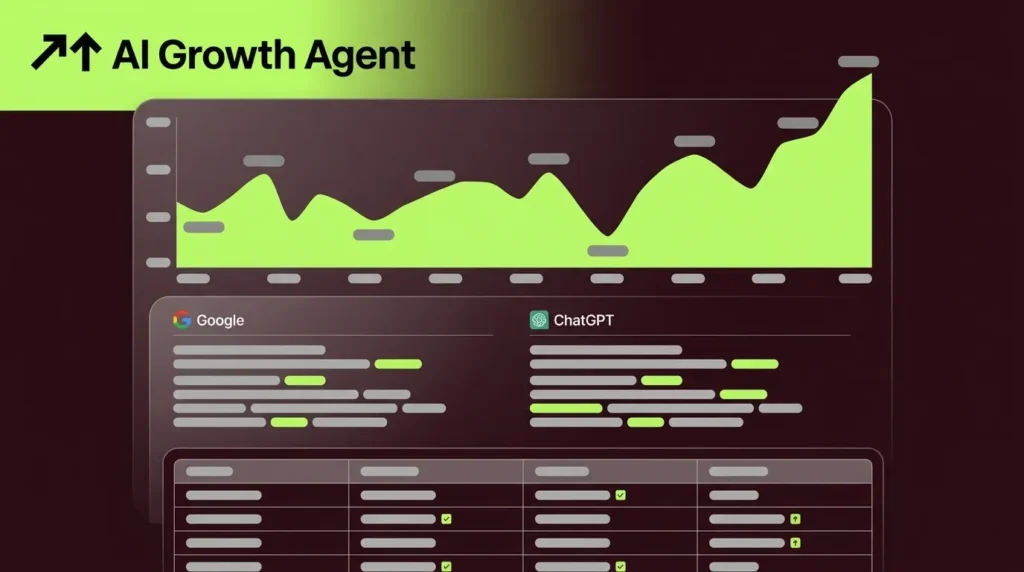
- AI citation rate. This metric tracks whether your content appears in AI responses, which represents the top of the funnel. It is tracked via AI Growth Agent’s proprietary dashboard, which monitors appearance in Google AI Overviews and ChatGPT responses across every seed term and long-tail query in the Content Topology.
- Bot visits. This layer confirms that AI systems actually crawl your content, which is the prerequisite for citations. It is captured through the WordPress plugin, which identifies crawls by GPTBot, PerplexityBot, and other AI training agents down to the individual URL level.
- Impression lift. This layer verifies that increased AI visibility translates to traditional search gains. It is verified independently through Google Search Console, isolating AI Growth Agent content from the client’s existing domain pages.
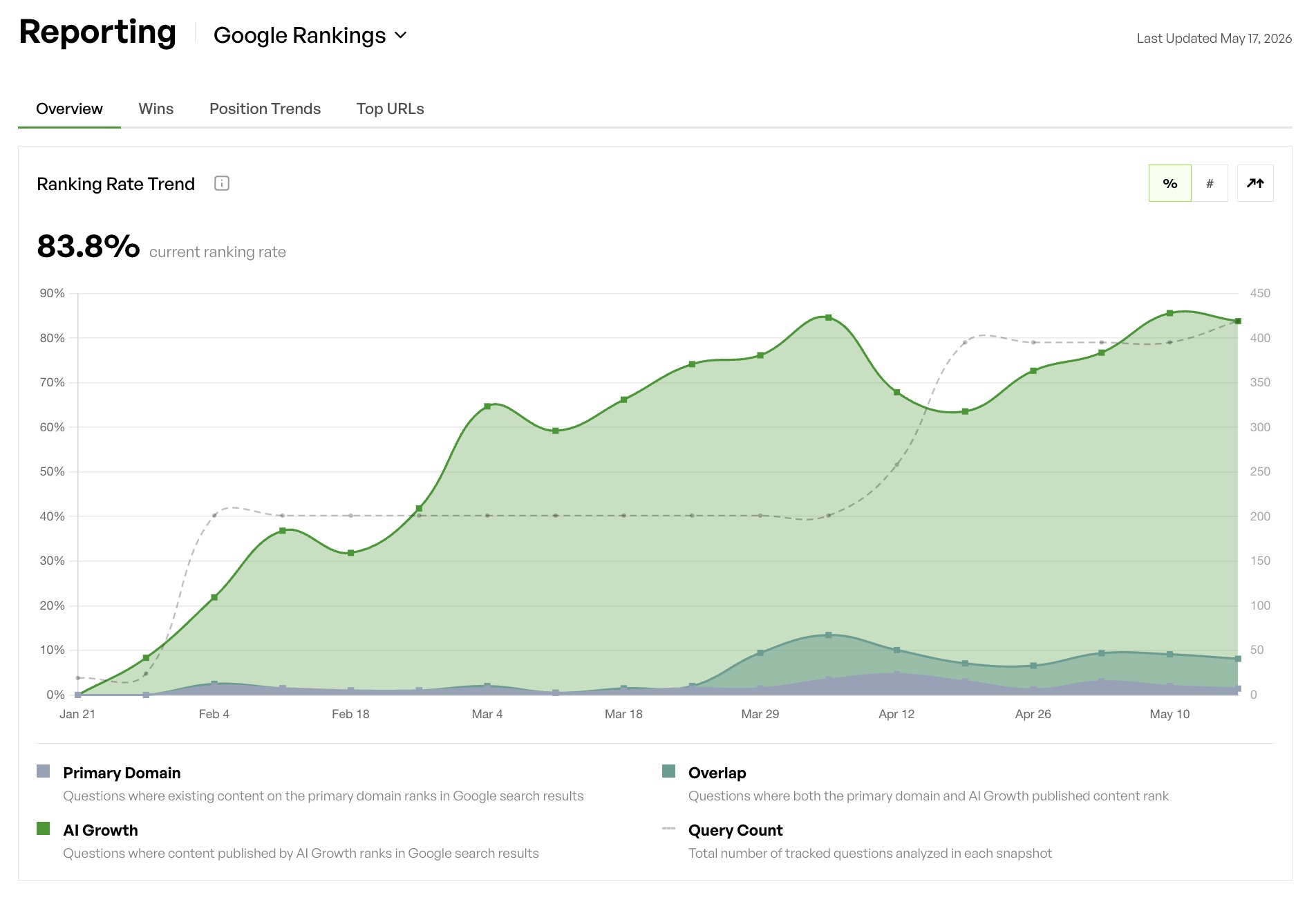
Across the first 12 weeks, AI Growth Agent clients average more than 12,000 additional AI citations and mentions, over 100,000 additional bot visits, and a lift of more than 20% in impressions in Google Search Console. Recently updated content earns more citations than content updated a month ago, which is why the engine runs a weekly self-healing loop that refreshes timestamps, updates statistics, and re-indexes affected articles automatically. High-priority pages should receive meaningful updates every 2–4 weeks to maintain citation eligibility under Perplexity’s freshness weighting. AI Growth Agent enforces this cadence without any action from the client.
Schedule a consultation to review your current citation rate and visibility gaps.
Perplexity vs. ChatGPT vs. AI Growth Agent + Perplexity: SEO Task Comparison
| SEO Task | Perplexity (standalone) | ChatGPT (standalone) | AI Growth Agent + Perplexity |
|---|---|---|---|
| Seed term & long-tail discovery | Strong, surfaces authoritative sources and related questions | Moderate, no live web retrieval in base model | Automated weekly across 1,500+ queries with no prompt cap |
| Competitor citation audit | Manual, requires query-by-query review | Limited, no inline citations in base model | Automated across full Content Topology, with signals that feed content decisions |
| Claim validation & fact-checking | Strong, inline numbered citations tied to specific claims | Weaker, prone to hallucination without a retrieval layer | Automated cascade of anti-hallucination checks against live sources |
| Publishing with full technical SEO | None, research tool only | None, generation tool only | Automated schema, robots.txt, sitemap, MCP, and reverse-proxy deployment |
Common Mistakes & Troubleshooting for Perplexity SEO
- Blocking PerplexityBot in robots.txt. Firewall and CDN rules that return non-200 status codes for the PerplexityBot user-agent prevent indexing entirely. AI Growth Agent’s plugin configures allow rules automatically on setup.
- Publishing content without a direct answer in the opening paragraph. As noted in Phase 3, the Bottom Line Up Front structure is critical, and without it even well-researched content struggles to earn citations. The engine enforces the Answer–Evidence–Depth structure on every article.
- Treating Perplexity research as a one-time exercise. Citation decay happens quickly, and recently updated content earns more citations than content updated a month ago. The weekly self-healing loop prevents decay without manual republishing.
- Tracking only a capped set of self-selected prompts. Monitoring tools show the slice of the market you already thought to ask about. AI Growth Agent maps the full universe across dozens of seed terms and hundreds of long-tail queries, refreshed every week.
- Skipping schema implementation. FAQPage and structured markup improve Perplexity’s ability to extract and verify content for citations. Without schema, even well-written content is harder for AI systems to parse and cite.
Advanced Scenarios for Multi-Brand Portfolios and Large Libraries
Mature AI Growth Agent clients operate search universes of more than 1,500 queries, refreshed weekly. For multi-brand portfolios, each brand receives its own Company Manifesto, Content Topology, and publishing environment, which are connected through separate reverse-proxy rewrites to their respective primary domains. The engine runs more than 3,000 searches per week per account to keep the universe snapshot current.
Perplexity’s proprietary index spans over 200 billion URLs, so long-tail coverage requires consistent, structured content at scale, not a handful of pillar pages. For large existing content libraries, AI Growth Agent’s batched update system refreshes every article in the sector automatically, which prevents authority decay across hundreds of URLs simultaneously. When a competitor spams thousands of pages to shift rankings, the engine detects the movement in real time and responds with targeted content production before the shift compounds.
Frequently Asked Questions
How often does AI Growth Agent refresh content to maintain Perplexity citation eligibility?
The engine runs a weekly self-healing loop that refreshes timestamps, updates statistics, and re-indexes affected articles automatically. Every article in your sector is updated in batches on a continuous cadence. No action is required from the client team.
What happens when a citation decays or a competitor displaces a ranking?
AI Growth Agent’s proprietary dashboard monitors citation rate and ranking position across every query in the Content Topology weekly. When displacement appears, the engine prioritizes that query in the next content production cycle and updates the affected article. The client sees the movement in the dashboard before it compounds.
How does AI Growth Agent handle E-E-A-T signals for Perplexity and Google?
The engine applies author schema to every article, sources authoritative outbound links automatically, and validates every claim and quote against live credible sources rather than a model’s training data. The Company Manifesto provides the first-hand expertise layer that generic AI tools cannot replicate. Organization and Person schema are deployed automatically through the WordPress plugin.
Can AI Growth Agent integrate with an existing SEO stack such as Ahrefs, Surfer, and Google Search Console?
Yes. Google Search Console connects as an independent audit layer for impressions and indexing confirmation. Surfer and Frase outputs can inform content briefs that feed into the engine. AI Growth Agent’s own data infrastructure, including Search Intelligence, AI Analytics, Bot Tracking, and AI Ranking, runs in parallel and does not require the client to replace existing tools, although it removes the need to wire them together manually.
Does AI Growth Agent work for regulated industries with legal disclaimer requirements?
The engine supports dynamic legal disclaimers, claim prioritization from internal documentation, and citation validation against evidence found online from credible sources. Requirements are configured once and applied to every future article generation automatically. Industries including finance, health, and law are active client categories.
Conclusion: Turn Perplexity Research into a Self-Updating Search-Universe Engine
Perplexity functions as the research and uncertainty-measurement layer. It surfaces what your market is asking, which competitors receive citations, and where your content has semantic gaps. Perplexity drives roughly 7–11% of AI referral traffic according to 2026 Statcounter and survey data and converts referred traffic at the 12.4% rate mentioned earlier, which represents a 4.4x advantage over traditional search. That combination creates a high-value channel, but a research tab does not become a search-universe engine on its own.
The five-phase workflow above converts Perplexity outputs into a living content system that maps seed terms and long-tail queries, validates every claim, publishes with full technical SEO, and self-heals on a weekly cadence. At every phase, the manual handoff that breaks DIY workflows is removed. AI Growth Agent acts as the steering wheel, and Perplexity serves as the instrument panel that keeps it calibrated.
Clients move from first meeting to first published article in as early as one week, with content indexing in as little as two weeks. The search universe expands from that point automatically and incrementally, with proof isolated to what the engine actually generated.
Book your consultation to start building your search-universe engine.