Written by: Mariana Fonseca, Editorial Team, AI Growth Agent
Key Takeaways for PR Leaders
- PR agencies can close the gap between earned-media campaigns and AI citation visibility by layering structured, headless content on top of existing press work.
- A seven-step, four-week rollout uses AI Growth Agent as the single external engine to audit citations, map seed terms, build Content Topology, publish structured releases, and configure a four-pillar diagnostic dashboard.
- Technical optimization and bot tracking are fully automated, requiring no new hires or tool stacks from the agency while delivering measurable citation lifts and incremental visibility reporting.
- Client outcomes show average gains of more than 12,000 additional AI citations, 100,000 bot visits, and a 20%+ lift in impressions within the first twelve weeks.
- Agencies ready to expand their service line can schedule a demo with AI Growth Agent to review citation benchmarks and launch the add-on retainer.
The Discovery Shift: Clients Now Trust AI Answers First
The move from blue links to AI answers is now visible in everyday search behavior. AI Overviews appeared in 6.49% of searches in January 2025 and rose to 13.1% by March 2025, and click-through rates dropped 58% for top-ranking results on queries that trigger AI Overviews. When a summary appears, only about 8% of people click through to verify AI answers. Most users accept the answer and move on.
Earned media remains foundational inside this shift, not peripheral to it. In July 2025, roughly 76% of URLs cited in Google AI Overviews also ranked in the top 10 organic results, confirming that traditional search authority still supports AI citation visibility. Press placements, thought leadership, and third-party coverage build the domain trust that models draw on when deciding what to cite. Earned media alone no longer controls the citation context, though. Structured content now shapes what the model says about a brand, which competitors it groups that brand with, and which claims it attributes to that brand.
Forrester reports that 89% of B2B buyers have adopted generative AI as a central source for self-directed information throughout the buying process. Clients already ask why competitors surface in ChatGPT while their own brands do not. The agency that answers that question with a repeatable system wins the retainer. The seven-step playbook below provides that system through a four-week rollout that turns earned media into AI citation authority without disrupting current client work.
Schedule a demo to see if you are a good fit and get a live citation audit for one of your clients.
How to Launch AI Optimization Services in 4 Weeks
The seven steps below map across a four-week timeline. Each step names the goal, the sequence of actions, the required inputs, the roles involved, and the validation checkpoint. AI Growth Agent’s four pillars, Search Intelligence, AI Analytics, Bot Tracking, and AI Ranking, serve as the diagnostic backbone throughout.
Week 1: Kickoff and Universe Mapping
Step 1 — Audit Current AI Citation Presence
The first step establishes a baseline that quantifies the gap between where each client appears in AI answers today and where competitors appear. To build that baseline, run structured prompts across ChatGPT, Perplexity, and Google AI Mode for each client’s top five product or service categories. Log citation frequency, citation context, and competitor co-mentions so you can compare performance later. You will need the client brand brief, an existing press coverage list, and top competitor domains as inputs. The agency account lead runs the prompts while AI Growth Agent’s Search Intelligence layer processes the competitive signal. By the end of day five, you have a citation gap table that shows client mention rate versus the top three competitors, ready to share with the client.
Step 2 — Map Seed Terms and Long-Tail Queries from Press Assets
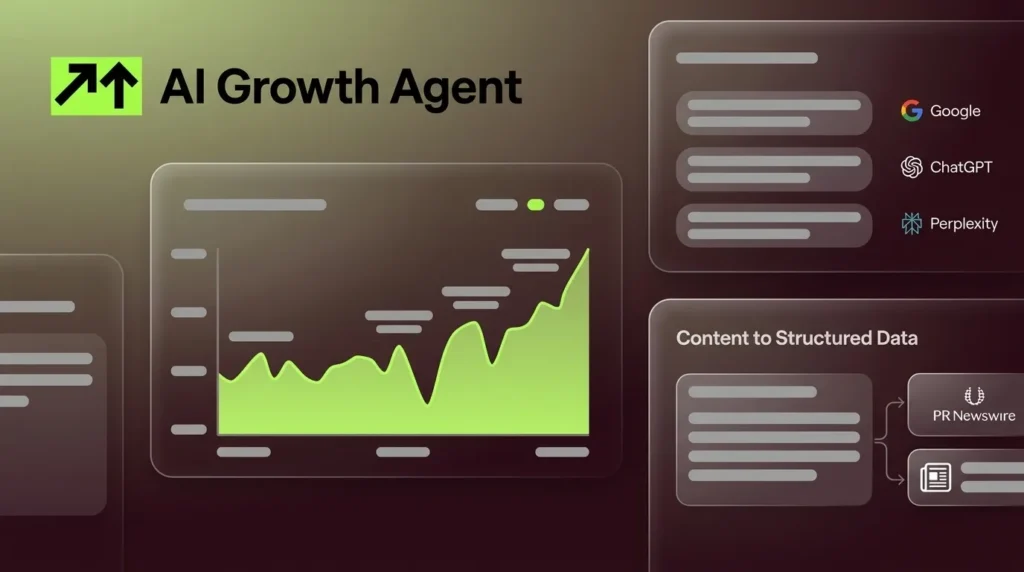
The second step replaces intuition-driven topic selection with an evidence-based map of every query the client’s ideal customer actually asks. Feed the client’s brand brief and press asset library into AI Growth Agent’s Content Topology engine. The engine ingests unstructured material, runs real-time Google and ChatGPT searches, and returns a hierarchy of seed terms with long-tail queries beneath each one. You supply the brand manifesto or brief, product pages, and top-performing press releases as inputs. AI Growth Agent generates the topology while the agency reviews and approves it with the client. The output is a topology of roughly 300 to 400 queries organized by seed term, with AI Overview and ChatGPT citation data that confirms which long-tail queries deserve priority.
Suggested visual: A two-column table listing the top 10 seed terms in column one and the three highest-priority long-tail queries beneath each in column two, with a citation-frequency score in column three.
Week 2: Turn Press Coverage into Structured Content
Step 3 — Convert Validated Press into a Content Topology
Week 2 starts by feeding existing earned-media assets into living content that AI surfaces can read, trust, and cite. Map each high-authority press placement to the long-tail queries it supports so every article has a clear query target. When a press asset validates a claim, the engine pulls that source into the article’s citation layer so AI models see the supporting evidence. When gaps appear, the engine spawns parallel research agents that gather primary-source evidence to close them. You provide a press coverage archive, client primary-source URLs, and brand voice memories as inputs. AI Growth Agent’s content engine drafts the articles while an agency journalist reviews first drafts for brand accuracy. By the end of this step, you hold three to five ready-to-publish articles, each backed by validated external sources and structured with full schema markup.
Step 4 — Publish Structured Releases for Priority Queries
The next step gets authoritative content indexed against the highest-gap queries identified in Week 1. Publish the first articles to the AI Growth Agent-managed blog, which connects to the client’s domain through a reverse proxy rewrite. Each article ships with rich schema, Open Graph metadata, internal linking, and llms.txt compatibility so AI crawlers can parse it cleanly. You use the approved articles from Step 3 and the reverse proxy configuration for the client’s domain as inputs. AI Growth Agent handles publishing and technical SEO automatically while the agency confirms the subdirectory connection. The checkpoint for this step is clear: articles live on the client’s domain, sitemap submitted, and Google Search Console showing initial crawl activity within the first two weeks.
Suggested visual: A timeline bar showing Day 1, topology approved, through Day 14, first articles indexed, with milestones at article draft, client review, publish, and first bot visit.
Week 3: Technical Readiness and Diagnostic Visibility
Step 5 — Apply Agent-Ready Technical Optimization
Week 3 focuses on making every published asset readable by AI crawlers, training agents, and agentic surfaces. AI Growth Agent’s WordPress plugin provisions the full agentic technical SEO stack automatically. The stack includes Blog MCP, OpenAI discovery via /.well-known/, Agent Card guidance, natural language query parameters, Markdown served to agent crawlers, and llms.txt and llms-full.txt. The agency’s technical team does not need to intervene. You only need the domain configuration completed in Week 2 as an input. AI Growth Agent activates the stack while the agency confirms that the plugin is active. The validation checkpoint arrives when llms.txt is live, Blog MCP responds correctly, and automated web stories generate for each published article.
Step 6 — Configure the Four-Pillar Diagnostic Dashboard
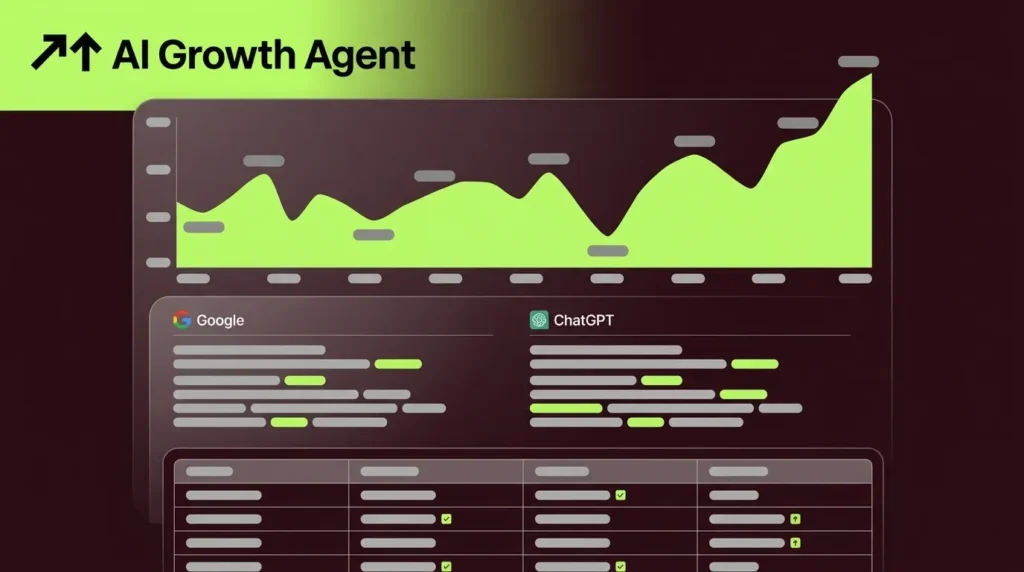
The next step gives the agency a single view of the four data streams that shape what AI surfaces say about each client. Start by activating Search Intelligence to map the traditional search landscape and competitor positioning. Then connect AI Analytics so you can track brand value and consumer behavior across the full journey. Enable Bot Tracking to log every crawl, citation, and training sweep that touches the new content. Finally, configure AI Ranking to monitor citation context and order of mention week over week. You provide the client domain, Google Search Console access, and a competitor domain list as inputs. AI Growth Agent configures all four pillars while the agency reviews the dashboard with the client. The checkpoint is a live dashboard where all four pillars return data and the first bot-tracking report shows which AI crawlers have visited the client’s new content.
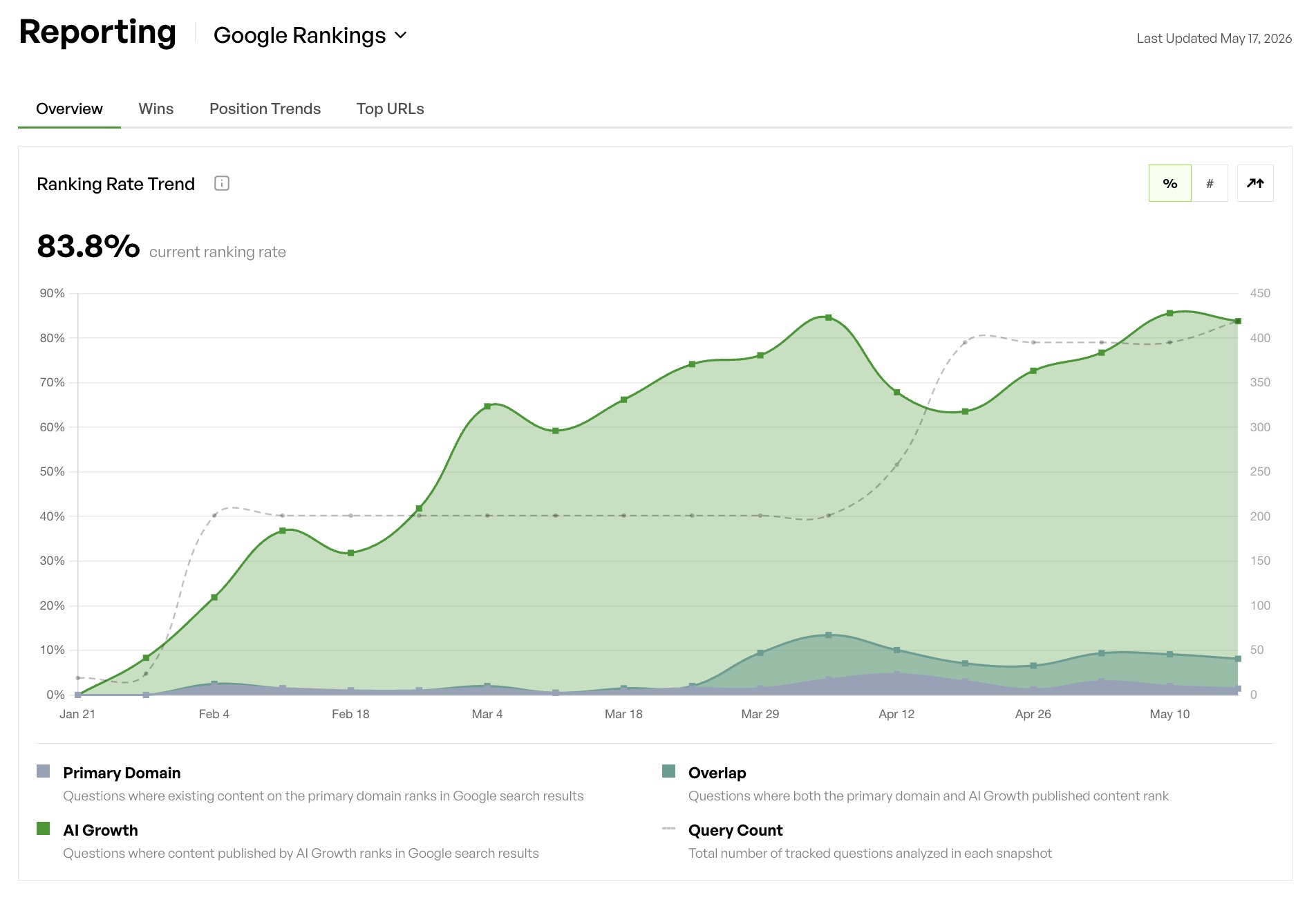
Suggested visual: A four-quadrant diagram labeling each pillar with its primary output: Search Intelligence, competitive positioning map; AI Analytics, brand sentiment and journey data; Bot Tracking, crawl and citation log; AI Ranking, citation context and mention order.
Week 4: Report Results and Secure the Retainer
Step 7 — Present the Measurement Report and Retainer Offer
Week 4 converts the pilot into a recurring flat-fee add-on by presenting clear incremental visibility results. Pull the incremental visibility report from AI Growth Agent and isolate citations, bot visits, and impressions generated by the new content rather than pre-existing brand visibility. Use this report to build a concise client pitch that connects metrics to revenue and pipeline. You will draw on four-pillar dashboard data, a Google Search Console comparison for pre- and post-launch, and the bot-tracking citation log as inputs. The agency account lead presents the findings while AI Growth Agent’s reporting layer supplies the numbers. The validation checkpoint is a client-facing report that shows first indexing confirmation, initial bot visits, and a citation baseline that future weeks can improve against.
Client Pitch Script Template
“Before we started, [Client Brand] appeared in AI answers for [X] of the [Y] queries we tracked. Competitors [A] and [B] were cited in [Z]% of those same answers. In four weeks, we published [N] articles against your highest-gap queries. AI crawlers have visited the new content [bot-visit count] times. Google Search Console shows [impression lift]% more impressions on AI Growth Agent content versus your baseline. The engine is live, the content is self-healing, and the citation gap is closing. The flat-fee add-on to continue this work is [price range], with no per-article charges and no prompt limits. You own every article we produce.”
Suggested visual: A before-and-after bar chart showing citation frequency for the client versus top two competitors at Week 0 and Week 4, with bot visits as a secondary axis.
Flat-Fee Add-On Pricing Model Position the service as a flat monthly retainer layered onto the existing earned-media contract. The fee covers the full AI Growth Agent engine, including universe mapping, content production, technical SEO, bot tracking, and incremental visibility reporting. No per-article charges, no credit limits, and no per-prompt billing apply. The client owns all content produced.
Client Outcomes That Prove Incremental Visibility
The four-week playbook above is grounded in documented client results. Leva Sleep is now the most mentioned retailer for adjustable beds in Canada, with ChatGPT citing Leva Sleep content over 10,000 times per month and $40,000 to $50,000 in deals closed in under three weeks from buyers who discovered the brand through AI Growth Agent content. Breadless is now one of the most recommended healthy franchises in the US, with ChatGPT citing eatbreadless.com over 45,000 times per month and a 30x lift in Google Search Console impressions over six months. Across the first twelve weeks, AI Growth Agent clients average more than 12,000 additional AI citations and mentions, over 100,000 additional bot visits, and a 20%+ lift in impressions.
These outcomes are incremental. AI Growth Agent publishes into a separate environment and reports only the visibility it generates, never taking credit for brand authority that already existed.
Schedule a consultation session to review citation benchmarks for your clients’ categories.
Will AI Replace PR Specialists?
AI will not replace PR specialists because AI surfaces still require the domain trust that earned media builds. As noted earlier, the majority of AI citations still come from top-ranking organic results, which means press placements, authoritative bylines, and third-party coverage remain the foundation of citation eligibility. AI replaces the manual production overhead instead. The content team, the SEO specialist, the schema work, and the monitoring stack move into a single engine. AI Growth Agent handles the technical and content engine so agency specialists focus on strategy, relationships, and the earned-media work that builds the domain authority models draw on. The agency’s value proposition expands rather than shrinking.
PR Trend for 2026: Earned Media Plus AI Optimization
The defining trend in 2026 is the integration of earned media with structured AI optimization under a single strategy and set of KPIs. 86% of SEO professionals have integrated AI into their workflow, while most clients have not, which creates a demand gap agencies can monetize. AI search visitors convert at 4.4x the rate of average organic search visitors, giving agencies a revenue argument that resonates with any client tracking pipeline. Agencies that layer AI optimization onto earned media using headless marketing win new high-margin retainers while keeping press campaigns central. Agencies that ignore this shift leave the citation context to chance.
Common Agency Objections and Clear Responses
Objection: “We do not have the bandwidth to run another service line.” The four-week rollout requires no new hires and no new tools. AI Growth Agent’s engine handles content production, technical SEO, bot tracking, and reporting automatically. The agency’s role is to review the topology, approve articles, and present the dashboard to the client. The time investment stays measured in hours per week, not headcount.
Objection: “Adding AI optimization will erode our margins.” The flat-fee model means the agency pays a fixed engine cost and prices the add-on retainer above it. Leading PR agencies in 2026 deploy AI-augmented retainers that layer real-time monitoring and AI-powered attribution directly onto traditional earned-media services. The margin structure remains favorable because a single engine replaces a full production team of specialists.
Objection: “AI will replace our PR jobs.” AI handles data-intensive tasks and frees PR team time for high-value human activities like relationships, strategy, and creative storytelling. The agency’s journalists, strategists, and account leads remain the irreplaceable layer. The engine replaces the production stack, not the people who direct it.
Conclusion: From Search Visibility to AI Answer Authority
The four-week playbook above gives PR agencies a concrete path from earned-media-only to a full AI optimization service line. You audit citations in Week 1, build the Content Topology and publish first articles in Week 2, deploy technical optimization and the four-pillar dashboard in Week 3, and deliver the measurement report and pitch the retainer in Week 4. Every step runs on AI Growth Agent as the single external engine, with no internal production overhead and no specialist hiring required.
Earned media remains the trust foundation that models draw on when deciding what to cite. Agencies that win in 2026 layer structured, living content on top of that foundation so they control the citation context, not just the press coverage. The GEO services market is projected to grow at a 34 to 50% CAGR through 2031. The retainer opportunity is open now, and the leaderboard is being written this year.
Traditional search tools show you where your brand stands. AI Growth Agent makes your brand the answer. Book a kickoff and see your first article live within a week.
Frequently Asked Questions
How does AI Growth Agent integrate with an existing PR retainer without disrupting current client work?
AI Growth Agent operates as a separate content and technical layer connected to the client’s domain through a reverse proxy rewrite, typically under a subdirectory or subdomain. It does not touch the agency’s existing press workflow, media relationships, or the client’s main site. The agency continues running press campaigns as normal. AI Growth Agent runs the content engine in parallel, feeding structured articles into the same domain to build citation authority alongside earned coverage. The only coordination required is a weekly review of the Content Topology and article approvals, which most agencies handle in under two hours per client per week.
What does “living content” mean in practice, and why does it matter for PR clients?
Living content is content that updates and self-heals over time rather than going stale after publication. When a press placement references a statistic that changes, when a product detail is updated, or when the year turns and an article’s date becomes outdated, AI Growth Agent’s engine detects the decay signal through Google Search Console and bot-tracking data and refreshes the article automatically. For PR clients, this means the citation context the agency worked to establish does not erode between retainer reviews. The brand’s narrative stays current in AI answers without the agency manually auditing hundreds of articles.
How is incremental visibility measured, and how do agencies present it to clients?
AI Growth Agent publishes into a separate environment so it can isolate exactly the visibility it generates, separate from the brand authority the client already had. The reporting layer cross-references per-article bot tracking, Google Search Console impressions and clicks, and AI citation frequency week over week. Agencies present this as a before-and-after comparison, showing citation frequency and impression volume at the start of the engagement versus the current week, with bot visits as a secondary metric confirming that AI crawlers are actively reading the new content. The four-pillar dashboard, Search Intelligence, AI Analytics, Bot Tracking, and AI Ranking, provides the data behind each metric in a single view the agency can share directly with the client.
Can a small PR agency with no technical staff run this service line?
Yes. The entire technical stack, including schema markup, robots.txt, sitemaps, Blog MCP, llms.txt, instant indexing, autoredirects, and bot tracking, is provisioned automatically by AI Growth Agent’s engine. The only integration step on the agency’s side is the reverse proxy rewrite that connects the blog to the client’s domain, which AI Growth Agent supports with setup documentation across Cloudflare, Vercel, and other common hosts. No plugin installation, schema work, or engineering hours are required from the agency or the client. The agency’s role stays strategic, focused on reviewing the Content Topology, approving articles, and presenting results.
How quickly can a PR agency expect to see citation results for a new client?
The first article is typically live within one week of kickoff. Content has indexed in as little as ten days and often within two weeks. Citation frequency builds as more articles are published and as AI crawlers return for subsequent training sweeps. The baseline results mentioned earlier, over 12,000 additional citations, 100,000+ bot visits, and a 20%+ impression lift, typically emerge across the first twelve weeks. Individual results vary by industry, competitive density, and the volume of existing domain authority the client brings into the engagement, but the four-week rollout is designed to produce a measurable baseline, including first indexing, initial bot visits, and a citation gap comparison, before the agency pitches the ongoing retainer.