Written by: Mariana Fonseca, Editorial Team, AI Growth Agent
Key Takeaways
-
Headless marketing stacks create developer dependency that blocks real-time narrative updates in AI search environments.
-
Loss of visual control and WYSIWYG previews creates inconsistent brand voice across AI surfaces and search results.
-
Higher ownership costs and slower time-to-market give competitors time to dominate AI conversations before brands can respond.
-
Stale content and limited monitoring tools cause brands to lose citations and visibility in zero-click AI search results over time.
-
AI Growth Agent addresses all six challenges with a single engine that automates content creation, monitoring, and updates, so brands regain narrative control.
1. Developer Dependency Blocks Real-Time Narrative Updates
Developer dependency in headless stacks slows narrative updates to a pace AI search no longer tolerates. In a headless marketing stack, content teams cannot push updates without routing requests through engineering. On a monolithic platform, changing a banner on the homepage requires submitting a developer ticket that enters a queue and takes several hours. Headless architectures were supposed to reduce that friction, yet without a governed canonical data model and disciplined platform ownership, the marginal cost of each new capability grows superlinearly after initial rollout, and the architecture shifts the burden toward ongoing governance rather than eliminating technical dependency.
This dependency directly weakens AI search performance. In a zero-click landscape where information agents monitoring the web 24/7 are rolling out this summer for Google AI Pro and Ultra users, a brand that cannot update its narrative in real time cedes the conversation to whatever the model last indexed. AI Growth Agent’s headless engine removes the developer from the loop by automating the entire content lifecycle. The engine writes, publishes, monitors, and self-heals content on autopilot so updates land in minutes instead of days. Because the brand controls the narrative in plain language instead of tickets, real-time responses to AI search trends become practical for the first time.
2. Lost Visual Previews Break Brand Voice Across AI Surfaces
Loss of visual previews in headless environments makes brand voice drift across AI and search surfaces. Traditional WYSIWYG editors were built for a single destination, the web page a human would scroll. They often generate excess HTML that slows page loads, causes rendering inconsistencies across devices, and makes content reuse difficult in headless environments where the same content must feed web, mobile, and other channels. Once content leaves the CMS and flows into AI surfaces, voice rules encoded in visual templates no longer apply.
AI search engines read structure, not layout. AI-driven search engines reward structured data, schema density, and entity clarity, which makes visual-only WYSIWYG editing insufficient for maintaining visibility and brand control in headless marketing stacks. Brand voice then drifts from one surface to the next, with no enforcement at the layer where AI systems actually parse the content. AI Growth Agent enforces brand voice through style memories configured once and applied to every future generation. Those rules govern every article, every surface, and every update. The engine skips visual templates and applies rules at the generation layer, where AI surfaces actually read and interpret the content.
3. Ownership Costs Rise While Teams Struggle to Scale
Headless implementations often raise ownership costs while still requiring more people to scale content. The total cost of ownership for headless implementations is consistently underestimated. A headless Shopify implementation carries a higher three-year TCO compared to a standard Shopify setup, with ongoing maintenance costs because custom frontends require manual updates for API changes, security, and dependencies. At the enterprise level, mid-enterprise organizations spend significantly more in year one on composable DXP migration, and Gartner notes that integration alone represents a substantial portion of total DXP program cost, with internal budgets underestimating integration spend.
These costs push teams toward headcount instead of automation. Scaling content usually means adding an editor, an SEO specialist, a designer, an engineer, and a stack of monitoring tools, each with its own contract and review cycle. An agency RFP often runs about three months, then three more to produce the first assets, which puts a brand close to a year before anything meaningful is in motion. AI Growth Agent replaces that stack with one engine at a flat fee, with no per-article charges, credit limits, or per-prompt billing. The client owns the site, the content, and the relationship with the AI surfaces, while the engine functions as the production team.
4. Slow Launches Hand AI Conversations to Competitors
Slow time-to-market lets competitors train AI models with their own narrative before your content appears. Enterprise headless or custom website builds require significant time from start to launch, according to 2026 development time benchmarks. In a market where AI surfaces are still in their first generation and the leaderboard is being written this year, a lengthy launch timeline functions as a forfeit. Competitors who publish authoritative content now train the next generation of models with their own story. Brands that wait train those models with whatever happens to be sitting on the open web.
Fast deployment changes that trajectory. Breadless went from invisible to the most recommended healthy franchise in the US, ahead of CAVA, Rush Bowls, and Sweetgreen, with a substantial lift in Google Search Console impressions over six months and ChatGPT citing eatbreadless.com thousands of times per month. AI Growth Agent moves from kickoff to the first published article in about one week, with content indexing in as little as ten days. The process avoids RFP cycles, long onboarding, and year-long ramps, so brands can enter AI conversations while the field remains open.
5. Stale Content Quietly Loses AI Citations
Stale content erodes AI visibility even when web pages still look current. Headless marketing stacks often ship content that feels current on launch day and outdated by the next quarter. Legacy CMSs are not AI-ready because content is typically tangled with presentation markup, the API layer was never designed as the primary delivery mechanism, and content is organized around pages rather than reusable components, which makes it harder to expose clean structured content to AI tools and crawlers. When a model runs a citation pass and finds outdated figures, superseded claims, or broken source links, the brand loses that citation, and traditional headless stacks rarely detect or address that loss.
This decay happens quietly while customers keep trusting AI answers. A significant portion of people say they are skeptical of AI answers, yet only a small percentage ever click through to verify them. A stale citation therefore becomes a wrong answer delivered at scale to an audience that will not check it. AI Growth Agent’s living content model self-heals and updates over time. When the year turns, every article in a sector refreshes automatically. The engine detects stale articles through Google Search Console signals and bot-traffic awareness, then updates them before they decay, so authority compounds instead of eroding.
6. Monitoring Tools Hide Most of the AI Search Universe
Monitoring tools alone cap visibility and leave most of the AI search universe unseen. The standard response to AI search visibility gaps is to add a monitoring tool. The underlying problem is structural. Monitoring tools cap clients at a small set of tracked prompts, so they only ever see the slice of their market they already thought to ask about. A tool that tracks a limited number of prompts stays blind to the long-tail queries where customers actually form opinions and where AI surfaces actually cite sources. Monitoring reports the absence of visibility but does not fix it.
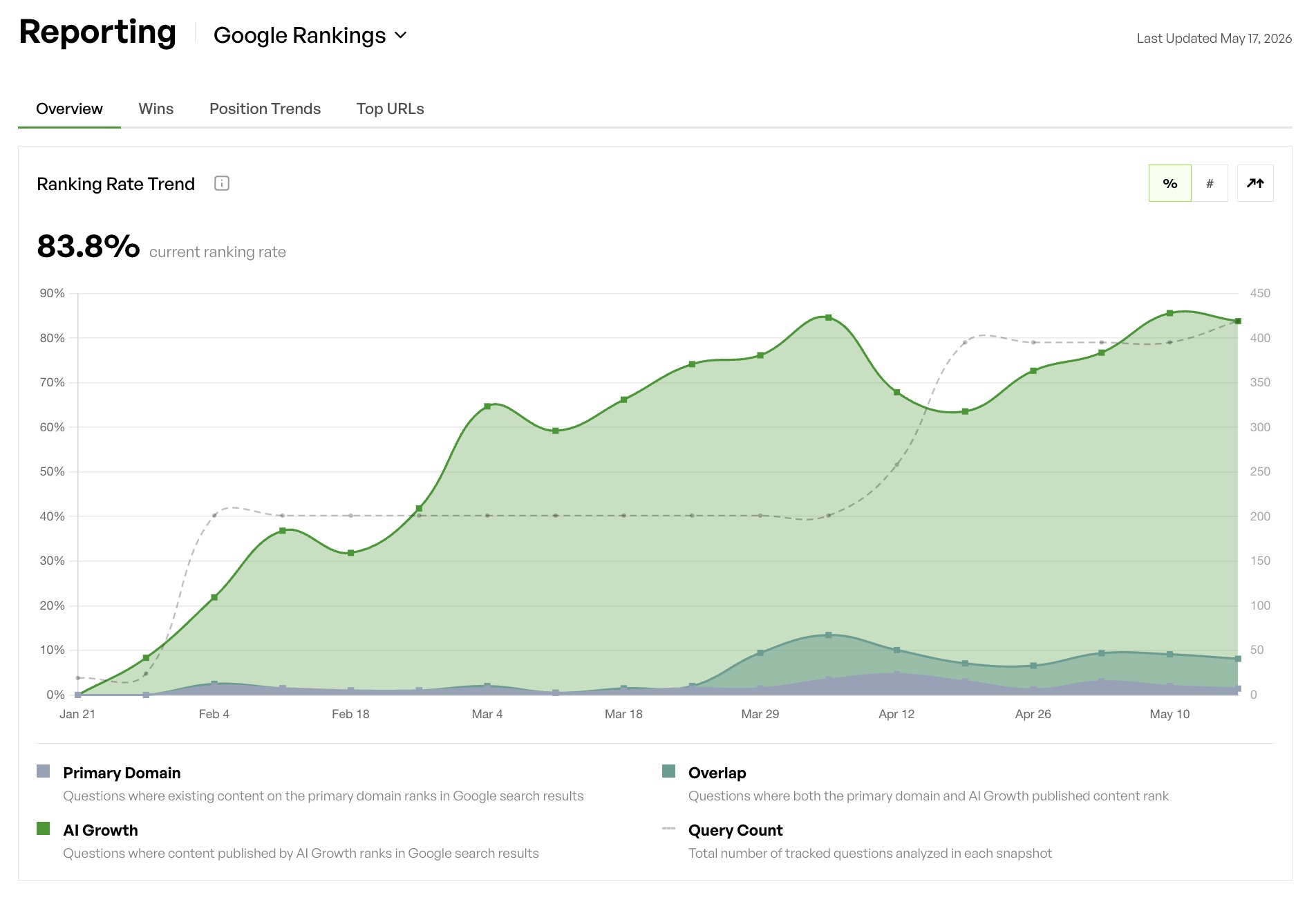
AI Growth Agent replaces that narrow view with a full-universe snapshot and ties it directly to action. The engine captures the entire universe, hundreds of seed terms and the long-tail queries beneath them, refreshed every week, running thousands of searches weekly just to refresh the snapshot, with prompt count never a billed metric. Mature clients reach universes of more than a thousand queries. The engine tracks bot interactions, per-article citation data, and Google Search Console signals in one place, then responds by producing and publishing content that fills the gaps. Monitoring becomes a steering system instead of a rearview mirror.
Synthesis: How the Six Challenges Compound
These six challenges do not operate in isolation. Developer dependency slows narrative updates, which makes it harder to correct brand voice drift once visual control disappears. Higher ownership costs then prevent teams from hiring enough specialists to keep up, so slow time-to-market hands the conversation to competitors. Stale content quietly loses citations, while capped monitoring hides the full extent of that loss. Together, they describe a stack that was never designed for a world where AI surfaces decide what a brand means before the customer ever visits a page.
Solving all six challenges requires a single engine that owns creation, monitoring, and updates instead of a longer list of tools or agencies. Across the first twelve weeks, AI Growth Agent clients average thousands of additional AI citations and mentions, tens of thousands of additional bot visits, and a notable lift in impressions. Brands that secure AI citations this year train the next generation of models with their own story. Brands that wait allow the open web to define them.
Start with a custom AI visibility snapshot and see what the models already believe about your brand.
Frequently Asked Questions
What is headless marketing and how does it differ from headless commerce?
Headless commerce decouples the customer-facing storefront from the backend commerce engine so the frontend stays branded while the backend scales independently. Headless marketing applies similar architectural logic to brand presence in AI search. The brand keeps its curated main site, the pages humans read and navigate. AI Growth Agent stands up a separate, fully optimized blog the brand owns, connected through a reverse proxy rewrite under a subdirectory or subdomain. The engine writes, publishes, monitors, and self-heals content without requiring a content team, an SEO agency, or engineering support. Marketing by and for the robots, without added headcount, becomes the operating principle.
Why do traditional headless marketing stacks create so much developer dependency in 2026?
Traditional headless stacks decouple the presentation layer from the content repository, which was meant to give marketers more autonomy. In practice, the governance required to maintain that autonomy, including versioned schemas, API ownership, integration management, and schema evolution rules, demands ongoing technical resources that most marketing teams do not have. Without that governance, every content update that touches structure, schema, or delivery logic routes back to engineering. The dependency does not disappear. It relocates from the CMS interface to the integration layer, where it is harder to see and more expensive to resolve.
How does AI Growth Agent measure results in a zero-click environment where visits cannot be tracked?
AI Growth Agent commits to brand mention rate and citation rate as primary metrics, supported by Google Search Console impressions and bot traffic as independent audits. Because the engine publishes into a separate environment, it reports only the incremental visibility it actually generated and never takes credit for visibility the brand already had. Per-article bot tracking shows exactly when ChatGPT cites the content and where. Clients who measure best capture traffic source at the conversion moment and consistently see a lift in organic leads after starting. In a zero-click world, no tool can fully attribute an AI recommendation to a sale, yet the combination of citation data, bot traffic, and Search Console impressions provides a defensible weekly proof of impact.
How long does it take to see results, and what does the first week look like?
A professional journalist interviews the client during kickoff week to build the brand manifesto. That material feeds the keyword topology and the first articles. As mentioned earlier, the first article typically goes live within a week of kickoff, with indexing often following in ten days to two weeks depending on industry authority. The standard engagement runs as a three-month pilot, because indexing timelines vary by industry and authority compounds over time, yet clients usually see movement early. Leva Sleep closed $40,000 to $50,000 in deals in under three weeks from buyers who discovered the brand through AI Growth Agent content.
Does AI Growth Agent interfere with an existing website or require a technical team to operate?
AI Growth Agent runs alongside the existing site without disrupting it and does not require an internal technical team to operate. The engine stands up a top-of-funnel blog styled to match the brand’s existing site, connected through a reverse proxy rewrite or subdomain. It does not touch the curated main site or its structure. The only integration step on the client’s side is the reverse proxy rewrite that connects the blog to a subdirectory under the brand’s domain. Everything else, including the full technical and agentic SEO stack, schema, Blog MCP, llms.txt, robots.txt, sitemaps, instant indexing, autoredirects, and 404 tracking, ships automatically in every package. The internal team gives feedback in plain language, and the engine learns and applies it to every future generation without re-briefing.