Written by: Mariana Fonseca, Editorial Team, AI Growth Agent
Key Takeaways for Winning AI Citations
- Headless marketing separates a brand’s main site from a dedicated engine that produces structured, validated content built for AI crawlers and AI assistants like ChatGPT and Perplexity.
- Brands using this architecture gain narrative control at scale, so AI results cite accurate, authoritative claims without extra headcount or manual duplication.
- Implementation relies on API-first content layers, clean schema markup, locale-specific structured data, and primary-source validation to raise citation rates across AI-native discovery channels.
- Examples from Nike, Allbirds, Salesforce, and others show concrete gains such as category ownership, long-tail query coverage, and consistent recommendations across zero-click surfaces.
- Companies like Breadless and Leva Sleep earned top AI citations and qualified leads using AI Growth Agent’s zero-headcount engine; see how the engine works for your category.
1. Nike: Structured Product Content That Guides AI Shopping Answers
Nike’s content architecture separates its commerce backend from its editorial and product content layer, then pushes structured data through APIs to web, app, and AI-driven experiences. Every product page carries rich schema markup for product, review, and organization data, which gives AI systems the validated, machine-readable signals they need to cite Nike accurately for running shoes, training gear, and performance queries.
This architecture gives Nike narrative control at the head of the funnel. When a customer asks ChatGPT which running shoe handles overpronation, Nike’s structured content is positioned to surface because the data is clean, validated, and formatted for agent consumption. This positioning is possible because the implementation relies on an API-first content layer that decouples editorial updates from the commerce backend, so marketing teams can refresh claims without engineering involvement and keep cited content current.
AI results prioritize this content because of schema fidelity combined with content freshness. Headless commerce implementations that pair API-first backends with modern frontend frameworks consistently outperform legacy stacks on the structured data signals AI systems prioritize.
2. Allbirds: Sustainability Story That AI Repeats Everywhere
Allbirds built its brand on a sustainability story and uses a headless content architecture to ensure AI repeats that story accurately. Product descriptions, material sourcing pages, and carbon footprint content live as discrete, reusable content blocks delivered via API, so the same validated claims power the website, the app, and the structured data that AI crawlers index.
For Allbirds, this means controlling what AI says when a customer asks about sustainable footwear. In a zero-click environment where most users never verify the source, owning the cited claim becomes the main objective. The implementation uses a headless CMS that stores content as structured data and delivers it through APIs, allowing marketing teams to publish reusable content blocks instantly across websites, mobile apps, and AI assistants without manual duplication.
Citations hold up under AI verification because of claim validation at the content layer. Every sustainability figure is sourced and structured so that when an AI system runs a citation pass, the claim survives scrutiny.
Run your marketing the way the brands cited in AI search are running it: headless, built for robots, without extra headcount. Explore whether this approach fits your brand.
3. Burberry: Localized Content That Wins Regional AI Queries
Burberry operates across more than 50 markets and uses a headless content architecture to localize editorial, product, and campaign content without rebuilding the backend for each region. A single content repository pushes market-specific variants through APIs to regional storefronts, apps, and the structured data that AI systems index per locale.
This setup keeps Burberry’s brand narrative consistent across every market while local queries surface locally relevant content. An AI assistant responding to a query about luxury outerwear in Japan cites Burberry’s Japanese content, not a generic global page. Hygraph’s Content Federation approach, which fetches data from multiple backend sources and exposes it through a unified GraphQL API, shows how teams maintain a single source of truth for structured content while supporting multiple channels, brands, and markets at scale.
Regional queries surface this content through locale-specific structured data. AI systems index and cite content at the URL level, so localized pages with clean schema outperform generic global pages for regional searches.
4. Oatly: Category-Defining Content That Trains Oat Milk Answers
Oatly entered a category it largely invented and used content architecture to ensure AI defines oat milk on Oatly’s terms. Educational content about oat milk nutrition, production, and environmental impact is structured with validated primary sources and published in formats that AI crawlers can parse and cite. The brand’s content functions as source material that AI systems draw from when answering category questions.
The result is category ownership in AI answers. When a customer asks Perplexity about the environmental impact of oat milk versus dairy, Oatly’s structured, sourced content is positioned to be the citation. Modern headless CMS platforms embed AI capabilities for automated content generation, metadata tagging, and personalization, with many users reporting faster time-to-market and higher productivity.
Primary-source validation gives AI systems the confidence to cite Oatly’s claims. Oatly’s content architecture enforces that standard at the publishing layer.
5. Target: Omnichannel Product Data That Feeds AI Shopping Guides
Target’s headless architecture separates its product content layer from its commerce backend, so the same structured product data powers web, app, in-store kiosks, and the AI tools that now answer shopping queries. Product schema, review schema, and local business schema are provisioned automatically across every published asset.
This approach allows Target to appear in AI answers for high-intent shopping queries without running a separate content operation for each channel. Headless commerce lets brands deliver omnichannel experiences by pushing consistent content and commerce across web, mobile, apps, kiosks, and more while separating the frontend storefront from the backend ecommerce engine. Citation performance comes from broad schema coverage combined with content freshness signals, which AI systems favor when selecting sources.
6. Salesforce: B2B Thought Leadership Built for AI Comparison Queries
Salesforce publishes a high volume of research reports, product documentation, and thought leadership content structured for AI-native discovery. Every asset carries full metadata, author schema, and organization schema. The content answers the long-tail queries enterprise buyers ask AI tools when evaluating CRM and cloud platforms.
This structure lets Salesforce control the narrative in AI answers for enterprise software queries. When a buyer asks ChatGPT to compare CRM platforms, Salesforce’s structured, validated content is positioned to be cited first and most completely. Salesforce Commerce Cloud delivers measurable advantages for data-driven enterprises through tight integration and AI-driven personalization via Einstein and Agentforce. AI systems weight this content heavily because it combines author schema with strong organizational authority signals.
Stop letting AI define your brand at random. Take back the narrative across online search. Talk with AI Growth Agent about your category.
7. HubSpot: Long-Tail Content Network for B2B AI Visibility
HubSpot publishes thousands of articles that cover the full long tail of marketing, sales, and CRM queries. The content uses clean HTML, full metadata, FAQ schema, and internal linking that compounds authority across the universe of queries HubSpot wants to own. AI systems index this network and cite it in response to the specific, conversational questions B2B buyers ask.
This strategy keeps HubSpot present in AI answers across a wide range of B2B marketing queries without a separate content operation for each one. The implementation relies on a content topology that maps seed terms to long-tail queries and then produces authoritative content against each one in a systematic way. Structured content modeling in headless CMS platforms defines typed fields and relationships, enforces consistency across thousands of entries, and enables efficient repurposing with lean teams.
Citation strength comes from internal linking combined with content depth. AI tools favor content ecosystems that demonstrate comprehensive coverage of a topic, not isolated pages.
8. Shopify: Developer Docs That Anchor Technical AI Answers
Shopify’s developer documentation and help center content follow the discipline of a headless content system. Every API reference, integration guide, and troubleshooting article carries clean schema, validated claims, and structured data that AI tools can parse and cite. When a developer or merchant asks an AI assistant how to implement a headless storefront on Shopify, Shopify’s own documentation often becomes the citation.
This structure lets Shopify control the technical narrative in AI answers for ecommerce development queries. Shopify paired with a Hydrogen storefront calling the Storefront API qualifies as a true headless implementation under the 2026 definition that requires architectural separation, front-end freedom, and API-only integration. AI tools cite this documentation because it combines technical precision with strong content authority and remains current.
9. Breadless: Zero-Headcount Engine That Becomes a Top Healthy Franchise Pick
Breadless is the clearest 2026 example of headless marketing delivering measurable AI citation outcomes without a content team. Using AI Growth Agent’s headless marketing engine, Breadless published authoritative franchise development and category content structured for AI-native discovery across ChatGPT, Perplexity, and Google’s AI Mode.
Breadless is now one of the most recommended healthy franchises in the US, ahead of CAVA, Rush Bowls, and Sweetgreen in its search universe, with Google Search Console impressions growing substantially in six months and ChatGPT citing eatbreadless.com thousands of times per month. The brand generates highly qualified franchisee leads each week from buyers who discovered it through AI-cited content.
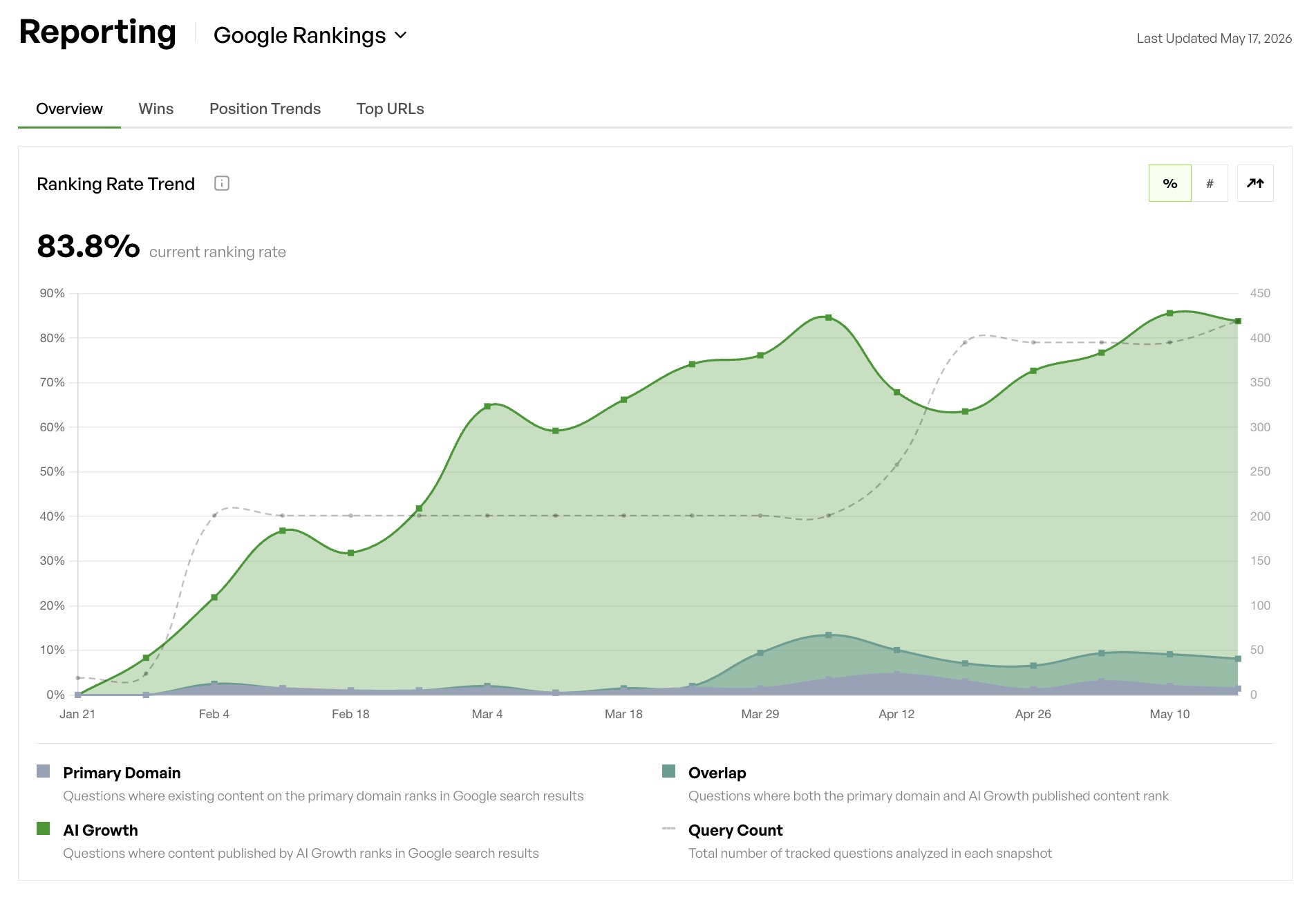
The implementation uses the full headless stack: a fully optimized blog connected to the brand’s domain via reverse proxy rewrite, living content that self-heals over time, and agentic technical SEO including Blog MCP, llms.txt, and agent discovery via /.well-known/. No content team, no agency, one engine.
10. Leva Sleep: AI Citations That Drive $40,000–$50,000 Deals
Leva Sleep took a similar approach, targeting financing, setup, side-sleeper, back-pain, and anti-snoring queries across AI tools. The content used full schema, validated primary sources, and the technical SEO stack that AI crawlers require to trust and cite a source.
Citation performance comes from long-tail coverage combined with living content. Leva Sleep’s articles answer the specific, conversational queries buyers ask AI tools at the bottom of the funnel, and the engine keeps that content current instead of letting it go stale.
Get found across online search without managing another tool or agency. Go live with a headless engine in about a week.
11. Bisutti: Parallel Engines for Consumer and Corporate Event Journeys
Bisutti, a high-end Brazilian events group, demonstrates how the same architecture scales across distinct buyer journeys by running two parallel AI Growth Agent engines. One engine focuses on consumer events such as weddings and social parties, and the other focuses on corporate events. Each engine runs its own universe map and content topology, producing authoritative content structured for the distinct queries each buyer type asks AI tools.
This implementation shows that headless marketing scales across multiple buyer journeys without adding headcount. Two engines and two content topologies still support one brand. AI tools cite Bisutti’s pages because they deliver audience-specific long-tail coverage that matches the exact query a buyer asks.
12. Exceeds.ai: Consistent Recommendation Across Perplexity, ChatGPT, and Google AI
Exceeds.ai shows what systematic execution looks like in a crowded market, becoming the leading solution for measuring AI adoption. The team used AI Growth Agent’s headless marketing engine to distribute content across AI-native search experiences, structured with full technical and agentic SEO, which produced consistent citations across every major AI assistant within weeks of launch.
Exceeds.ai achieved its first citation within two weeks, with a majority of traffic now sourced from generated content and a top-alternative placement on Perplexity. The brand is consistently recommended across Perplexity, ChatGPT, and Google’s AI Mode.
Citation consistency comes from systematic long-tail coverage combined with agentic technical SEO. Blog MCP, llms.txt, and agent discovery signals tell AI tools exactly how to read, trust, and cite the content, which keeps recommendations aligned across surfaces.
When Headless Marketing Becomes the Right Move
Headless marketing solves the gap for teams that cannot deliver schema, technical SEO, or structured formats that AI tools require. Most CMOs lead non-technical teams, and that reality creates the need for a separate engine that handles the technical layer while marketing focuses on the story.
A second concern is speed. An agency RFP often runs about three months, then three more to produce the first assets, which means close to a year before anything meaningful is live. AI Growth Agent moves from kickoff to the first published article in about one week, with content indexing in as little as ten days.
A third concern is the do-it-yourself trap. Producing one article with a chatbot is possible, but producing the second requires running the entire process again, and quality drifts from one piece to the next. One company produced a large volume of articles this way and not one was cited. The zero-headcount engine answers all three concerns by mapping the universe, validating every claim, publishing with the full technical and agentic SEO stack, and self-healing content over time while the client owns the site, the content, and the results.
Conclusion: Architecture That Trains the Next Generation of AI
The 12 examples above share a single underlying architecture: content built for the actual reader in 2026, which is the crawler, the training agent, and the AI assistant running a citation pass. Headless commerce architecture adoption grew year-over-year in 2026, with composable architectures gaining traction among enterprises, which reflects a broad recognition that decoupled, API-first content delivery has become the standard for brands that need narrative control across every surface.
The brands winning AI citations today are not the ones with the largest content teams. They are the ones with the most structured, validated, and technically complete content architecture. Headless marketing provides that architecture, and AI Growth Agent is the only engine that delivers the full stack at scale with living, self-healing content and measurable AI citations, without adding headcount.
The leaderboard in AI search is being written this year. Brands that establish authoritative content now are training the next generation of models with their own narrative.
Traditional search tools show you where your brand stands. AI Growth Agent makes your brand the answer. Find out if you qualify for the program.
Frequently Asked Questions
What is headless marketing?
Headless marketing is a content architecture that decouples the brand’s curated main site from the engine that produces and publishes content for AI tools. The term borrows from headless commerce, where the storefront a customer sees is separated from the backend that runs the business. In headless marketing, the brand keeps its main site while a separate, fully optimized engine produces structured, validated content built for the crawlers, training agents, and AI assistants that read, cite, and act on it. The result is marketing by and for the robots, without new headcount on the brand’s side.
How is headless marketing different from headless commerce?
Headless commerce separates the frontend storefront from the backend commerce engine that manages checkout, inventory, and payments, with the two layers communicating through APIs. Headless marketing applies the same architectural logic to brand presence in AI search. Instead of decoupling a storefront from a commerce backend, headless marketing decouples the brand’s curated main site from the content engine that produces authoritative, structured content for AI tools. The goal of headless commerce is transaction performance across channels. The goal of headless marketing is narrative control across AI answers.
How do you measure AI citations from headless marketing?
Measurement in headless marketing tracks four signals. The first is brand mention rate and citation rate across AI tools. The second is Google Search Console impressions as an independent audit. The third is bot traffic that shows every crawl and citation pass by AI training agents. The fourth is incremental visibility that isolates what the content engine generated versus visibility the brand already had.
AI Growth Agent publishes into a separate environment specifically so it can report only on the visibility it actually created. Per-article bot tracking shows exactly when ChatGPT or another AI assistant cites a specific piece of content, which gives brands a direct line of sight from content to citation to organic lead.
Does implementing headless marketing require a technical team?
No. The zero-headcount engine handles schema provisioning, robots.txt, sitemaps, Blog MCP, agent discovery via /.well-known/, llms.txt and llms-full.txt, instant indexing, autoredirects, and 404 tracking automatically. The only integration step on the brand’s side is a reverse proxy rewrite that connects the blog to a subdirectory under the brand’s domain. The brand’s team gives feedback in plain language, the engine learns from it, and every future article reflects those rules without re-briefing. No engineering hours, plugin configuration, or schema work are required from the client.
When does headless marketing make the most sense for a mid-market or enterprise brand?
Headless marketing makes the most sense when a brand already has an identity and a promise but lacks control over what AI tools say about it. This approach fits brands that need to cover a large universe of long-tail queries their buyers are asking AI assistants, brands whose current agency or internal team cannot deliver structured, validated content at the speed AI search requires, and brands that want to own their content and site rather than depend on an agency that controls both.
Headless marketing is particularly useful in competitive categories where the AI citation leaderboard is still being written. Brands that establish authoritative content now are training the next generation of models with their own narrative.