Written by: Mariana Fonseca, Editorial Team, AI Growth Agent
Key Takeaways
- Generative engines now answer queries directly, reduce clicks, and shape brand narratives before users reach your site.
- Traditional SEO stays essential while LLMO adds answer-first content, long-tail coverage backed by evidence, and agent-ready technical infrastructure.
- A seven-step system maps your full query universe, produces structured content, deploys schema and llms.txt, and tracks incremental visibility gains.
- Headless marketing replaces agency stacks with an autonomous engine that writes, publishes, refreshes, and reports without new headcount.
- Brands ready to become the answer in AI surfaces can schedule a demo with AI Growth Agent and get their first article live within a week.
How to Improve Generative Engine Visibility
Large language model optimization (LLMO) writes and structures content so AI surfaces find it, trust it, and cite it. It differs from legacy SEO in three core ways. It works in natural language instead of keyword density. It rewards citation context instead of page rank. It favors living content that self-heals instead of static pages that decay.
Web traffic from generative-AI-driven referrals in the United States increased more than 10× between July 2024 and February 2025, and AI visitors view fewer pages and bounce more often than traditional search visitors. The channel already drives real traffic and revenue.
Improving generative engine performance means closing the gap between your brand narrative and what AI answers say when customers ask about you. Four levers close that gap. You need universe coverage across seed terms and long-tail queries. You need structured content that generative engines can parse and cite. You need agentic technical infrastructure so bots and agents can read your site. You also need incremental visibility measurement that proves what changed.
The seven steps below turn each lever into a repeatable system.
Schedule a demo to see if you are a good fit and get your first article live within a week.
Is SEO Dead or Evolving in 2026?
SEO has evolved into two disciplines that must run together. Traditional technical SEO, including structured HTML, schema markup, sitemaps, and internal linking, remains table stakes because generative engines still rely on crawlable, well-structured pages as source material. Optimizing structural information such as headings and schema drives 17.3% average citation improvement across AI engines.
Ranking position alone no longer determines brand visibility. Average position-one CTR has dropped since 2023, while when AI Overviews appear, the zero-click rate reaches approximately 80%. Google AI Mode crossed one billion monthly users within its first year, with queries more than doubling every quarter.
Citation context now acts as the leaderboard. Your position in an AI answer, the brands grouped with you, and the claims tied to your name define visibility. By 2026, marketers are shifting success metrics from clicks to presence metrics such as AI mentions and AI-generated referral traffic. Traditional SEO forms the foundation. LLMO builds the structure on top.
How to Get Started With Generative Engine Optimization
To capture citation context and appear in AI answers, you must first understand what questions customers actually ask. The entry point is universe mapping, which defines the full set of queries and prompts that describe your market before you produce a single piece of content. Most brands track a few head terms and lose the rest of the conversation. Google generates multiple fan-out queries per prompt, so one customer question spawns a web of sub-queries your content must cover to appear in the synthesized answer.
The seven steps below move from universe mapping through measurement. Each step includes the goal, required inputs, sequence of actions, and validation checkpoints you need to execute it.
Step 1: Universe Mapping
Goal: Build a complete map of every seed term and long-tail query in your market before you produce any content.
Required inputs: Brand manifesto, product pages, competitor domains, and real-time Google and ChatGPT search data.
Actions: Identify three to five anchor seed terms that organize your market. Run real-time searches across Google AI Overviews and ChatGPT to surface the long-tail queries customers actually ask. Map fan-out sub-queries beneath each seed term. A Seer Interactive study found that 95% of Gemini fan-out queries had zero search volume, which confirms that traditional keyword tools miss most of the conversation.
Validation checkpoint: A new account should surface three to four hundred queries in the first pass. A mature universe reaches 1,600 or more queries refreshed weekly.
Suggested visual: A seed term hierarchy table with three columns: seed term, long-tail query cluster, and estimated fan-out count per prompt.
Step 2: Content Topology
Goal: Turn the universe map into a strategic content architecture that assigns query clusters to content types and sets production order.
Required inputs: Universe map from Step 1, competitor URL analysis, and AI Overview citation data that shows which content formats win each cluster.
Actions: Classify each query cluster by intent: informational, comparative, or transactional. Assign a content type to each cluster based on what already wins the result. Comparative listicles account for 32.5% of AI citations in large-scale citation analysis, which makes them the highest-performing format for competitive clusters. Prioritize clusters where competitors have thin or unstructured coverage.
Validation checkpoint: Every cluster in the topology has an assigned content type, a target query, and a competitor gap identified before production starts.
Suggested visual: A Content Topology table with four columns: seed term, query cluster, assigned content type, and competitor gap rating.
Step 3: Evidence-Based Long-Tail Production
Goal: Produce authoritative content for each long-tail query cluster with validated sources, structured formatting, and answer-first architecture.
Required inputs: Content Topology from Step 2, primary source URLs, brand manifesto, and real-time AI Overview and ChatGPT results as the objective function.
Actions: Open every article with a direct answer in the first 40 to 60 words. Many pages cited by ChatGPT place a short, direct answer immediately after a question-based heading. Use FAQ blocks, comparison tables with proper HTML thead elements, and numbered process steps throughout. Comparison tables that use proper HTML thead and descriptive columns often achieve higher AI citation rates. Validate every claim and source against evidence found online before publishing. Many of ChatGPT’s top cited pages come from original research, first-hand data, or academic sources.
Validation checkpoint: Every published article contains a direct answer in the opening paragraph, at least one structured element such as a table, FAQ block, or numbered list, and every factual claim links to a verifiable source.
Suggested visual: A content checklist with items: answer-first opening, question-based H2s, FAQ block, comparison table, validated citations, and schema type assigned.
Step 4: Agentic Technical SEO
Goal: Make every page readable, parseable, and citable by AI crawlers, training agents, and agentic systems acting on a user’s behalf.
Required inputs: Published content from Step 3, WordPress plugin with bot tracking, and robots.txt configuration.
Actions: Provision full schema markup across Article, FAQ, Organization, Author, and HowTo types. Schema.org markup improves machine readability and helps establish provenance by explicitly telling AI systems what content means. Once your content is structured for machine understanding, you must ensure AI systems can actually access it. Configure robots.txt to allow GPTBot, PerplexityBot, and ClaudeBot. Since 79% of top news sites block at least one major AI training bot, permitting access creates an immediate competitive advantage. Implement server-side rendering so content is not hidden behind JavaScript. Publish llms.txt and llms-full.txt so AI surfaces can read the brand in the format they need. Deploy Blog MCP with schema, manifest, discovery, and capability guidance exposed to agents. Serve OpenAI discovery and Agent Card guidance via /.well-known/. Enable natural language query parameters via /?s={query} so agents that pass a query into the URL receive a tailored, internally linked response.
Validation checkpoint: Bot tracking confirms GPTBot, PerplexityBot, and ClaudeBot are crawling the site. Schema validates without errors. llms.txt is publicly accessible.
Suggested visual: An agentic technical SEO checklist with items: schema suite deployed, robots.txt open to AI crawlers, llms.txt live, Blog MCP active, /.well-known/ endpoints serving discovery files, and Markdown served to agent crawlers.
Step 5: llms.txt and Blog MCP Deployment
Goal: Establish direct interoperability with AI surfaces and agentic browsers so your brand is readable in the formats these systems prefer.
Required inputs: Published site from Step 4, brand manifesto, and sitemap.xml.
Actions: Publish llms.txt at the root domain to declare the brand’s content structure to AI surfaces. Publish llms-full.txt with complete content for surfaces that consume the full file. Deploy Blog MCP, which is also compatible with Chrome 146 and other WebMCP-enabled browsers, with schema, manifest, discovery, and capability guidance. Serve pages in Markdown to agent crawlers. Ensure the sitemap.xml includes a dedicated web-stories sitemap. Configure instant indexing so new content enters the index within days instead of weeks.
Validation checkpoint: llms.txt and llms-full.txt return 200 status codes. Blog MCP endpoint is discoverable. Web stories sitemap is submitted and accepted in Google Search Console.
Suggested visual: A deployment checklist with items: llms.txt live, llms-full.txt live, Blog MCP endpoint active, Markdown served to agents, web stories sitemap submitted, and instant indexing enabled.
Step 6: Living Content
Goal: Prevent content decay by building a self-healing system that refreshes articles in response to Google Search Console signals, bot-traffic data, and calendar triggers.
Required inputs: Published content library, Google Search Console data, bot tracking data, and content performance metrics.
Actions: Monitor Google Search Console for impressions decay on published articles. Trigger refreshes when average position drops or impressions plateau. An Ahrefs analysis found that AI assistants prefer content that is 25.7% fresher than URLs appearing in organic search results, and fresher content is often cited more frequently by AI assistants. Refresh every article in a sector automatically when the calendar year turns. Use internal linking to compound authority from high-performing articles to underperforming ones. Centralize every article’s relationships, performance data, and bot and Search Console signals in one place so authority compounds instead of decaying.
Validation checkpoint: No article in the library is more than 12 months old without a documented refresh. Bot tracking confirms AI crawlers are returning to refreshed content. 65% of AI bot hits target content published within the past year and 79% target content updated within the past two years.
Suggested visual: A content health table with four columns: article title, last refresh date, current average position, and next scheduled refresh trigger.
Step 7: Incremental Visibility Measurement
Goal: Isolate the visibility your content program actually generated, separate from the visibility your brand already had, and report it week over week.
Required inputs: Bot tracking data, Google Search Console, AI citation data, and a separate publishing environment for new content.
Actions: Publish new content into a separate environment so incremental gains are attributable to the program rather than existing brand authority. Track AI citations and mentions, bot visits, and Google Search Console impressions week over week. Cross-reference bot traffic with citation data to confirm which articles are being cited and by which AI surfaces. Report citation context, including where the brand appears in the answer, who it is grouped with, and what claim it is cited for. Use internal linking to double down on articles that index well and lift those that do not.
Validation checkpoint: Weekly reporting shows incremental AI citations, bot visits, and impressions attributed to new content, separate from baseline brand visibility.
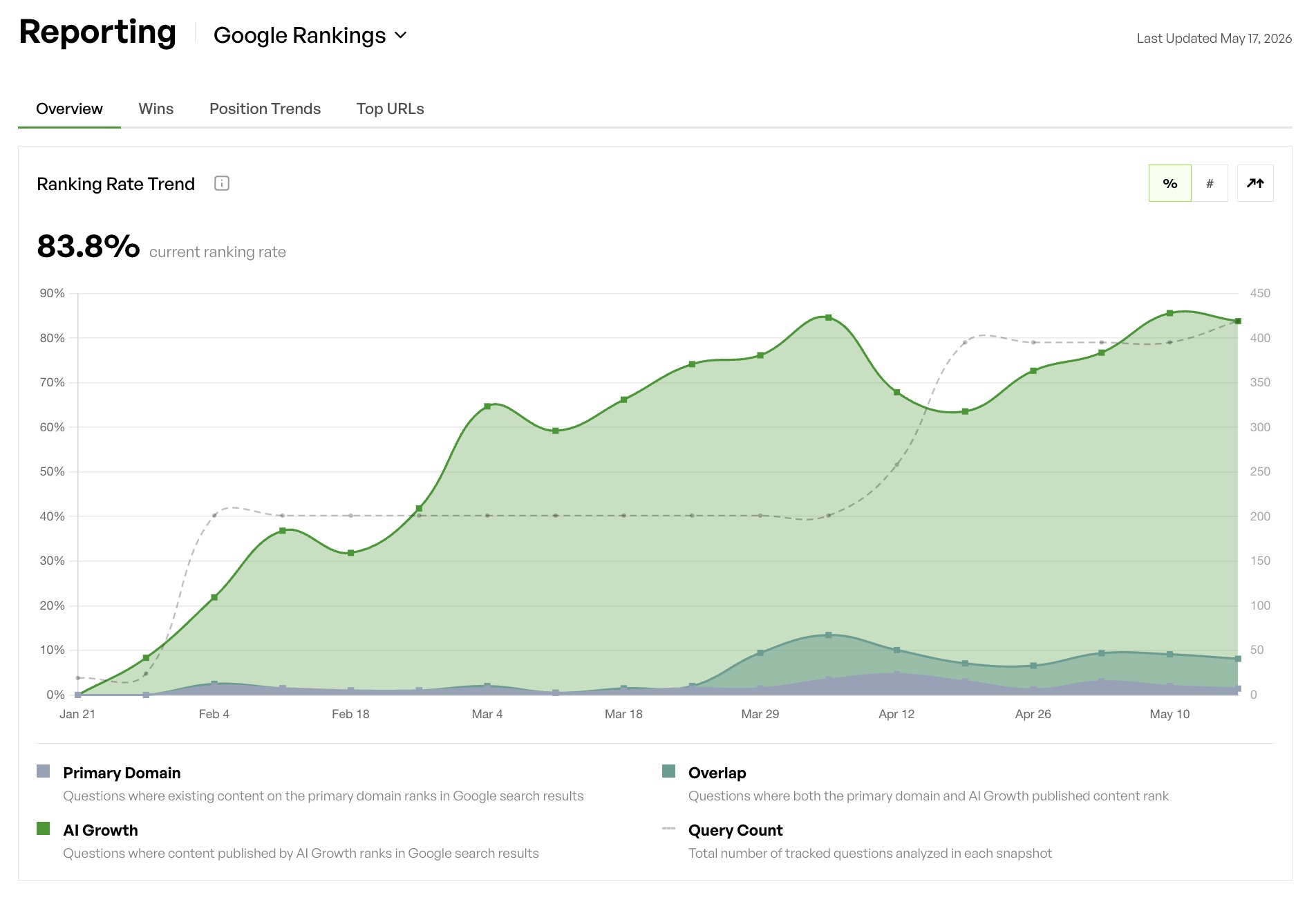
Suggested visual: The citation lift table below.
| Content Type | 12-Week AI Citation Lift | 12-Week Bot Visit Lift | 12-Week Impression Lift |
|---|---|---|---|
| Structured, evidence-based long-tail content (AI Growth Agent average) | +12,000 citations and mentions | +100,000 bot visits | +20% |
| Unstructured content without schema or answer-first formatting | Baseline (no documented lift) | Baseline (no documented lift) | Baseline (no documented lift) |
Headless Marketing: Replacing the Agency Stack With One Engine
Headless marketing provides the architecture that makes this seven-step system executable without adding headcount. It borrows from headless commerce. The brand keeps its curated main site while an autonomous engine runs the content, technical SEO, publishing, and reporting behind it.
The first half of headless marketing focuses on who actually reads the content. The primary readers are not human visitors scrolling through a blog. They are crawlers, training agents, AI surfaces running citation passes, and increasingly agents acting on the user’s behalf. GPTBot traffic grew 305% from May 2024 to May 2025. Pages that look beautiful to a human and remain invisible to a bot do not function as assets. They function as decoration.
The second half removes team dependency. The old way required an editor, an SEO specialist, a designer, an engineer, a content agency, a web agency, a PR firm, and a stack of monitoring tools. An agency RFP often runs three months, followed by three more months to produce the first assets. Many brands wait close to a year before anything meaningful ships.
Headless marketing replaces that stack with one engine. AI Growth Agent stands up a fully optimized blog the brand owns, styled to match its existing site and connected through a reverse proxy rewrite under a subdirectory or subdomain. The engine writes, publishes, monitors, self-heals, and reports. The brand states what it wants to win, in plain language, and the engine pursues those wins.
The differentiation from legacy SEO is structural. Legacy SEO acts like a rearview mirror and shows where the brand stands after the fact. Large language model optimization with headless marketing acts like the steering wheel and produces the content models will use to describe the brand, in the formats and structures the models can read, with the validation that earns the citation. Studies report widely varying conversion multipliers for AI-sourced traffic versus traditional search, ranging from below organic to 23x higher with no single consensus factor.
Across the first twelve weeks, AI Growth Agent clients see the citation and traffic lifts detailed in Step 7 above, with some clients achieving even more dramatic results. Breadless reached a 30x lift in Google Search Console impressions over six months and is now the most recommended healthy franchise in the US ahead of CAVA, Rush Bowls, and Sweetgreen. Leva Sleep closed $40,000 to $50,000 in deals in under three weeks from buyers who discovered the brand through AI Growth Agent content.
The brands cited in AI search this year are training the next generation of models with their own narrative. Brands that wait are training the next generation with whatever happens to be sitting on the open web.
Frequently Asked Questions
How long does it take to see results from generative engine optimization?
The first article is typically live within one week of kickoff. Content has indexed in as little as ten days and often within two weeks. The standard engagement is a three-month pilot because indexing timelines vary by industry and query cluster, but most clients see AI citations and bot traffic movement within the first month. Citation rates build across query clusters over three to four months as the content library grows and internal linking compounds authority across the universe.
Who owns the content and the site produced through headless marketing?
The brand owns the site and all content outright. AI Growth Agent stands up a fully optimized blog connected to the brand’s domain through a reverse proxy rewrite under a subdirectory or subdomain. There is no agency dependency, no lock-in, and no situation where a vendor controls the site. The brand can take the property and operate it independently at any point. Pricing is a flat fee with no per-article charges, credit limits, or per-prompt billing, and clients own everything produced.
What technical dependencies does the brand need to manage?
The only integration step on the brand’s side is the reverse proxy rewrite that connects the blog to a subdirectory under the brand’s domain. Setup documentation is generated for the brand’s specific host, whether Cloudflare, Vercel, or another provider. Everything else, including the full schema suite, WordPress plugin, robots.txt, sitemaps, web stories, Blog MCP, agent discovery via /.well-known/, llms.txt and llms-full.txt, instant indexing, autoredirects, and 404 tracking, is included in every package and requires no technical skill from the brand’s team.
How is incremental visibility measured, and how do you separate it from existing brand authority?
AI Growth Agent publishes into a separate environment so it can report only on the visibility it actually generated, never taking credit for visibility the brand already had. Reporting tracks AI citations and mentions, bot visits by bot type, and Google Search Console impressions week over week, cross-referenced to isolate what the new content program contributed. Google Search Console serves as an independent audit. Bot tracking confirms which AI surfaces are crawling and citing specific articles. In a zero-click world, the clients who measure best capture source at the conversion moment and consistently see a lift in organic leads after starting.
How does large language model optimization differ from traditional SEO, and do both need to run simultaneously?
Traditional technical SEO remains foundational because generative engines still crawl and index pages the same way traditional search does. Highly structured HTML, full metadata, rich schema markup, internal linking, proper sitemaps, and a detailed robots.txt are all still required. LLMO builds on top of that foundation by adding answer-first content architecture, evidence-based long-tail coverage across the full query universe, agentic technical infrastructure including Blog MCP and llms.txt, and living content that self-heals over time. Running only traditional SEO without LLMO leaves the brand invisible in the AI surfaces where customers are increasingly resolving purchase decisions. Running only LLMO without the technical foundation means content may not be crawled or indexed reliably. Both must run in parallel, which is why AI Growth Agent ships the complete stack in every engagement.
Conclusion
The discovery shift has already arrived. Google AI Mode has crossed one billion monthly users. Zero-click rates continue to climb as AI Overviews expand, which reinforces the urgency of the citation-first approach outlined above. The brands cited in AI answers today are building the training signal that shapes what the next generation of models says about their market.
The seven-step system above, from universe mapping through incremental visibility measurement, provides the operational path from invisible to cited. Headless marketing supplies the architecture that makes this path executable without an agency stack, without adding headcount, and without waiting a year for the first asset to ship.
Traditional search tools show you where your brand stands. AI Growth Agent helps your brand become the answer.