Written by: Mariana Fonseca, Editorial Team, AI Growth Agent
Key Takeaways
- The Search Universe Method maps every query layer, from head terms to long-tail prompts, so your brand wins AI Overview citations that traditional tools miss.
- Baseline assessment, Company Manifesto creation, and weekly fan-out extraction create a reliable foundation for tracking incremental visibility.
- Query fan-out, People Also Ask (PAA), and utility-keyword analysis expose the hidden sub-queries AI systems use, most of which show zero search volume.
- Schema-rich living content, validated against the Manifesto and updated at scale, keeps your citations fresh as models retrain.
- Book a demo with AI Growth Agent to map your full search universe and start winning AI citations in as little as one week.
Phase 1: Baseline Assessment of Your Current Visibility
Goal: Establish where the brand stands across traditional rankings, AI Overview citations, and bot traffic before new content goes live.
Actions: Pull Google Search Console data to identify existing impressions and click patterns. This snapshot sets your organic baseline. Next, audit which pages, if any, already appear in Google AI Overviews or ChatGPT, because these citations form a separate visibility layer that GSC does not isolate. Log current bot traffic using a WordPress plugin that identifies crawlers such as GPTBot, since bot visits act as an early signal of AI indexing. Finally, document which seed terms the brand already owns and which terms show no presence, so later gains clearly count as incremental.
Why this matters: Google Search Console aggregates AI Overview impressions with standard organic data, so you cannot see AI-driven visibility without a separate tracking layer. A keyword ranking at position one experiences up to a 58% decline in organic CTR when an AI Overview appears. Baseline assessment locks in the pre-engagement benchmark so every reported result later reflects real lift.
Checkpoint: A documented snapshot of current organic rank, AI Overview citation rate, bot visit volume, and Google Search Console impressions, separated by primary domain pages versus any AI Growth Agent content.
With the baseline in place, the next step builds the brand foundation that will guide every keyword and content decision so AI systems cite accurate, specific information instead of generic claims.
Phase 2: Company Manifesto and Search Universe Mapping
Goal: Create authoritative brand documentation that anchors every downstream content and keyword choice.
Actions: Run a structured interview with a professional journalist to capture the brand’s positioning, product features, audiences, and competitive edge. Ingest unstructured materials such as brand guidelines, sales PDFs, and product pages. From this source material, produce a Company Manifesto, a detailed AI-indexed document that acts as the anti-hallucination foundation for all content generation.
Why this matters: AI models favor content with strong E‑E‑A‑T signals. Pages with real author bylines, cited sources, original data, and demonstrated expertise are more likely to be selected for AI Overviews. The Company Manifesto creates that differentiation at the source before a single article is written. Generic AI tools cannot match this because they lack a brand-specific knowledge base.
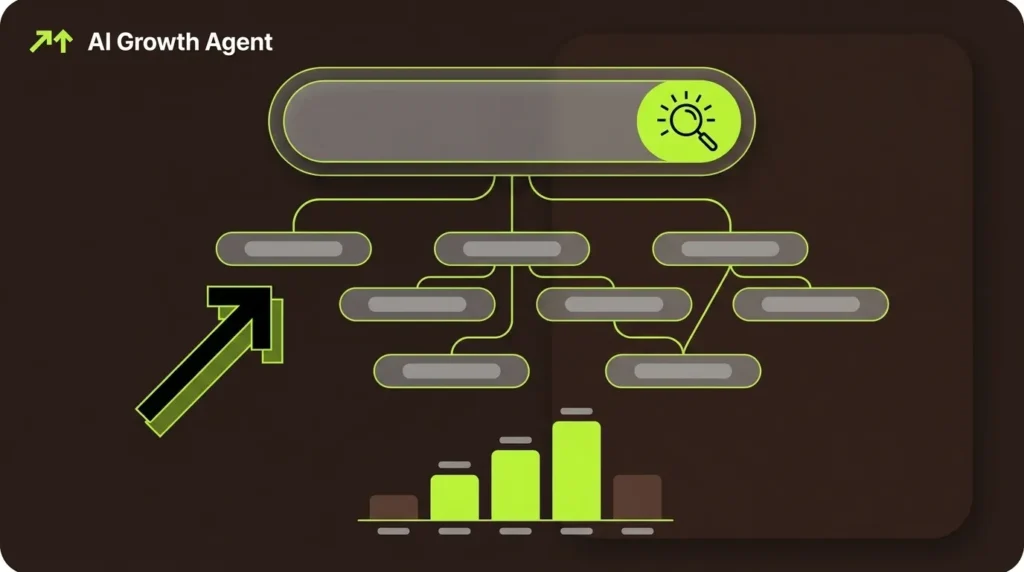
From the Company Manifesto, AI Growth Agent builds a Content Topology. This structure shows the brand’s search universe, organized by seed terms with hundreds of derived prompts under each one, refreshed weekly from real-time Google and ChatGPT data.
Checkpoint: A reviewed and approved Company Manifesto, plus an initial Content Topology of 9–15 seed terms and 300–400 prompts ready for Phase 3 extraction.
See how we map your search universe from day one
Phase 3: Extracting Query Fan-Out Sub-Queries
Goal: Surface the synthetic sub-queries AI systems run internally before generating an answer, including queries that traditional keyword tools never show.
Actions: For each seed term in the Content Topology, extract the fan-out sub-queries that AI platforms generate. Map each sub-query against the six core validation dimensions AI systems use: entity identity, attribute features, reputation signals, recency, cross-source consensus, and contradicting evidence.
Why this matters: AI search platforms use query fan-out to handle ambiguous queries, explore multiple interpretations, pull information from diverse sources, and anticipate follow-up questions. 95% of fan-out phrases show zero monthly search volume, so Semrush and Ahrefs never surface them. Google’s AI Mode uses query fan-out to generate 8–16 parallel sub-queries per request. Google AI Mode crossed 1 billion monthly users within its first year, and queries more than doubled every quarter, so the fan-out surface keeps expanding.
An estimated 15% of daily searches in 2026 are brand-new queries with zero historical data that volume-based tools cannot reveal. AI Growth Agent runs more than 3,000 searches per week to keep the universe snapshot current without prompt caps.
Checkpoint: A documented fan-out map per seed term that covers the specific sub-queries AI systems run to validate the brand before citing it, with each sub-query tagged by intent type and validation dimension.
Phase 4: PAA Mapping and Utility-Keyword Discovery
Goal: Find the People Also Ask subtopics and utility-intent queries that signal topical authority and expand your citation surface.
Actions: For each seed term and fan-out cluster, extract PAA boxes from live SERPs. Categorize queries by intent: informational, commercial, transactional, and utility such as calculator, comparison, template, or checker. Identify which intent types trigger AI Overviews in the brand’s specific market.
Why this matters: People Also Ask often appears alongside AI Overviews on SERPs, so PAA subtopics act as a direct signal of what the AI system considers adjacent and authoritative. AI Overview trigger rates usually rise as query length increases. Targeting conversational queries with four or more words becomes essential because that is where AI Overviews concentrate.
Utility keywords such as comparison terms, “best X for Y” queries, and action-first modifiers carry strong citation potential. Comparison content performs well in AI Overviews and other LLM responses, placing brands inside AI-generated answers across search engines and chat platforms.
Checkpoint: A PAA map per seed term cluster and a utility-keyword list segmented by intent type, with AI Overview trigger likelihood noted per category based on live SERP data.
Walk through your Content Topology in a live demo
Phase 5: Tracking Competitor AI Visibility
Goal: Reveal which competitors win citations in AI Overviews and ChatGPT and pinpoint the content gaps your brand can claim.
Actions: Run the Content Topology prompts from the perspective of each primary competitor. Identify which competitor URLs appear, in what context, and for which claims. Flag gaps where no competitor holds a strong citation, since these represent the fastest wins. Track order of mention as the new ranking metric because AI-generated answers do not use a fixed position list.
Why this matters: Pages that appear in multiple fan-out results gain higher scores through reciprocal rank fusion when they rank consistently across sub-query result lists. A brand that appears once receives a mention. A brand that appears across the full fan-out cluster becomes the default answer.
Checkpoint: A competitor citation map per seed term cluster and a prioritized gap list ranked by citation opportunity and commercial intent.
Phase 6: Producing Schema-Rich Living Content
Goal: Publish schema-rich, bot-readable content that answers fan-out sub-queries, PAA subtopics, and utility-keyword intent, then keep that content current as the market shifts.
Actions: For each prompt in the Content Topology, deploy research agents to analyze current Google and ChatGPT results, competitor signals, PAA boxes, and forum discussions. Cross-check every claim against the Company Manifesto and live primary sources. Publish with full schema coverage, including article, FAQ, HowTo, local business, organization, author, product, and software application schema. Configure advanced robots.txt, sitemap.xml, Blog MCP, and Web MCP automatically through the WordPress plugin. Set a steady publishing cadence, typically twice daily, instead of bulk-dumping content.
Why this matters: Structured data such as FAQPage and HowTo schema improves an AI system’s ability to parse question-based content and increases citation likelihood in AI Overviews. Ahrefs 2025 research found that AI tools cite pages that are 25.7% fresher than those typically surfaced in traditional search. Living content, updated in batches so every article in the sector refreshes continuously, keeps citations from decaying between model training sweeps.
AI Growth Agent’s engine produces between 2 and 50 articles per day per client, up to 500 per month, with every article validated against live research instead of a model’s training data.
Checkpoint: Published articles with full schema, MCP endpoints, and sitemap entries confirmed. Bot traffic tracking active via the WordPress plugin. First indexing usually occurs within two weeks of publication.
Go from kickoff to first published article in one week — book your session
Phase 7: Weekly Reporting on Incremental AI Visibility
Goal: Prove exactly what the Search Universe Method generated, separate from visibility the brand already owned.
Actions: Every Monday, capture a fresh snapshot of the search sector across all Content Topology prompts. Report appearance in Google AI Overviews and ChatGPT, traditional organic rank against competitors, bot visit volume by crawler type including GPTBot, and Google Search Console impressions. Split results into three buckets: primary domain pages, overlapped pages, and AI Growth Agent pages. Deliver results through the proprietary dashboard, the WordPress plugin, and Google Search Console as an independent audit.
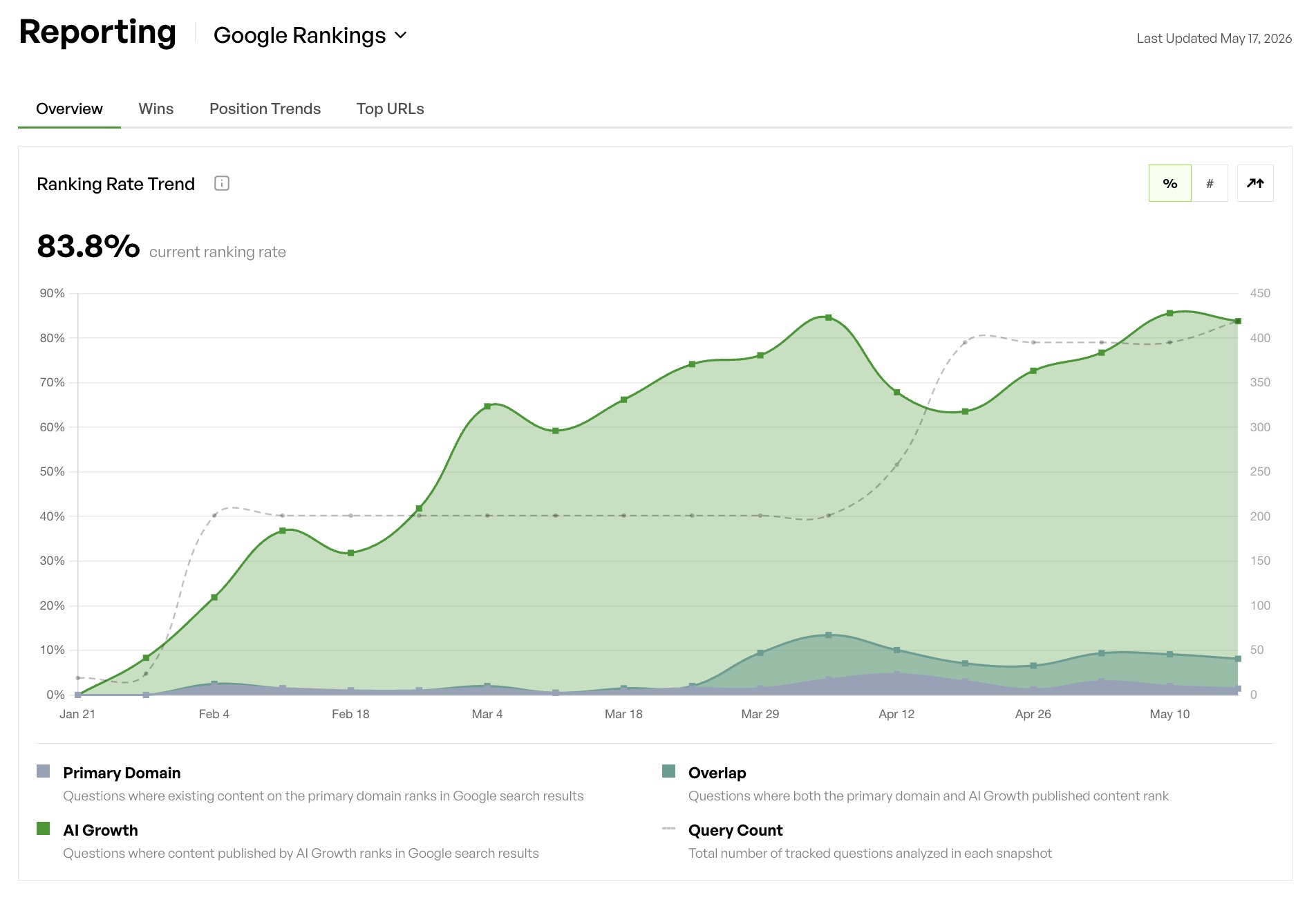
Why this matters: Incremental visibility reporting answers the question every CMO receives from their CEO: is this working, or are we claiming credit for visibility we already had? AI Growth Agent only claims credit for what its engine generates.
Checkpoint: Weekly dashboard report delivered with bot traffic, citation context, impressions, and organic rank all trending in the right direction. Anomalies such as a competitor spamming pages to disrupt rankings appear in real time and can be addressed before they compound.
Traditional Keyword Research vs. The Full-Universe Approach
The following table highlights how volume-based keyword tools differ from the full-universe approach across query coverage, fan-out identification, content execution, and visibility measurement, all of which directly affect AI citation rates.
| Dimension | Traditional Capped-Prompt Tools (e.g., Semrush, Ahrefs) | Full-Universe Approach (AI Growth Agent) | Why It Matters |
|---|---|---|---|
| Query coverage | Limited to self-inputted prompts, with average error rates of approximately 50% vs. Google Search Console data across 184 websites | Full search universe mapped from real-time Google and ChatGPT data, 3,000+ searches per week, no prompt caps | The vast majority of fan-out queries have no historical volume data, which shows why traditional tools miss the AI search surface |
| Fan-out sub-query identification | Not supported, tools optimized for single-query lookup | Fan-out extraction per seed term across all six validation dimensions | Pages appearing across multiple fan-out results score higher via reciprocal rank fusion |
| Content production | Data only, content briefing, writing, and publishing left to the client | 2–50 articles per day, schema-rich, claim-validated, published automatically on cadence | FAQPage and HowTo schema increases citation likelihood in AI Overviews |
| Visibility reporting | Rank position and estimated volume, while AI Overview clicks blend into standard organic traffic in GA4 with no separate referral parameter | Incremental visibility isolated week over week, including AI Overview citations, ChatGPT mentions, bot traffic, and GSC impressions in one dashboard | The 58% CTR decline at position one shows why rank position alone no longer predicts traffic |
Common Mistakes and Troubleshooting in AI Keyword Strategy
Tracking only head terms. Head terms represent a small share of the queries AI systems actually answer. Many keywords that trigger AI Overviews carry low monthly search volumes. Brands that focus only on high-volume terms stay invisible to most of their own market.
Publishing without schema. Content that looks authoritative to humans but lacks structured data remains decoration to a bot. FAQPage, HowTo, and author schema act as the parsing layer that lets AI systems extract and cite specific passages.
Treating content as static. As noted earlier, AI systems favor fresher content, which turns static publishing into a liability. Content published and forgotten loses citation share as the market moves and competitors release newer material.
Confusing monitoring with action. Knowing that a brand does not appear in a capped set of prompts does not equal a strategy. The gap between a monitoring dashboard and a citation win requires content production, technical SEO, and living updates, which monitoring tools do not provide.
Ignoring bot traffic as a signal. When content is cited in a Google AI Overview without receiving a click, that citation remains invisible in Google Search Console. Bot traffic, tracked at the crawler level, becomes the leading indicator that AI systems are reading and indexing the brand’s content before citations appear in dashboards.
Verifying Outcomes Across Three Data Layers
Three independent data layers confirm that the Search Universe Method performs as intended.
Bot traffic via WordPress plugin. Every crawl by GPTBot, Google‑Extended, and other AI training agents is captured at the server level. Rising bot visit volume, with AI Growth Agent clients averaging over 100,000 additional bot visits in the first 12 weeks, confirms that AI systems actively read the content.
Impressions via Google Search Console. GSC impressions provide an independent audit of indexing momentum. A 20% or higher lift in impressions within the first three months represents the average across AI Growth Agent clients. Google Search Console includes AI Overview data in its Performance report but does not separate AI Overview impressions from traditional organic results, which makes the proprietary dashboard layer essential for isolation.
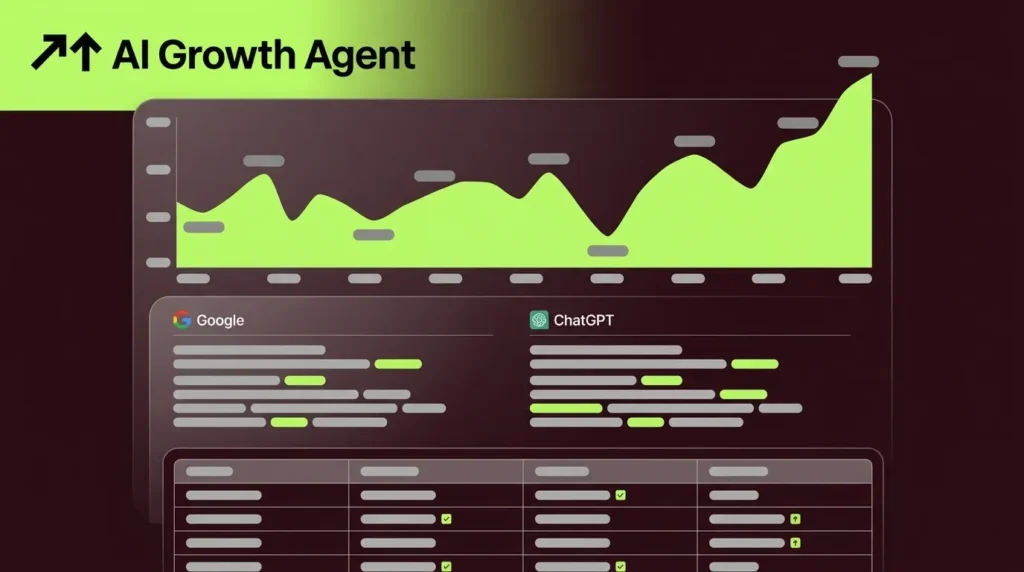
Citation context in AI Overviews and ChatGPT. The proprietary dashboard runs real-time searches across the full Content Topology every week and records where the brand appears, in what context, grouped with which competitors, and for which specific claims. This replaces the old idea of a ranking number with citation context, the metric that reflects AI search reality.
All three layers are reported weekly and split into primary domain, overlapped, and AI Growth Agent buckets, so incremental visibility never blends with pre-existing brand equity.
Frequently Asked Questions
How long does it take to see citations in Google AI Overviews after starting?
The first article can be live within one week of kickoff. Content has indexed in as little as two weeks. Citation rates in AI Overviews and ChatGPT usually become measurable within the first month, with the standard engagement structured as a three-month pilot because indexing timelines vary by industry and competitive density. Clients like Jelly and Exceeds.ai received their first citations within two to three weeks.
Who owns the keyword research and content strategy, the client or AI Growth Agent?
The client owns all content, the blog property, and the strategic direction. AI Growth Agent owns the execution engine. The client defines which markets and narratives to win in plain language. The engine maps the search universe, extracts fan-out queries, produces content, and reports results. No technical skill is required from the client’s team.
What technical dependencies are required to get started?
No additional tools are required beyond domain access for the reverse proxy rewrite or subdomain setup. AI Growth Agent provisions the WordPress plugin, schema, robots.txt, sitemap.xml, MCP endpoints, and bot tracking automatically. The setup is infrastructure-agnostic and works with Cloudflare, Vercel, and other providers. The new blog does not interfere with any existing site structure.
How does AI Growth Agent handle prompt caps compared to traditional tools?
Prompt count never acts as a billed metric. Traditional monitoring tools cap the number of queries a client can track and charge more to see further into their own market. AI Growth Agent maps the full search universe, starting at 300–400 prompts across 9–15 seed terms and scaling to 1,500+ queries for mature clients, refreshed weekly at a flat fee with no per-prompt or per-article charges.
Can AI Growth Agent work alongside an existing SEO agency or internal team?
Yes. AI Growth Agent stands up a separate, fully optimized top-of-funnel blog connected through a subdirectory or subdomain. It does not touch the curated main site or any existing blog. Incremental visibility reporting isolates exactly what AI Growth Agent generated versus what the existing domain already had, so attribution conflicts do not arise.
How does the engine prevent content from hallucinating or going stale?
Every claim, source, and quote is validated against live research, not a model’s training data, before any article is published. A cascade of anti-hallucination checks runs across primary and external sources. Content remains living and updates in batches so every article in the sector refreshes continuously, which also supports re-indexing. When a client changes a rule, CTA, or link, the engine syncs and updates affected live articles automatically overnight.
Conclusion: Turning Your Brand into the AI Default Answer
Traditional keyword research tools were built for a search environment that no longer exists. Traditional search queries average about 3.4 words while AI search queries average 5.5–12 words depending on platform and query type. Websites ranked number one on Google appear in AI-generated answers 31% of the time, so the old model of rank tracking cannot steer AI visibility.
The Search Universe Method replaces fragmented tools and capped prompts with one autonomous engine that maps the full query landscape, extracts fan-out sub-queries, produces schema-rich living content from a Company Manifesto and Content Topology, and reports incremental visibility every Monday. The leaderboard in AI search is still forming. Brands that establish authoritative content now train the next generation of models with their own narrative.
AI Growth Agent positions your brand as the answer.
Book a demo request and see how the Search Universe Method works for your market.