Written by: Mariana Fonseca, Editorial Team, AI Growth Agent
Key Takeaways for MCP AI Search in 2026
- MCP AI search optimization pairs MCP endpoints with Agent Cards, A2A standards, token-efficient resources, and living content that self-heals over time.
- Resources serve read-only structured content, and Tools handle interactive natural language queries, which together enable precise AI citations.
- Token efficiency through pagination, summaries, and JSON Schema 2020-12 helps agents read and cite brand claims before hitting context limits.
- Subdirectory deployments via reverse proxy inherit parent domain authority, which speeds indexing and increases AI citation rates compared to subdomains.
- AI Growth Agent provisions the full MCP stack, including Agent Cards, reverse proxy, living content, and four-pillar measurement in one week. Schedule a demo to get started.
How Resources and Tools Work Together in MCP
The Model Context Protocol defines three first-class primitives: Tool, Resource, and Prompt. For content-focused MCP AI search optimization, Resources and Tools carry the most weight.
Resources are read-only, URI-addressed data objects. An agent calls resources/read to retrieve a catalog entry, an FAQ block, or a structured article without modifying anything. Resources are the right primitive for content that agents consume as context, such as product descriptions, brand FAQs, and structured knowledge bases.
Tools are executable actions defined by JSON Schema input definitions. An agent calls tools/call to trigger a search, filter a content set, or retrieve a personalized response. Tools are the right primitive for interactive queries, including the natural language query parameter pattern (/?s={query}) that AI Growth Agent deploys on every client site.
A copy-paste MCP server configuration for a blog resource endpoint looks like this:
{ "mcpServers": { "blog": { "transport": "streamable-http", "url": "https://yourdomain.com/mcp", "headers": { "Mcp-Method": "resources/read", "Mcp-Name": "blog-content" } } } }The MCP 2026-07-28 release candidate mentions an Mcp-Method header on Streamable HTTP transport to help load balancers route requests without inspecting the body. Token optimization starts here. List and resource read results now carry ttlMs and cacheScope fields modeled on HTTP Cache-Control, which enables clients to cache tools/list responses and reduce redundant round trips.
Token Efficiency and Structured Data for Reliable Citations
Token efficiency acts as a prerequisite for reliable AI citations. An agent that hits a context-window ceiling before reading a brand’s key claims will not cite those claims. Every structural decision in a Blog MCP implementation should be evaluated against token cost.
Three patterns matter most in 2026.
Pagination. Token-aware responses that intelligently paginate large result sets keep individual responses within agent context windows. A resource endpoint returning 847 documents should report “12 of 847 documents” with a cursor, not dump the full corpus.
Truncation with summaries. Resources should expose a summary field alongside full content. Agents performing citation passes read summaries first. They call resources/read on full content only when the summary signals relevance.
JSON Schema 2020-12. SEP-2106 proposes that Tool inputSchema and outputSchema in a future MCP release conform to full JSON Schema 2020-12, but the SEP remains Draft with an open PR as of the 2026-07-28 Release Candidate. Declaring precise output schemas reduces the tokens an agent spends inferring structure and increases the probability that a citation is attributed to the correct content node.
Each of these patterns maps directly to citation outcomes. Agents that receive well-structured, paginated, schema-declared responses cite more precisely and more frequently than agents parsing unstructured HTML.
Agent Card Discovery with /.well-known/agent-card.json
An MCP server that no agent can find behaves like a service running on an unpublished number. Under the Agent2Agent protocol, each agent publishes an Agent Card at /.well-known/agent-card.json that describes its name, capabilities, and endpoint, which enables runtime discovery and routing without manual code changes or redeployments.
A production Agent Card for a content-focused MCP deployment looks like this:
{ "schemaVersion": "1.0", "name": "Brand Content Agent", "description": "Exposes structured brand content, FAQs, and product resources for AI agent consumption.", "provider": { "organization": "Your Brand", "url": "https://yourdomain.com" }, "capabilities": { "streaming": true, "pushNotifications": false }, "skills": [ { "id": "content-search", "name": "Content Search", "description": "Returns structured brand content matching a natural language query.", "tags": ["content", "search", "brand"], "inputModes": ["text"], "outputModes": ["text", "json"] } ], "securitySchemes": { "oauth2": { "type": "oauth2", "flows": { "authorizationCode": { "authorizationUrl": "https://yourdomain.com/oauth/authorize", "tokenUrl": "https://yourdomain.com/oauth/token", "scopes": { "content:read": "Read brand content resources" } } } } }, "endpoints": { "mcp": "https://yourdomain.com/mcp" } }MCP servers should expose a standard metadata format via .well-known endpoints so that server capabilities are discoverable without requiring a live connection. The Agent Card functions as that metadata format. A2A was donated to the Linux Foundation and now governs agent discoverability across more than 150 organizations, including Microsoft, AWS, Salesforce, SAP, and ServiceNow.
WebMCP support in Chrome turns browser-based agent discovery into a production reality. AI Growth Agent deploys Agent Cards across every client site automatically.
Reverse Proxy Subdirectories for Stronger Authority Signals
Subdirectory deployment gives your MCP content an authority boost that subdomains do not receive. Domain authority is not inherited by default, so a blog hosted on a separate origin starts from zero. A reverse proxy rewrite changes that by serving the entire AI Growth Agent site, including MCP endpoints, discovery files, and content, from a subdirectory on the client’s domain without any assets touching the client’s CDN, CMS, or origin server.
A Cloudflare Workers reverse proxy rewrite for a subdirectory deployment looks like this:
export default { async fetch(request) { const url = new URL(request.url); if (url.pathname.startsWith("/blog")) { const targetUrl = "https://your-aga-origin.com" + url.pathname + url.search; return fetch(targetUrl, { method: request.method, headers: request.headers, body: request.body }); } return fetch(request); } };For Vercel, the equivalent configuration in vercel.json:
{ "rewrites": [ { "source": "/blog/:path*", "destination": "https://your-aga-origin.com/blog/:path*" } ] }The subdirectory approach matters because Google treats a subdomain as a separate site. A subdirectory inherits the parent domain’s authority, which accelerates indexing speed, AI citation rate, and share of voice across the full content universe. The MCP endpoint served at yourdomain.com/mcp carries that same authority signal to agents that evaluate source credibility.
Schedule a demo to confirm fit and receive the exact reverse proxy configuration for your stack.
7-Step MCP Implementation Checklist
- Provision the MCP server. Deploy a Streamable HTTP MCP server with Mcp-Method headers, output schemas, and ttlMs cache fields on all list and read responses.
- Publish llms.txt and llms-full.txt. Place both files at the domain root. llms.txt provides a concise brand and content summary. llms-full.txt exposes the complete structured content index for AI surfaces that need full context.
- Deploy Blog MCP. Configure the Blog MCP endpoint with schema, manifest, discovery, and capability guidance. Enable natural language query parameters at
/?s={query}so agents can query the blog directly without custom integration code. - Publish the Agent Card. Serve a valid agent-card.json at
/.well-known/agent-card.jsondeclaring MCP endpoint, skills, security schemes, and streaming capabilities. Also serve OpenAI discovery at/.well-known/openai.json. - Configure the reverse proxy. Rewrite the blog subdirectory to the AI Growth Agent origin using the Cloudflare or Vercel patterns above. Verify that the MCP endpoint, Agent Card, and llms.txt files resolve correctly under the parent domain.
- Connect living-content hooks. Enable automatic content refresh triggers tied to Google Search Console signals and bot-traffic data. These hooks prevent your content from going stale, which would cause it to lose citation priority as agents favor fresher sources. By updating content when signals indicate staleness, self-healing hooks ensure the next training sweep finds the current brand narrative rather than outdated information.
- Activate four-pillar measurement. Stand up Search Intelligence, AI Analytics, Bot Tracking, and AI Ranking dashboards. Establish a weekly snapshot cadence. Isolate incremental visibility from pre-existing brand visibility in all reporting.
Four-Pillar Measurement for Incremental Visibility
Measurement turns MCP implementation into accountable growth infrastructure. The four-pillar data foundation connects every technical step to a business outcome.
Search Intelligence maps the traditional search landscape, including positioning, competition, search volume, and the structure of who is already winning. It highlights white space where MCP-served content can displace existing results.
AI Analytics tracks brand value and consumer behavior across the full journey, from external touchpoints like Google and ChatGPT queries through content consumption, demographics, and sentiment. It surfaces which MCP-served resources generate citation context and briefly calls back to which ones agents skip when they hit context limits.
Bot Tracking logs every bot interaction, including traditional crawlers and AI training agents. This granular logging matters because AI-referred sessions grew substantially according to industry research, which elevates bot traffic from a secondary metric to a primary visibility signal. With that shift, per-article bot tracking becomes essential. It shows exactly when ChatGPT cites a specific page and which page it was, which gives you attribution data that aggregate bot metrics cannot provide.
AI Ranking replaces the static ordered list with order of mention and citation context. Where a brand appears in an AI answer, and how that position evolves week over week against the content plan, forms the new leaderboard. Optimization strategies including citations, statistics, and structured quotations improved AI engine visibility in research from Princeton and Georgia Tech.
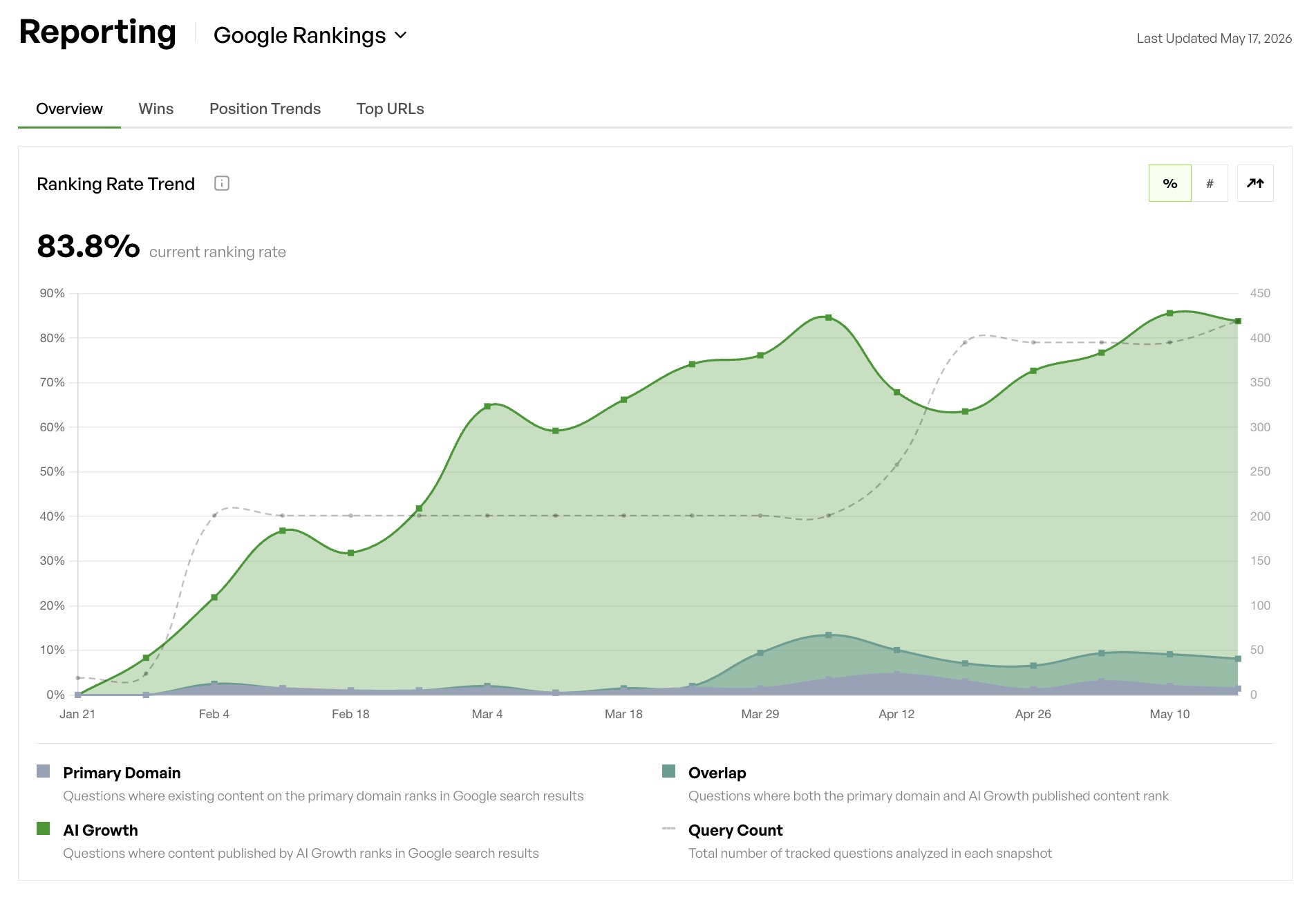
Incremental visibility reporting isolates what MCP-served content actually generated, separate from visibility the brand already had. That separation provides defensible proof of ROI in a zero-click search environment.
Platform vs. DIY: Choosing the One-Week Stack
The DIY path for MCP AI search optimization often stalls between prototype and production. Deploying an MCP server in a day is realistic. Deploying an MCP server that is discoverable via a valid Agent Card, served under a subdirectory that inherits parent-domain authority, paired with token-efficient resources, llms.txt, living content that self-heals, and four-pillar measurement reporting incremental visibility week over week requires a different level of execution.
The gap between those two efforts is where most implementations fail. The MCP server runs, but nothing cites it. The Agent Card is missing or malformed. The blog lives on a subdomain and inherits no authority. The content goes stale three weeks after launch. The reporting dashboard shows total impressions, not incremental ones.
MCP alone is insufficient for production use because it is a communication protocol without mandated central management, unified observability, or consistent authorization enforcement across servers. The same principle applies to content. MCP without discoverability, living content, and measurement functions as a protocol without a strategy.
As mentioned earlier, the full stack goes live within a week of kickoff. The Blog MCP, Agent Card, reverse proxy rewrite, llms.txt, llms-full.txt, automated web stories, bot tracking, instant indexing, and four-pillar measurement are included in every package. Clients average more than 12,000 additional AI citations and mentions, over 100,000 additional bot visits, and a 20%+ lift in impressions across the first twelve weeks. Breadless now receives over 45,000 ChatGPT citations per month. Leva Sleep closed $40,000 to $50,000 in deals in under three weeks from buyers who discovered the brand through AI Growth Agent content.
The one-week kickoff timeline contrasts with the agency alternative, which often involves a three-month RFP, three more months to produce first assets, and a year before anything is in motion. It also contrasts with the DIY chatbot path, where one company produced roughly 300 articles without a single citation.
Schedule a consultation session to go from kickoff to first published article in about one week.
Conclusion: Ship the Full MCP Stack, Not Just the Protocol
MCP AI search optimization in 2026 functions as a stack, not a single endpoint. The stack includes a Streamable HTTP MCP server with token-efficient Resources and Tools, a valid Agent Card at /.well-known/agent-card.json, a reverse proxy rewrite that inherits parent-domain authority, llms.txt and llms-full.txt, living content that self-heals, and four-pillar measurement that isolates incremental visibility from existing brand equity.
Every layer depends on the others. An MCP server without an Agent Card remains undiscovered. An Agent Card without living content points agents to stale information. Living content without measurement produces no defensible proof of ROI. Brands that win AI search this year ship the full stack, not just the protocol.
Traditional search tools show you where your brand stands. AI Growth Agent focuses on making your brand the answer. The leaderboard in AI search is being written now, and brands that establish authoritative, agent-ready content today are training the next generation of models with their own narrative.
Schedule a demo to confirm fit and see your first article live within a week.
Frequently Asked Questions
What is the difference between MCP Resources and MCP Tools in the context of AI search optimization?
Resources are read-only, URI-addressed data objects that agents consume as context without modifying them. They are the right primitive for content that agents read during citation passes, such as product descriptions, FAQs, structured articles, and knowledge base entries. Tools are executable actions that agents call to trigger a search, filter a result set, or retrieve a personalized response. In a Blog MCP deployment, a Resource serves a specific article or catalog entry, while a Tool handles natural language queries that return dynamically assembled, internally linked responses. Both primitives are necessary for a complete MCP AI search optimization implementation. Resources alone give agents content to read. Tools give agents a way to query that content intelligently, which produces precise, attributable citations rather than generic brand mentions.
Why is an Agent Card required for MCP discoverability, and what happens without one?
An Agent Card is the structured JSON declaration that tells compliant agents where an MCP server lives, what capabilities it exposes, what skills it offers, and how to authenticate. It is served at the canonical location /.well-known/agent-card.json and acts as the mechanism through which A2A-compliant agents discover a site’s interactive endpoints at runtime without manual code changes or redeployments. Without an Agent Card, an MCP server remains effectively undocumented. Agents that follow the A2A discovery standard will not find it. WebMCP support in Chrome makes browser-based agent discovery a live production reality. The A2A protocol, now governed by the Linux Foundation and supported by over 150 organizations, defines the Agent Card as the standard front door for any site that wants to be cited and used by an agent. A site can have a fully functional MCP server and still be invisible to the majority of compliant agents if the Agent Card is absent or malformed.
How does a reverse proxy subdirectory deployment affect MCP citation rates compared to a subdomain?
Google treats a subdomain as a separate site from the parent domain. A blog or MCP endpoint hosted at blog.yourdomain.com starts with zero inherited authority and must build domain trust independently. A subdirectory deployment, achieved through a reverse proxy rewrite that serves the AI Growth Agent origin from yourdomain.com/blog, inherits the parent domain’s full authority signal. That authority inheritance accelerates indexing speed, increases the probability that AI agents evaluate the content as a credible source, and lifts citation rates across the full content universe. The MCP endpoint served at yourdomain.com/mcp carries the same authority signal to agents evaluating source credibility as every other page on the domain. In practice, the subdirectory approach produces faster first indexing, higher AI citation rates, and stronger share of voice than an equivalent subdomain deployment. AI Growth Agent provisions the reverse proxy rewrite as the sole integration step on the client’s side, with setup documentation generated for the client’s specific host, whether Cloudflare, Vercel, or another provider.
What does “living content” mean in the context of MCP AI search optimization, and why does it matter for citations?
Living content refers to content that updates and self-heals over time rather than going stale after publication. In the context of MCP AI search optimization, it matters because AI training sweeps and citation passes occur repeatedly. Models are retrained, agents re-crawl sources, and citation context shifts as the information landscape changes. A brand that publishes content once and leaves it static trains future model generations with outdated information. A brand running living content ensures that every training sweep and citation pass finds the current brand narrative, current product specifications, and current competitive positioning. AI Growth Agent implements living content through automatic refresh triggers tied to Google Search Console signals and bot-traffic data. When a year turns, every article in a sector refreshes automatically. When a stale signal appears, the self-healing system updates the content before the next agent crawl. This compounding effect separates brands that maintain citation authority over time from brands whose AI search presence decays after the initial content push.
How does AI Growth Agent measure the incremental visibility generated by MCP AI search optimization?
AI Growth Agent publishes into a separate environment so it can report only on the visibility it actually generates, never on visibility the brand already had. The four-pillar data foundation, covering Search Intelligence, AI Analytics, Bot Tracking, and AI Ranking, provides the measurement backbone. Bot Tracking logs every bot interaction at the per-article level, including the specific bot ChatGPT uses to cite sources, so the system can attribute a citation to a specific piece of content rather than to the brand in aggregate. AI Ranking tracks order of mention and citation context week over week, which replaces the static rank number with a dynamic position signal. Google Search Console serves as an independent audit layer, cross-referenced against bot traffic and citation data that no single monitoring tool brings together on its own. The result is incremental visibility reporting that isolates what MCP-served content contributed, separate from pre-existing brand equity. Clients see exactly which articles drive bot visits, which queries generate AI mentions, and how those metrics move week over week against the content plan.