Written by: Mariana Fonseca, Editorial Team, AI Growth Agent
Key Takeaways
- MCP brand authority tracks how easily AI agents can discover, query, and cite a brand through Model Context Protocol servers. It differs from traditional domain authority metrics.
- Five layers build MCP brand authority: Blog MCP servers, llms.txt files, Agent Cards, structured schema, and self-healing content.
- Major AI platforms including ChatGPT, Perplexity, and Google AI Mode now call MCP-enabled endpoints for live, structured brand data instead of relying only on static crawls.
- AI Growth Agent provisions the complete MCP stack automatically, publishes the first article within a week, and helps content index in as little as ten days.
- Schedule a kickoff with AI Growth Agent to stand up MCP infrastructure and start earning measurable citations in AI-synthesized answers.
How MCP Works for Modern Marketing Teams
The Model Context Protocol is an open standard that defines how foundation-model-based agents interact with external systems through a client-server architecture. Each tool is exposed with a name, natural-language description, and input schema that agents can understand. Anthropic released MCP as an open standard in November 2024, and by March 2026 it had reached 97 million monthly SDK downloads with over 5,800 community-built servers.
In December 2025, Anthropic donated MCP to the Agentic AI Foundation under the Linux Foundation, co-founded by Anthropic, Block, and OpenAI. Google’s Agent2Agent (A2A) protocol reached production-grade v1.0 in early 2026 and is now governed by the Linux Foundation with support from 150+ organizations including Microsoft, AWS, Salesforce, SAP, and ServiceNow. At Google I/O 2026, Google announced that AI Mode had crossed 1 billion monthly users, with agentic booking extended to local services and information agents rolling out for Google AI Pro and Ultra users. With this scale of agentic adoption across platforms, the marketing implications become direct and immediate.
For marketing teams, MCP acts as the protocol layer that makes a brand’s tools, content, and data callable by AI agents in real time. A brand without an MCP server cannot be queried directly by agents, even if its traditional SEO signals are strong.
How ChatGPT and Other AI Surfaces Use MCP
ChatGPT, Perplexity, Gemini, and Google AI Mode all consume MCP-enabled endpoints for real-time context. OpenAI adopted MCP in March 2025 and Microsoft in March 2025, so the major AI surfaces that synthesize answers for users now query MCP servers directly instead of relying only on crawled snapshots.
Traditional crawling produces a static index. A bot visits a page, stores a copy, and that copy ages until the next crawl. MCP-enabled endpoints provide live context. An agent queries the server at the moment a user asks a question and receives structured, current data. Agentic commerce protocols such as OpenAI’s ACP and Google’s UCP assume MCP as the underlying data plane for tool discovery, so MCP becomes the required upstream layer for brands that want agentic discoverability before any transaction or recommendation occurs.
The shift to agentic discoverability in the 2026 agentic internet expands the core visibility question. Visibility now depends on both Google indexing and agent access. A brand must ask whether an agent can query its MCP server and receive a structured, citable answer. Brands that support this query pattern appear in AI-synthesized responses. Brands that do not support it remain invisible to the AI readers now handling most discovery.
How MCP Complements Existing APIs for Brands
MCP extends, rather than replaces, existing APIs. The Model Context Protocol is a standardized communication framework that allows AI models to securely connect to and interact with external APIs, databases, and tools, so LLMs can perform real actions instead of only returning text answers. The API provides the underlying capability. MCP provides the discoverability and invocation layer that lets an agent call that capability without custom integration work.
A brand can run a fully functional REST API and still remain invisible to AI agents if it has no MCP server. Without an MCP server, systems remain invisible to AI agents, which produces zero visibility inside AI-driven discovery flows and scraped or outdated product data. The core technical components of an MCP implementation are schemas, tools, policies, and orchestration. Schemas model brand data in machine-readable form. Tools expose controlled functions. Policies enforce access control and audit logging. Orchestration connects catalog, content, and fulfillment within a unified agent-accessible network.
Production MCP servers implement three primitives: tools (executable functions), resources (read-only data such as product catalogs), and prompts (parameterized templates). Agents discover these primitives via list methods and invoke them over stdio or Streamable HTTP transports. A brand’s MCP server advertises these capabilities so any compliant agent understands what the brand offers and how to interact with it, without prior bilateral integration.
MCP Brand Authority vs Traditional Brand Authority
Moz Domain Authority is a third-party approximation metric on a 1-100 scale, calculated via machine learning models trained on actual search results and incorporating link profile quantity and quality, linking root domains, and spam signals. It functions as a comparative rather than absolute metric and does not predict exact page rankings. Brand authority in AI search is built through repeated brand and entity co-occurrence around specific topics across the wider web, which differs from domain authority or backlink-based metrics.
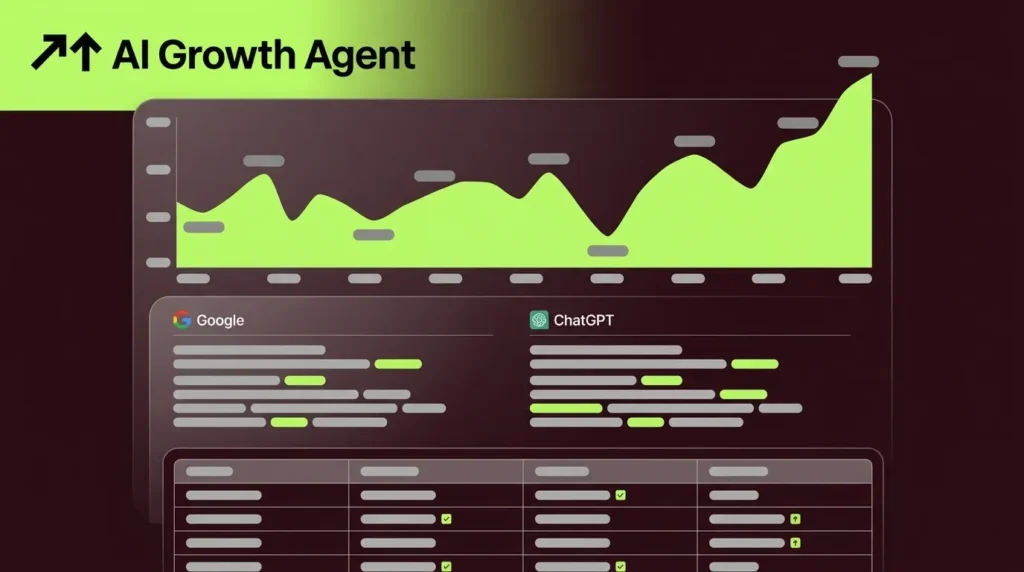
A brand can have high link authority in AI systems such as ChatGPT yet low brand recall, or the reverse, which shows that traditional backlink metrics do not fully describe AI discoverability or citation presence. The table below contrasts the two authority models across four clear dimensions: core metric, data source, visibility measurement, and content signal.
| Dimension | Traditional Brand Authority (Moz/Ahrefs) | MCP Brand Authority Signal | AI Growth Agent Pillar |
|---|---|---|---|
| Core authority metric | Domain Authority score (1-100 scale, Moz) or Domain Rating (1-100 scale, Ahrefs), with scores above 60 considered strong | Citation frequency and brand mention rate across ChatGPT, Gemini, Perplexity, AI Overviews, and AI Mode | AI Ranking: order of mention and citation context in AI-synthesized answers, tracked week over week |
| Authority data source | Backlink profile, including quantity and quality of referring domains, link quality from high-authority sites, and spam signals | Brand and entity co-occurrence across the wider web, with brand search volume as a proxy for authority growth and market demand | Search Intelligence: real-time Google and ChatGPT data across hundreds of seed terms and long-tail queries, refreshed weekly |
| Visibility measurement | Backlink count, where the #1 Google result typically has 3.8x more backlinks than positions #2-#10 (Backlinko study) | Presence as a source link in LLM responses compared with explicit brand mentions, which represent two distinct visibility measures | Bot Tracking: every crawl, citation, and training sweep by traditional crawlers and AI training agents, including per-article ChatGPT citation counts |
| Content quality signal | Schema markup and structured data, which Google structured data engineer Ryan Levering confirmed play a critical role in grounding Google’s generative AI systems because they are computationally cheaper than extraction | Catalog completeness score, defined as the percentage of content containing all structured attributes that AI agents evaluate, since incomplete data causes agents to skip content during discovery | AI Analytics: brand value and consumer behavior across the full journey, from external AI-tool queries through content consumption, demographics, and sentiment |
Five Layers That Build MCP Brand Authority
MCP brand authority grows from a concrete implementation stack, not from a monitoring dashboard. The implementation path runs through five layers that work together: Blog MCP servers, llms.txt and llms-full.txt files, Agent Cards at /.well-known/, structured schema, and self-healing content.
Blog MCP servers. A Blog MCP server exposes a brand’s content as a queryable, agent-callable resource, which makes that content discoverable to any compliant AI agent. This infrastructure must support both AI crawlers and human browsers, so production implementations need to handle multiple transport protocols. AI Growth Agent’s Blog MCP is compatible with Chrome 146+ and other WebMCP-enabled browsers and exposes schema, manifest, discovery, and capability guidance to agents regardless of how they connect. Mid-market brands can reach live MCP and multi-protocol agentic discoverability in 2-4 weeks by partnering with infrastructure platforms that translate existing content into protocol-compliant feeds with AI-optimized descriptions.
llms.txt and llms-full.txt. These files tell AI surfaces how to read a brand’s content, similar to robots.txt but designed for LLMs. Without them, AI crawlers must infer content structure from HTML, which produces lower-quality citations. With them, the brand declares its content architecture in a format AI surfaces can parse directly.
Agent Cards at /.well-known/. The A2A protocol introduces a structured Agent Card served at /.well-known/agent-card.json that declares in JSON what a site offers to agents, the endpoints they can call, and how to authenticate. A site that runs an MCP server without an Agent Card behaves like a service operating on an unpublished number. Both layers need to ship together.
Structured schema. Microsoft’s Bing principal program manager Fabrice Canel confirmed that Microsoft uses structured data to support LLM interpretation of web content. AI Growth Agent provisions a complete schema suite automatically, including Article, FAQ, LocalBusiness, Organization, Review, Product, Author, and Software Application schema on every published asset.
Self-healing content. Content that goes stale trains the next generation of models with an outdated narrative. Living content, refreshed automatically when the year turns or when Google Search Console signals decay, keeps the brand’s current narrative in every training sweep. Headless marketing provides the architecture that makes this sustainable. One engine replaces the SEO agency, the content tool, the web agency, the GEO monitor, the schema plugin, the analytics stack, and the PR firm.
Start a kickoff and get your full MCP brand authority stack live within the first week.
The Engine Behind Sustainable MCP Brand Authority
Standing up a Blog MCP server once does not create a durable strategy. MCP brand authority compounds when structured, agent-readable content is produced at scale, refreshed continuously, and reported on with precision. That outcome requires an engine, not a one-time implementation.
AI Growth Agent operates as an autonomous system that maps a brand’s full universe across online search and then wins that universe on autopilot. It ingests a brand manifesto built from a journalist-led interview, maps hundreds of seed terms and the long-tail queries beneath them using real-time Google and ChatGPT data, and produces authoritative content that validates every claim and source. The first article goes live within a week of kickoff, and content can begin indexing in as little as ten days.
The engine provisions the complete agentic technical SEO stack on every published asset. It starts with the discoverability layer, including Blog MCP, llms.txt and llms-full.txt, and Agent Cards at /.well-known/, which tell agents what exists and how to query it. It then adds the query interface, including natural language query parameters at /?s={query}, Markdown served to agent crawlers, and OpenAI discovery endpoints, which let agents retrieve structured answers in real time. Finally, it manages the operational layer, including automated web stories, instant indexing, autoredirects, and 404 tracking, which keep content fresh and accessible. None of this requires action from the client’s team because the system provisions the stack automatically as a single integrated workflow.
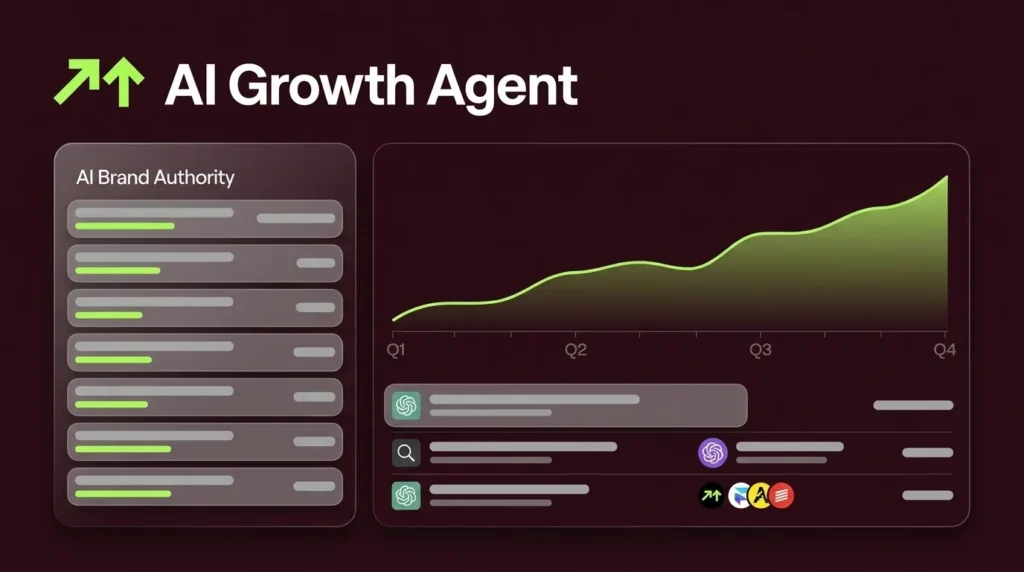
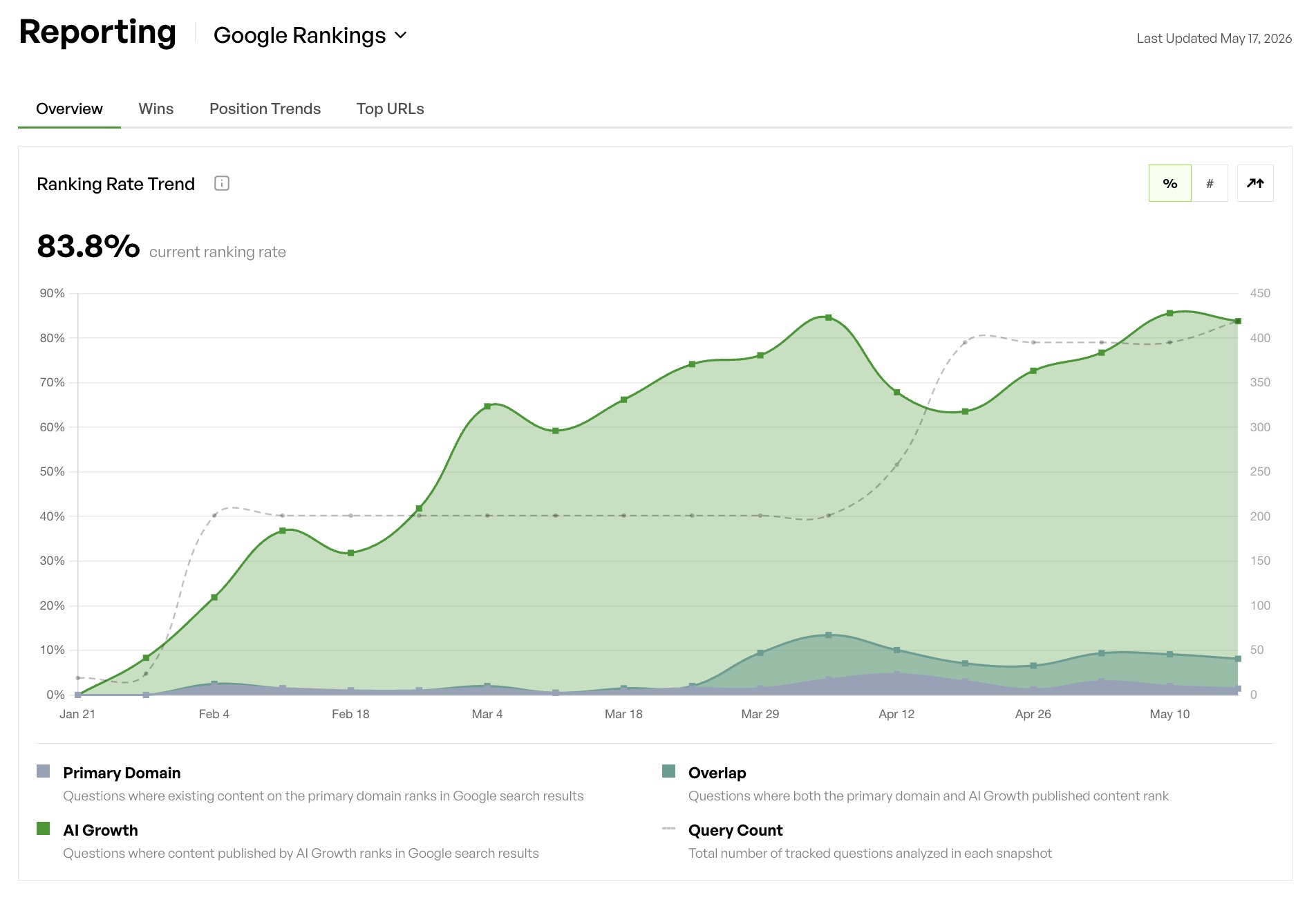
Reporting isolates exactly what AI Growth Agent generated, week over week, separate from visibility the brand already had. The four pillars, Search Intelligence, AI Analytics, Bot Tracking, and AI Ranking, feed a single data backbone that turns the market into a diagnosis and the diagnosis into content decisions.
Conclusion: Taking Narrative Control in the Agentic Internet
Traditional SEO supports discovery and being found, while brand authority drives being recommended in AI-synthesized answers. This shift moves focus from legacy visibility metrics to citation and recommendation behavior. Monitoring tools report on that shift. They do not change it.
The brands cited in AI search this year train the next generation of models with their own narrative. Brands that wait train the next generation with whatever content happens to sit on the open web. Digital PR professionals increasingly track AI citation mentions as a success metric, and the leaderboard is being written now, not next year.
MCP brand authority provides the measurable output that determines whether AI surfaces cite and recommend a brand. It grows through structured MCP implementations, agent-readable content at scale, and the four pillars of Search Intelligence, AI Analytics, Bot Tracking, and AI Ranking. Traditional search tools show where a brand stands. AI Growth Agent focuses on making that brand the answer.
Frequently Asked Questions
What is MCP brand authority and why does it matter more than domain authority in 2026?
MCP brand authority measures how discoverable, queryable, and citable a brand is to AI agents operating through Model Context Protocol servers. Domain authority measures the strength of a site’s backlink profile on a 1-100 scale and functions as a proxy for Google ranking potential. These metrics describe different realities. A brand can hold a domain authority score above 60 and still remain invisible to ChatGPT, Perplexity, and Google AI Mode if it has no MCP server, no llms.txt file, no Agent Card at /.well-known/, and no structured content that agents can parse and cite. In the 2026 agentic internet, where AI Mode has crossed 1 billion monthly users and agents complete discovery, research, and booking on behalf of users, the decisive question becomes whether an agent can find, query, and cite the brand in real time. MCP brand authority answers that question with measurable signals such as citation frequency, brand mention rate across AI surfaces, bot visit volume, and order of mention in AI-synthesized answers.
How does a Blog MCP server differ from a standard website or API, and what does it actually expose to AI agents?
A standard website is built for human readers and relies on navigation, hero images, and brand copy that a person scrolls through. A standard API exposes data programmatically but requires custom integration work for every system that wants to consume it. A Blog MCP server acts as the discoverability and invocation layer that sits on top of a brand’s content and makes it callable by any compliant AI agent without custom integration. It exposes three primitives: tools, which are executable functions an agent can invoke, such as retrieving a specific article or answering a natural language query; resources, which are read-only structured data like a content catalog; and prompts, which are parameterized templates. The server advertises these capabilities during an initialize handshake so any agent querying the site knows exactly what it can request and how to request it. AI Growth Agent brought Blog MCP to market early, with clients running it in the summer of 2025, and the Blog MCP is compatible with Chrome 146+ and other WebMCP-enabled browsers, so it serves both AI agent crawlers and human browsers through the same infrastructure.
What is the implementation stack required to build MCP brand authority, and how long does it take?
The full implementation stack for MCP brand authority includes five layers that must work together. First, a Blog MCP server exposes brand content as a queryable, agent-callable resource. Second, llms.txt and llms-full.txt files declare content architecture in a format AI surfaces can parse directly. Third, an Agent Card served at /.well-known/agent-card.json tells compliant agents what the site offers, which endpoints they can call, and how to authenticate. Fourth, a complete structured schema suite covers Article, FAQ, Organization, Product, Author, and related types, provisioned on every published asset. Fifth, living, self-healing content refreshes automatically so the brand’s current narrative is what agents find in every training sweep, not a stale version from six months ago. AI Growth Agent provisions this entire stack automatically on every client site, with no action required from the client’s team. The only integration step on the client’s side is a reverse proxy rewrite that connects the blog to a subdirectory under their domain. As mentioned earlier, this rapid timeline means the first article goes live within a week and begins indexing within about ten days.
How do the four pillars of Search Intelligence, AI Analytics, Bot Tracking, and AI Ranking replace traditional SEO reporting?
Traditional SEO reporting centers on three metrics: keyword rankings, organic traffic, and backlink counts. These metrics describe what happened in the past on a single channel. The four pillars describe what is happening now across the full agentic search environment. Search Intelligence maps the complete traditional search landscape, covering positioning, competition, and search volume across hundreds of seed terms and long-tail queries, refreshed every week with real-time Google and ChatGPT data. AI Analytics tracks brand value and consumer behavior across the full journey, from external AI-tool queries through content consumption, demographics, and sentiment. Bot Tracking records every bot interaction, including every crawl, citation, and training sweep by both traditional crawlers and AI training agents, down to the per-article level. AI Ranking tracks where a brand appears in AI-synthesized answers and how that position evolves week over week, because AI answers have no static ordered list and order of mention now functions as the ranking signal. Together, the four pillars turn the market into a diagnosis and the diagnosis into content decisions, instead of a set of disconnected dashboards that only report on the past.
Why do monitoring-only tools fail to build MCP brand authority, and what is the difference between monitoring and action?
Monitoring tools track whether a brand appears for a capped set of prompts across AI surfaces and then report the result. These tools do not produce content, stand up MCP servers, publish structured schema, or act on the data they surface. A brand that learns it is not appearing in ChatGPT responses for its core queries still has to solve that problem with a separate content team, a separate web agency, a separate schema tool, and a separate publishing workflow. Monitoring behaves like a rearview mirror and shows where the brand has been. MCP brand authority is built upstream by producing the agent-readable content that AI surfaces will cite before a user ever asks the question. AI Growth Agent does not operate as a monitoring company. It produces the content, owns the publishing, provisions the full agentic technical SEO stack, and reports the incremental visibility it actually generated, isolated from visibility the brand already had. This distinction matters because in a zero-click, agentic search environment, the brands that control the narrative are the ones that produced the content the models trained on, not the ones that watched the leaderboard after the fact.