Written by: Mariana Fonseca, Editorial Team, AI Growth Agent
Key Takeaways for Search and Citation Strategy
-
Perplexity AI accelerates a shift toward zero-click searches, with rates reaching 65–69% in 2026 and 93% of Google AI Mode queries ending without external clicks.
-
Perplexity selects sources using real-time RAG models and semantic relevance instead of traditional Google ranking signals such as backlinks or domain authority.
-
Ranking #1 on Google no longer guarantees traffic, while brands cited in AI Overviews earn significantly higher conversion rates and more organic clicks.
-
Content formats that win citations include structured comparisons, original data, FAQ schema, expert quotes, and self-contained answer passages of 150–300 words.
-
AI Growth Agent maps your brand’s complete search universe across Google, AI Overviews, and Perplexity to win citations on autopilot—see how the engine maps your competitive landscape.
Perplexity vs Google: How Each Engine Picks Winners
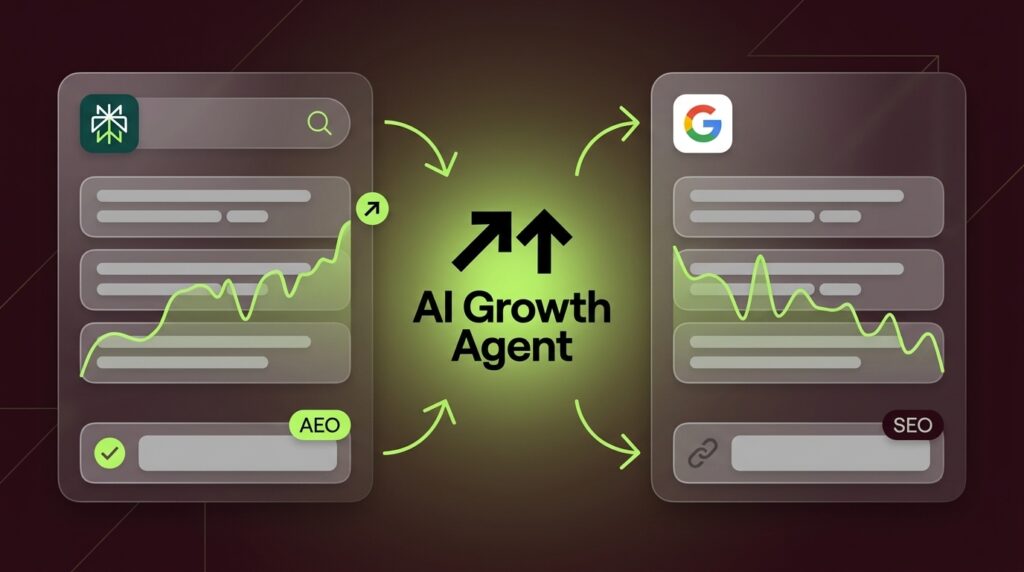
Google ranks pages, while Perplexity selects sources to synthesize answers. These processes rely on different signals and create different winners.
Google’s ranking system weights domain authority, backlink profile, Core Web Vitals, and long-form content depth. A page earns position through accumulated link equity and historical trust signals. The system looks backward at what has already proven trustworthy.
Perplexity runs a real-time Retrieval-Augmented Generation (RAG) model. It breaks each user query into 3 to 5 sub-queries, retrieves about 10 potentially relevant pages, and cites only 3 to 4 in the final response. Selection follows a clear order: semantic relevance first (conceptual completeness and entity relationship density), then direct reference in the answer, then freshness, then readability and structure.
Perplexity also applies a three-layer machine learning reranker that can discard entire result sets when too few sources meet its quality thresholds. Its L3 reranker activates specifically for entity searches about companies, people, topics, and concepts, and applies much stricter quality filters. A brand that ranks #1 on Google for its category term may fail Perplexity’s L3 filter and receive no citation at all.
Web mentions correlate at 0.664 with Google AI Overview brand visibility, while backlinks show only a 0.218 correlation. The implication is clear: the signals that built Google rankings provide weak prediction for Perplexity citations.
Does Ranking #1 Still Matter in 2026?
If traditional ranking signals no longer predict citation visibility, you need to reassess how much value the #1 Google position still delivers. The #1 organic position still carries value, but its economics have deteriorated sharply. Ahrefs data shows AI Overviews reduced click-through rates for the #1 organic position by 34.5% in April 2025, and by December 2025 the reduction had worsened to 58%.
The traffic that does arrive from AI-mediated search carries much higher intent. AI search visitors convert at 14.2% compared to Google’s 2.8%, with some data showing AI visitors converting up to 23 times better than traditional organic search visitors.
The strategic move is not abandoning Google rankings. You shift away from treating a single ranking position as the main visibility metric. Brands cited in AI Overviews earn 35% more organic clicks and 91% more paid clicks than brands that are not cited. Citation authority across both platforms now outweighs single-position dominance on either one.
Ready to map your brand’s full search universe? See how we track citation authority across both platforms.
How Perplexity Citations Diverge from Google Ranking Signals
The variance in citation overlap reveals a critical insight: Perplexity and Google AI Overviews align with each other far more than either aligns with traditional Google rankings. This shift changes where brands must focus their efforts to earn visibility. The table below quantifies this divergence across three major studies.
|
Study / Source |
Platforms Compared |
Overlap Finding |
Query Scope |
|---|---|---|---|
|
Perplexity citations vs. Google top-10 organic |
60% overlap; 40% from outside Google top results |
Citation pattern analysis |
|
|
Perplexity citations vs. Google AI Overview citations |
82% overlap between the two AI platforms |
Cross-platform citation analysis |
|
|
Google AI Overviews vs. Google top-20 organic |
54% overlap; 48% of AI Overview citations from outside top-100 organic |
16-month longitudinal analysis |
The variance across studies reflects differences in query type and methodology, but the directional finding stays consistent. AI platforms agree with each other far more than they agree with traditional organic rankings, and a substantial minority of citations come from sources Google does not surface in top positions at all.
The top signals Perplexity weights include semantic concept density, recency, structured formatting, and entity relationship density. These differ materially from Google’s traditional factors of domain authority, backlink volume, and page-level link equity. Cited content on Perplexity tends to contain more explicit concepts than uncited content, and Perplexity citations favor fresher content.
From Backlinks to Authoritative Mentions in AI Answers
The shift from link-building to citation authority represents a structural change in discovery, not a passing trend. Keywords rank pages, but authority gets cited, and the content formats that earn citations follow the mechanics described above.
Because Perplexity’s RAG model favors semantic concept density and extractable answer passages, certain content formats consistently outperform generic long-form articles. The formats below align with those selection criteria by increasing entity relationships, providing self-contained text blocks, or signaling freshness and authority.
-
Structured comparisons and data tables. Content with clear formatting such as headings, bullets, and tables receives more citations from LLMs.
-
Original statistics and proprietary data. Original research and first-party data drive a 30–40% visibility boost in AI citations across major platforms.
-
FAQ sections with schema markup. FAQ, HowTo, and Article schema increase selection odds for AI Overview inclusion.
-
Expert quotes with verified credentials. Content with named author bylines receives 1.9 times more citations from AI systems like ChatGPT and Perplexity compared to anonymous or corporate-only attribution.
-
Best-of lists and ranked recommendations. These match the query decomposition patterns Perplexity uses for entity and comparison searches.
-
Self-contained answer passages of 150–300 words. Bullet points and numbered lists are frequently extracted by AI systems.
-
Earned media placements and third-party mentions. Earned media drives approximately 84% of AI citations, with more than half coming from sources published in the last 12 months.
Why Traditional SEO and Monitoring Stacks Break in 2026
The old model of assembling an agency, briefing a team, and waiting months for content now creates a competitive drag. In 2026, that delay becomes a liability. Agencies still chase Google rankings using signals that show a 0.218 correlation with Perplexity visibility, while the signals that matter most today, such as semantic concept density, freshness, and entity relationships, demand a different production system.
Monitoring tools compound the problem by creating a false sense of coverage. Platforms that track AI search visibility cap clients at a small set of self-inputted prompts, which means they only show a rearview mirror of the queries a brand already thought to ask about. This limitation becomes critical because LLMs cite a limited number of domains per response, which creates winner-takes-most competition across hundreds of long-tail queries that capped monitoring tools never surface.
DIY chatbot workflows initially look like a workaround for this gap, yet they usually produce one decent article and then stall. These workflows lack embedded intelligence for keyword selection from real-time search data, lack anti-hallucination validation at scale, skip schema implementation, and provide no self-healing when content goes stale.
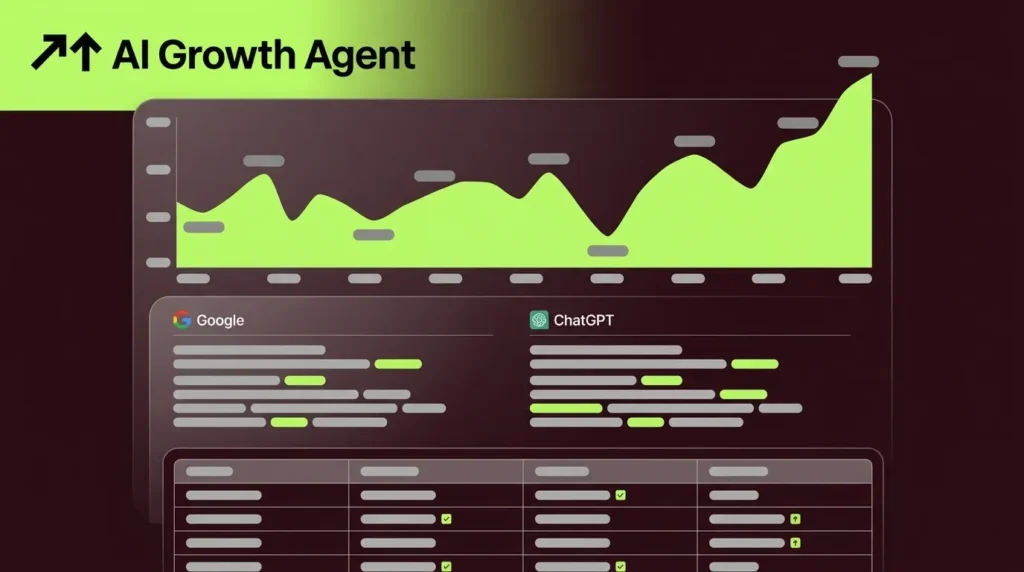
AI Growth Agent replaces this fragmented stack with a single autonomous engine. Its data infrastructure runs more than 3,000 searches per week to keep the universe snapshot current, tracks bot interactions from GPTBot and other AI crawlers through a proprietary WordPress plugin, and reports incremental visibility across Google Rankings, Google AI Overviews, and ChatGPT in one dashboard, isolating exactly what AI Growth Agent content contributed.
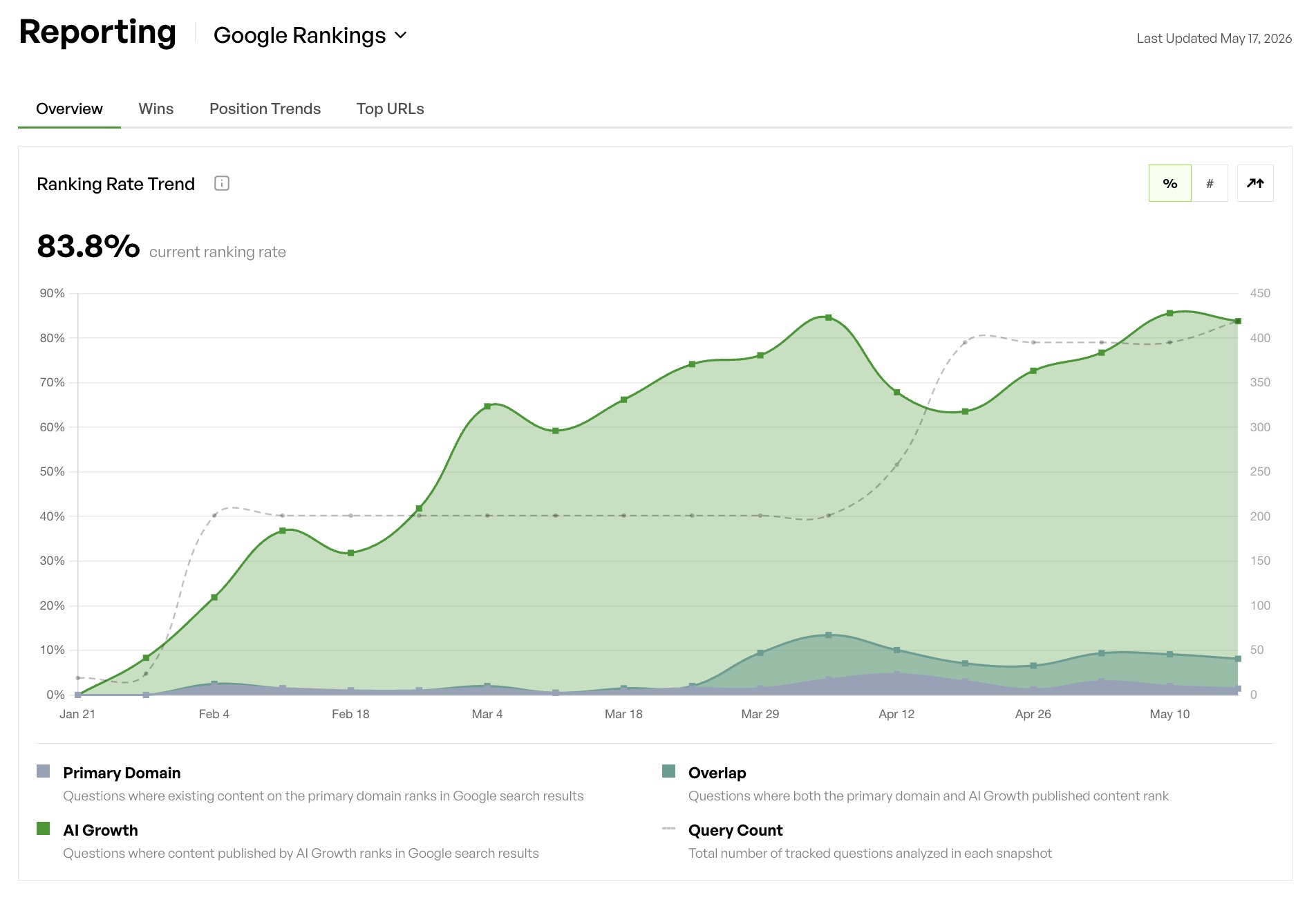
Explore how AI Growth Agent maps your search universe and replaces your monitoring stack.
How AI Growth Agent Maps and Wins Your Search Universe
AI Growth Agent begins with a Company Manifesto, a one-hour journalist-led interview that produces an extensive, AI-optimized document capturing the brand’s positioning, product features, legal requirements, and market context. This document becomes the anti-hallucination foundation for every article the engine produces.
The engine then builds a Content Topology, which maps the brand’s search universe from 9–15 seed terms and 300–400 derived prompts, and expands to 1,500+ queries for mature clients. Every seed term and prompt is tracked weekly from real-time Google and ChatGPT data, creating a living portrait of the competitive landscape instead of a static keyword list.
Content production runs at 2 to 50 articles per day per client. Each article is validated against live search results, competitor signals, People Also Ask data, and forum discussions before writing begins. Full schema coverage, including Article, FAQ, Organization, Author, and Product, ships automatically. The WordPress plugin manages bot tracking, MCP, robots.txt, and sitemaps out of the box.
Living content updates keep articles from going stale. When a rule, CTA, or data point changes, the engine syncs and updates affected live articles overnight. Across the first three months, clients average more than 12,000 additional AI citations and mentions, over 100,000 additional bot visits, and a 20%+ lift in impressions in Google Search Console.
Exceeds.ai went from invisible to consistently recommended by Perplexity and ChatGPT, with more than 55% of total traffic coming from AI Growth Agent content and a top-alternative placement on Perplexity within weeks of launch. Jelly became the #1 cited solution for “Restaurant Inventory Management in the UK” on ChatGPT within three weeks of going live.
Frequently Asked Questions
What criteria does Perplexity use to select sources in 2026?
Perplexity’s RAG model, detailed earlier, prioritizes semantic relevance through a three-layer ML reranker, with the L3 layer applying significantly higher quality filters for entity queries. Approximately 50% of Perplexity’s citations come from content published in the previous year, and content updated within two hours is cited 38% more often than content last updated a month ago. Schema markup, structured formatting, and self-contained answer passages of 150–300 words all increase citation probability.
How much do Perplexity citations overlap with Google top results?
The overlap varies by study methodology and query type. A 2024 Search Engine Land citation pattern analysis found 60% overlap with Google’s top-10 organic results, with 40% of Perplexity citations coming from sources outside Google’s top results entirely. BrightEdge data shows an 82% overlap between Perplexity citations and Google AI Overview citations, which means the two AI platforms agree on sources far more than either agrees with traditional Google rankings. The practical takeaway is that brands must pursue citation signals independently of their Google ranking position.
Is Perplexity an NLP metric or a separate AI search engine?
Perplexity functions as a separate AI answer engine, not a metric, not an algorithm update, and not a signal within Google’s ranking systems. It runs its own real-time RAG infrastructure using Sonar models to search the live web and synthesize responses with mandatory citations. It has no direct influence on Google’s PageRank or Core Web Vitals assessments. Its indirect effect on Google rankings comes from behavioral shifts, because more users now resolve queries on Perplexity without clicking through to websites, which can affect branded search volume, click-through rates, and engagement signals that Google does observe. The strategic response is to earn citations on Perplexity directly, not to treat it as a Google ranking factor.
How can brands shift from backlink strategies to citation authority?
Brands shift by producing content that AI systems can easily extract and cite instead of content designed mainly for link acquisition. This approach includes building topical clusters with pillar pages and interlinked sub-pages that show comprehensive subject coverage, using FAQ and HowTo schema consistently, writing self-contained answer passages of 150–300 words, including original data and proprietary statistics, adding verified author metadata and credentials, earning placements in third-party listicles and reputable publications, and updating content frequently enough to avoid Perplexity’s recency decay penalties.
Web mentions and brand authority signals correlate far more strongly with AI search visibility than backlink quality. An autonomous system that continuously produces, publishes, and refreshes citation-worthy content across a brand’s full search universe becomes the operational requirement, not a one-time content audit or a link-building campaign.
Conclusion: Win the Citation Game Across the Full Search Universe
Perplexity does not rewrite Google’s algorithm. It accelerates the move to a citation-based visibility model where the brand that earns the authoritative mention wins the discovery moment, regardless of its traditional ranking position. With the zero-click rates detailed earlier reshaping search economics, the click no longer serves as the primary unit of value. The citation does.
Brands that keep relying on backlink accumulation, capped monitoring tools, and slow agency workflows hand narrative control to competitors who already run systems built for this environment. The search universe has become too large, too dynamic, and too distributed across platforms to manage with fragmented point solutions or manual effort.
AI Growth Agent operates as the autonomous engine that maps the full search universe, including seed terms, long-tail queries, competitor movements, and citation gaps, and then wins that universe on autopilot through living, self-optimizing content with full schema, technical SEO, and incremental visibility reporting that proves exactly what the engine contributed.
AI Growth Agent makes your brand the answer. See the autonomous engine in action.