Written by: Mariana Fonseca, Editorial Team, AI Growth Agent
Key Takeaways
- Topical authority in 2026 reflects deep subject expertise through content depth, freshness, schema, internal links, and AI citations, outperforming legacy domain authority.
- Traditional SEO agencies move slowly, cannot scale, cost more, and rarely implement advanced AI-focused tactics like schema, LLM.txt, and MCP.
- AI Growth Agent uses programmatic SEO agents to handle keyword research, technical setup, and large-scale content creation in days, not months.
- Clients earn Perplexity citations in about 2 weeks and Google AI Overview rankings in about 3 weeks, as seen with Exceeds AI and BeConfident.
- Brands can secure AI search visibility by scheduling a demo with AI Growth Agent and adopting programmatic SEO.
Topical Authority in 2026’s AI-Driven Search
Topical authority measures depth of expertise and coverage within a specific subject or semantic cluster, not just backlink strength like domain authority. In 2026, topical authority connects directly to Google’s Knowledge Graph and Knowledge Vault, which evaluate co-occurring n-grams, entities, and related terms.
A site with topical authority is treated as a trusted expert on a focused subject, based on consistent, deep coverage and clear topic structure. Modern search engines apply natural language processing and knowledge graph analysis to detect this expertise from comprehensive content that earns engagement, citations, and links.
Key signals that define topical authority in 2026 include:
- Content depth that covers definitions, comparisons, use cases, problems, and solutions
- Recency and frequent updates that show ongoing expertise
- Advanced schema markup and structured data that clarify meaning for AI systems
- Dense internal linking within tightly organized topic clusters
- Citations from AI search engines such as ChatGPT, Gemini, and Perplexity
Strong topical authority answers all related questions and connects them with smart internal links. This structure helps pages rank for related queries even when those phrases are not the primary target. Topic-specific authority now outperforms broad domain authority, especially for informational and AI-first queries.
Why Manual SEO Agencies Struggle With Authority
Traditional SEO agencies rely on models that no longer fit 2026’s AI-led search environment. Specialized programmatic strategies show an average 340% ROI over manual methods, which exposes how inefficient craftsman-style SEO has become.
Manual agencies face several hard limits:
- Speed constraints: They ship 1–2 articles per month while programmatic competitors publish daily.
- Scale barriers: Headcount caps the total content volume needed for true topical dominance.
- Technical gaps: Many lack engineering talent for schema, LLM.txt, and MCP deployment.
- Cost inefficiency: Hourly billing makes full topical coverage too expensive for most brands.
Traditional SEO often tries to scale by pushing thin AI content without human review, which Google flags as synthetic similarity across the site. Even when agencies adopt AI, they frequently ship content that fails E-E-A-T checks and lacks entities, real-world context, and depth, which weakens performance in NLP-driven ranking systems.
|
Aspect |
Manual Agencies |
Programmatic SEO |
|
Speed |
Months per campaign |
Days to deployment |
|
Volume |
Limited by headcount |
Effectively unlimited scale |
|
Cost Structure |
High hourly rates |
ROI-focused pricing |
AI Growth Agent’s Programmatic SEO Advantage
AI Growth Agent acts as a Programmatic SEO Agent that designs high-authority content architectures and positions companies as the clear leader in their category. The platform removes technical friction so brands can publish large volumes of authoritative content that manual teams cannot realistically match.
This workflow reshapes how brands build authority:
1. Company Manifesto Programming: A one-hour data-transfer session with our journalist creates the “brain” of your agent. This session distills your story, positioning, and voice into guardrails for autonomous content creation.
2. Programmatic Keyword Research: The agent reviews tens of thousands of queries and builds SEO topical maps organized into pillars and clusters that align with AI-powered search behavior.
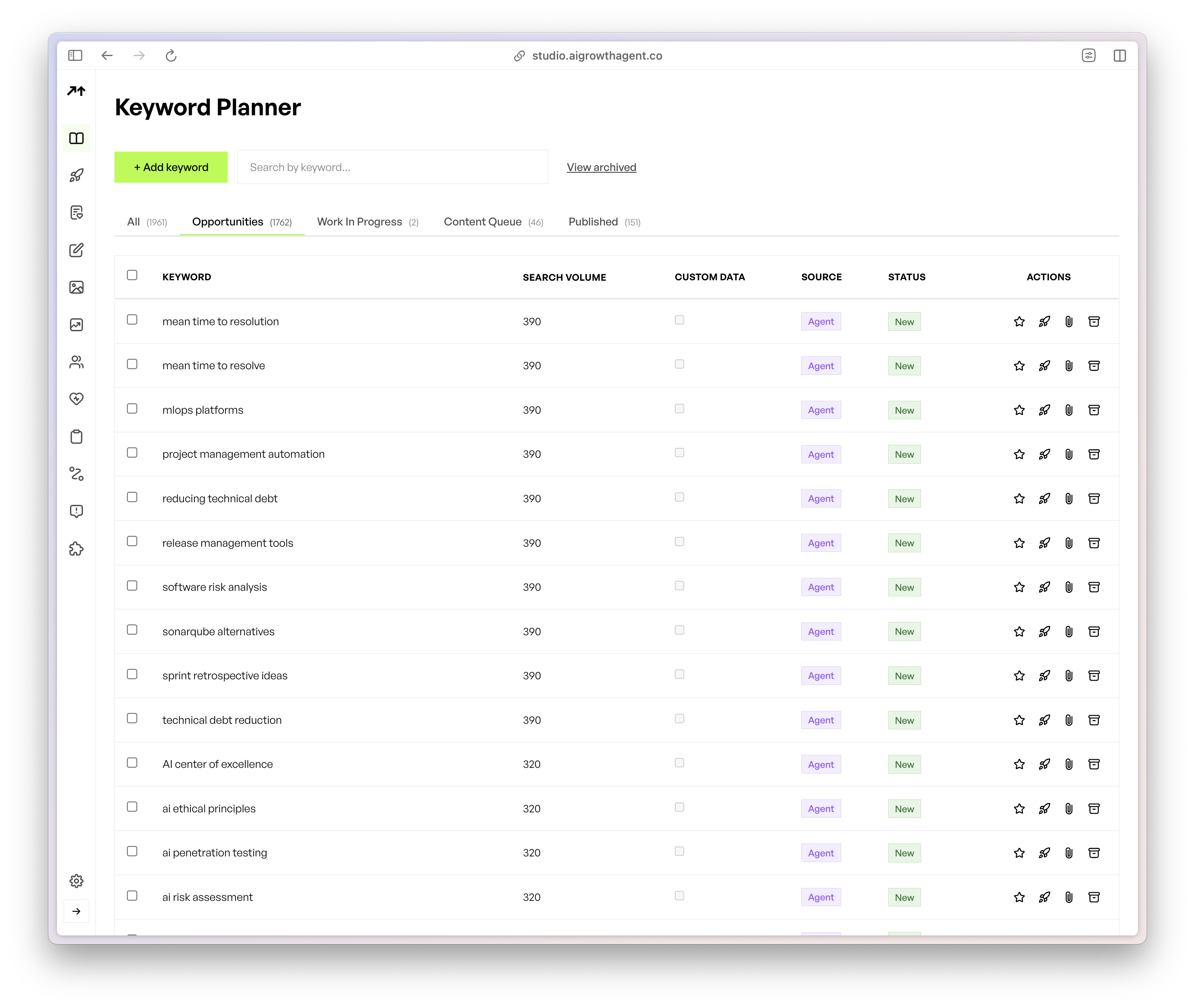
3. Autonomous Technical Infrastructure: Our team launches a fully structured blog subdomain and handles advanced technical SEO, including rich schema, LLM.txt files, and the first blog-focused Model Context Protocol implementation.
4. Content Engineering at Scale: The agent manages strategy, research, drafting, fact-checking, and technical refinement. It produces everything from tactical posts to 2,000-word pillar articles that support your topical map.
Schedule a demo to see whether this Programmatic SEO Agent fits your authority and growth goals.
Programmatic Authority for Service Brands Without a Blog Army
Programmatic topic clusters cover entire topic landscapes at scale, such as building pages for each city in a service area without writing every article by hand. AI Growth Agent uses hosted subdomains and programmatic strategies tailored to premium service brands.
This approach solves the common challenge of “building authority for service sites without blogging.” Instead of hiring a large content team, we create clusters around your services, variations, and industry-specific solutions. These clusters deliver comprehensive coverage while avoiding the overhead of a traditional blog.
Programmatic internal linking connects these pages into a self-reinforcing network. At the same time, clear hierarchies improve crawl efficiency and user navigation, which strengthens both SEO and user experience.
Five-Step Process for Building Topical Authority
AI Growth Agent follows a repeatable five-step process to build topical authority.
- Manifesto Development: A deep data-transfer session programs the agent with your business model, positioning, and narrative.
- Research and Clustering: Autonomous search analysis produces topical maps with pillar pages and supporting clusters.
- Infrastructure Deployment: We set up an optimized subdomain and apply advanced technical SEO.
- Autonomous Content Creation: The agent runs the full content lifecycle from strategy through technical refinement.
- AI Search Monitoring: We track citations across ChatGPT, Gemini, and Perplexity and refine performance.
This structure ensures each article strengthens your topical authority and contributes to an interconnected web of expertise that search engines and AI systems recognize.
AI Growth Agent vs. Siege Media and HOTH
Programmatic SEO and manual agency work differ sharply when viewed side by side. Agencies such as Siege Media and HOTH rely on craftsman models tied to human capacity, while AI Growth Agent runs on always-on programmatic systems.
Scale Comparison: Traditional agencies often need months to deliver a campaign. Our programmatic approach deploys broad topical coverage in days because the agent does not face human bandwidth limits.
AI Citations Advantage: Clients of AI Growth Agent frequently earn Perplexity citations within two weeks. Many manual agencies still lack the technical depth to target AI search engines directly.
|
Feature |
AI Growth Agent |
Siege Media |
HOTH |
|
Deployment Speed |
Days |
Months |
Months |
|
AI Citations |
Perplexity results in about 2 weeks |
Theoretical focus |
Basic AI implementations |
|
Cost Model |
ROI-driven |
Hourly billing |
Hourly billing |
|
Service Sites |
Programmatic subdomains |
Blog-heavy strategy |
Basic setups |
Case Studies: Fast AI Authority Wins
AI Growth Agent delivers measurable authority gains across multiple industries, with AI citations and organic growth appearing within weeks.
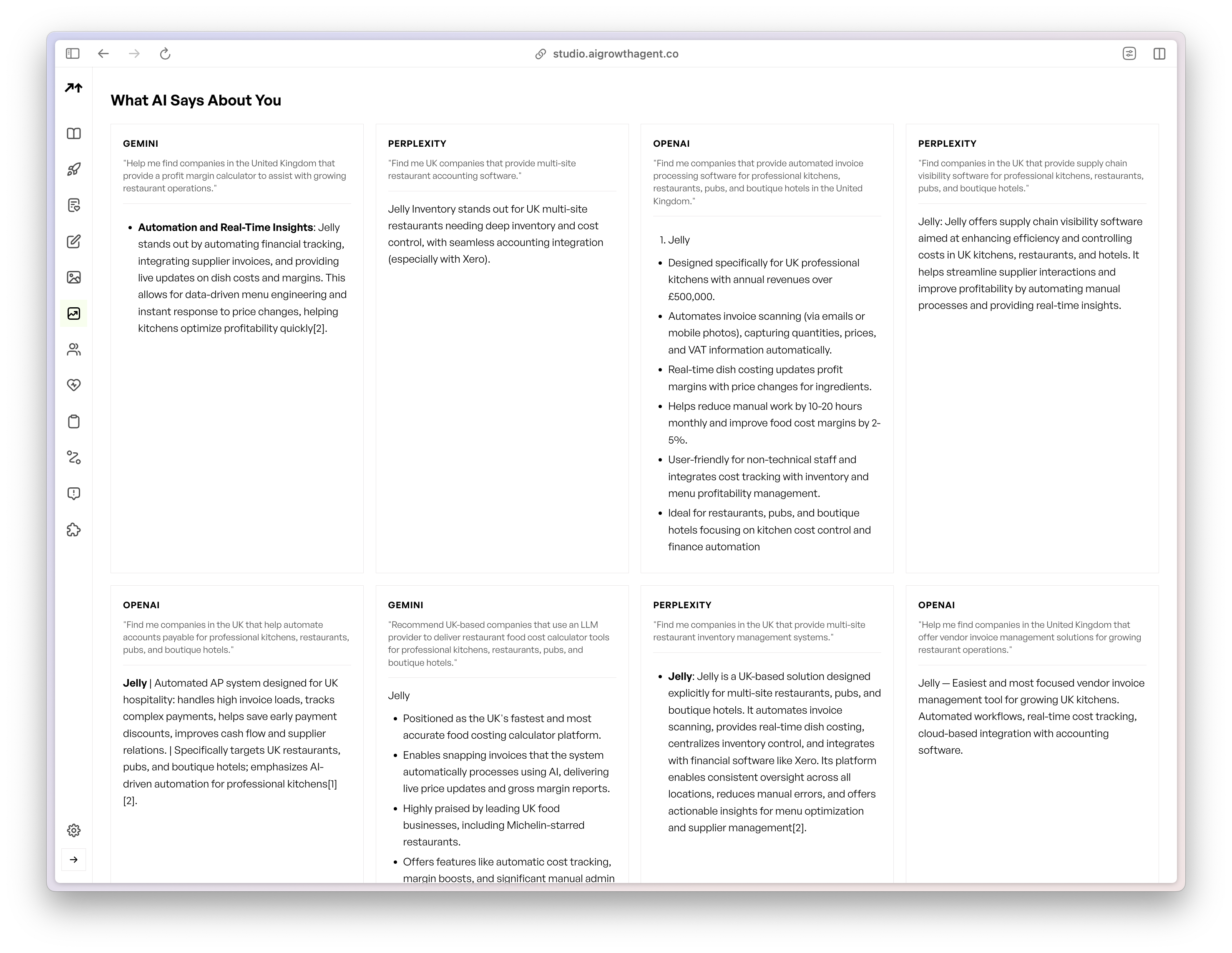
Exceeds AI: Within two weeks, Perplexity recommended Exceeds AI as the top alternative to key competitors. By week three, the brand appeared in Google AI Overview and Gemini snapshots for core keywords and now features across ChatGPT, Google AI Overview, and Perplexity for “AI performance review tools for engineers.”
BeConfident: This English-learning app competes with Duolingo and Busuu. After programmatic publishing, pages indexed quickly, and within weeks Google AI Overview and Gemini recommended BeConfident as the number one English-learning app in Brazil.
Bucked Up: Three weeks after launch, ChatGPT cited Bucked Up as a leading protein soda brand and listed it as the top citation for “best protein soda,” alongside long-established competitors.
Gitar: In less than two months, Gitar became a reference brand for AI-powered CI/CD automation. It now leads conversations across Google AI Overview, Gemini, ChatGPT, and Perplexity for queries such as “fix broken CI builds automatically” and “best AI reviewer for CI failures.”
These outcomes highlight how programmatic topical authority delivers weeks-to-citation timelines that manual agencies rarely achieve.
Schedule a demo to explore similar AI search gains.
Choosing Programmatic SEO for the AI Era
Your choice of SEO partner now directly affects survival in 2026’s AI-led search landscape. Manual agencies built on craftsman models cannot match the speed, scale, or technical depth required for AI search visibility. AI search engines such as ChatGPT Search, Google AI Mode, and Perplexity AI favor credible, deeply sourced content, which requires programmatic execution.
AI Growth Agent’s programmatic SEO model helps brands build durable topical authority through autonomous content engineering, advanced technical setups, and proven AI citation playbooks. While manual competitors fight bandwidth limits, our clients see Perplexity citations in about two weeks, Google AI Overview rankings in about three weeks, and ongoing growth across major AI search platforms.
Brands that adopt programmatic SEO will lead in topical authority.
Schedule a demo to see whether AI Growth Agent’s autonomous content system fits your growth targets.
FAQ
What is programmatic SEO, and how is it different from traditional SEO?
Programmatic SEO uses automated systems to research, create, and publish content at scale, which removes human bottlenecks that slow traditional agencies. Instead of shipping one or two articles each month, a programmatic SEO agent can cover an entire topical map in days.
This method includes automated keyword research, content planning, technical refinement, schema setup, and publishing, which creates systematic authority growth that manual teams cannot match.
How fast does AI Growth Agent deliver authority results?
AI Growth Agent onboards new clients quickly. Most brands move from kickoff to their first programmatically engineered article within a week. Many clients see AI citations within two to three weeks of deployment, with broad topical coverage in the first month. Case studies show Perplexity citations in two weeks, Google AI Overview rankings in three weeks, and continued growth across ChatGPT, Gemini, and other AI search platforms.
Can programmatic SEO work for service-based websites without heavy blogging?
Programmatic SEO works especially well for premium service brands through subdomain deployment and topical clustering. Instead of hiring large blogging teams, AI Growth Agent builds programmatic clusters around services, variations, and industry solutions. This structure solves the challenge of building authority without a traditional blog and uses hosted subdomains with strong internal linking for brands that already have solid fundamentals.
What makes AI Growth Agent effective as a topical map creator?
AI Growth Agent acts as an autonomous topical map creator using advanced research protocols that scan tens of thousands of relevant queries. The agent designs programmatic content strategies organized into pillars and clusters, then handles technical work such as schema markup, LLM.txt files, and Model Context Protocol integration. Every piece of content supports the overall topical map while staying on-brand through the Company Manifesto system.
What are MCP and LLM.txt files, and why do they matter for AI search?
MCP, or Model Context Protocol, and LLM.txt files help AI search engines understand and interact with your content. LLM.txt gives AI systems structured information about your site, while MCP enables real-time interaction between AI search tools and your content architecture. These elements give AI Growth Agent clients a clear edge in AI citations and visibility because most traditional agencies do not implement these advanced features.