Written by: Mariana Fonseca, Editorial Team, AI Growth Agent
Key Takeaways for llms.txt in 2026
- llms.txt acts as a Markdown routing layer that helps AI agents quickly find your most important pages when paired with a full agentic technical SEO stack.
- Robots.txt must explicitly permit target AI crawlers before llms.txt can matter. The two files work together but serve different purposes.
- Deployment is simple through WordPress plugins, documentation platforms, or static-site generators, yet the file still needs ongoing maintenance so it never points agents to stale or deleted content.
- llms.txt does not replace traditional SEO or improve Google Search rankings. Schema markup, authoritative content, and internal linking remain the foundation.
- AI Growth Agent provisions llms.txt and the complete agentic stack automatically, with no manual work for your team. See how the automated stack runs in a live walkthrough.
When llms.txt Makes Sense for AI Citations
llms.txt delivers measurable value only when your site meets specific conditions. Outside those conditions, the implementation and maintenance cost outweigh the return. The file works as a routing and prioritization layer for AI agents, pointing them to clean Markdown summaries of key content instead of forcing them to parse JavaScript-heavy HTML.
Sites implementing llms.txt have seen increases in referral traffic from answer engines in early experiments, and in late 2025, a portion of new signups for some leading tech platforms came directly from AI referrals after documentation was optimized for machine readability. Those results came from sites that matched the right profile and ran a complete stack.
- Your site delivers structured, server-side-rendered HTML that agents can fetch directly without JavaScript rendering.
- Your robots.txt already permits the AI crawlers you want to reach: GPTBot, ClaudeBot, PerplexityBot, OAI-SearchBot, and Google-Extended.
- You have 20 or more high-signal canonical pages worth surfacing, such as product pages, pillar guides, case studies, documentation, and pricing.
- Your goals include agent-consumption workflows such as Perplexity research passes or IDE agents pulling documentation, not only Google Search ranking.
- You maintain a process to keep the file current after major site restructures or content retirement, because a stale llms.txt pointing to deleted pages harms narrative control.
- You are ready to pair llms.txt with the rest of the agentic technical SEO stack, including schema, Blog MCP, and living content, because the file alone does not earn citations at scale.
Narrative control in AI search starts with the content models use to describe your brand. You create that control by publishing material in formats and structures models can read, backed by validation that earns citations. llms.txt contributes one signal inside that broader system and works best when coordinated with the rest of your stack. Book a working session to map your full agentic stack.
How llms.txt Interacts With robots.txt
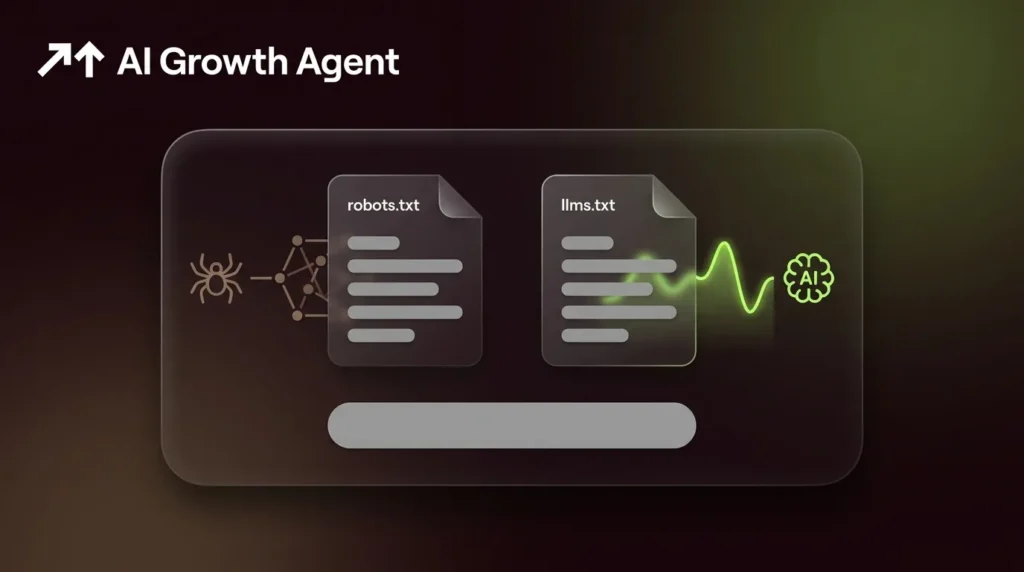
llms.txt and robots.txt serve different roles and need to be aligned. robots.txt directs or restricts bot access to website sections, while llms.txt provides AI crawlers with a Markdown summary of key site content to improve understanding rather than control access. In 2026, with zero-click AI search now the default across ChatGPT, Perplexity, and Google AI Mode, this distinction matters. A brand can ship a perfectly structured llms.txt and still remain invisible to AI surfaces if robots.txt blocks the crawlers that would read it.
- robots.txt is exclusion-oriented and tells bots where they cannot go. robots.txt directives always override llms.txt, so any path disallowed in robots.txt will not be fetched even if listed in llms.txt.
- llms.txt is context-oriented and tells AI agents which pages contain the most valuable information once access is granted.
- sitemap.xml handles discovery by listing every page that exists, while llms.txt handles prioritization by highlighting which pages matter most to AI agents.
- Start with a robots.txt audit. Confirm that GPTBot, ClaudeBot, PerplexityBot, OAI-SearchBot, and Google-Extended are explicitly permitted on the paths you plan to list in llms.txt.
- Add the llms.txt path as a supplemental Sitemap reference in robots.txt alongside your XML sitemap so AI crawlers can discover the file.
- Neither llms.txt nor llms-full.txt enforces access rules. Both aim to supply structured context rather than enforce access, with neither standard actively sought by major AI crawlers as of May 2026.
Steps to Generate and Deploy llms.txt
Most modern site architectures can ship llms.txt with little friction. The build process usually takes a short amount of time for a hand-authored file, and implementation through a WordPress plugin toggle takes only a brief period. The file must resolve at https://yourdomain.com/llms.txt, served as text/plain or text/markdown with an HTTP 200 status and no authentication wall.
- WordPress: Yoast SEO and Rank Math added native llms.txt generation in 2025. Enable the toggle in the plugin dashboard and the file generates automatically with smart content selection and noindex URL filtering.
- Documentation platforms: Mintlify, Fern, GitBook, Vercel Docs, and Supabase Docs generate llms.txt and llms-full.txt automatically for all hosted documentation sites.
- Static-site generators: Place the file in /public for Next.js or Astro, or in /static for Hugo. VitePress sites can use the vitepress-plugin-llms to auto-generate both files.
- Custom or enterprise backends: Hand-authoring remains the recommended approach for custom-built or enterprise marketing sites because auto-generators tend to over-include pages. Structure the file with one H1 for the brand name, a blockquote summary of one to three sentences, and H2 sections that group 20 to 50 canonical pages with one-sentence descriptions per link.
- llms-full.txt: llms-full.txt is a single bundled file containing the full text of core content for agents that need complete documentation or source material at once. Deploy it when your primary use case is documentation consumption by IDE agents. Keep llms.txt under 5,000 tokens as a discovery file.
- Multilingual sites: Use one file per language root, such as /en/llms.txt or /he/llms.txt.
- Maintenance: Automate generation through a CI/CD pipeline and schedule quarterly reviews, with immediate updates after major restructures or content retirement.
AI Growth Agent provisions llms.txt and llms-full.txt automatically as part of every package, alongside the full agentic technical SEO stack, with no manual steps required from your team. See how automated provisioning works in a live walkthrough.
Why llms.txt Does Not Replace Traditional SEO
llms.txt supports your SEO efforts but never replaces them. llms.txt is complementary to SEO and belongs inside a broader technical SEO stack. Google’s John Mueller has stated publicly that no AI systems or mainstream search engines currently use llms.txt, and the file has no effect on Google Search positions. Traditional technical SEO remains mandatory for brands that want visibility across both legacy search and AI surfaces.
- Highly structured HTML, full metadata, and rich schema markup act as prerequisites, not optional extras. Schema helps bots understand content and powers rich results.
- Internal linking that compounds authority across a content universe cannot be replaced by any single file.
- Fresh, living content that self-heals over time earns citations across training sweeps. A static llms.txt pointing to stale pages has the opposite effect.
- llms.txt forms one layer of a six-layer agentic technical SEO stack that also includes robots.txt access control, AGENTS.md or CLAUDE.md project context, skill.md capability files, semantic Markdown twins, and per-page token metadata.
- Bot tracking, Blog MCP, and agent discovery via /.well-known/ are the components that make a brand machine-readable at the level AI surfaces require in 2026.
- llms.txt without authoritative content behind it functions like a table of contents for a book that has not been written.
Scenarios Where You Should Skip llms.txt
Certain site types and goals do not justify the effort of llms.txt. In these cases, deployment creates maintenance overhead without meaningful movement in citations, bot traffic, or narrative control.
- Brochure sites with fewer than 20 high-signal pages: The content set is too small to curate. Invest in schema and authoritative content first.
- Sites whose primary goal is Google Search ranking: Major search engines do not use llms.txt for ranking, and the file contributes nothing to traditional SERP positions.
- Sites with no process to maintain the file: llms.txt is not an indexing protocol like robots.txt or XML sitemaps, and there is no official promise of improved AI search visibility from the standard. A stale file pointing to deleted pages introduces inaccuracy into the brand’s AI-readable surface.
- Sites where robots.txt blocks all major AI crawlers: llms.txt cannot override those directives, so you need to fix robots.txt first.
- High-compliance regulated sites without a legal review process for the file’s contents: The file surfaces your most important pages to AI agents, and any inaccuracy in descriptions or links becomes a compliance risk.
- Sites relying on llms.txt as a standalone citation strategy: llms.txt is not a GEO ranking factor, and brands should not expect citation boosts in ChatGPT, Perplexity, or similar surfaces from implementing it alone.
How llms.txt Fits Inside a Headless Marketing Stack
Brands earning AI citations and bot traffic at scale in 2026 rely on a complete agentic technical SEO stack, not a single file. Every component reinforces the others and feeds one coherent system. AI Growth Agent clients have seen additional AI citations and mentions, additional bot visits, and a lift in impressions across the first twelve weeks, because the engine ships the full stack, not just llms.txt.
- Schema markup: Article, FAQ, organization, product, author, and software application schema tell bots what the content means, not only what it says. Schema forms the foundation that makes every other signal trustworthy.
- Blog MCP: Model Context Protocol endpoints expose the brand’s content directly to AI agents with schema, manifest, discovery, and capability guidance. AI Growth Agent brought Blog MCP to market first, with clients running it in the summer of 2025.
- llms.txt: The routing layer that points AI agents to the brand’s highest-signal pages in clean Markdown, which reduces token cost and latency for agents consuming the content.
- llms-full.txt: The complete content bundle for agents that need full documentation or source material at once, which reduces hallucination risk on complex or technical queries.
- Living content: Self-healing articles that update automatically when the world changes, so the next training sweep finds the brand’s current narrative instead of a stale one.
- Agent discovery via /.well-known/: OpenAI discovery and Agent Card guidance served at /.well-known/ so agents can find and understand the brand’s capabilities without a manual integration step.
- Bot tracking: Per-article visibility into every AI crawler interaction, including when ChatGPT cites the content and where, so the system can double down on what indexes well and lift what does not.
Headless marketing keeps this stack running without extra headcount. The brand keeps its curated main site, while the engine handles schema, MCP, llms.txt, llms-full.txt, publishing, self-healing, and reporting. Join a strategy session to see the full stack in action.
Objections and Evidence Around llms.txt Traffic Impact
Traffic impact from llms.txt depends heavily on use case and stack maturity. The current evidence shows mixed direct effects, with clearer value in agentic workflows than in broad AI search.
“AI crawlers do not even fetch the file.” This statement is largely accurate for major AI search crawlers today. An analysis of LLM bot traffic events found that major AI search crawlers including GPTBot, ClaudeBot, PerplexityBot, OAI-SearchBot, and Google-Extended almost never fetch /llms.txt, with a small number of direct requests observed in a 90-day window. The file’s primary value today sits in agentic workflows rather than AI search crawlers.
“It is just for developers.” This view is partially true and still undersells the strategic value for brands with developer audiences or documentation-heavy sites. IDE agents such as Cursor, Windsurf, Claude Code, GitHub Copilot, Cline, and Aider routinely fetch the file from documentation sites. For SaaS and developer platforms, this behavior creates a direct path to agent-driven product discovery.
“Google ignores it.” This statement is correct. In July 2025, Google’s Gary Illyes stated that Google does not support llms.txt and has no plans to do so. This fact does not remove the value of the file. It simply clarifies that llms.txt belongs inside an agentic stack rather than acting as a Google ranking lever.
“Early experiments show traffic gains.” Some experiments do show gains. Sites implementing llms.txt have seen increases in referral traffic from answer engines in early experiments. Those gains came from sites that paired the file with authoritative, well-structured content and a complete agentic stack, not from llms.txt alone.
“Adoption is still low.” A SE Ranking study of domains found adoption for llms.txt in 2025. Low adoption gives early movers in the right categories a structural advantage. It also means the file has not yet become a universal standard, which makes deployment as part of a complete stack more valuable than deployment in isolation.
Frequently Asked Questions About llms.txt
What is the difference between llms.txt and llms-full.txt?
llms.txt is a concise, categorized index of a site’s most important pages, written in Markdown with one-sentence descriptions per link. It works as a routing layer that points AI agents to the right content quickly and should stay under 5,000 tokens so agents can read it in full.
llms-full.txt is a single bundled file containing the complete text of core content, intended for agents that need full documentation or source material at once rather than a curated index. The two-file approach is the standard recommendation, with llms.txt handling discovery and prioritization and llms-full.txt supplying complete context.
llms-full.txt delivers the most value for documentation-heavy sites, SaaS platforms, and brands where AI agents need to ingest full product or policy content without following multiple links. For most mid-market brand blogs, llms.txt alone is sufficient and llms-full.txt remains optional.
Will adding llms.txt improve my Google Search rankings?
llms.txt does not improve Google Search rankings. Major search engines have stated that they do not use llms.txt for ranking and have no plans to adopt it. The file has no effect on traditional SERP positions.
Its value appears in agent-consumption workflows, inference-time retrieval by AI surfaces like Perplexity, and IDE agents like Cursor and Claude Code that pull documentation directly. If your primary goal is Google Search ranking, your investment belongs in schema markup, structured HTML, authoritative content, and internal linking. llms.txt enters the stack after those foundations are in place, not instead of them.
How often should I update my llms.txt file?
A quarterly review cadence works as a baseline, with immediate updates after major site restructures, new service pages, or content retirement. A stale llms.txt that points to deleted or outdated pages harms narrative control by directing AI agents to broken or inaccurate content.
For e-commerce sites with frequently changing inventory, automate generation during site deployment so the file stays synchronized with live content. For enterprise marketing sites with a stable content architecture, a quarterly audit combined with a CI/CD pipeline that flags manual changes is sufficient. The maintenance burden stays low when generation is automated, which is why documentation platforms like Mintlify and Fern generate the file automatically for all hosted sites.
Is llms.txt enough to earn AI citations and bot traffic at scale?
llms.txt alone is not enough to earn AI citations and bot traffic at scale. It forms one component of a complete agentic technical SEO stack, not a standalone citation strategy.
Brands earning AI citations and bot traffic at scale run schema markup across every article, Blog MCP endpoints for direct agent interoperability, living content that self-heals over time, bot tracking that shows exactly when and where AI crawlers cite the content, and agent discovery via /.well-known/. llms.txt without authoritative content behind it acts like a table of contents for a book that has not been written.
The file tells AI agents where to look, while the content, structure, and validation determine whether what they find earns a citation. The full headless marketing stack is the only architecture that delivers all of these components without requiring a content team, an SEO agency, and an engineering hand to coordinate them.
What site types benefit most from llms.txt in 2026?
SaaS and developer platforms with public documentation gain the most benefit, because IDE agents like Cursor, Windsurf, and Claude Code routinely fetch llms.txt from documentation sites to route agent queries. E-commerce sites with large catalogs benefit from hierarchical llms.txt files that list category indexes rather than individual SKUs, which reduces AI model confusion on product queries.
Mid-market and enterprise brand blogs benefit when llms.txt is deployed as part of a complete agentic stack that includes schema, Blog MCP, and living content. Brochure sites with fewer than 20 high-signal pages, sites whose primary goal is Google Search ranking, and sites without a maintenance process for the file see little to no return from implementation.
Conclusion: When llms.txt Belongs in Your 2026 Roadmap
llms.txt belongs on your roadmap in 2026 when your site type and goals match the criteria in the decision framework above and when you treat it as one component of a complete agentic technical SEO stack. The file does not act as a ranking lever, a standalone citation strategy, or a replacement for authoritative content, schema markup, or the technical foundations that make a brand machine-readable at the level AI surfaces require.
Brands that control their narrative across ChatGPT, Perplexity, and Google AI Mode rely on a complete headless marketing system. That system includes schema, Blog MCP, llms.txt, llms-full.txt, living content, bot tracking, and agent discovery, all coordinated by one engine that does not require extra headcount to operate. This architecture is what earns citations and bot traffic at scale without adding a content team, an SEO agency, or another tool to manage.
The leaderboard in AI search is being written this year. Brands that establish authoritative, machine-readable content now train the next generation of models with their own narrative. Brands that wait train those models with whatever happens to be sitting on the open web.
Book your strategy session to map your brand’s path to AI search visibility.