Written by: Mariana Fonseca, Editorial Team, AI Growth Agent
Key Takeaways for Your MCP Content Engine
- An MCP content engine connects a brand’s structured narrative directly to AI agents and crawlers, combining Model Context Protocol with agentic technical SEO layers like Blog MCP, llms.txt, Agent Cards, and discovery endpoints.
- This architecture supports headless marketing that makes a brand the answer in AI search results instead of only tracking rankings in traditional search tools.
- Implementation moves through five coordinated phases: assessment, architecture design, content infrastructure, agentic technical SEO deployment, and ongoing measurement of citation lift.
- Results depend on shipping the discovery layer alongside the MCP server, using subdirectory hosting via reverse proxy, and maintaining security controls such as OAuth 2.1 and read-only scoping.
- Schedule a consultation session to see how AI Growth Agent‘s Blog MCP stack ships this architecture in week one.
Prerequisites and Starting Conditions
Three core inputs must exist before implementation begins, and each plays a different role in the system. First, a brand manifesto: a structured document that defines what the brand is, what it claims, what it will not say, and which primary sources it treats as ground truth. This manifesto provides the narrative foundation. Second, primary sources: the URLs, product pages, and validated references the engine will cite rather than relying on a model’s training data. These sources give the manifesto verifiable backing. Third, domain access: the ability to configure a reverse proxy rewrite or subdomain, publish files to /.well-known/, and modify robots.txt and sitemap.xml. This access enables the technical infrastructure that makes both the manifesto and sources discoverable to agents.
Baseline knowledge required includes familiarity with how AI surfaces consume content, the difference between traditional technical SEO and agentic technical SEO, and a working understanding of why zero-click search has shifted the value of organic visibility from click volume to citation context. This shift makes comprehensive query mapping essential, so teams that have not yet mapped their Content Topology, meaning the full universe of seed terms and long-tail queries their ideal customers actually use, should complete that mapping before proceeding.
Five-Phase Implementation Overview
Implementation moves through five phases that build on each other. Phase one is assessment: auditing the current content surface, identifying what is already indexed, and mapping the full query universe. Phase two is architecture: designing the MCP host, client, and server model and selecting transport and security controls. Phase three is content infrastructure: publishing the brand manifesto and primary sources in formats agents can parse, including Markdown serving, llms.txt, and llms-full.txt. Phase four is agentic technical SEO: deploying Blog MCP, Agent Cards, /.well-known/ discovery, and natural language query parameters. Phase five is measurement: tracking bot visits, citation context, indexing speed, and incremental visibility week over week.
The most common delay occurs between phases three and four. Teams often publish content but fail to expose the discovery layer, which leaves a functional MCP server running on an undeclared address. Both layers must ship together for either to matter.
Step-by-Step Guide
Step 1: Define the MCP Architecture
Goal: Establish the host, client, and server model that will serve brand context to AI agents.
MCP uses a client-host-server architecture in which the MCP client is the AI application or agent that requests access to external data, the MCP host is the infrastructure environment that manages communication, and the MCP server provides specific tools, resources, and capabilities. MCP reduces the N×M integration problem to N+M by requiring each client and each server to implement the protocol once, which enables reuse across many AI experiences.
MCP uses JSON-RPC 2.0 as its messaging format and supports stdio for local process communication and HTTP with Server-Sent Events for remote cloud-based servers. For a marketing content engine, the recommended transport is HTTP/SSE, which supports remote access by AI crawlers and citation agents without requiring local process access.
Tools: Reverse proxy (Cloudflare, Vercel, or equivalent), MCP server runtime, JSON-RPC 2.0 transport layer. Validation: Confirm the capability discovery handshake completes and the server returns a structured list of tools, resources, and prompts to a test client.
Understanding how these components connect is essential to implementation success. The architecture diagram below shows the relationship between the MCP host, client, and server, and illustrates how the reverse proxy rewrite enables the transport layer to serve content from your domain. Suggested visual: Architecture diagram labeled with MCP host (AI runtime or agent framework), MCP client (mediator layer), MCP server (Blog MCP endpoints), reverse proxy rewrite, and transport layer (HTTP/SSE).
Step 2: Implement Security and Trust Controls
Goal: Prevent prompt injection, tool poisoning, and unauthorized access before the server is exposed to agent traffic.
The MCP specification explicitly states that it does not enforce security at the protocol level, which places all responsibility for authentication, authorization, and monitoring on implementation teams. Bitsight research identified roughly 1,000 exposed MCP servers lacking any authorization, allowing retrieval of all available tools and resources via the initialize handshake.
Tool poisoning is a form of indirect prompt injection in which a malicious prompt is inserted into the metadata of an MCP tool, infecting the AI agent during discovery. Mitigations include deploying an MCP gateway that enforces allowlisting of approved servers, applies capability-level permission scoping, and inspects all tool invocations. Version pinning locks approved server metadata so that any post-approval change triggers a connection block.
For a marketing content engine, the practical controls form three layers of defense. OAuth 2.1 for HTTP-based transports ensures only authenticated agents can connect. Read-only tool scoping for public-facing endpoints prevents those agents from modifying data even if authentication is compromised. Audit logging of every tool invocation creates a forensic trail if either layer fails. Do not expose the MCP server publicly without authorization, and prefer stdio transport for internal tooling while reserving HTTP/SSE for the public-facing Blog MCP endpoint.
Validation: Run a discovery handshake from an external IP and confirm only declared, read-scoped tools are returned. Confirm no credentials or internal endpoints are exposed in tool metadata.
Step 3: Expose the Brand Manifesto and Primary Sources
Goal: Make the brand’s structured narrative available to AI agents in formats they can parse, trust, and cite.
The brand manifesto is the primary source of truth. It defines what the brand is, what it claims, and which sources it treats as authoritative. Publish it as a structured resource on the MCP server, accessible via a named resource endpoint. Alongside it, expose primary source URLs as validated references the server can return in response to agent queries.
While the manifesto provides the narrative structure, agents also need instructions for how to discover and navigate that content. Publish llms.txt and llms-full.txt at the root of the domain. These files tell AI crawlers how to read the brand’s content, which pages are authoritative, and how the content is organized. They function as the LLM-readable equivalent of robots.txt, declaring intent rather than restrictions. Serve all content in Markdown to agent crawlers in addition to standard HTML. MCP enables AI systems to retrieve live records and files on demand with provenance metadata such as source IDs and timestamps, which grounds answers in current authoritative data rather than cached embeddings or static training data.
Tools: MCP server resource endpoints, llms.txt generator, Markdown rendering middleware. Validation: Query the MCP server for the brand manifesto resource and confirm the response includes structured metadata, source attribution, and a Markdown-formatted body.
Step 4: Deploy the Agentic Technical SEO Layer
Goal: Signal to AI agents what the site offers, where to find it, and how to interact with it.
This layer has four components that must ship together as a single discovery system. First, Blog MCP: the interface that lets AI agents query the content library in natural language and retrieve structured answers. Blog MCP exposes schema, manifest, discovery, and capability guidance to agents and is compatible with Chrome 146+ and other WebMCP-enabled browsers. Second, Agent Card at /.well-known/agent-card.json: the A2A protocol enables agent discovery through a machine-readable Agent Card published at a well-known URL that describes the agent’s name, capabilities, and endpoint. This is the agent’s business card, declaring in JSON what the site offers and how to authenticate.
Third, OpenAI discovery served via /.well-known/: a parallel discovery file that surfaces the MCP endpoint to OpenAI-compatible agents. Fourth, natural language query parameters via /?s={query}: appending a natural language query to the URL autotriggers a personalized, internally linked response, so an agent passing a query directly into the URL receives a tailored answer without requiring a separate API call.
Google distinguishes MCP from A2A by role: MCP connects agents to tools and data, while A2A handles agent-to-agent discovery and communication. A site with an MCP server and no Agent Card functions like a service running on an undeclared address. Both layers must be live for either to function.
The following diagram illustrates how all four discovery components work together in the stack, showing the path from agent discovery through the reverse proxy to the Blog MCP endpoint. Suggested visual: Discovery stack diagram showing /.well-known/agent-card.json, /.well-known/ OpenAI discovery, llms.txt, llms-full.txt, Blog MCP endpoint, and /?s={query} parameter, all served through the reverse proxy rewrite from a subdirectory on the client’s domain.
Validation: Fetch /.well-known/agent-card.json and confirm it returns a valid JSON structure with declared capabilities and endpoint. Query /?s=your-brand-topic and confirm a structured, internally linked response is returned.
Step 5: Connect the Reverse Proxy and Inherit Domain Authority
Goal: Serve the entire MCP content engine, including discovery files, Blog MCP endpoints, and content, from a subdirectory on the client’s domain without touching the existing CMS or origin server.
The reverse proxy rewrite is the architecture that ties the stack together. It serves the Blog MCP, discovery files, and content from a subdirectory, for example yourdomain.com/blog, so the content inherits the parent domain’s authority rather than starting from zero on a subdomain. Google treats subdomains as separate sites, so the subdirectory configuration lifts every metric the engine reports on, including indexing speed, citation rate, and share of voice across the universe.
Configure the reverse proxy at the CDN or cloud layer, such as Cloudflare or Vercel. The only integration step on the client’s side is this rewrite. Every other component of the stack, including schema, bot tracking, sitemap, and MCP endpoints, is provisioned by the engine. Validation: Confirm that requests to yourdomain.com/blog/article-slug return content served by the Blog MCP infrastructure, that /.well-known/ files are accessible from the root domain, and that Google Search Console registers the subdirectory as part of the main property.
Common MCP Content Engine Mistakes and Fixes
Publishing content without the discovery layer. The most common error is standing up a Blog MCP server without publishing the Agent Card or llms.txt. The MCP server is unreachable by agents that have no declaration telling them it exists. Fix: ship /.well-known/agent-card.json and llms.txt before or simultaneously with the MCP server.
Subdomain instead of subdirectory. Hosting the Blog MCP on a subdomain fragments domain authority. As explained in Step 5, hosting on a subdomain weakens the lift the engine can deliver. Fix: configure the reverse proxy rewrite to serve content from yourdomain.com/blog.
Exposing the MCP server without authorization. Authorization is optional for MCP implementations per the specification, but omitting it exposes all tools and resources to any agent that completes the initialize handshake. Fix: implement OAuth 2.1 and scope public-facing tools to read-only operations.
Stale manifesto content. A brand manifesto that has not been updated since launch trains agents on outdated narrative. Fix: treat the manifesto as living content, reviewed and updated on the same cadence as the content library.
No bot tracking. Without per-article bot tracking, there is no way to confirm which pages are being cited, by which agents, and at what frequency. Fix: deploy bot tracking at the article level before measuring citation lift.
Indexing assumptions. Publishing content does not guarantee indexing. Fix: use instant indexing submission on every new article and monitor Google Search Console for coverage errors.
Verifying Outcomes and Measuring Results
Measurement for an MCP content engine operates across four signals that together show whether the system works. First, indexing speed: how quickly new articles appear in Google Search Console after publication. Content indexing in as little as ten days is achievable with instant indexing and a properly configured sitemap. Second, bot tracking: per-article logs of every bot that touches the content, including the crawlers AI surfaces use to cite sources. This is the only way to confirm the MCP server is being reached and the content is being read. Third, citation context: where the brand appears in AI answers, what claim it is cited for, and which competitors it is grouped with. This replaces the old concept of a ranking number. Fourth, incremental visibility: Google Search Console impressions isolated to content the engine generated, reported week over week, separate from visibility the brand already had.
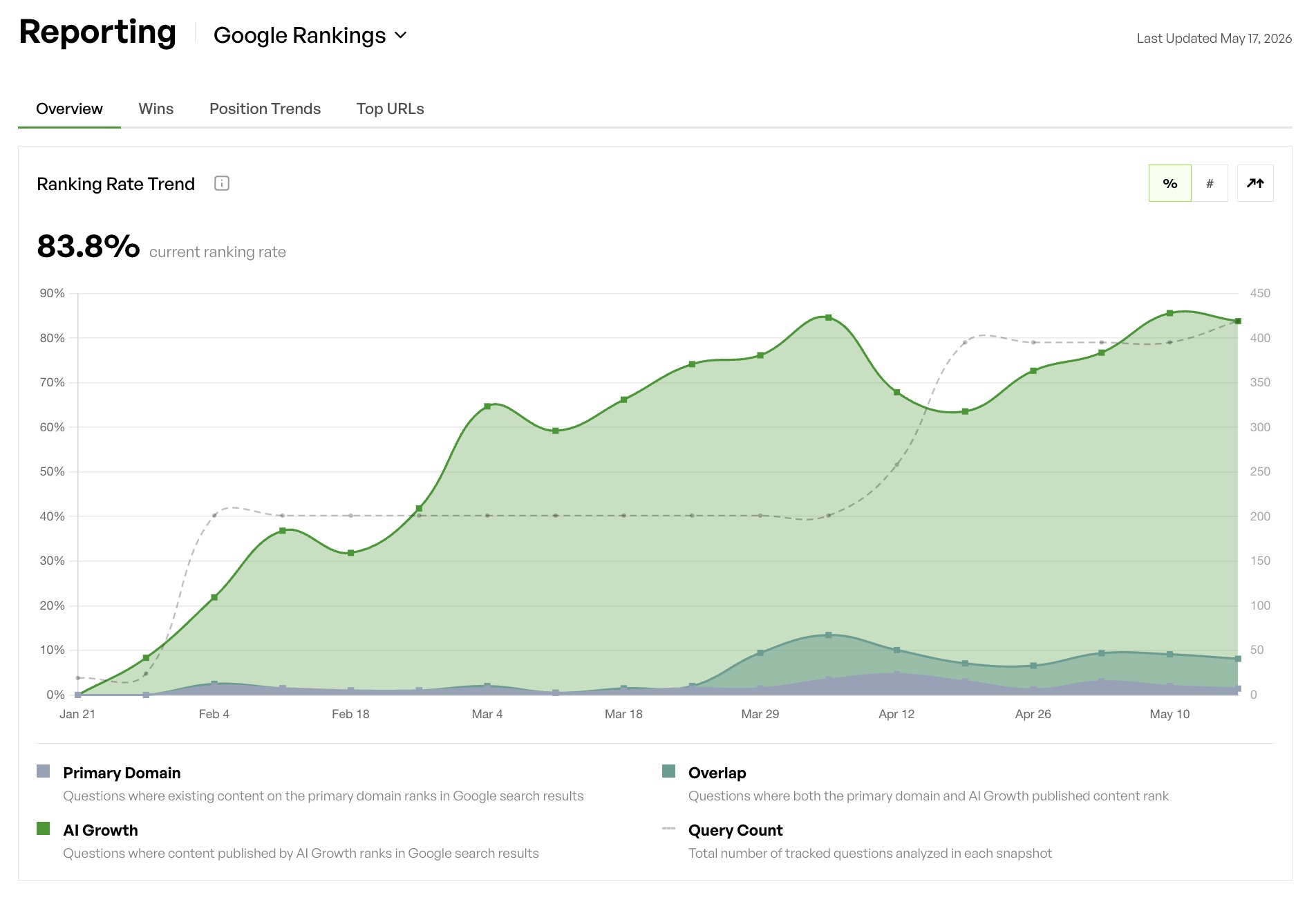
Recommended review cadence is weekly for bot tracking and citation context, and monthly for a full universe snapshot that refreshes seed term rankings, AI mention rates, and share of voice across the Content Topology.
Advanced Scaling Scenarios and Roadmap
Advanced deployments treat multi-brand governance and internal linking as related scaling challenges. Multi-brand and multi-domain deployments run parallel MCP content engines, each with its own manifesto, Content Topology, and Blog MCP endpoint, connected through a shared governance layer that enforces brand separation and prevents narrative bleed between properties. Large content libraries then require dynamic internal linking at scale, treating the content graph as an optimization problem. High-authority articles pass PageRank to lower-authority articles through structured link insertion, which compounds authority across the universe rather than letting it concentrate on a handful of pages.
Adjacent topic expansion follows the same evidence-based process as the initial universe map. Real-time AI Overview and ChatGPT search results serve as the objective function for identifying which adjacent long-tail queries are worth pursuing, and the engine produces authoritative content against each one systematically. The A2A protocol, brought to production-grade v1.0 in early 2026 and now governed by the Linux Foundation with support from 150+ organizations including Microsoft, AWS, Salesforce, SAP, and ServiceNow, defines the standards layer the agentic internet is being built on. As new standards ship, the MCP content engine must be updated to remain at the front of agent discovery.
Frequently Asked Questions
What is the difference between a Blog MCP and a standard MCP server?
A standard MCP server exposes tools, resources, and prompts to AI agents through the Model Context Protocol, using the architecture described in Step 1. A Blog MCP is a marketing-specific implementation that exposes a brand’s content library, structured narrative, and primary sources as queryable resources, combined with the full agentic technical SEO layer including Agent Cards, llms.txt, natural language query parameters, and Markdown serving. The Blog MCP is designed specifically to make a brand’s content the answer AI agents return when a user asks a relevant question, rather than serving as a general-purpose tool integration layer.
How long does it take to see citation lift after deploying an MCP content engine?
Indexing can begin within ten days with instant indexing submission and a properly configured sitemap. Citation lift, meaning measurable increases in the number of times AI surfaces cite the brand’s content, typically becomes visible within the first four to six weeks as the content library grows and bot traffic accumulates. The standard engagement is a three-month pilot because indexing timelines vary by industry and domain authority, but early signals including bot visits and Google Search Console impressions appear well before the pilot concludes.
Does the MCP content engine require a technical team to operate?
The only integration step that requires technical access is the reverse proxy rewrite that connects the Blog MCP infrastructure to a subdirectory on the client’s domain. Everything else, including schema, bot tracking, sitemap, Agent Cards, llms.txt, and MCP endpoints, is provisioned by the engine automatically. The client’s team gives feedback in plain language and the system learns. No ongoing engineering involvement is required after the initial reverse proxy configuration.
How does the MCP content engine handle brand voice and compliance requirements?
The brand manifesto is the primary source of truth and acts as the guardrail for every piece of content the engine generates. Style memories carry voice rules, such as preferred terminology or words the brand never uses, and the engine applies them to every future generation without re-briefing. Legal disclaimers, claim prioritization for regulated sectors, and anti-hallucination controls are configured once and applied universally. Every claim, source, and quote is validated against primary sources and verified external research before content is published, rather than relying on a model’s training data.
What is the relationship between llms.txt, Agent Cards, and the Blog MCP?
These three components serve different roles in the agent discovery stack and must all be present for the system to function. llms.txt and llms-full.txt serve the discovery role described in Step 3, while the Agent Card and Blog MCP handle interactive queries. The Agent Card at /.well-known/agent-card.json declares in structured JSON what the site offers to interactive agents, the endpoints they can call, and how to authenticate, following the A2A protocol standard. The Blog MCP is the interactive endpoint itself, the service the Agent Card points to, where agents can query the content library in natural language and retrieve structured, cited answers. A site can have any one of these without the others, but only the combination of all three creates a fully agent-ready content surface.
Conclusion
An MCP content engine is not a monitoring layer and not a content tool. It is the production architecture that makes a brand’s narrative the answer AI agents return at scale, without adding headcount or stitching together agencies and tools. The architecture requires five layers working together: a secure MCP host, client, and server model; a structured brand manifesto and primary source library; agentic technical SEO including Blog MCP, Agent Cards, llms.txt, and natural language query parameters; a reverse proxy rewrite that serves everything from a subdirectory on the client’s domain; and incremental visibility reporting that isolates what the engine actually generated.
Each layer compounds the others. Content without discovery is invisible. Discovery without content is an empty endpoint. Both without measurement produce no actionable signal. The brands establishing this architecture now are training the next generation of AI models with their own narrative. The brands that wait are training the next generation with whatever happens to be sitting on the open web.
AI Growth Agent’s Blog MCP stack ships schema, bot tracking, self-healing content, Agent Cards, llms.txt, natural language query parameters, and incremental visibility reporting in one engine, with the first article live within a week of kickoff and the indexing timeline described in the FAQ section. It is the only complete, owned solution that covers every layer of the MCP content engine without requiring a technical team, an agency, or a stack of disconnected tools.
Schedule a consultation session with AI Growth Agent and see your first article live within a week.