Written by: Mariana Fonseca, Editorial Team, AI Growth Agent
Why This Zero-Team Approach Works
-
WordPress organic visibility in 2026 depends on an autonomous engine that handles mapping, publishing, schema, and reporting without extra hires or stitched tools.
-
Zero-click searches and AI Overviews compress traditional traffic, so citation in AI surfaces now delivers more value than a classic top ranking.
-
The seven-phase autonomous engine replaces agencies and DIY chatbots by shipping claim-validated, self-healing content that compounds authority over time.
-
Clients see measurable lifts, averaging 12,000+ AI citations and a 20%+ increase in Google Search Console impressions within the first 12 weeks.
-
Schedule a demo with AI Growth Agent to evaluate whether this zero-team approach aligns with your brand’s growth goals.
Why WordPress SEO Still Matters in 2026
Traditional rankings still exist, but the traffic they deliver has been structurally compressed. The 2024 SparkToro/Datos study found that 58.5% of U.S. Google searches produced zero clicks, with only 360 clicks per 1,000 searches reaching the open web. Mobile zero-click behavior reached 77% in The Digital Bloom’s 2025 analysis.
AI Overviews now drive much of this compression. Ahrefs’ December 2025 study of 300,000 keywords found AI Overviews correlate with a 58% lower average CTR for the top-ranking page. Seer Interactive’s September 2025 study of 3,119 informational queries across 42 organizations found AI Overviews cut organic CTR by 61%. ALM Corp’s February 2026 analysis showed organic click share fell by 11 to 23 percentage points across multiple verticals between January 2025 and January 2026.
The inversion in value now sits inside AI surfaces. Brands cited inside AI Overviews earn 35% more organic clicks and 91% more paid clicks than uncited competitors on the same queries. Only 12% of URLs cited by AI platforms rank in Google’s traditional top 10 for the same queries. The definition of winning has changed, and citation in AI surfaces now matters more than a position-one ranking on a clean SERP.
Why Standard Organic Approaches Fail Without a Team
The two standard paths both fail in this new environment. Assembling an agency often takes roughly three months for an RFP, then three more months before first assets ship, which means close to a year before meaningful motion. DIY with a chatbot may produce one reasonable article, then quality drifts and inconsistency creeps in. This approach often creates content that AI platforms ignore and that contains errors and gaps.
Both paths share the same structural flaw. They depend on stitching together agencies, tools, and people, and they leave content that goes stale the day it ships. Given this shift toward AI citation as the primary success metric, the traditional approaches to WordPress SEO no longer deliver reliable results. The alternative is a seven-phase autonomous engine that replaces the entire stack.
Phase 1: Build a Live Search Universe From Google and ChatGPT
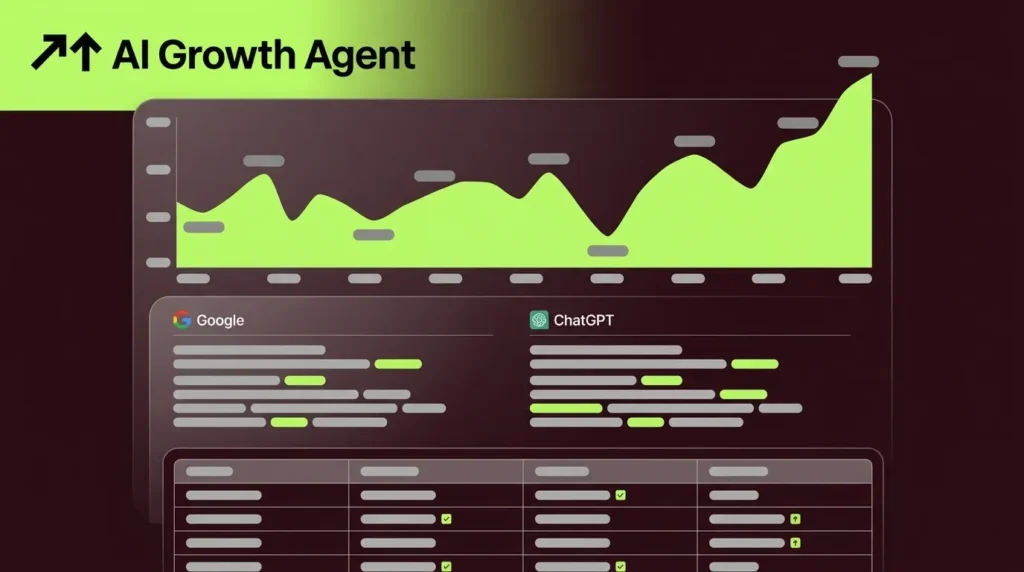
AI Growth Agent starts with a Company Manifesto, a comprehensive brand document created through a journalist-led interview and ingestion of existing brand materials. From that foundation, the engine derives a Content Topology, which forms a complete portrait of the brand’s search universe. This universe includes seed terms and hundreds of long-tail queries beneath them, pulled from real-time Google and ChatGPT results rather than a model’s training data.
A new account typically starts with 9–15 seed terms and 300–400 prompts, refreshed weekly. The system runs more than 3,000 searches per week to keep the universe snapshot current, generating the citation volume and bot traffic detailed in the Key Takeaways above.
Phase 2: Launch an Owned, On-Brand Blog in One Week
AI Growth Agent provisions a fully configured, branded blog that the client owns outright. The blog connects to the client’s domain through a reverse proxy rewrite, typically under a subdirectory, or through a subdomain. WordPress powers 42.2% of all websites and 59.6% of known-CMS sites in 2026, so it serves as the dominant platform for this infrastructure. The setup works with Cloudflare, Vercel, or any other host.
Nothing in the existing site structure changes, and no agency controls the property. The brand keeps full control of its domain, while the engine handles the heavy lifting behind the scenes.
Phase 3: Use the WordPress Plugin to Structure Content and Track Bots
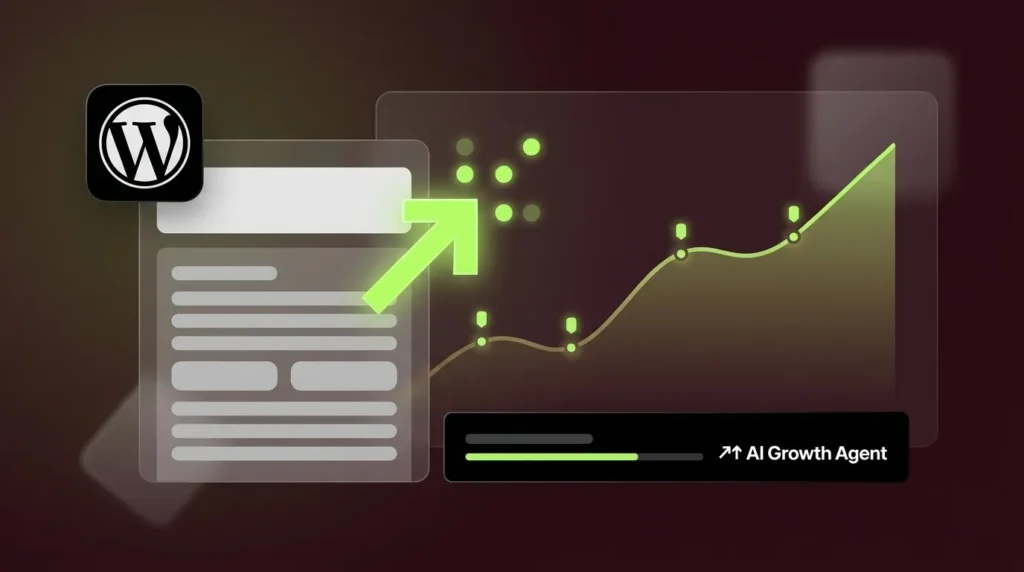
AI Growth Agent’s WordPress plugin deploys automatically and includes full schema coverage (article, FAQ, local business, organization, review, product, author, and software application), advanced robots.txt, a proper sitemap.xml, Blog MCP, Web MCP, and bot traffic tracking that identifies individual crawlers including GPTBot. This schema coverage directly increases the likelihood of appearing in rich search results, which drives higher impression counts. The plugin also improves page speed to under 0.4 seconds, a threshold that correlates with higher ChatGPT citation rates because faster pages are more accessible to AI crawlers.
All of this happens automatically and requires no technical skill from the client’s side. See how the WordPress plugin integrates with your existing infrastructure.
Phase 4: Produce Claim-Validated Content From Your Manifesto
Research agents fan out across the web before a single word is written for each article. They analyze current Google and ChatGPT results, competitor signals, People Also Ask boxes, and forum discussions. Every claim, source, and quote is validated against live research rather than a model’s training data.
A memory system saves every piece of client feedback so the same note never needs to be repeated. B2B marketers who publish original research and proprietary data often report higher conversion rates and stronger SEO performance than those that do not, and the Company Manifesto becomes the proprietary data layer that generic tools cannot match.
Phase 5: Keep Articles Fresh With Self-Healing Updates
Content stays alive instead of going stale. AI Growth Agent ships batched updates so every article in a client’s sector refreshes continuously. When a client changes a rule, a CTA, or a link, the engine syncs and updates all affected live articles automatically overnight, with no republishing required.
Websites with regularly updated blogs have over 430% more indexed pages than static websites without one. Authority compounds instead of decaying when every article remains current and aligned with the latest guidance.
Phase 6: Track Incremental Visibility With Weekly Reporting
AI Growth Agent only takes credit for the visibility it actually generates. Weekly reporting isolates AI Growth Agent-generated content from the brand’s existing domain visibility, with a clear separation between primary domain pages, overlapped pages, and AI Growth Agent pages. Clients track appearance in Google AI Overviews and ChatGPT, traditional organic rank against competitors, and real-time crawler identification via the WordPress plugin.
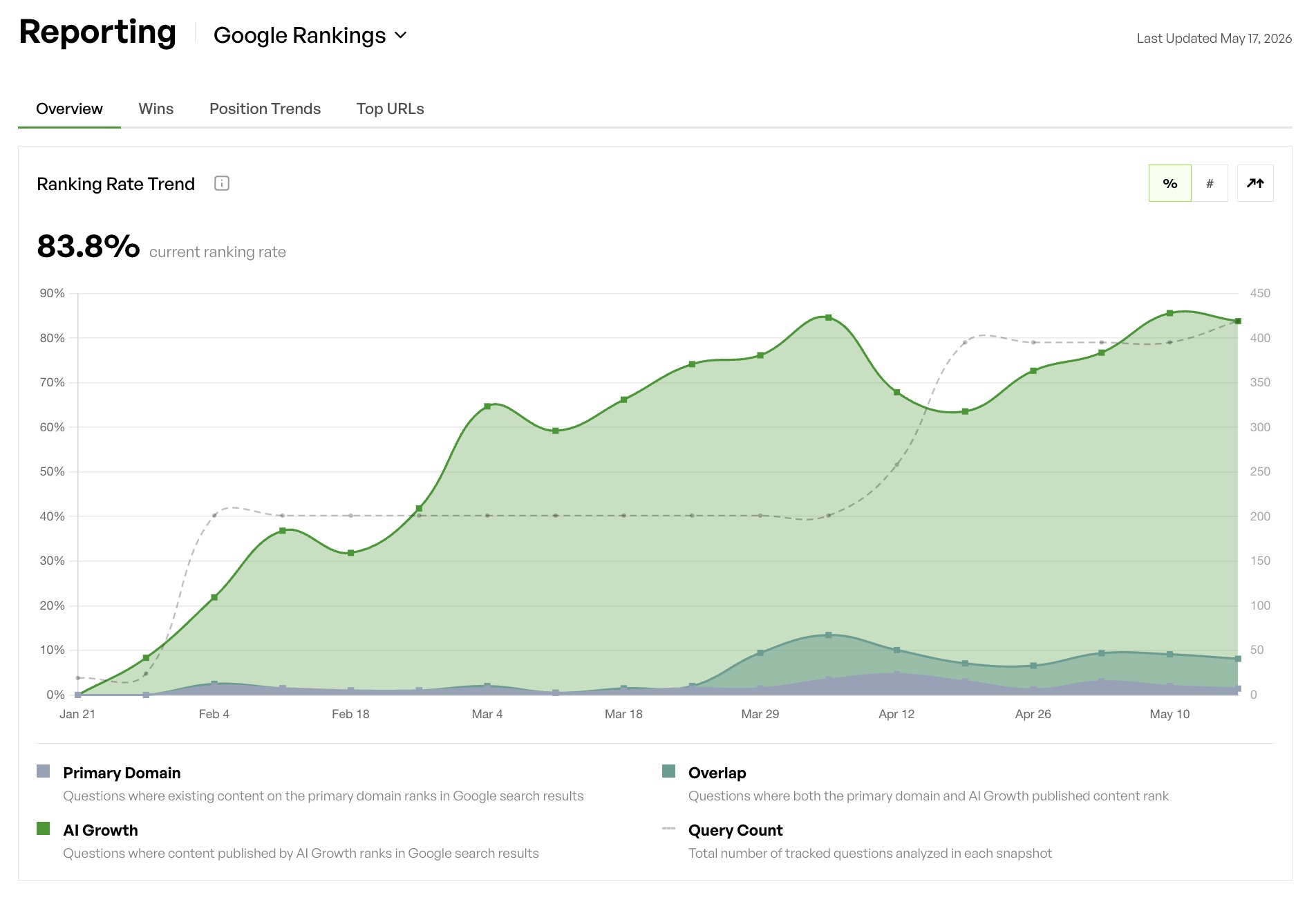
Google Search Console provides an independent impressions audit, confirming the 20%+ lift detailed earlier. Request a walkthrough of the incremental reporting dashboard.
Phase 7: Scale to 1,500+ Prompts Without Per-Prompt Fees
The search universe expands as the engine matures. Mature clients reach 1,500+ queries, refreshed weekly, which deepens coverage across every relevant topic cluster. Pricing remains a flat fee, and prompt count never becomes a billed metric.
The engine produces between 2 and 50 articles per day per client, up to 500 per month. This output arrives without the cost structure of an agency or the quality drift that appears in a DIY stack.
How the Autonomous Engine Compares to Other Options
|
Category |
Example |
What It Does |
Where It Stops |
|---|---|---|---|
|
DIY AI content writers |
Claude, Jasper |
Single-shot article generation from a manual prompt |
No Company Manifesto, Content Topology, claim validation, publishing, schema, bot tracking, or self-healing, and mass-produced chatbot content often fails to earn citations |
|
GEO/AI search monitors |
Profound, Athena, Peec AI |
Track brand appearance for a capped set of self-inputted prompts |
Monitoring-first, with no site setup, no content production, and no self-healing, and node-based agents require client-side engineering to configure |
|
SEO agencies |
Various |
Done-for-you SEO and content production |
RFP takes about three months and first assets take three more months, HubSpot organic traffic declined 70–80% after broad top-of-funnel content with weak product adjacency, and the client often does not own the blog |
|
Autonomous engine |
AI Growth Agent |
Maps full search universe, stands up owned blog, deploys advanced WordPress plugin, generates living claim-validated content, and reports incremental visibility weekly |
Fixed-fee model with first article in as early as one week, and clients own all content and the blog property outright |
Frequently Asked Questions
How long does it take to get the first article published and indexed?
The first article can be live within one week of kickoff. Indexing has occurred in as little as two weeks. The standard engagement runs as a three-month pilot because indexing timelines vary by industry and domain authority. AI Growth Agent’s WordPress plugin and sitemap configuration accelerate discovery by notifying search engines the moment new content is published.
Do I need a technical team or developer to set this up?
No technical team is required. AI Growth Agent provisions the WordPress plugin, schema, robots.txt, sitemaps, MCP endpoints, and reverse proxy documentation automatically. The client’s team gives feedback in plain language, either to AI Growth Agent’s team or directly to its internal chatbot. There is no code to write or maintain on the client’s side.
How does AI Growth Agent handle legal and compliance requirements?
The engine supports dynamic legal disclaimers, claim prioritization from internal documentation, and validation of every claim and source against live evidence rather than a model’s training data. Compliance requirements are configured once and then applied automatically to every future article generation. Citation styles such as AMA or Chicago are also supported for regulated industries.
Who owns the blog and the content?
The client owns the blog property outright. It connects to their domain through a reverse proxy rewrite or subdomain and is never controlled by AI Growth Agent or a third-party agency. The client also owns all content produced, with no per-article or per-prompt charges, and ownership does not depend on maintaining a subscription.
How does incremental reporting prove that results come from AI Growth Agent and not existing brand visibility?
AI Growth Agent publishes into a separate environment and reports week over week with a clear separation between primary domain pages, overlapped pages, and AI Growth Agent pages. The proprietary dashboard tracks appearance in Google AI Overviews and ChatGPT, the WordPress plugin tracks bot traffic by crawler identity, and Google Search Console provides an independent impressions audit. Clients who measure best also capture lead source at conversion, which allows them to trace organic leads directly to AI Growth Agent content.
The Autonomous Engine as a Compounding Growth Path
Agencies move slowly, cost more, and keep brands dependent. DIY chatbots produce inconsistent output at scale and cannot handle schema, bot tracking, or self-healing. Monitoring tools show what is happening but do not change it. The autonomous engine stands out as the only option that maps the full search universe, publishes living content, deploys advanced WordPress infrastructure, and proves incremental results without adding headcount or managing a complex tool stack.
AI referral traffic converts 3-5x better than organic search. The leaderboard of AI citations is still being written, and brands that establish authoritative, structured, living content now are training the next generation of models with their own narrative. Brands that wait train those models with whatever happens to be sitting on the open web.
Book a working session to see how this autonomous engine could support your WordPress growth.