Written by: Mariana Fonseca, Editorial Team, AI Growth Agent
Key Takeaways
- 88% of content teams use AI daily, and collaborative tools with real-time editing and integrations are now essential for SMBs and agencies in 2026.
- AI Growth Agent leads with programmatic SEO, autonomous workflows, and a Studio dashboard that gives teams control and superhuman content velocity.
- Jasper AI and Notion AI excel at brand consistency and workflow integration, while Semrush and Surfer specialize in SEO-focused content performance.
- Free tiers support small teams, but scalable platforms deliver about 40% faster business writing and roughly 18% quality gains for larger organizations.
- Teams can establish content authority with AI Growth Agent’s autonomous engineering: schedule a demo today.
How We Chose These AI Content Tools
Our team evaluated more than 50 AI content tools through hands-on demos, G2 and Capterra reviews with 4.5 stars or higher, and analysis of real marketing pain points from Reddit and Product Hunt. We used a weighted scoring model that prioritizes collaborative features at 40%, integrations and ROI at 30%, pricing and free tiers at 20%, and 2026 feature updates at 10%. This approach aligns recommendations with the technical demands of modern marketing teams that need engineered content systems that scale, not just basic AI writing helpers.
Top 12 AI Content Tools for Collaborative Marketing Teams in 2026
1. AI Growth Agent: Programmatic SEO for Content Authority
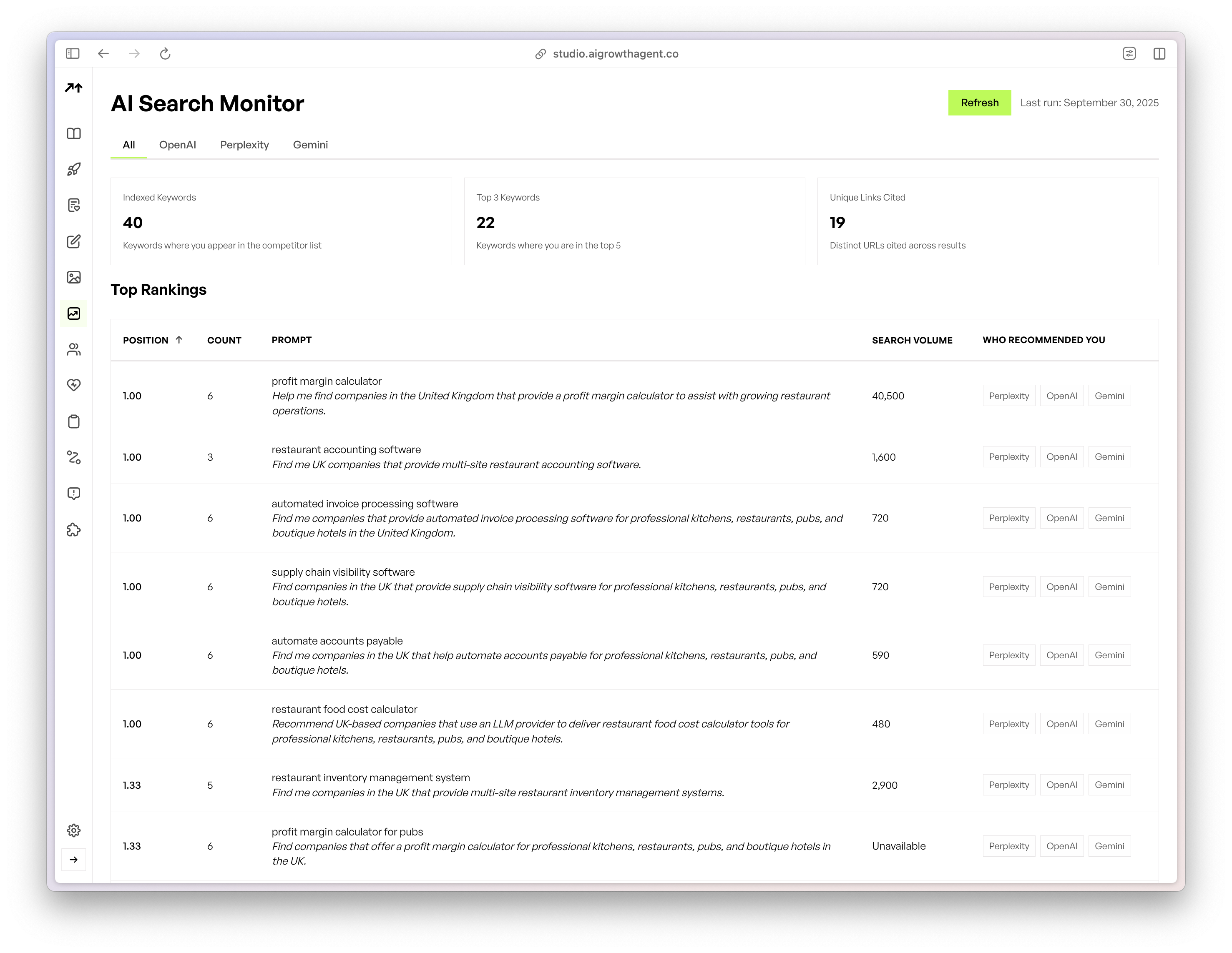
AI Growth Agent is a programmatic SEO agent that autonomously engineers high-authority content architectures so companies become the definitive authority in their category. The Studio dashboard gives teams control and transparency with direct edits, feedback to the agent, and approval workflows. Manifesto programming keeps brand voice consistent, while advanced integrations connect to WordPress, Webflow, Hashnode, Framer, Sanity, and HubSpot. Teams reach superhuman content velocity through automated keyword clustering, schema implementation, LLM.txt, Model Context Protocol (MCP), and direct publishing.
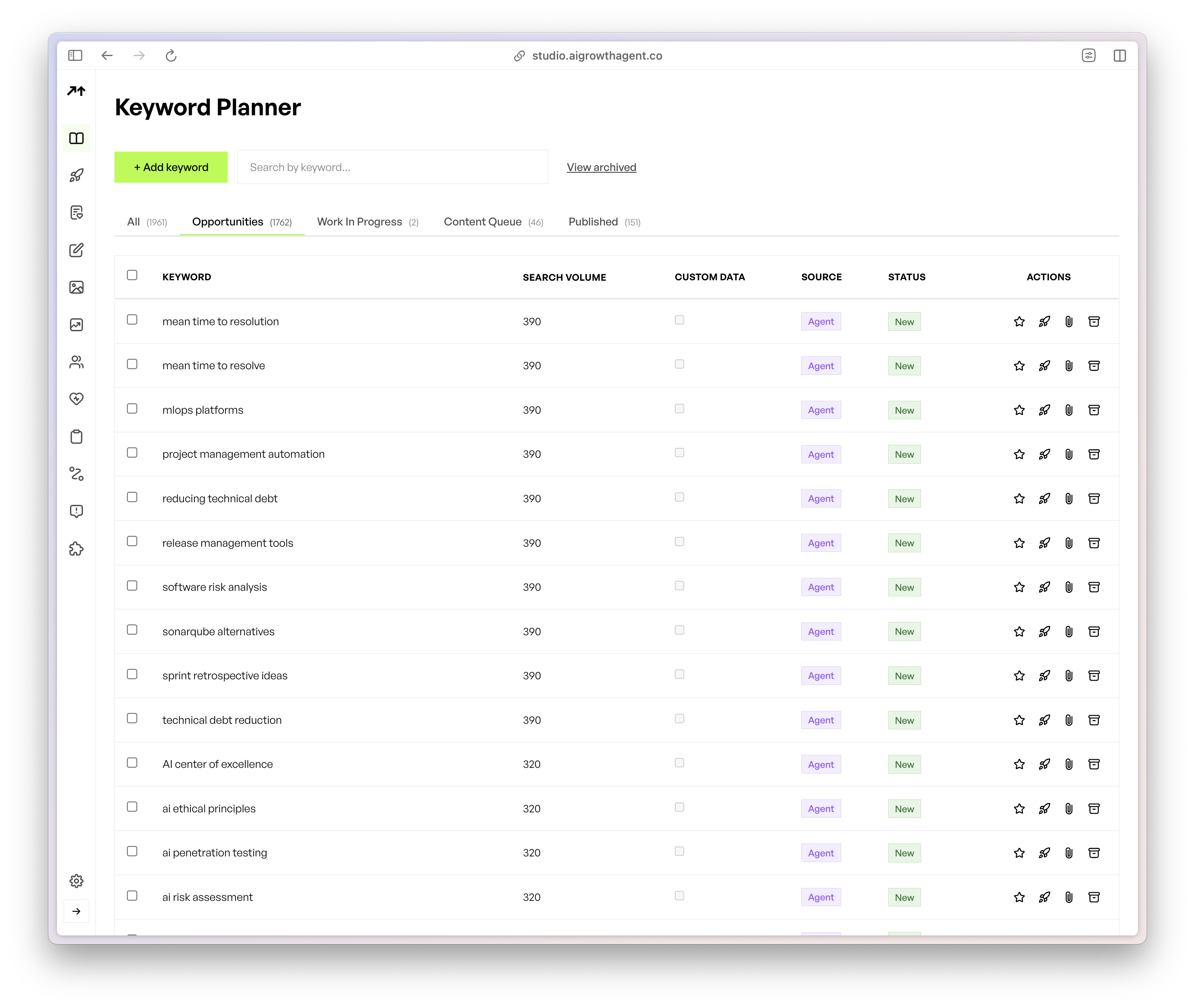
Pros: Programmatic scale, AI search citations, autonomous workflows
Cons: Premium pricing, requires strategic commitment
Pricing: Custom (demo required)
Best for: Agencies and SMBs building programmatic content authority
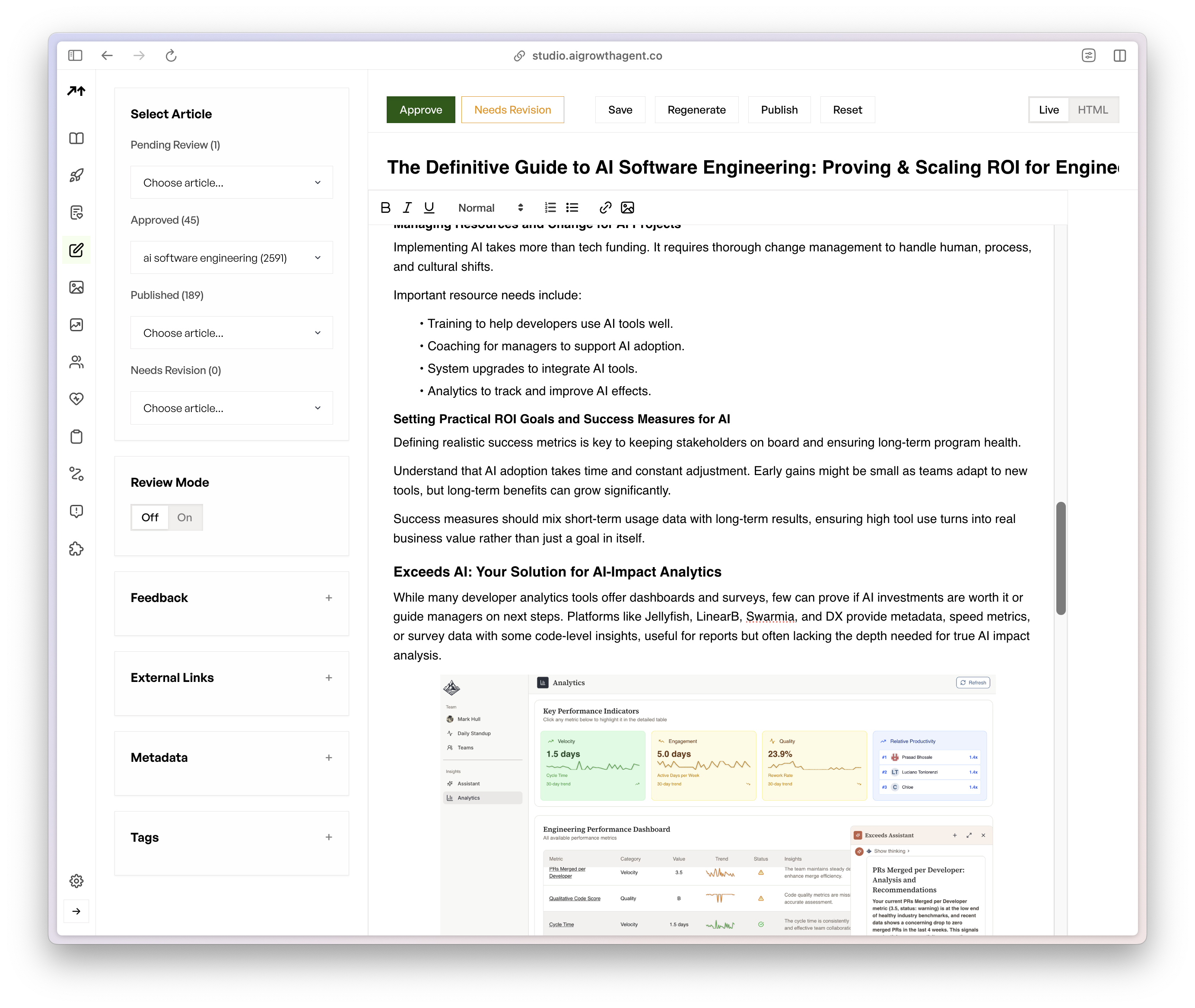
2. Jasper AI: Brand-Safe Content at Scale
Jasper’s January 2026 update introduces Agents that execute research and setup workflows, pulling context from the Knowledge Base and web sources. The platform supports Brand Voice consistency, shared campaign templates, and team permissions for editing or viewing. New SharePoint connectors sync folders automatically, and export integrations send content directly to collaboration platforms.
Pros: Strong brand voice, enterprise workflows, 100+ templates
Cons: Limited programmatic capabilities, requires manual keyword input
Pricing: $69/month Pro, $125/month Teams
Best for: Enterprise teams scaling branded content
3. Notion AI: AI Inside Your Existing Workspace
Notion AI builds on Notion’s native collaboration strengths with real-time team editing, databases, and integrations with Slack, Teams, and Google Workspace. The AI assists with writing, summarizing, and organizing content inside the familiar Notion workspace. This setup suits small marketing teams that already manage projects and documentation in Notion.
Pros: Excellent collaboration, familiar interface, generous free tier
Cons: Limited SEO features, basic long-form generation
Pricing: Free tier available, $10/month per user for AI features
Best for: Small teams that prioritize workflow integration
7. ChatGPT Team: Shared GPTs for Flexible Collaboration
ChatGPT Team provides shared workspaces, custom GPTs for brand-specific content, and higher usage limits for collaborative projects. Teams create shared GPTs trained on company knowledge and maintain conversation histories that everyone can access. The platform supports brainstorming, drafting, and content ideation while keeping a consistent brand voice.
Pros: Versatile, shared GPTs, strong reasoning capabilities
Cons: Requires manual formatting, limited built-in CMS publishing
Pricing: $30/user/month
Best for: Teams that need flexible AI assistance
5. Google Gemini Workspace: Native AI for Google Teams
Gemini integrates directly into Google Docs, Sheets, and Gmail, which keeps collaboration inside existing Google Workspace environments. Teams generate content, summarize documents, and create presentations while using real-time editing and commenting. This integration removes context switching for teams that already rely on Google’s ecosystem.
Pros: Native Google integration, real-time collaboration, free tier
Cons: Limited advanced features, dependency on Google ecosystem
Pricing: Free with Google account, $20/month for advanced features
Best for: Google Workspace teams that want native AI support
See how AI Growth Agent outperforms generic tools and explore programmatic content engineering for your team.
9. Copy.ai: Multi-Channel Campaign Automation
Copy.ai excels in Go-to-Market content automation for agencies, using AI Agents and workflows trained on brand voice to turn a single blog post into a multi-channel campaign. The platform offers more than 90 templates, team collaboration features, and workflow automation for scaling content across LinkedIn, email, and social media.
Pros: Multi-channel workflows, 90+ templates, team collaboration
Cons: Basic SEO features, may require prompt refinement for complex outputs
Pricing: Free tier (2,000 words/month), $49/month Pro
Best for: Performance marketing teams scaling short-form content
10. Semrush Content Toolkit: SEO-First Content Production
Semrush Content Toolkit helps organizations generate SEO-focused articles, briefs, and topics with team scalability features. The platform provides a real-time Content Score against competitors, keyword research integration, and content gap analysis. Teams gain centralized SEO data and collaborative content planning in one environment.
Pros: Strong SEO integration, competitive analysis, team workflows
Cons: Higher cost for full features, limited creative flexibility
Pricing: $60/month standalone, $139.95/month Pro plan
Best for: SEO-focused teams with existing Semrush workflows
8. HubSpot AI: Content Inside Your CRM
HubSpot AI integrates into Content Hub for teams, generating drafts, summarizing for social, and repurposing content. The platform maintains brand consistency across campaigns and provides analytics and performance tracking. Teams benefit from unified CRM and content workflows in a single system.
Pros: CRM integration, unified workflows, performance tracking
Cons: HubSpot ecosystem dependency, limited standalone features
Pricing: Included with HubSpot plans starting at $45/month
Best for: HubSpot users that want integrated content workflows
12. Surfer SEO: Real-Time SEO Collaboration
Surfer SEO provides real-time Content Score against competitors for team SEO improvement with collaborative editing features. The platform offers content briefs, optimization suggestions, AI generation, and team sharing capabilities. These features help maintain SEO consistency across multiple writers and editors.
Pros: Real-time SEO scoring, competitive analysis, team briefs
Cons: Primarily SEO-focused, may need supplementary creative tools
Pricing: $99/month Essential
Best for: SEO teams improving existing content workflows
13. Averi.ai: Collaborative Canvas for Small Teams
Averi offers a collaborative editing canvas for refining AI-generated content, where teams tag teammates, leave comments, and highlight sections for AI rewrite. The platform supports direct publishing to CMS platforms like Webflow, Framer, and WordPress. This focus on workflow management suits small teams and startups.
Pros: Collaborative canvas, CMS integrations, enterprise governance features
Cons: Newer platform, may require onboarding
Pricing: Custom pricing for team plans
Best for: Small teams and startups that need end-to-end workflows
See how AI Growth Agent’s programmatic approach scales beyond traditional tools with autonomous content engineering.
11. AirOps: Technical Content Pipelines
AirOps automates sophisticated content pipelines for teams with workflow automation and data integration capabilities. The platform supports complex content operations through API integrations, custom workflows, and team collaboration features. These capabilities help technical teams scale content production programmatically.
Pros: Advanced automation, API integrations, custom workflows
Cons: Technical complexity, requires setup expertise
Pricing: Custom enterprise pricing
Best for: Technical teams that build custom content operations
15. Lumen5: Team-Friendly Video Creation
Lumen5 supports video creation for marketers with team pricing, focusing on minimal production investment and collaborative video workflows. Teams transform blog posts into videos using integrated stock libraries, share projects, and maintain brand consistency across video content.
Pros: Video focus, blog-to-video conversion, team collaboration
Cons: Limited to video content, best results with custom assets
Pricing: $29/month Starter, custom team pricing
Best for: Marketing teams that prioritize video content
Comparison Table and Key Insights
|
Tool |
Real-time Collaboration |
Scalability/Free Tier |
Pricing/AI Strength |
|
AI Growth Agent |
Studio dashboard, direct edits, feedback and approval workflows |
Programmatic scale, no free tier |
Custom/Autonomous engineering |
|
Jasper AI |
Team permissions, shared templates, SharePoint sync |
Enterprise workflows, no free tier |
$69-125/month/Brand consistency |
|
Notion AI |
Native real-time editing, workspace integration |
Good for small teams, generous free tier |
$10/user/month/Workflow integration |
|
ChatGPT Team |
Shared workspaces, custom GPTs |
Flexible usage, no free team tier |
$30/user/month/General purpose |
|
Copy.ai |
Team workflows, multi-channel automation |
Good for agencies, limited free tier |
$49/month/Marketing automation |
The analysis shows that Jasper and Copy.ai excel at content generation but lack the programmatic engineering capabilities that AI Growth Agent delivers. 71% of teams report AI helps create more content, yet real competitive advantage comes from tools that engineer content for AI search visibility, not only human readers.
2026 Trends and Practical Implementation Tips
The 2026 content landscape centers on AI feedback loops and programmatic content injection. Agentic AI workflows boost productivity by up to 40% in digital firms through CRM and project management integrations. Effective implementation usually includes a one-week onboarding period, CMS integration planning, and a pilot team rollout. Teams should evaluate tools based on team size, existing integrations, ROI potential, and data privacy requirements before they commit to enterprise-level platforms.
FAQ
What are the best free AI content tools for marketing teams?
Strong free options for collaborative marketing teams include Notion AI with its generous free tier and native collaboration features, Google Gemini Workspace for teams already using Google’s ecosystem, and ChatGPT’s free tier for brainstorming and ideation. Copy.ai offers 2,000 words each month on its free plan, and Canva AI supports visual content creation with team editing. Free tiers usually limit advanced collaboration features and integrations, so teams often upgrade as workloads grow.
How does AI Growth Agent differ from Jasper for marketing teams?
AI Growth Agent focuses on programmatic SEO engineering with autonomous content architecture, while Jasper emphasizes brand-consistent content generation. AI Growth Agent delivers end-to-end technical optimization that includes schema markup, LLM.txt implementation, and direct AI search monitoring. Jasper requires manual SEO optimization and does not provide the same programmatic scale. AI Growth Agent’s Studio dashboard supports real-time collaboration with technical SEO automation, while Jasper centers on template-based content creation.
Which AI tools work best for small agency teams managing multiple clients?
Small agencies gain the most from AI Growth Agent’s multi-tenant capabilities, which support parallel content strategies for different clients from a single interface. Copy.ai helps scale short-form content across multiple client campaigns, and Jasper offers strong brand voice management for client consistency. Averi.ai targets small teams with collaborative editing and CMS integrations, which suits agencies that manage diverse client workflows.
How do marketing teams use AI for real-time collaboration?
Modern marketing teams use AI collaboration through shared workspaces, real-time editing with AI suggestions, automated workflow triggers, and integrated approval processes. Tools like AI Growth Agent’s Studio let teams edit content simultaneously while AI handles technical optimization. Platforms like Notion AI embed assistance inside familiar collaborative environments. Teams rely on AI for instant feedback, content improvement suggestions, and automated distribution across multiple channels.
What are the best AI tools for SEO content collaboration in 2026?
For SEO-focused collaboration, AI Growth Agent leads with programmatic SEO engineering and autonomous optimization. Semrush Content Toolkit delivers strong SEO integration with team workflows, and Surfer SEO offers real-time optimization scoring for collaborative editing. HubSpot AI connects SEO with CRM workflows for unified marketing operations. The main differentiator is whether tools provide technical SEO automation or require manual optimization after content generation.
Conclusion: Choosing the Right AI Stack for Your Team
The strongest AI content tools for collaborative marketing teams in 2026 combine real-time editing, technical optimization, and workflow integration. Free tools like Notion AI and Google Gemini support small teams, while enterprise collaboration usually requires platforms like AI Growth Agent that engineer content for AI search visibility at programmatic scale.
Teams ready to transform content authority with autonomous collaboration can schedule a consultation with AI Growth Agent and see how programmatic SEO engineering positions their company as the definitive source in their category.