Written by: Mariana Fonseca, Editorial Team, AI Growth Agent
Key Takeaways for Enterprise LLMs.txt Strategy
- AI answer surfaces now drive brand discovery, so narrative control becomes a content architecture challenge instead of a reactive PR task.
- LLMs.txt and LLMs-full.txt act as complementary discovery and ingestion layers within an agentic technical SEO stack that also includes schema, robots.txt, and MCP.
- Adoption remains limited in 2026, with measurable value concentrated among developer audiences using AI IDEs and documentation-heavy sites.
- A four-pillar data foundation of search intelligence, AI analytics, bot tracking, and AI ranking turns static files into living, measurable components of the stack.
- AI Growth Agent provisions and governs the entire agentic technical SEO stack on autopilot; see the full stack in action during a live walkthrough.
Where LLMs.txt and LLMs-Full.txt Sit in the Agentic Stack
LLMs.txt was proposed by Jeremy Howard of fast.ai on September 3, 2024, as a community convention, not an official W3C or IETF specification. It is a plain-text Markdown file hosted at the root of a domain that gives AI agents a curated index of a site's most important pages. These pages include core product pages, pricing, documentation, and cornerstone guides. Where robots.txt tells bots where not to go, llms.txt tells them where the high-signal content is. The two files operate in entirely different parts of the stack and neither replaces the other.
LLMs-full.txt is the companion format: a single concatenated Markdown export of an entire site's important pages, enabling models to ingest full context in one request. Profound's research indicates AI crawlers fetch llms-full.txt more frequently than llms.txt, because the full-content Markdown removes an extra retrieval step for real-time agents. Together, the two files form a two-tier pattern. LLMs.txt supports fast discovery. LLMs-full.txt supports deep ingestion.
The Model Context Protocol (MCP) represents the next evolution: llms.txt provides read permission for AI agents while MCP adds write and execute permissions, turning a readable site into an interactive, queryable knowledge layer. LLMs.txt, llms-full.txt, robots.txt, schema markup, and MCP servers function as complementary nodes in a single agentic technical SEO stack rather than competing standards.
Five-Step Enterprise LLMs.txt Implementation Checklist
- Audit robots.txt to confirm desired AI crawlers (GPTBot, ClaudeBot, PerplexityBot, Google-Extended) are not blocked before deploying any llms.txt file.
- Identify 20 to 50 canonical pages covering core product, pricing, integrations, key documentation, and customer stories, and write one-sentence agent-oriented descriptions for each.
- Structure the file with one H1 containing the brand name, a blockquote summary, and 4 to 7 H2 sections grouped by user journey, with a final "## Optional" section for lower-priority resources.
- Publish llms.txt at the domain root as text/plain, add a supplemental sitemap reference in robots.txt, and add a link rel=”llms-txt” tag in the site head to signal the file's existence to clients.
- Publish a companion llms-full.txt for documentation-heavy properties, establish a quarterly review cadence to remove dead URLs and add new cornerstone content, and connect both files into the broader agentic stack alongside schema markup and MCP endpoints.
The 2026 State of LLMs.txt Adoption
A 2026 Ahrefs analysis of 137,000 domains found that 28% published an llms.txt file, but 97% of those with a valid file received zero requests for it in May 2026, with the sample skewing toward tech-savvy sites, implying lower adoption among websites generally. Adoption remained limited in 2026, representing a niche rather than mainstream enterprise practice.
No major LLM provider has formally adopted llms.txt as part of its crawler protocol. OpenAI's GPTBot honors robots.txt but does not officially use llms.txt; Anthropic publishes its own llms.txt but does not state that its crawlers use the standard; Google uses robots.txt via Google-Extended for AI crawl management with no mention of llms.txt support. The file should be treated as a low-cost bet rather than a guaranteed ranking or citation lever. Its value is highest when treated as one node in a complete agentic stack rather than a standalone tactic.
Developer-focused AI tools including Cursor, Continue, and Aider actively read and support llms.txt and llms-full.txt for context management, with server logs showing primarily on-demand, real-time fetches triggered by explicit user requests rather than automatic integration into standard crawl pipelines. For enterprise teams whose audiences include developers using AI IDEs, or who publish technical documentation, the immediate value is measurable today.
The Four-Pillar Data Foundation for a Living LLMs.txt
A static llms.txt file functions as a declaration, while a living component pairs that declaration with measurement. A data foundation shows whether the file is being fetched, whether the brand narrative it encodes influences model outputs, and whether the pages it highlights earn citations. Four pillars form the measurement layer that closes this gap and create a feedback loop where static files become living components.
Search Intelligence provides a complete portrait of the traditional search landscape, including positioning, competition, search volume, and the structure of who already wins each result. It turns a raw situation into an actionable diagnosis and identifies which canonical pages deserve priority placement in the llms.txt index.
AI Analytics tracks brand value and consumer behavior across the full journey, from external touchpoints like Google and AI-tool queries through content consumption, demographics, and sentiment. This layer surfaces whether the narrative encoded in llms.txt appears in what models actually say about the brand.
Bot Tracking records every bot interaction, traditional crawlers and AI training agents alike, including every crawl, citation, and training sweep. Without visibility into who is reading the content, it is impossible to tell whether the brand is being read at all. Bot tracking isolates whether llms.txt and llms-full.txt are being fetched and by which agents.
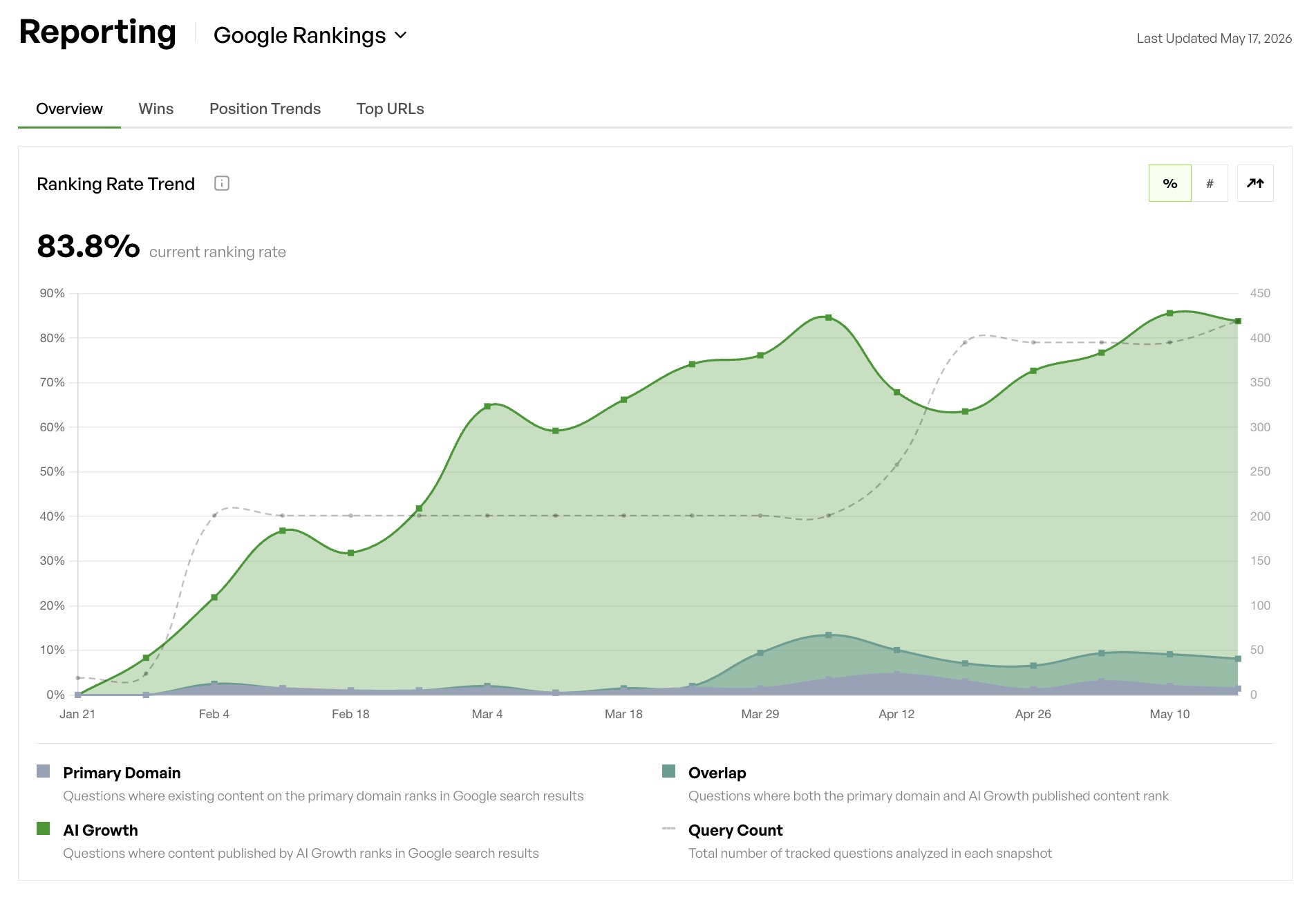
AI Ranking replaces the old idea of a position number. AI answers have no static ordered list, so order of mention and citation context become the new leaderboard. Incremental visibility reporting isolates the contribution of the llms.txt node specifically and separates what the file and the pages it indexes contributed from visibility the brand already held.
Integration Architecture for Schema, MCP, Robots.txt, and LLMs-Full.txt
LLMs.txt is complementary to schema.org markup and RSS feeds rather than a replacement, and it can coexist with broader agentic protocols such as MCP and commerce and A2A-style layers. The integration architecture for an enterprise deployment rests on four interdependent layers.
Robots.txt and crawler boundaries. Robots.txt manages crawler access through Allow and Disallow directives while llms.txt manages AI comprehension as a navigation aid with no blocking capability, reinforcing the separation of concerns established earlier. A production robots.txt for an agentic stack includes separate User-agent blocks for GPTBot, ClaudeBot, PerplexityBot, and Google-Extended, plus dual Sitemap directives pointing to both the XML sitemap and /llms.txt.
Schema markup. Schema helps bots understand the content and powers rich results. Article, organization, product, FAQ, and author schema operate at the page level and encode structured facts that models can extract and cite. LLMs.txt operates at the domain level and points agents to the pages where that schema lives. The two layers reinforce each other. Schema makes individual pages machine-readable, and llms.txt makes the site's architecture machine-navigable.

MCP servers and /.well-known/ discovery. Some platforms now provision MCP servers alongside llms.txt and llms-full.txt, positioning llms.txt as the entry point and MCP as the deeper structured-data integration that turns documentation into a queryable knowledge layer. Agent Card guidance and OpenAI discovery served via /.well-known/ extend this architecture to agentic browsing contexts.
Dynamic generation and versioning. LLMs.txt files should be updated quarterly or whenever major content or structural changes occur; stale links to deleted pages are treated as a signal of an unmaintained site. Enterprise deployments benefit from dynamic generation tied to the CMS, so the file reflects the current canonical page set without manual maintenance cycles.
Production-Ready Enterprise LLMs.txt Template
# [Brand Name] > [Brand Name] is a [one-sentence third-person description of what the brand does, who it serves, and the primary value it delivers. State what the brand is not in this sentence or the next.] [Brand Name] does not [explicit scope boundary: name the adjacent category, use case, or competitor framing the brand should not be associated with]. ## Product - [Core Product Page](https://domain.com/product): Overview of [product name], its primary use case, and the audience it serves. - [Pricing](https://domain.com/pricing): Current pricing model, plan tiers, and what is included at each level. - [Integrations](https://domain.com/integrations): Full list of supported integrations and connection methods. ## Customers - [Case Studies](https://domain.com/customers): Verified outcomes from named customers across [industry verticals]. - [Testimonials](https://domain.com/testimonials): Direct quotes from customers on specific use cases. ## Documentation - [Getting Started](https://domain.com/docs/start): Step-by-step onboarding for new users. - [API Reference](https://domain.com/docs/api): Full API documentation with endpoint descriptions and authentication guidance. ## Company - [About](https://domain.com/about): Founding story, mission, and leadership team. - [Security and Compliance](https://domain.com/security): Data handling, certifications, and compliance posture. ## Optional - [Blog](https://domain.com/blog): Long-form guides and industry analysis. Fetch specific articles rather than the index. - [Changelog](https://domain.com/changelog): Product update history. Relevant for version-specific queries only.
The "what we are not" language in the opening blockquote carries the highest leverage for hallucination reduction. FastHTML's llms.txt demonstrates this boundary approach by including an "Important notes" section that explicitly states incompatibilities to reduce hallucinations. Enterprise teams should treat this section as the primary narrative control lever in the file.
Governance, Maintenance Cadence, and When LLMs.txt Earns the Engineering Effort
Production llms.txt files require quarterly maintenance reviews to add new cornerstone content, remove dead URLs returning 301 or 404 responses, and keep the file current. The governance cadence should align with the broader content calendar. When a major product page is published or retired, the llms.txt index updates in the same sprint.
The file delivers measurable value in three scenarios. First, when the audience includes developers using AI IDEs such as Cursor or Continue, where a clean llms.txt reduces token cost during retrieval and increases answer accuracy by helping the model orient to the right documentation pages before fetching them. Second, when the site has a large content library where a curated map adds real clarity, particularly for documentation-heavy SaaS products. Third, as an anticipatory measure that positions the brand for adoption acceleration as more AI surfaces formalize their use of it.
The file delivers less measurable value when the site is small, the content library is shallow, or the primary audience does not use AI-native developer tools. SE Ranking's analysis of approximately 300,000 domains found no statistically significant correlation between having an llms.txt file and higher AI citation frequency. The file is a necessary node in the agentic stack, not a sufficient one. Citation frequency is driven by the quality and authority of the content the file points to, not by the file itself.
An llms.txt that accurately describes a brand and points models to canonical pages reduces narrative drift by preventing outdated blog posts, third-party descriptions, or competitor comparisons from shaping the model's brand summary. That outcome is the governance case for maintaining the file even when direct fetch rates remain low.
How AI Growth Agent Provisions the Agentic Stack on Autopilot
LLMs.txt functions as one node in a broader agentic technical SEO stack that also includes schema markup, robots.txt, llms-full.txt, MCP servers, /.well-known/ discovery, bot tracking, AI ranking measurement, and the living content that all of these files reference. Assembling and governing that stack manually requires an engineer, an SEO specialist, a content team, and a monitoring layer working in coordination. Most enterprise marketing organizations do not have this team in-house, and assembling it through agencies often takes close to a year before anything is live.
AI Growth Agent provisions llms.txt and llms-full.txt, Blog MCP, OpenAI discovery and Agent Card guidance via /.well-known/, advanced robots.txt, proper sitemap.xml, full schema markup, bot tracking, instant indexing, autoredirects, and 404 tracking automatically, with no technical action required from the client. Every package includes the full stack. The only integration step on the client side is the reverse proxy rewrite that connects the blog to a subdirectory under the brand's domain.
Across the first twelve weeks, AI Growth Agent clients average more than 12,000 additional AI citations and mentions, over 100,000 additional bot visits, and a 20%+ lift in impressions, with the first article live within a week and content indexing in as little as ten days. Incremental visibility reporting isolates exactly what the engine generated, week over week, so the CMO has a defensible answer for the CEO instead of a dashboard that takes credit for visibility the brand already held.
Traditional search tools show where your brand stands. AI Growth Agent makes your brand the answer. Book a kickoff and see your first article live within a week.
Conclusion: Turning LLMs.txt into a Living Node in Your Agentic Stack
LLMs.txt does not act as a ranking lever in isolation. It operates as a narrative control instrument that works only when the pages it indexes are authoritative, the schema that structures those pages is valid, the robots.txt that governs crawler access is correctly configured, the MCP endpoints that expose the site to agents are live, and the bot tracking that measures all of it is running. Treating the file as a standalone tactic produces the outcome Ahrefs documented: near-zero fetch rates for isolated implementations. Treating it as one node in a complete agentic technical SEO stack produces measurable narrative control and hallucination reduction at scale.
The architecture is clear, and the operational pressure to deploy it without adding headcount is equally clear. AI Growth Agent operates as a single headless engine that provisions, governs, and measures the full stack, including llms.txt, llms-full.txt, schema, MCP, robots.txt, bot tracking, AI ranking, and the living content that all of these files reference, on autopilot, from kickoff to the first published article in about one week.
Take the first step toward making your brand the answer across every AI surface that matters and start with a strategy consultation. Begin with a focused consultation on your agentic technical SEO stack.
Frequently Asked Questions
What is the difference between llms.txt and llms-full.txt, and does an enterprise site need both?
LLMs.txt functions as a curated index: a slim Markdown file hosted at the domain root that lists the 20 to 50 most important pages on a site, grouped by user journey, with one-sentence descriptions that tell an AI agent what each page contains and when to fetch it. LLMs-full.txt acts as the companion format: a single concatenated Markdown export of the full content of those pages, enabling models to ingest everything in one request without additional fetches. Most enterprise marketing sites need only llms.txt. Documentation-heavy SaaS products, developer platforms, and any organization whose primary audience uses AI coding tools such as Cursor or Continue benefit from maintaining both. The two-tier pattern, slim index for fast discovery and full export for deep ingestion, is the production standard used by Anthropic, Vercel, and LangGraph.
Does llms.txt actually influence what AI models say about a brand?
Impact depends on the context and the surface. As noted earlier, formal adoption by major LLM providers has not occurred, and Google has explicitly stated it does not use the file for AI Overviews. The file's most reliable impact appears in developer-facing AI tools such as Cursor, Continue, and Aider, where it actively reduces token cost and improves answer accuracy by orienting the model to the right documentation before fetching. For broader AI surfaces, the file functions as an anticipatory measure and a narrative control instrument. An llms.txt that accurately describes a brand and points models to canonical pages reduces the risk of outdated blog posts, third-party descriptions, or competitor comparisons shaping the model's brand summary. The file is a necessary node in the agentic stack, not a sufficient one. Citation frequency is driven by the authority of the content the file points to, not by the file itself.
How does llms.txt fit alongside robots.txt, schema markup, and MCP in an agentic technical SEO stack?
Each element operates at a different layer of the stack and serves a distinct purpose. Robots.txt manages crawler access through Allow and Disallow directives and controls which bots can reach which pages. Schema markup operates at the page level and encodes structured facts about content, products, authors, and organizations that models can extract and cite. LLMs.txt operates at the domain level and provides a curated navigation map that points agents to the highest-value pages. LLMs-full.txt provides the full content of those pages in a single Markdown document for deep ingestion. MCP servers represent the next layer. Where llms.txt provides read access, MCP adds structured query capability and turns a readable site into an interactive knowledge layer. None of these files replaces the others. They function as complementary nodes in a single agentic technical SEO stack, and the enterprise implementation checklist in this article covers how to deploy them in the correct sequence.
What is the right maintenance cadence for an enterprise llms.txt file?
Quarterly reviews are the production standard, as outlined earlier. Each review should add new cornerstone content published since the last cycle, remove any URLs returning 301 or 404 responses, and verify that the "what we are not" boundary language in the opening blockquote still accurately reflects the brand's positioning. Major structural changes, such as a product launch, a pricing model change, or a significant documentation restructure, should trigger an out-of-cycle update in the same sprint as the content change. For enterprise teams managing large content libraries, dynamic generation tied to the CMS is the most reliable approach. The llms.txt index then updates automatically when canonical pages are published or retired and removes the dependency on a manual review cycle.
When is llms.txt not worth the engineering effort?
The file delivers the least measurable value when the site is small, the content library is shallow, and the primary audience does not use AI-native developer tools. SE Ranking's analysis of approximately 300,000 domains found no statistically significant correlation between having an llms.txt file and higher AI citation frequency, and OtterlyAI's 90-day crawler experiment found that only 0.1% of AI bot visits targeted the llms.txt file. For organizations in this position, the engineering effort is better directed at the content itself. Authoritative, well-structured pages with valid schema markup and strong internal linking remain the primary drivers of AI citation frequency. LLMs.txt becomes worth the effort when the audience includes developers using AI IDEs, when the site has a large documentation library, or when the brand is actively working to reduce hallucinations in AI outputs about its products and positioning.