Written by: Mariana Fonseca, Editorial Team, AI Growth Agent
Key Takeaways
- Agent discovery for brands is how AI agents locate, evaluate, and cite brand content across Google, ChatGPT, Perplexity, and emerging agentic surfaces using structured data, MCP endpoints, and llms.txt files instead of traditional blue links.
- Zero-click searches now dominate Google results, and AI agents consume and cite content directly inside their surfaces, so what the model says about a brand becomes the final answer for most users.
- Most brands fail at agent discovery because they map only a fraction of their universe, lack agentic technical SEO signals, rely on monitoring-only tools, and move at agency or DIY speeds that cannot keep up with AI surfaces.
- Effective solutions use real-time search intelligence, evidence-based long-tail topology, single-shot authoritative content generation, full traditional and agentic technical SEO deployment, self-healing content, and incremental visibility reporting.
- AI Growth Agent delivers these capabilities through headless marketing, helping brands control their narrative in AI answers; schedule a demo to get started.
The Market Shift: From Blue Links to Zero-Click AI Answers
Zero-click searches reached approximately 69% of Google searches by May 2025 according to Similarweb data, while other 2025 studies reported rates between 50% and 58.5%. Google's AI Mode crossed 1 billion monthly users within its first year. The number of active AI agents in enterprises worldwide is projected to grow from 28.6 million in 2025 to 2.216 billion by 2030. The AI agents market itself is estimated at $12.06 billion in 2026 and projected to reach $53.2 billion by 2030 at a 44.9% CAGR.
Every one of those surfaces consumes content the same way. Each surface reads, cites, and acts on whatever the model can find and trust. The user gets the answer inside the surface and rarely visits the source. Roughly 83% of people report skepticism toward AI answers, yet only about 8% click through to verify them. For most people, whatever the AI says becomes the answer.
For mid-market and enterprise brands, marketing now focuses on shaping the narrative, not just introducing the company. What matters is what AI says about the brand when a customer asks.
Why This Problem Matters: AI Agent Brand Visibility Is the New Leaderboard
Unlike traditional search rankings where brands could track their position on page one, AI answers have no static ordered list. Order of mention and citation context now replace the old ranking number. Repeating the same query 100 times to an AI tool typically yields 100 different answers, which makes traditional rank tracking ineffective. Brand locations appeared in AI recommendations just 6.5% of the time overall in SOCi's 2026 Local Visibility Index, far below the 36% appearance rate in Google's 3-Pack.
The leaderboard is being written this year. Brands that establish authoritative content now are training the next generation of models with their own narrative. Brands that wait are training the next generation with whatever happens to be sitting on the open web.
What Causes the Problem: Four Root Causes of Brand Discovery Failure
Four structural failures explain why most brands are invisible or inconsistently represented in AI-generated answers.
Incomplete universe mapping. Most brands track a handful of head terms and lose the rest of the conversation by default. An analysis of over 23,000 AI citations found that 91% came from third-party sources rather than brand websites, and brand search volume is the single strongest predictor of AI citations. Brands that only focus on head terms stay blind to most of their own market.
Absence of agentic technical SEO signals. Weak AI-readable signals such as missing JSON-LD schema markup, inadequate metadata, or poor HTML structure cause models to skip a brand even when the human-facing copy is strong. Blog MCP, llms.txt, and /.well-known/ discovery endpoints are non-negotiable in 2026. AI-cited pages are almost three times more likely to contain JSON-LD structured data than non-cited pages.

Reliance on monitoring-only tools. Monitoring shows whether you appear for a capped set of prompts. It does not produce content, own publishing, or act on the data. Traditional analytics frameworks fail to capture AI platform mentions, conversation context, and early-stage research signals occurring entirely outside the website environment.
Year-long agency or DIY timelines. An agency RFP runs about three months, then three more to produce the first assets. DIY chatbot approaches produce one decent article and then fall apart. One company produced roughly 300 articles this way and not one was cited. Recognizing these failures, most brands turn to familiar approaches that still do not solve the structural issues.
Common Ways Companies Try to Solve AI Visibility Gaps
Internal teams require an editor, an SEO specialist, a designer, and an engineer working in coordination. The skill divide between what an engineer thinks content should be, what a marketer wants, and what robots need to cite it rarely gets bridged inside one team.
SEO agencies move slowly, cost more, and operate at a smaller scale. An RFP takes three months, onboarding takes three more, and the whole period is spent briefing and chasing. Most agency stacks still lack meaningful AI search capability.
DIY with Claude or similar tools can draft one article quickly. The second article requires running the entire process again. Quality drifts, schema is missing, and no system exists for self-healing content at scale.
GEO monitoring platforms such as Profound, Athena, Peec AI, and Scrunch AI track whether a brand appears for a capped set of prompts. Monitoring is not action. These tools identify the gap and leave the brand to fill it without a production system behind them.
What an Effective Agent Discovery Solution Must Deliver
An effective agent discovery solution requires six non-negotiable capabilities, which together form a complete system. It starts with real-time Search Intelligence that maps the full universe of seed terms and long-tail queries from live Google and ChatGPT data, because teams cannot target queries they never see.
That intelligence powers evidence-based long-tail topology built from real AI Overview and ChatGPT results as the objective function. The topology then guides single-shot authoritative content generation with anti-hallucination controls that validate every claim and source before publishing.
To make that content discoverable, the system deploys a full traditional and agentic technical SEO stack automatically, including schema, Blog MCP, llms.txt, /.well-known/ discovery, and proper sitemaps. Because the search landscape shifts constantly, the content must be living and self-healing, updating over time instead of going stale.
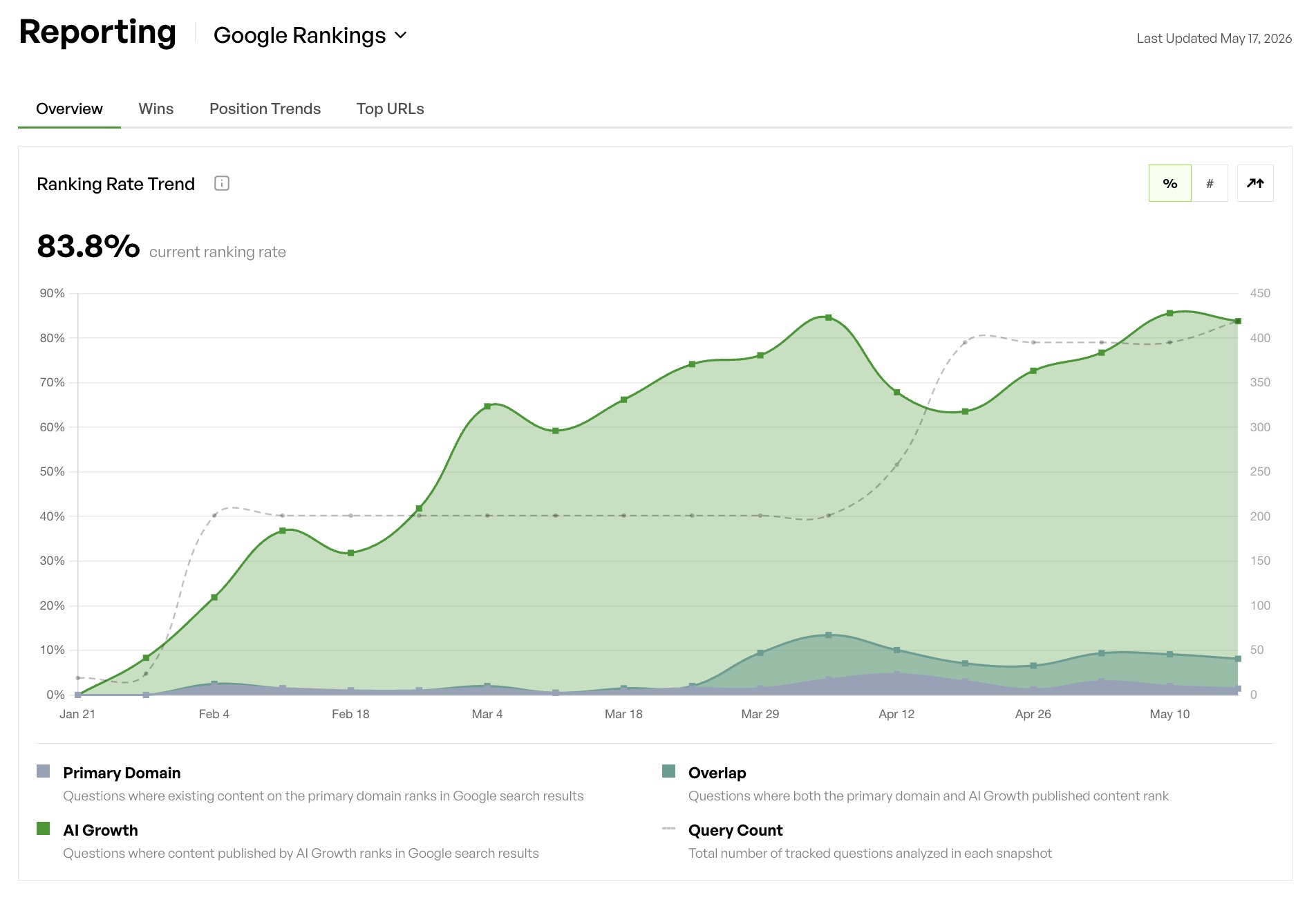
Finally, incremental visibility reporting isolates exactly what the solution generated, separate from visibility the brand already had. The four pillars that feed this system are Search Intelligence, AI Analytics, Bot Tracking, and AI Ranking. Teams that win this channel see all four and act on them within the same week.
How Headless Marketing Platforms Solve Agent Discovery
Headless marketing decouples the curated main site from an owned, optimized blog connected via reverse proxy or subdomain. The brand keeps its storefront. An autonomous engine runs behind it, producing and self-healing content for the actual readers in 2026: crawlers, training agents, AI surfaces running citation passes, and agents acting on the user's behalf.
Third-party mentions in news outlets show roughly 3x higher correlation with AI visibility than traditional backlinks. Headless marketing addresses this reality by producing authoritative content at scale across the full long tail. That content earns citations from the sources AI models trust and ships with the technical signals that make every page machine-readable.
AI Growth Agent clients average more than 12,000 additional AI citations and mentions, over 100,000 additional bot visits, and a 20%+ lift in impressions across the first twelve weeks. Breadless achieved a 30x lift in Google Search Console impressions over six months and is now the most recommended healthy franchise in the US ahead of CAVA, Rush Bowls, and Sweetgreen. Leva Sleep became the most mentioned retailer for adjustable beds in Canada, with ChatGPT citing its content over 10,000 times per month and $40,000 to $50,000 in deals closed in under three weeks from buyers who found them through AI Growth Agent content.
How to Win Agent Discovery: A 7-Step Implementation Checklist
- Kickoff manifesto interview. A journalist with 10+ years of experience interviews the brand to build the manifesto: brand voice, factual references, deny lists, and the personalization that makes every future article compliant by default.
- Universe mapping with 3,000+ weekly searches. Agents map the full set of seed terms and long-tail queries from real-time Google and ChatGPT data. The topology is evidence-based, not guessed, using AI Overview and ChatGPT results as the objective function.
- Seed-term selection in the Content Planner. The brand and the engine jointly choose which seed terms to attack first, with white-space research surfacing the queries competitors are missing.
- Single-shot content generation with anti-hallucination controls. A multi-agent orchestration across OpenAI, Anthropic, Gemini, Grok, Perplexity, Exa, and Firecrawl produces authoritative articles. Every claim, source, and quote is validated against evidence found online before anything ships.
- Automatic schema and MCP deployment. Every article ships with full schema markup, Blog MCP, llms.txt and llms-full.txt, OpenAI discovery and Agent Card guidance via /.well-known/, natural language query parameters, and Markdown served to agent crawlers. No technical action is required from the client.
- Weekly refresh and internal linking. The engine refreshes stale articles in response to Google Search Console signals and bot-traffic data. It also compounds authority through systematic internal linking across the universe.
- Incremental reporting review. Weekly reporting isolates exactly what the engine generated, cross-referencing bot traffic, Google Search Console, and citation data to prove incremental visibility rather than riding existing brand equity.
Agent Discovery Platforms Comparison
| Capability | GEO Monitoring Tools (e.g., Profound, Athena) | AI Content Writers (e.g., Jasper) | AI Growth Agent |
|---|---|---|---|
| Speed to first article | No content produced | Same day, no strategy | About 1 week from kickoff |
| Prompt and query coverage | Capped set of tracked prompts | Client-defined only | 3,000+ searches weekly across full universe |
| Agentic technical SEO depth | None | None | Full stack: Blog MCP, llms.txt, /.well-known/, schema suite, bot tracking, instant indexing |
| Proof of incremental results | Monitors existing visibility only | No reporting | Incremental visibility reporting isolated from pre-existing brand equity |
The sharpest line is this: monitoring tools tell you what is happening. AI Growth Agent changes what is happening. They are a rearview mirror. It is the steering wheel.
Key Considerations Before Choosing a Solution
Team technical skill level. Most marketing teams lack the engineering resources to deploy and maintain agentic SEO infrastructure, which means the solution must require no technical skill from the client side. Schema, MCP endpoints, robots.txt, sitemaps, and /.well-known/ discovery must deploy automatically, because manual configuration stalls programs before they start. The only integration step should be the reverse proxy rewrite connecting the blog to a subdirectory under the brand's domain.
Brand-voice consistency. Style memories must carry voice rules across every future generation so content feels like it comes from one team. The engine should learn from feedback once and never require the same correction twice. Agent memory allows retention of user preferences and past interactions across sessions, making agents increasingly opinionated about which brands meet specific standards over time. Consistent brand voice in owned content compounds in value as agents mature.
Fixed pricing over per-prompt billing. Monitoring tools cap clients at a small set of tracked prompts and charge more to see further. A solution that bills per prompt penalizes the brand for seeing its own universe. Fixed pricing with no per-article charges, credit limits, or per-prompt billing is the only model that lets a brand see and win the full long tail.
Conclusion: Take Control of Your Brand Narrative
The AI leaderboard is being written in 2026. Brands that map their full universe, deploy agentic technical SEO signals, produce living authoritative content, and prove incremental citation gains are training the next generation of models with their own narrative. Brands that rely on monitoring dashboards, agency timelines, or DIY chatbot stacks are ceding that narrative to whoever happens to be indexed.
Headless marketing is the architecture that creates this advantage. One engine replaces the SEO agency, the content tool, the web agency, the GEO monitor, the schema plugin, the analytics stack, and the PR firm. The brand owns the site, the content, and the relationship with AI surfaces. The engine handles everything else.
Traditional search tools show you where your brand stands. AI Growth Agent makes your brand the answer. Take control of your narrative by scheduling a consultation and seeing your first article live within a week.
Frequently Asked Questions
What is agent discovery for brands and why does it matter in 2026?
Agent discovery for brands is the process by which AI agents locate, evaluate, and cite brand content across surfaces like ChatGPT, Perplexity, and Google's AI Mode using structured data, MCP endpoints, and llms.txt files. It matters in 2026 because zero-click search now accounts for the majority of search traffic, so users receive answers inside AI surfaces without visiting a brand's website. If a brand is not structured and positioned to be found and cited by AI agents, it is effectively absent from the conversation at the moment a customer is making a decision. Brands that establish authoritative, machine-readable content now are training the next generation of models with their own narrative.
How does headless marketing differ from traditional SEO or content marketing?
Traditional SEO and content marketing are built for human visitors navigating blue links. Headless marketing is built for the actual readers in 2026: crawlers, AI training agents, citation passes, and agents acting on a user's behalf. It decouples the curated main site from an owned, fully optimized blog connected via reverse proxy or subdomain, so the brand's storefront stays intact while an autonomous engine produces, publishes, and self-heals content at scale.
There is no content team to manage, no agency to brief, and no stack of monitoring tools to stitch together. The engine handles schema, MCP endpoints, llms.txt, bot tracking, internal linking, and incremental reporting automatically. The result is a compounding organic presence in a channel the brand owns, rather than paid visibility that disappears the moment spend stops.
What agentic technical SEO signals does a brand need to be discoverable by AI agents?
A brand needs both traditional and agentic technical SEO signals deployed together. On the traditional side, it needs highly structured HTML, full metadata including Open Graph, rich schema markup across article, author, product, FAQ, and organization types, proper sitemaps, a detailed robots.txt, internal linking, and fresh content with automatic updates.
On the agentic side, it needs the signals mentioned earlier, including Blog MCP, llms.txt, and /.well-known/ discovery, plus natural language query parameters at /?s={query} that return personalized, internally linked responses to agents. It also needs Markdown served to agent crawlers and additional schema guidance that helps AI surfaces parse brand content accurately. With the right engine in place, none of these signals require technical action from the brand's marketing team.
How long does it take to see results from an agent discovery program?
With AI Growth Agent, the first article is typically live within one week of kickoff. Content has indexed in as little as ten days and often within two weeks. The standard engagement is a three-month pilot, because indexing timelines vary by industry and the compounding effect of living content builds over time. These results align with the typical client experience described earlier in the article.
How is AI Growth Agent different from GEO monitoring platforms?
GEO monitoring platforms track whether a brand appears for a capped set of prompts. They identify the gap and leave the brand to fill it with no production system behind them. AI Growth Agent is not a monitoring company. It maps the full universe of seed terms and long-tail queries refreshed weekly with 3,000+ searches, produces authoritative living content single-shot, deploys the full traditional and agentic technical SEO stack automatically, and proves incremental visibility in reporting that isolates exactly what the engine generated. The difference matches the gap between a rearview mirror and a steering wheel. Monitoring tells you where you stand. AI Growth Agent changes what the answer is.