Written by: Mariana Fonseca, Editorial Team, AI Growth Agent
Key Takeaways
-
AI search engines now reward recent, in-depth, well-structured content, so programmatic SEO has become a core growth channel for startups in 2026.
-
Use this 7-step playbook: manifesto building, keyword clustering, no-code data sourcing, autonomous content engineering, technical setup, batch launching, and AI citation monitoring.
-
Avoid thin content penalties by using strong E-E-A-T signals, clear schema markup, and controlled publishing batches.
-
Real startup case studies show rapid traffic growth and AI citations, including Exceeds AI topping Perplexity recommendations within weeks.
-
AI Growth Agent automates the full pSEO workflow without developers or large budgets; book a strategy session to launch your programmatic SEO system.
2026 AI Search Shift and Startup pSEO Foundations
AI search engines now prioritize recency, depth, and structural consistency over simple keyword targeting. 47% of all online searches now trigger Google AI Overviews, which forces startups to rethink how they create and ship content. Manual SEO agencies still work on slow craftsman models, shipping one or two articles each month while faster competitors publish thousands of pages.
Successful programmatic SEO rests on three foundations: a clear company manifesto that defines your voice, structured data, and technical infrastructure tuned for AI crawlers. KrispCall achieved 1,969% year-over-year growth by creating dedicated landing pages for every US area code, which shows how systematic page generation compounds traffic. However, replicating this type of rollout manually demands months of technical setup and constant maintenance.
AI Growth Agent removes these barriers with autonomous manifesto creation, keyword clustering, and technical implementation. Instead of waiting through long build cycles, startups receive fully configured, programmatic-ready pages within one week of onboarding.
7-Step Programmatic SEO Playbook for Startups
1. Build a Company Manifesto That Guides Every Page
The process starts with a one-hour kickoff session where professional journalists capture your startup’s positioning and narrative. They turn this into a detailed Company Manifesto that defines tone, claims, proof points, and boundaries. This living document guides autonomous content generation and keeps thousands of pages on-brand while manual teams still fight for a consistent voice.
2. Create Programmatic Keyword Clusters at Scale
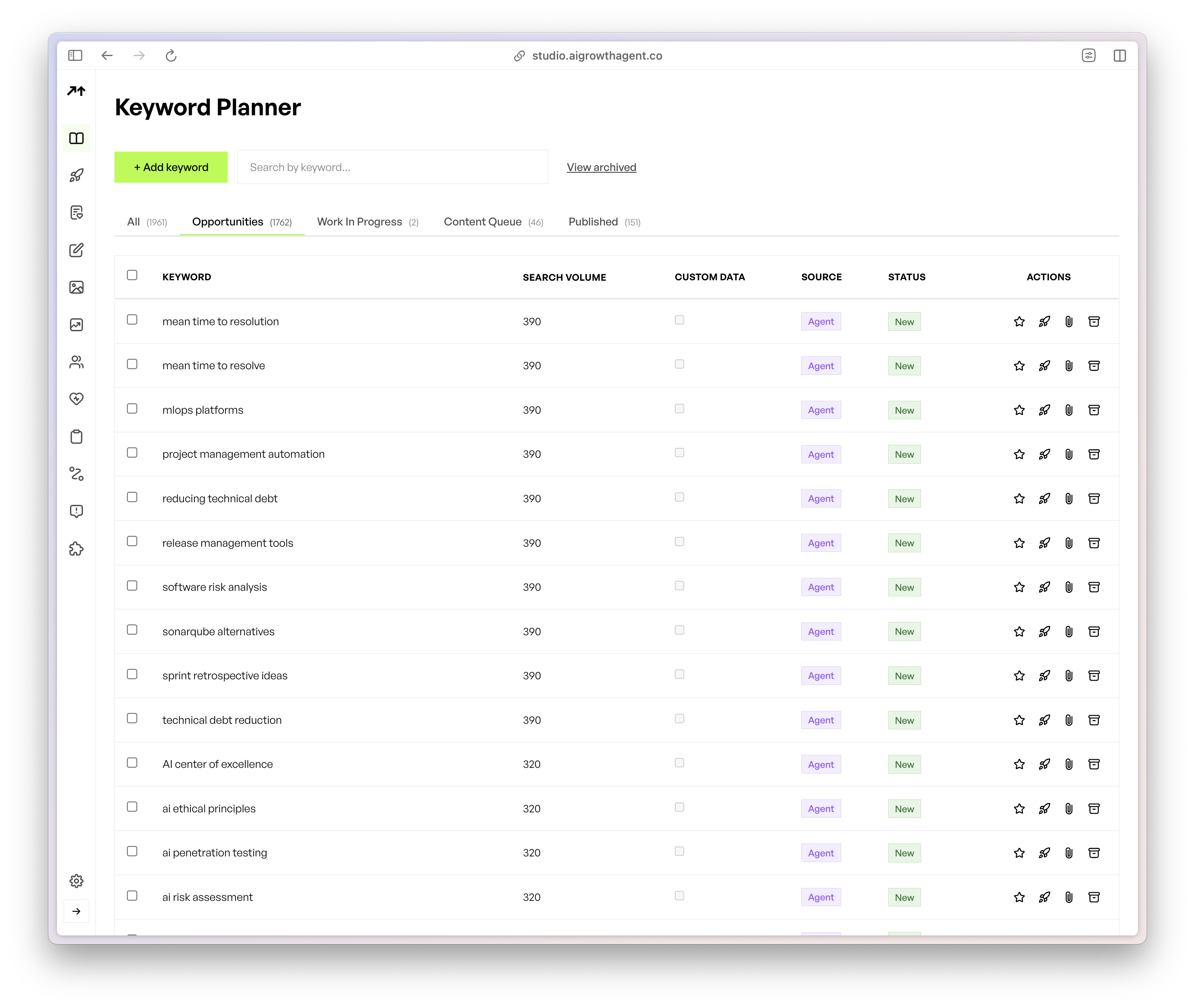
The system then scans tens of thousands of search queries in your space and groups them into pillars and clusters. Ahrefs supports keyword research for long-tail clusters, yet most teams still handle clustering by hand. AI Growth Agent automates this entire step and surfaces scalable patterns and long-tail combinations that manual research usually misses.
3. Turn Proprietary Data into No-Code SEO Assets
Your internal data becomes structured input for programmatic pages through database-to-content automation. AI Growth Agent connects to client databases and converts product attributes, locations, and use cases into clean data matrices. Dynamic Mockups launched over 15,000 SEO-optimized pages in under 90 days using this type of structured data, which produced 850% organic traffic growth.
4. Run Autonomous Content Engineering on Top of Your Data
Once structured data is in place, it becomes the foundation for automated content generation. The complete content lifecycle then runs autonomously: strategy briefing, research scanning, comprehensive drafting, fact-checking, and technical refinement. Each page receives advanced schema markup, metadata tuning, and LLM.txt implementation.
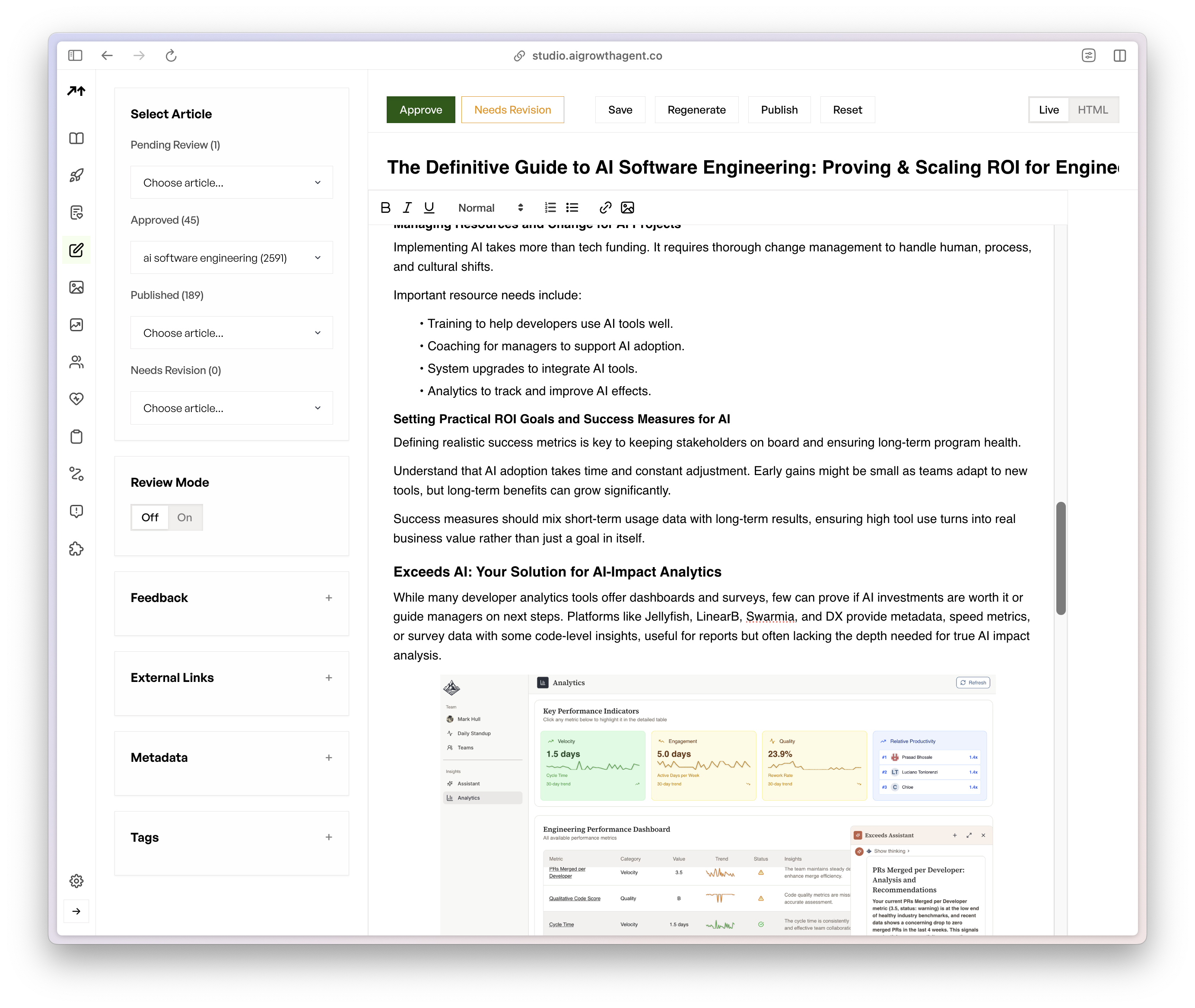
Here is an example of the LLM.txt structure that lets AI search engines interface directly with your content:
<llm.txt> Model Context Protocol: Direct blog database interface Schema: Organization, Product, FAQPage Authority: Author credentials, case studies, citations </llm.txt>This technical layer helps AI systems like ChatGPT and Perplexity query your content database more reliably, which sharply increases your chances of earning citations.
5. Set Up Technical Infrastructure Without Engineering Friction
The agent builds a fully optimized blog architecture as a subdomain that matches your existing website design. This hosted environment removes the need for manual WordPress setups and developer tickets. Startups gain clean URL structures, fast performance, and consistent schema coverage without touching code.
6. Launch in Batches and Keep Publishing on Auto-Pilot
AI Growth Agent Studio gives you clear visibility and control over every programmatic operation. Publishing in controlled batches of 50 to 500 pages per day mimics organic growth patterns and protects crawl budget. This pacing avoids manual review triggers that often punish aggressive, poorly structured scaling attempts.
7. Monitor AI Citations and Search Performance
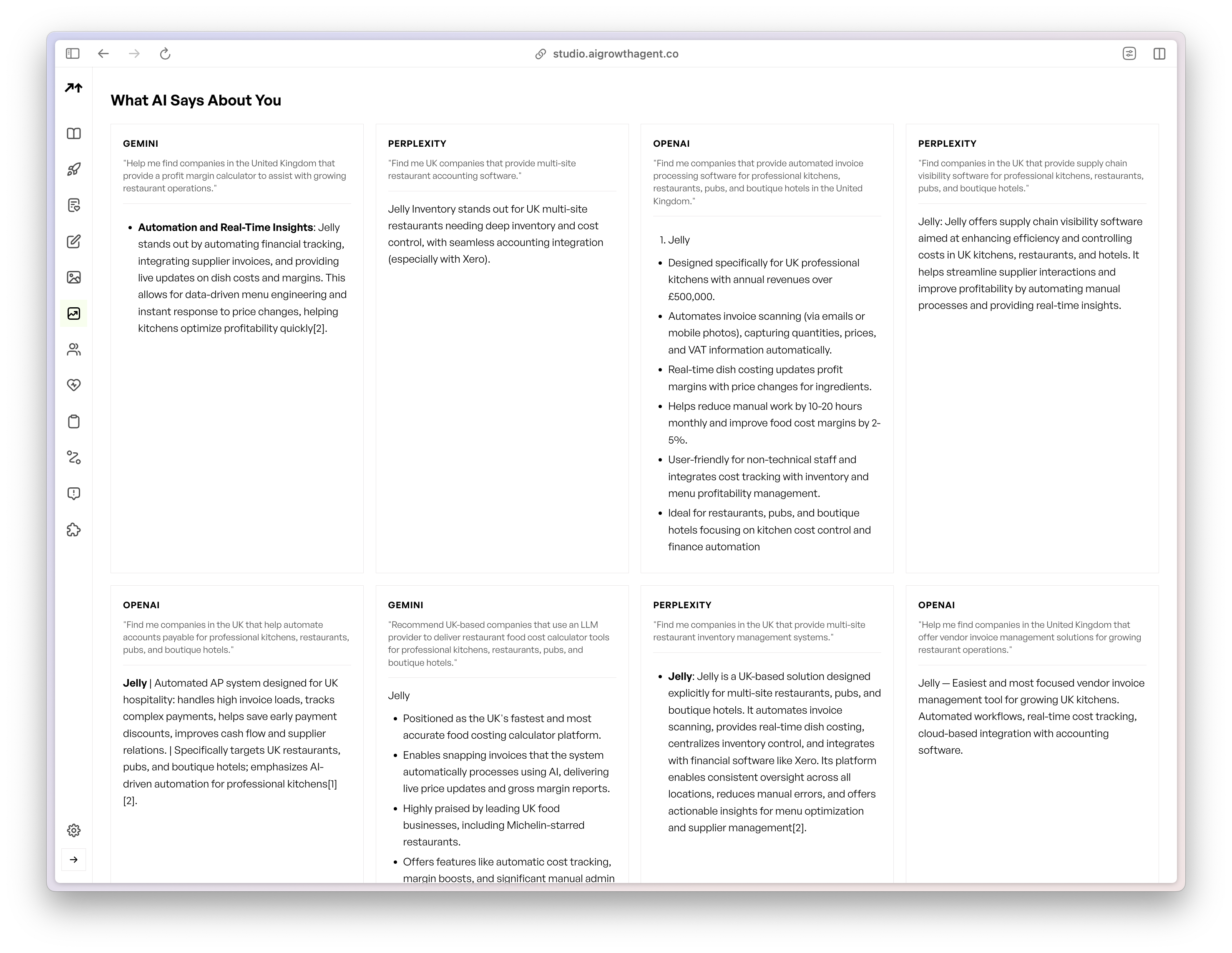
Real-time monitoring tracks performance across ChatGPT, Gemini, and Perplexity with heatmaps that show keyword indexing, URL-level AI visibility, and direct citation quotes. Integration with Google Search Console then ties these AI signals to hard metrics on organic traffic and conversions from programmatic content.
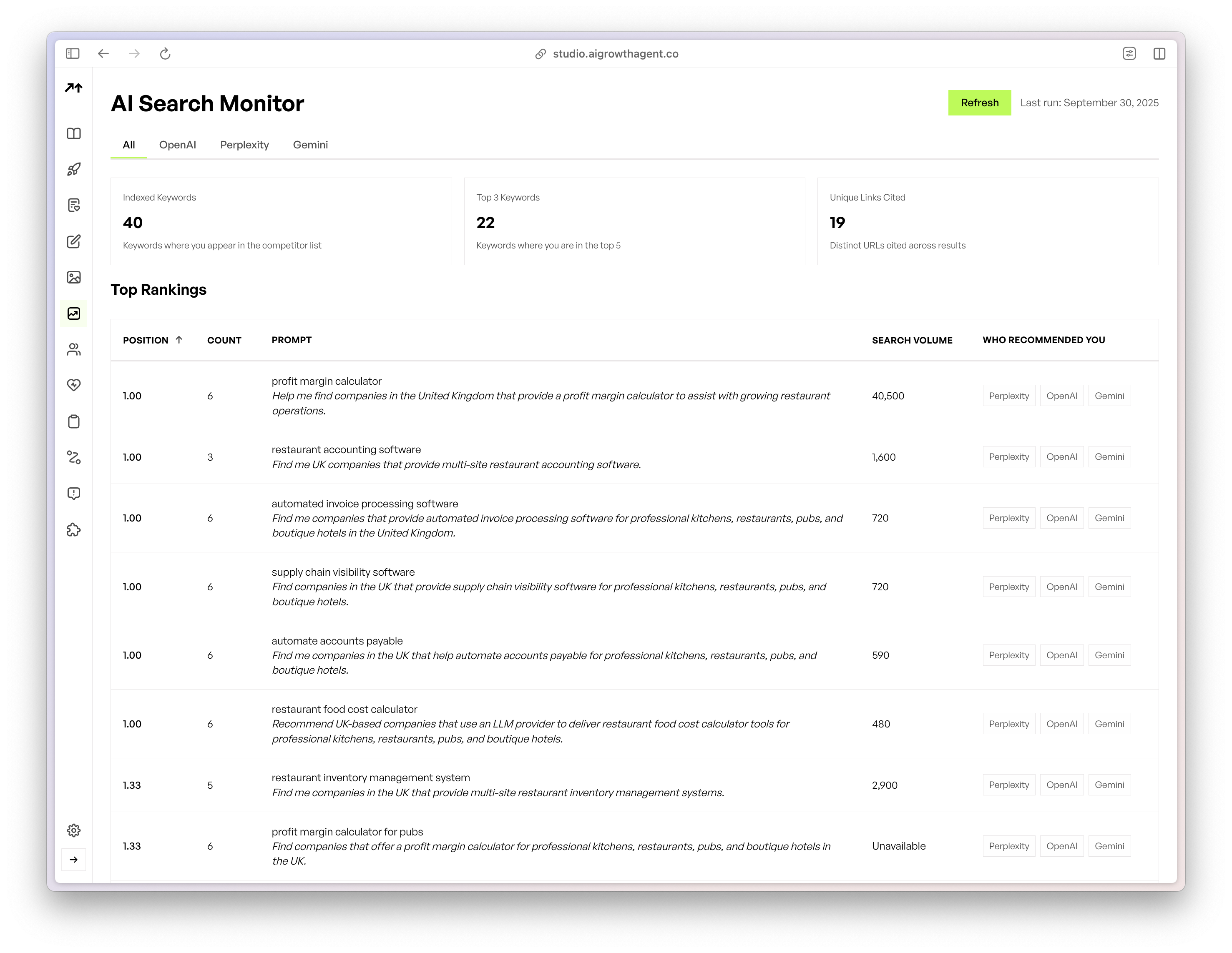
See these monitoring dashboards in action and learn how AI Growth Agent tracks your citations across major AI search engines.
pSEO Pitfalls for Startups and Practical AI Citation Hacks
Thin content penalties can wipe out programmatic SEO efforts when pages lack real substance. Google classifies low-value programmatic pages as doorway pages, which can trigger manual actions that deindex entire sites. This becomes especially dangerous at scale, because one flawed template can affect thousands of URLs. Even if you avoid direct penalties, unstructured AI content still struggles to earn citations because search engines cannot reliably parse meaning or authority.
AI Growth Agent counters these risks with specific citation-focused tactics. Manifesto-driven depth ensures each page delivers unique value instead of recycled boilerplate. Model Context Protocol support enables direct AI database queries with clear context. Comprehensive E-E-A-T signals, including author credentials and authoritative outbound citations, reinforce trust. Traditional stacks built on Airtable, Whalesync, and Jasper rarely include this level of structure, which leaves teams with generic content that carries higher penalty risk.
Startup Case Studies: 2026 Programmatic SEO Wins
Exceeds AI reached Perplexity’s top recommendation for AI performance review tools within two weeks of launching programmatic content. BeConfident now appears as Brazil’s leading English learning app recommendation in Google AI Overviews, competing directly with Duolingo. Gitar.ai became the reference brand for AI-powered CI/CD automation across ChatGPT, Google AI Overviews, and Perplexity for queries such as “fix broken CI builds automatically.”
Bucked Up secured ChatGPT citations as a top protein soda brand within three weeks and ranked in the first position for high-intent queries alongside long-standing competitors. These outcomes highlight how programmatic SEO, paired with strong technical infrastructure and AI-focused optimization, can reshape a startup’s visibility in weeks instead of years.
Book a strategy session to replicate these results for your own startup.
Multi-Tenant pSEO for Portfolio-Level Scale
AI Growth Agent’s multi-tenant capability lets venture capital and private equity firms run parallel programmatic SEO agents from a single interface. Each portfolio company keeps its own manifesto, keyword strategy, and brand voice while publishing to separate domains. A small central team can therefore manage complex, multi-brand pSEO programs at a scale that turns portfolio-wide search visibility into a durable competitive advantage.
FAQ
What is the best programmatic SEO tool for startups?
AI Growth Agent is an autonomous end-to-end programmatic SEO platform built specifically for startups. Manual tools still demand developer setup, constant configuration, and ongoing maintenance. This agent instead covers manifesto creation, keyword clustering, content production, technical optimization, and publishing, so lean teams can run enterprise-level content strategies without enterprise budgets.
How can startups avoid programmatic SEO penalties?
As discussed in the pitfalls section, avoiding thin content penalties requires three tactical controls. Publish in controlled batches that resemble natural growth, implement comprehensive E-E-A-T signals on every page, and maintain manifesto-driven depth that delivers genuine user value. Each page should include substantial, unique content, accurate schema markup, and authoritative citations, which AI Growth Agent automates at scale.
How does programmatic SEO work for B2B SaaS startups?
B2B SaaS startups gain the most from programmatic SEO when they cluster keywords around use cases, integrations, and industry-specific solutions. Dedicated pages for each integration, scenario, and vertical create coverage that manual content calendars cannot match. Proprietary data such as feature matrices, pricing tiers, and customer case studies then enriches these pages and improves both rankings and conversion rates.
What makes an autonomous programmatic SEO agent different from traditional tools?
Autonomous agents like AI Growth Agent remove human bottlenecks across strategy, content creation, technical setup, and publishing. Traditional tools still require people to run keyword research, write briefs, configure infrastructure, and review quality. This agent learns from early feedback, improves output quality over time, and eventually runs the entire program with minimal manual oversight.
Can startups scale programmatic SEO without developers?
The seven-step process described above supports full programmatic SEO deployment without in-house engineering. AI Growth Agent manages subdomain setup, schema implementation, and publishing automation inside a no-code environment. Bootstrapped startups can therefore access capabilities that previously required dedicated SEO and development teams.
How do you implement programmatic SEO without penalties for startups?
Penalty-free programmatic SEO depends on an AI-friendly structure and clear trust signals. Model Context Protocol support, comprehensive schema markup, and strong E-E-A-T integration help each page demonstrate expertise, experience, authoritativeness, and trustworthiness. AI Growth Agent applies these standards across thousands of URLs at once so startups can scale quickly while staying within search quality guidelines.
Conclusion: Claim Your pSEO Mountain Now
The seven-step programmatic SEO framework turns slow, manual content operations into an autonomous growth engine. While competitors wait on agency timelines and wrestle with technical blockers, AI Growth Agent gives startups a direct path to launch and scale complete pSEO systems. The teams that move first on these methods will own the majority of AI search citations in their categories.
Your digital footprint shrinks every day as AI-generated content floods the web. Manual SEO cannot keep pace with programmatic velocity in 2026’s AI search environment.
Claim your AI search territory before competitors do and launch your autonomous programmatic SEO strategy this week.