Written by: Mariana Fonseca, Editorial Team, AI Growth Agent
Key Takeaways for Scaling Perplexity AI
- Zero-click search on platforms like ChatGPT and Perplexity demands repeatable workflows that audit content and ship authoritative assets at scale.
- Enterprise teams can use Perplexity AI for research and audits but run into API rate limits, uneven outputs, and heavy coordination overhead.
- Large-scale optimization works best with answer-ready outlines, accurate schema, and ongoing refresh cycles that protect AI citation visibility.
- Organizations with hundreds of pages or multiple domains often see manual Perplexity workflows turn into bottlenecks that block real scaling and narrative control.
- AI Growth Agent replaces the manual workflow with an autonomous engine that maps your search universe and delivers incremental visibility week over week — see if autonomous optimization fits your content operation.
Prerequisites for Enterprise-Ready Perplexity Workflows
Your team needs solid SEO fundamentals before rolling out large-scale content optimization with Perplexity AI. That includes keyword research skills, AI prompting experience, access to search data, brand guidelines, CMS admin rights, and Perplexity Pro or API credentials.
Most enterprise teams underestimate the technical lift. You need someone who understands schema markup, can configure WordPress plugins or similar CMS integrations, and knows how to manage API rate limits and costs. Without these skills, even advanced Perplexity workflows produce inconsistent and hard-to-scale results.
Five-Phase Workflow from Assessment to Monitoring
The full workflow breaks into five phases. You start with assessing your current content library and search universe. You then run batch audits with Perplexity, build answer-ready outlines, connect everything to your CMS and schema systems, and finish with ongoing publishing and measurement cycles.
Each phase involves handoffs between research, writing, and technical teams. Delays often appear during API configuration, schema implementation, and baseline measurement setup. Timelines depend on your current infrastructure and the experience level of your team.
Step 1: Map Your Content Library and Search Universe
Begin by cataloging existing content performance through Google Search Console, identifying your top-traffic pages and the queries they currently rank for. This baseline reveals which content already has traction and where you are gaining visibility.
Next, use tools like Screaming Frog or Sitebulb to audit technical SEO elements across your content library. This technical review helps protect your current rankings and shows where structural issues might block future gains.
Then define your search universe. Start with 10 to 15 seed terms that represent your core market positioning. For each seed term, research long-tail variations using Google’s “People Also Ask” sections, competitor analysis, and keyword research tools. This foundation shapes every later decision.
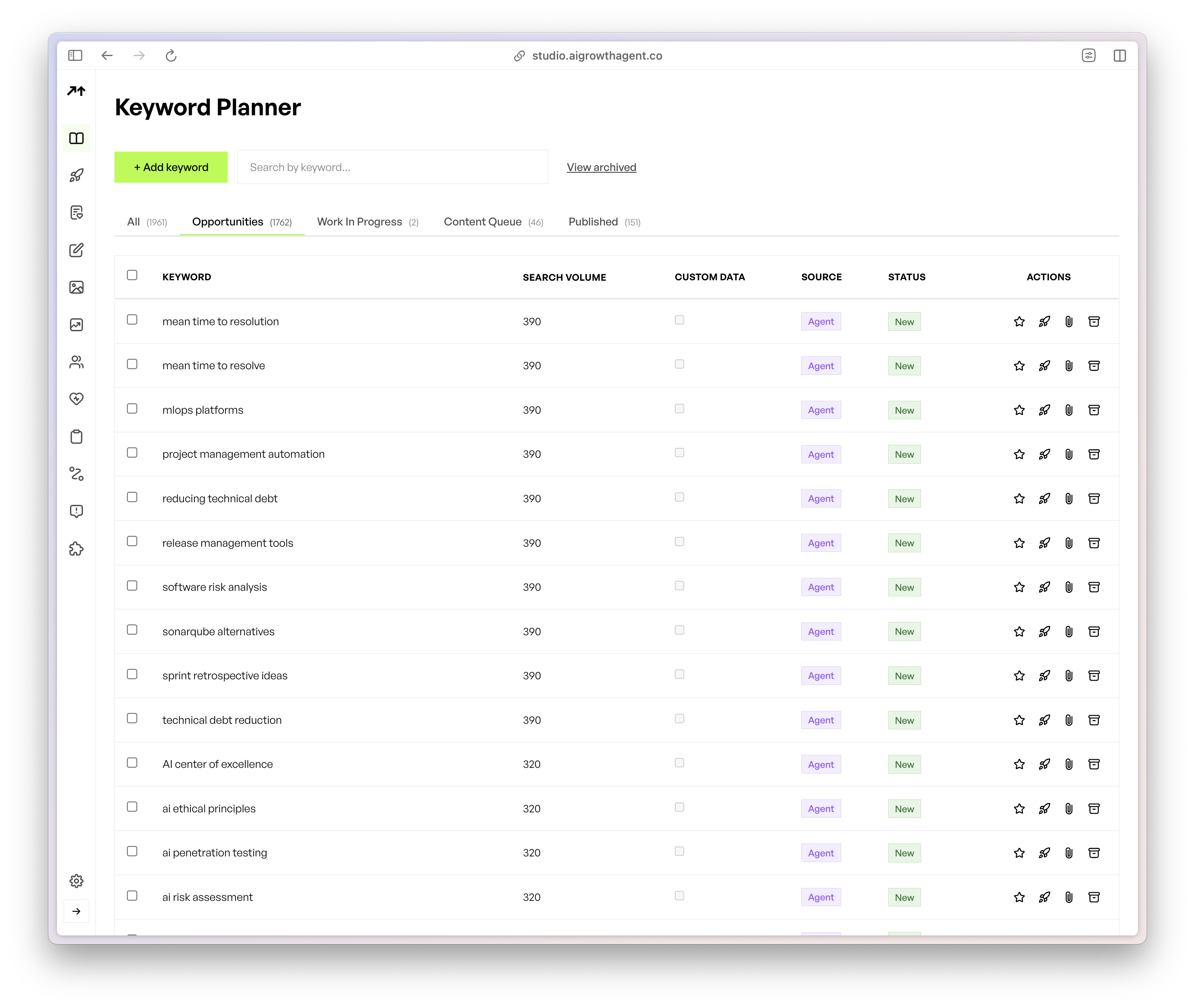
Document content gaps where competitors rank but your brand does not appear. Note pages with high traffic but low conversion rates. These pages often need restructuring into answer-ready formats that AI systems can parse and cite effectively.
Validate your assessment by checking real search results. Manually test 20 to 30 queries in ChatGPT and Google AI Overviews to see which brands currently dominate your space.
Learn how to automate this entire assessment process without manual cataloging and gap analysis.
Step 2: Run Batch Audits with Perplexity Pro Search and API
Perplexity Pro Search supports manual research with recent sources and citations, while the API enables batch processing for large content audits. The web_search tool costs $5.00 per 1,000 search calls plus token usage, so cost control matters for enterprise-scale work.
For batch audits, use Perplexity’s Agent API with the web_search tool configured for your research goals. Set search_recency_filter to “month” or “week” for current information. Use search_domain_filter to focus on authoritative sources and exclude low-quality sites.
API rate limits become real constraints at scale. Around 5% of AI model requests fail in production environments, and nearly 60% of those failures link to capacity limits. Plan for request failures and implement retry logic with exponential backoff.
Structure your batch prompts to review competitor content, surface trending topics, and analyze the current answer landscape for each query in your search universe. Save all outputs with clear source attribution so your team can use them in the next phase.
Step 3: Turn Research into Answer-Ready Outlines
Turn Perplexity research into content outlines that AI systems can parse easily. Use H2 and H3 headings that mirror common question patterns such as “What is,” “How to,” “Why does,” and “When should.” This structure helps AI systems pull relevant sections for citations.
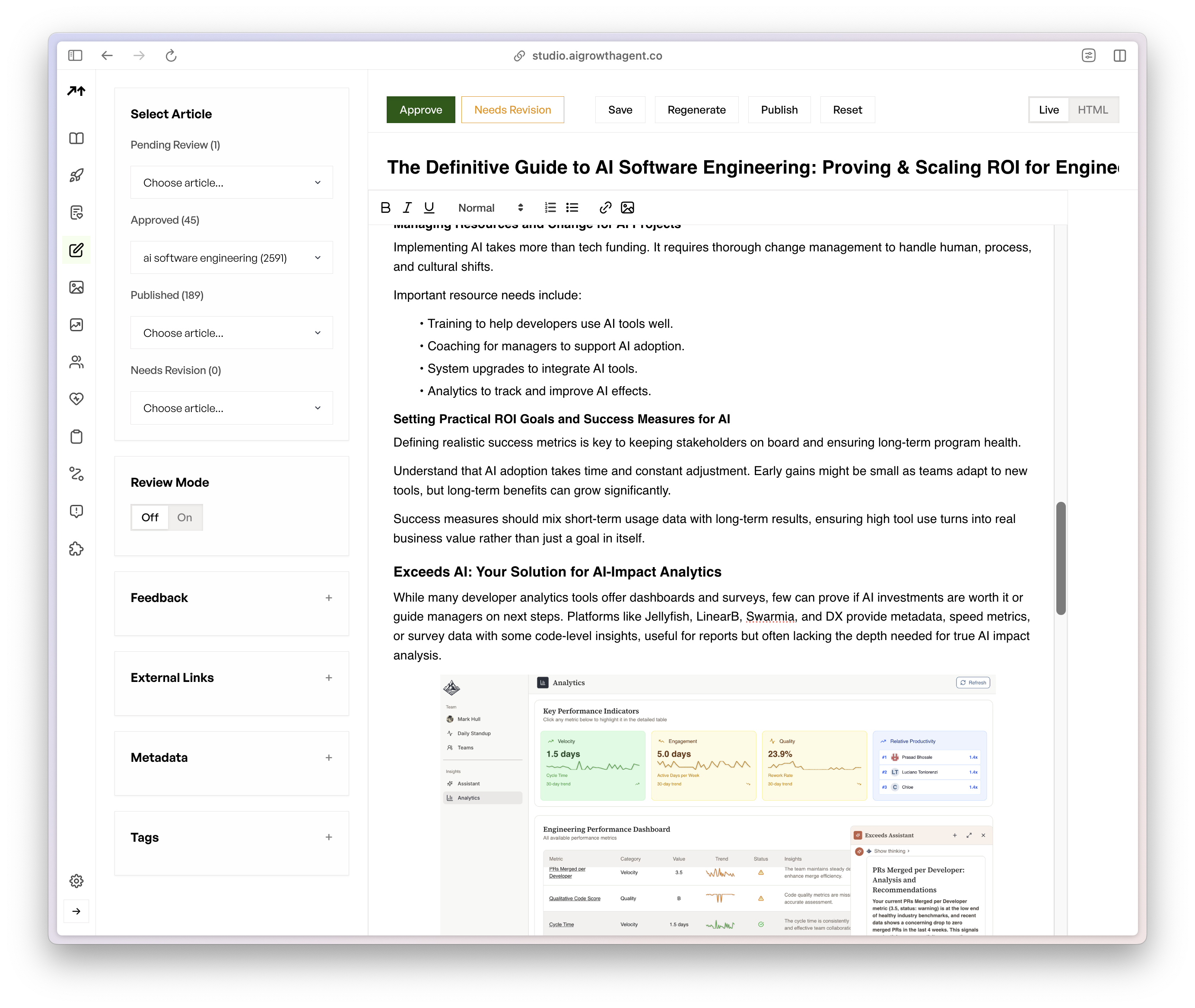
Include FAQ sections with complete answers, bullet lists for quick scanning, and clear topic sentences that summarize each key point. These structural elements make your content easier for AI systems to interpret and for humans to read, which can increase pageviews as users spend more time with well-organized material.
Specify required schema markup, internal linking opportunities, and citation requirements in every outline. Plan to fact-check every claim against primary sources, because AI systems now favor authoritative, well-sourced content.
Step 4: Connect CMS, Schema, and Publishing Workflows
Configure your CMS to support structured data markup, including Article, FAQ, and Organization schemas. WordPress users can rely on plugins that handle schema automatically. Custom CMS setups usually need developer support to implement accurate markup.
Define clear handoffs between research teams using Perplexity outputs and content teams responsible for writing and publishing. Optimization now needs to happen during content creation instead of after publication, so these handoffs should feel routine and predictable.
Set up staging environments for content review before publication. Include compliance checks for regulated industries, legal disclaimer reviews, and brand voice consistency checks.
Eliminate these technical integrations with a turnkey solution that handles CMS, schema, and publishing workflows automatically.
Step 5: Publish, Refresh, and Track Incremental Visibility
Run weekly content refresh cycles to keep information current and protect search visibility. Content intelligence highlights evergreen pieces worth refreshing and uses smart linking to connect new content to your archive.
Track bot traffic through server logs or analytics tools to understand AI system crawling behavior. Monitor Google Search Console for impression changes and ranking shifts. Use manual testing in ChatGPT and Google AI Overviews to confirm citation rates.
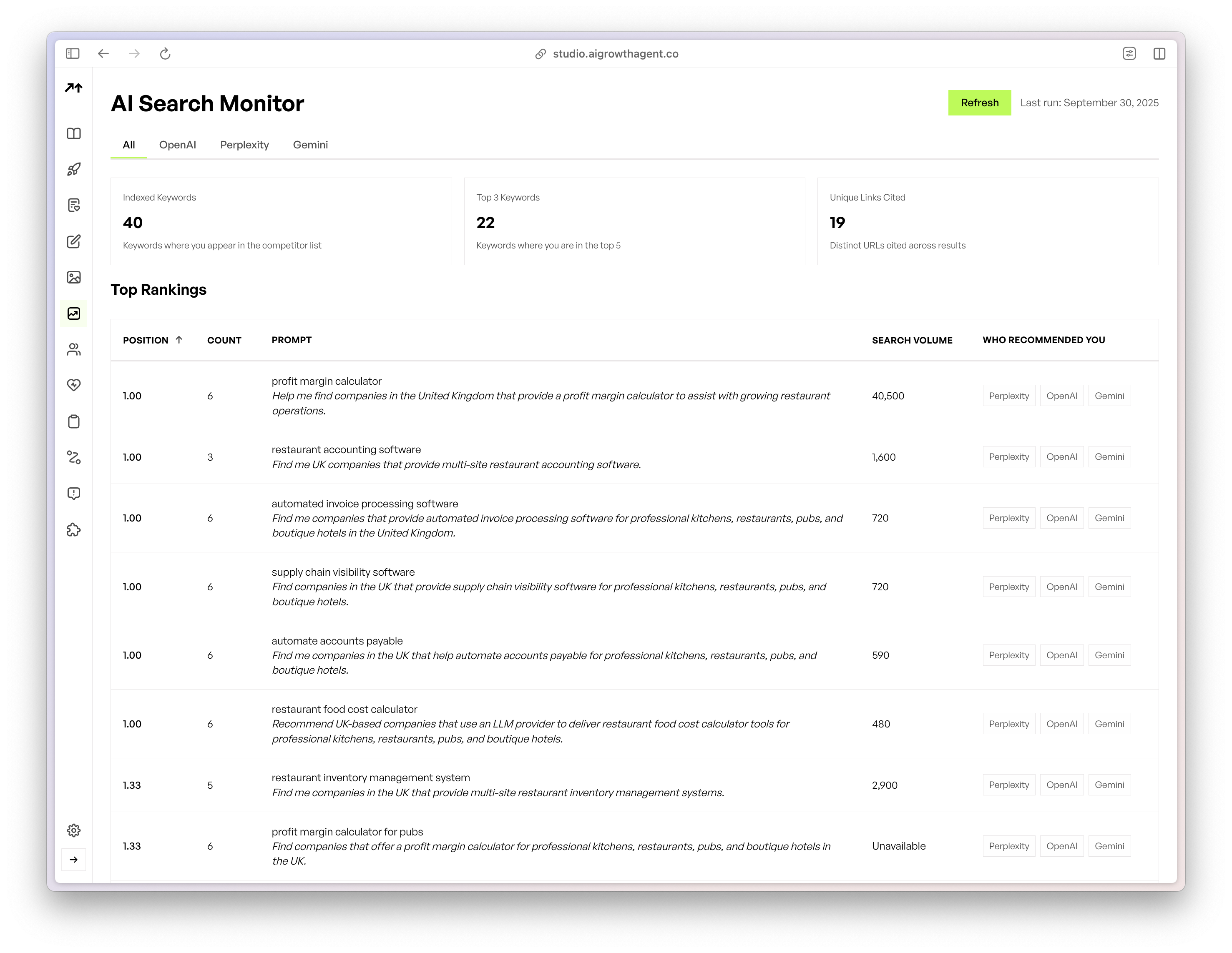
Establish baselines before you roll out changes so you can measure incremental improvements. Document which content pieces drive the most AI citations and invest in similar formats and topics.
Common Mistakes and How to Fix Them
Rate limit errors appear when API usage exceeds Perplexity’s capacity constraints. Use exponential backoff and request queuing to handle failures gracefully. Watch costs closely, because research-heavy workflows can trigger unexpected API charges.
Hallucination risk rises when teams rely only on AI-generated research without human review. Always verify claims against primary sources and keep editorial oversight in place for accuracy and brand compliance.
Inconsistent outputs often come from ad hoc prompting. Large language models respond best to clean instructions and clear constraints instead of casual, one-off prompts. Standardize your prompt patterns to improve reliability.
Missing schema markup prevents AI systems from parsing and citing your content correctly. Audit published pages on a regular schedule to confirm proper implementation across all content types.
Verifying Outcomes with Clear Metrics and Cadence
Track search rankings, organic traffic growth, and AI citation rates as your primary success metrics. AI KPIs work best on staggered cadences: weekly for adoption and usage, monthly for delivery and quality, and quarterly for ROI.
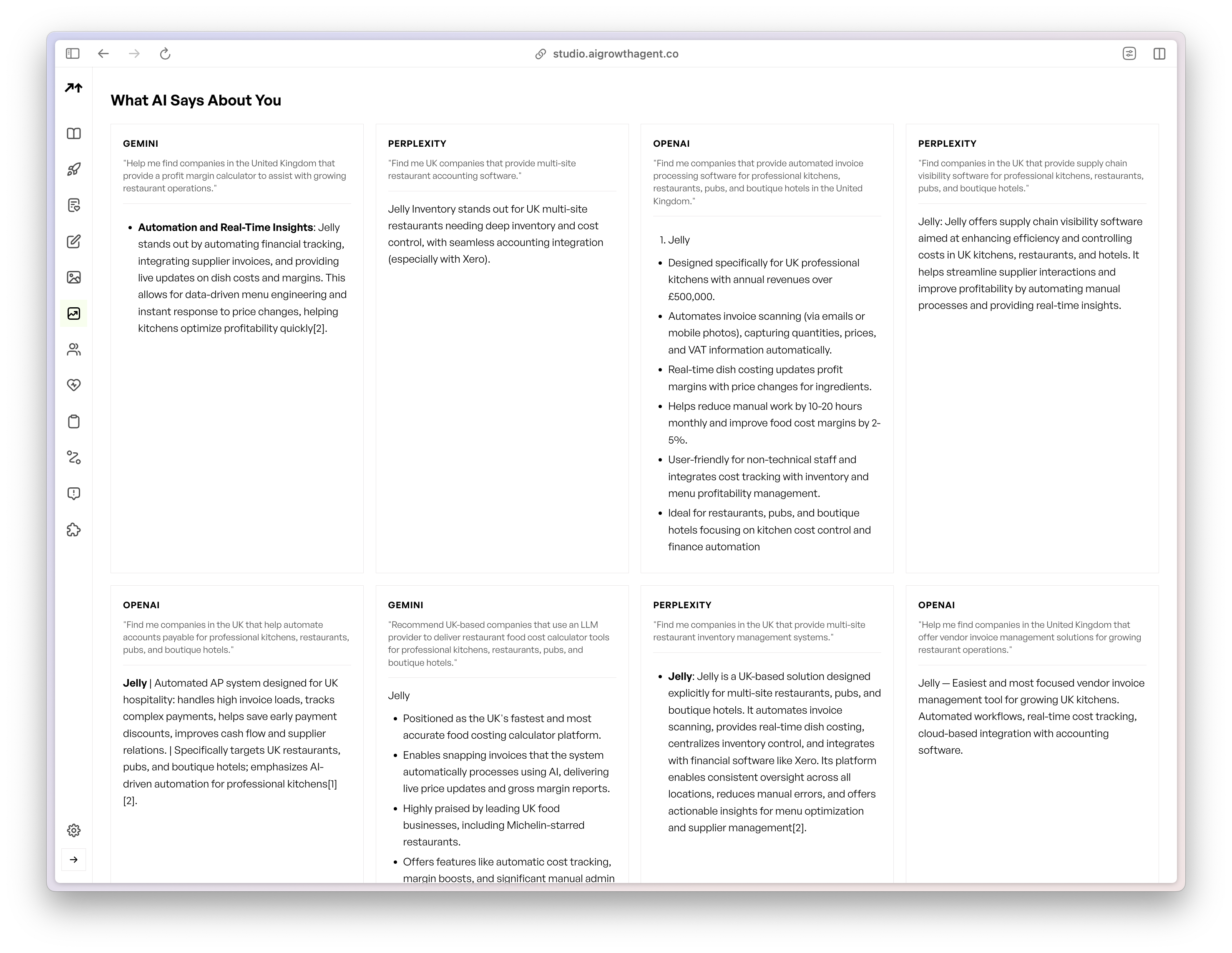
Monitor bot traffic patterns to see how AI systems crawl and index your content. Rising bot visits often signal upcoming gains in conversational search citations.
Use Google Search Console impression data to measure visibility improvements for target queries. Cross-check those results with manual testing in ChatGPT and Perplexity to confirm real citation performance.
Advanced Use Cases for Multi-Domain and Large Libraries
Managing optimization across multiple domains or very large content libraries can overwhelm manual Perplexity workflows. Cost creep and tool sprawl often appear when many models and agents run in parallel, which drives up cloud, licensing, and integration costs.
Organizations with hundreds or thousands of pages need automated systems for content auditing, gap analysis, and refresh cycles. Manual processes become bottlenecks once content volume exceeds the team’s capacity for regular updates and structured optimization.
When Perplexity Alone Stops Scaling
Manual and semi-automated Perplexity workflows hit hard limits that block true enterprise scaling. API rate limits cap research volume, manual prompting produces uneven outputs, and content grows stale without continuous optimization.
AI Growth Agent replaces the entire manual workflow with an autonomous engine that maps your complete search universe, produces living self-healing content, and proves incremental visibility through comprehensive measurement. The following table shows how this autonomous approach removes the core bottlenecks that keep manual Perplexity workflows from scaling.
| Capability | Perplexity Manual Workflow | AI Growth Agent Autonomous Engine |
|---|---|---|
| Search Universe Mapping | Limited by API rate limits and manual prompt creation | Complete universe of seed terms and long-tail queries, refreshed weekly |
| Content Production | Generic prompts cause models to output the mathematical average of the internet | Authoritative content grounded in Company Manifesto and brand positioning |
| Content Updates | Manual refresh cycles that require ongoing team coordination | Living, self-healing content with automated batch updates |
| Technical Implementation | Requires CMS integration, schema setup, and ongoing maintenance | WordPress plugin with full schema, MCP support, and bot tracking |
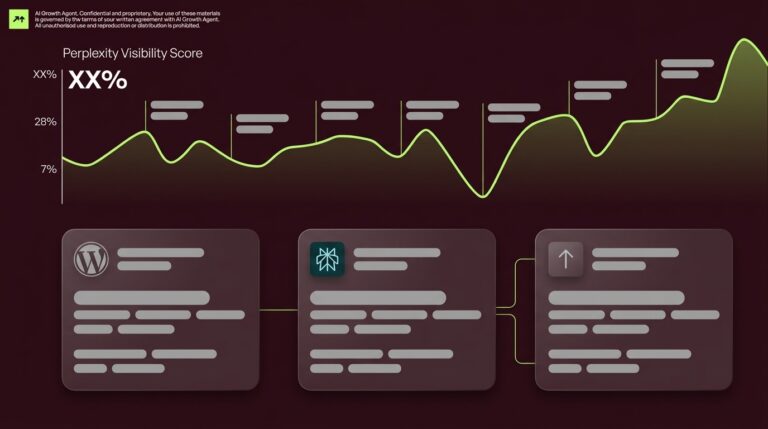
| Measurement | Fragmented tracking across multiple tools and dashboards | Incremental visibility reporting that isolates AI Growth Agent contributions |
The Content Topology provides strategic intelligence that manual keyword research cannot match. It tracks hundreds of queries across your market with competitor analysis and real-time positioning data. This comprehensive view gives your team narrative control at scale.
Frequently Asked Questions
How long does it take to see results from large-scale content optimization?
Perplexity workflows typically deliver measurable time savings, such as 45–90 minutes per day or 10+ hours per week, as soon as teams integrate them and use them consistently. These gains appear without long setup or indexing delays.
What team size is needed to manage Perplexity-based content workflows?
Enterprise-scale implementation usually involves technical, strategic, writing, and analytical roles working together. Smaller teams can handle basic workflows but often struggle with the coordination required for large libraries.
How do you prevent AI hallucinations in research-heavy content?
Use multi-layer fact-checking by verifying every claim against primary sources, keeping editorial oversight for accuracy review, and setting clear rules for acceptable source types. Avoid relying solely on AI-generated research without human validation.
What are the main cost considerations for scaling Perplexity workflows?
API costs rise with research volume, coordination overhead grows with content production, and technical maintenance demands ongoing developer time. Many organizations underestimate the total cost of ownership for manual AI workflows at enterprise scale.
When should organizations switch from manual workflows to autonomous systems?
Consider autonomous options when API rate limits restrict research volume, team coordination slows content production, manual processes cannot keep hundreds of pages fresh, or fragmented measurement makes incremental results hard to track.
Conclusion: Moving from Manual Effort to Autonomous Narrative Control
Perplexity AI offers strong research capabilities that speed up content audits and gap analysis for enterprise teams. Manual workflows, however, reach their limits when you try to extend them from basic research into full-funnel optimization across large libraries.
The key is recognizing when manual coordination, API constraints, and scattered measurement prevent your team from achieving real narrative control in AI search. At that point, the autonomous approach described above becomes essential for competitive advantage.
Successful content optimization still depends on strategy-first thinking, disciplined execution, and continuous measurement. Whether you rely on manual Perplexity workflows or adopt autonomous systems, the goal stays the same: make your brand the authoritative answer across your entire search universe.
Explore autonomous narrative control that maps your search universe and delivers incremental visibility on autopilot.