Written by: Mariana Fonseca, Editorial Team, AI Growth Agent
Key Takeaways
- Competitor AI share of voice tracks how often your brand appears in AI answers versus rivals across mentions, citations, placement, and empty space.
- Accurate measurement depends on a brand manifesto, real-time data access, a mapped prompt set, and Search Intelligence that exposes gaps and opportunities.
- The six-step process covers mapping competitors, building prompts, scoring on four dimensions, calculating empty space, benchmarking to a 30% target, and turning gaps into content.
- Empty space above 40% highlights the strongest opportunity, where the first authoritative content usually wins citations by default.
- Traditional search tools show where your brand stands today. Book a kickoff with AI Growth Agent to turn that visibility into AI answers that feature your brand.
Why Competitor AI Share Of Voice Now Decides Narrative Control
Customer discovery has shifted from blue links to AI answers, and that shift is accelerating. On these AI surfaces, AI chatbots recommend 5–8 brands on average per answer, varying by model (for example, 5.3 for Perplexity and 8.4 for ChatGPT). AI search behaves as a zero-sum channel in a way traditional search never did.
For mid-market and enterprise teams, competitor AI share of voice reveals exactly where narrative control is slipping away. The metric maps the full universe of seed terms and long-tail queries your buyers actually ask. It scores every rival across four dimensions and exposes the empty space where no brand is winning yet. Without this measurement, marketing decisions rely on a rearview mirror. With it, every content investment targets a specific gap.
This is where the right measurement infrastructure becomes critical. Traditional search tools show you where your brand stands, but they cannot close the gaps. AI Growth Agent operationalizes the six-step process below so your brand becomes the answer across AI surfaces. Book a kickoff and see your first article live within a week.
Core Inputs for Competitor AI Share Of Voice
Competitor AI share of voice runs on four core inputs that work together as a system. First, a brand manifesto acts as a single source of truth for voice, factual references, deny lists, and the claims the brand owns. This keeps every article and answer consistent.
Second, real-time data access across Google and ChatGPT replaces cached snapshots, because AI citations can shift significantly month to month for identical queries, with 40% to 60% of cited URLs changing in some categories. This live feed powers the third input, a Content Planner that maps seed terms to long-tail queries with evidence behind each one. The planner shows which questions are already covered and which remain open.
Fourth, Search Intelligence reveals who is winning each result, which domains and URLs rank, and where the white space sits. Together, these inputs create a governed environment where every prompt, response, and content decision ties back to a documented strategy.
Roles stay simple. The CMO or Builder acts as decision-maker, defines which seed terms matter, and approves the prompt set. The engine executes searches, scores rivals, calculates empty space, and feeds results into content production. No technical team is required on the brand side.
Stop letting AI define your brand at random. Control the narrative across online search. Book a kickoff with AI Growth Agent.
Six-Step Workflow for Competitor AI Share Of Voice
The measurement workflow runs in six steps: map the full competitor universe, build a prompt set, apply the four-dimension scoring rubric, calculate empty space percentage, benchmark against the 30% healthy share of voice target, and convert low scores into specific content actions through headless marketing.
Initial data from LLM tracking platforms suggests that 30% AI share of voice or platform parity in a primary category is a reasonable first target. In fragmented markets with many competitors, 15% may represent category leadership. In consolidated markets with two or three dominant players, anything below 30% signals a brand that is losing ground. Momentum matters as much as the raw number, so a brand moving from 8% to 14% over 60 days is on the right track.
The brands cited in AI search this year are training the next generation of models with their own story. See how to be one of them.
Step-by-Step Guide to Measuring Competitor AI Share Of Voice
Step 1: Map the Full Competitor Universe
Goal: Identify every brand competing for AI mentions across your market, not just the names you already know.
Sequence: Run real-time searches across Google and ChatGPT for your primary seed terms. Collect every brand that appears in AI-generated answers, AI Overviews, and organic results. Expand to long-tail queries beneath each seed term, because robots search the long tail and most brands miss it.
Inputs and tools: Real-time Google and ChatGPT data, Search Intelligence, and a seed term list from the Content Planner.
Roles: The CMO or Builder defines the seed terms. The engine runs searches and aggregates competitor names.
Validation: Cross-reference the competitor list against AI Overview results and ChatGPT recommendations for at least ten seed terms. Any brand appearing in more than 20% of responses belongs in the universe.
Visual note: A universe map at this stage looks like a hub-and-spoke diagram, with each seed term at the center and competitor domains radiating outward by frequency of appearance.
Step 2: Build a 50-Prompt Starter Set
Goal: Create a representative, bias-free prompt set that reflects real buyer language across funnel stages.
Sequence: Start with baseline brand and category questions. Add voice-of-customer data from sales calls, support tickets, and win/loss interviews. Mine communities like Reddit for pre-awareness questions and triangulate against search data such as keywords and People Also Ask boxes. Segment prompts by product or category entry point, funnel stage, and persona.
Inputs and tools: CRM data, sales call transcripts, Search Intelligence query fan-out, and People Also Ask results.
Roles: The CMO or Builder approves the final prompt list. The engine generates long-tail variants and validates against real-time AI results.
Validation: Each prompt must mirror a question a real buyer would ask. Remove any prompt that is brand-specific to your own company. The goal is category-level coverage where competitors appear naturally.
Visual note: A prompt-set table organizes prompts by funnel stage, persona, and seed term, with a column for the AI surface each prompt runs on.
| Prompt | Funnel Stage | Persona | AI Surface |
|---|---|---|---|
| Best adjustable bed retailers in Canada | Bottom | Consumer | ChatGPT, Google AI Mode |
| Healthiest fast-casual franchise to invest in | Bottom | Franchisee | ChatGPT, Perplexity |
| What is Banking as a Service in Brazil | Top | Enterprise CMO | ChatGPT, Google AI Mode |
| Best restaurant inventory management UK | Bottom | Builder | ChatGPT, Perplexity |
| Most recommended healthy franchise US | Bottom | Franchisee | ChatGPT, Google AI Mode |
Step 3: Apply the Four-Dimension Scoring Rubric
Goal: Score every competitor across mentions, citations, placement, and empty space to produce a complete picture of narrative control.
Sequence: Run the full prompt set across target AI surfaces. For each response, record whether each competitor brand is mentioned by name, whether its content is cited as a source, where in the response the brand appears, and whether any brand fills the response or the answer is unbranded.
Inputs and tools: Real-time ChatGPT and Google AI Mode responses, Search Intelligence, and bot tracking data.
Roles: The engine runs prompts and records scores. The CMO or Builder reviews the competitor scoring table and flags anomalies.
Validation: Re-run any prompt where the response changes significantly between two runs within 24 hours. AI search results are volatile, with brand mentions, citations, and recommendations changing across platforms, prompts, locations, and time.
The table below shows a representative competitor scoring snapshot across the healthy fast-casual franchise category, using the four-dimension rubric. Placement is described in prose because ordinal position is not directly comparable to percentage-based mention and citation scores.
| Brand | Mention Rate (%) | Citation Rate (%) | Placement |
|---|---|---|---|
| Breadless | 84 | 72 | First or second in most responses |
| Sweetgreen | 61 | 13 | Mid-response, rarely primary recommendation |
| CAVA | 55 | 18 | Mid-response, grouped with alternatives |
| Rush Bowls | 38 | 9 | Trailing mention, rarely cited |
Breadless mention and citation figures are drawn from AI Growth Agent client results. Competitor figures reflect relative positioning within the same search universe and are described directionally based on Search Intelligence data.
Step 4: Calculate Empty Space Percentage
Goal: Quantify the share of AI responses where no brand wins a mention, revealing the largest opportunity in the universe.
Sequence: For each prompt in the set, record whether the AI response contains any brand mention at all. Divide the number of unbranded responses by the total number of responses and multiply by 100.
Empty Space (%) = (Responses with no brand mention ÷ Total responses) × 100
Inputs and tools: Scored prompt-set responses from Step 3 and Search Intelligence.
Roles: The engine calculates empty space per prompt and per seed term cluster. The CMO or Builder prioritizes clusters with the highest empty space for immediate content action.
Validation: Treat any seed term cluster with empty space above 40% as a priority target. These queries lack a trusted source, so the first brand to publish authoritative content against them usually wins by default.
Visual note: A heat map of empty space by seed term cluster makes prioritization immediate, with dark cells indicating high empty space and high opportunity.
Step 5: Benchmark Against the 30% Healthy Share Of Voice Target
Goal: Classify your brand’s current AI share of voice as a visibility problem, an established position, or category leadership.
Sequence: Calculate your brand’s AI share of voice using the standard formula: AI Share of Voice = (Number of AI responses mentioning your brand ÷ Total AI responses for your prompt set) × 100. Apply this calculation per platform, such as ChatGPT, Perplexity, and Google AI Mode, before producing an aggregate score.
Apply these benchmarks: below 20% indicates a visibility problem, 20% to 50% indicates an established player, and 50% to 90% indicates category leader territory for bottom-of-funnel, solution-aware prompts. Use 30% AI share of voice or platform parity in a primary category as the initial target based on early LLM tracking data.
Inputs and tools: Scored prompt-set data from Steps 3 and 4 and per-platform response logs.
Roles: The engine calculates scores per platform and in aggregate. The CMO or Builder sets the target threshold and identifies which platforms show the largest gap.
Validation: Track momentum week over week. A brand improving from 8% to 14% over 60 days is moving in the right direction even before it reaches the 30% target.
Step 6: Turn Low Share Of Voice Into Published Content
Goal: Turn every gap identified in Steps 3 through 5 into a specific published article that closes the gap and earns the citation.
Sequence: For each seed term cluster where your brand scores below the 30% target or where empty space is high, identify the prompts driving the gap. Map each prompt to a content type such as guide, comparison, listicle, or explainer based on what is already winning the result. Feed the prompt list into the Content Planner. Publish authoritative, self-healing content against each one through headless marketing, with technical SEO, schema, and agentic discovery built in from day one.
The Princeton GEO paper tested nine tactics and found five that boosted AI citation rates by 30-41%, including quotation addition, statistics addition, and source citations. Every article produced through AI Growth Agent applies these levers by default, with validated primary sources behind every claim.
Inputs and tools: Gap analysis from Steps 3 to 5, the Content Planner, Search Intelligence, the manifesto, and the headless marketing engine.
Roles: The CMO or Builder approves the content priority list. The engine produces, publishes, and self-heals articles on autopilot.
Validation: Track bot visits and citation rate per article within two weeks of publication. AI Growth Agent clients average more than 12,000 additional AI citations and mentions across the first twelve weeks.
| Gap Prompt | Current Brand SoV (%) | Content Action | Target Platform |
|---|---|---|---|
| Best adjustable bed for back pain Canada | 12 | Authoritative guide with clinical citations | ChatGPT, Google AI Mode |
| Healthiest fast-casual franchise to invest in US | 8 | Franchise comparison with ROI data | ChatGPT, Perplexity |
| Top Banking as a Service platforms Brazil | 15 | Category explainer with product specifics | ChatGPT, Google AI Mode |
| Restaurant inventory management software UK | 0 (empty space) | Definitive how-to guide | ChatGPT, Perplexity |
Every gap identified in this step becomes a published article that earns the citation. Book a kickoff and turn your measurement into momentum within a week.
Common Mistakes and Troubleshooting in Competitor AI Share Of Voice Measurement
Prompt-set bias. A prompt set built only from head terms the brand already tracks misses the long tail where most AI citations occur. Effective prompt sets require voice-of-customer data from sales calls, support tickets, and community sources like Reddit, not just keyword lists. Audit the prompt set quarterly to stay aligned with evolving buyer language and AI model updates.
Ignoring empty space. Many teams focus on where competitors are winning and overlook prompts where no brand wins at all. Empty space is the highest-leverage opportunity in the universe. A brand that publishes authoritative content against an uncontested prompt wins the citation by default, with no competitive displacement required.
Failing to refresh data weekly. A snapshot taken once per quarter does not qualify as a measurement system. Weekly refreshes are the minimum cadence for a measurement that drives content decisions, given the volatility documented earlier. AI Growth Agent runs more than 3,000 searches every week just to maintain a current universe snapshot for each client.
Run your marketing the way the brands cited in AI search are running it, headless, by and for the robots, with no headcount. Book a kickoff with AI Growth Agent.
How to Verify Outcomes and Measure Results
Incremental visibility reporting isolates what new content actually generated, separate from visibility the brand already had. AI Growth Agent publishes into a separate environment and reports week over week where content is indexing, where new visibility is being driven, and where the two overlap.
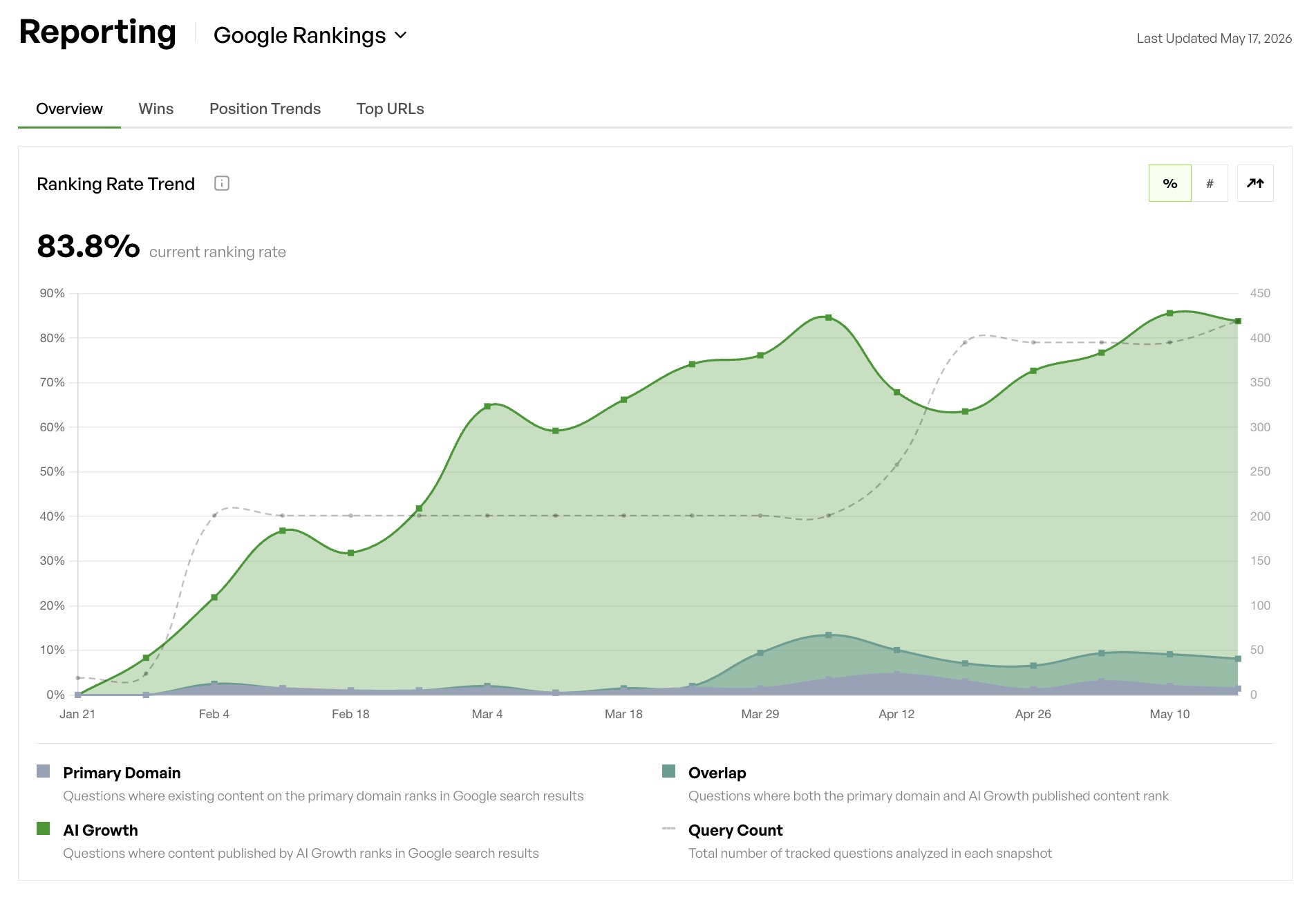
Bot tracking records every bot that touches the published content, including the bot ChatGPT uses to cite sources. This signal confirms that an article has entered the citation pipeline. Leva Sleep’s content is cited by ChatGPT more than 10,000 times per month, and Breadless content is cited more than 45,000 times per month. Both figures appear in per-article bot tracking logs.
Google Search Console serves as an independent audit. Cross-referencing Search Console impressions against bot tracking data and AI citation counts produces a three-signal confirmation that content is working. Breadless grew from 387,000 to 12.3 million Google Search Console impressions over six months using this measurement approach.
AMEC’s GEO measurement framework establishes that rigorous measurement requires a governed query library, documented methodology, repeat testing, and saved outputs as evidence, not a single dashboard screenshot. Apply the same standard to competitor AI share of voice by documenting every prompt run, saving every response, and tracking changes over time.
Scaling AI Share Of Voice and Planning Next Steps
Scaling from a 50-prompt starter set to a universe of 1,600 or more queries follows the same logic as the initial build, applied systematically across every seed term cluster. Mature AI Growth Agent clients reach universes of this size and run more than 3,000 searches weekly to keep the snapshot current. At this scale, the Content Planner becomes the operational center, showing which queries are ranking, which are not, and where internal linking can lift underperforming articles without new content production.
Platform changes require adaptation. When Google releases a new AI surface or ChatGPT updates its citation behavior, the prompt set and scoring rubric need review against the new response format. Momentum matters as much as raw AI share of voice, so a brand that tracks weekly can detect a platform shift within days and respond before competitors notice.
Enterprise teams managing multiple brands or markets benefit from parallel engines running separate universe maps and content topologies. Bisutti runs two parallel AI Growth Agent engines, one for consumer events and one for corporate events, each with its own universe map. AI Growth Agent now drives 71% of Bisutti’s brand mention visibility across both engines.
Get found across online search without managing another tool or agency. Talk to AI Growth Agent and go live in about a week.
Frequently Asked Questions
How long does it take to see results after publishing content to close an AI share of voice gap?
Most content indexes within ten days of publication and often within two weeks. AI citation rates usually begin to move within the first month for most clients. The standard engagement is a three-month pilot because indexing timelines vary by industry and query competitiveness, but bot tracking and Search Console signals appear early. Clients who track weekly can see momentum building within the first 30 days.
Who should own competitor AI share of voice measurement inside an organization?
The CMO, VP of Marketing, or founder acting as chief marketing officer should own this measurement. It is a strategic discipline that drives content investment decisions and narrative control, not a tactical SEO task. The internal team does not need technical skills to run it. The engine handles prompt execution, scoring, and reporting. The decision-maker defines which seed terms matter, approves the prompt set, and sets the target threshold for each category.
What technical dependencies are required to run this measurement at scale?
Real-time access to Google and ChatGPT data is the core dependency. Cached or sampled data produces scores that do not reflect current AI behavior. Beyond data access, the measurement system requires a Content Planner that maps seed terms to long-tail queries, Search Intelligence that shows which domains and URLs are winning each result, and bot tracking that confirms when published content enters the citation pipeline. AI Growth Agent provisions all of these as part of its standard package, with no engineering work required from the client.
How is AI share of voice different from traditional share of voice?
Traditional share of voice measures brand presence across paid media, organic search rankings, and earned media relative to competitors. AI share of voice measures how frequently a brand appears in AI-generated answers across a defined prompt set, tracking mentions, citations, and placement in responses rather than ranking positions. AI answers typically surface only three to five brands per response, with one receiving the primary recommendation. This structure makes AI share of voice a zero-sum metric in a way traditional share of voice is not. A brand that does not appear in an AI answer is invisible to the user, regardless of how it ranks in traditional search.
Can AI share of voice measurement be applied across multiple languages and markets simultaneously?
Yes. The same four-dimension scoring rubric applies across languages and markets, with prompt sets built from voice-of-customer data specific to each market. The universe map, seed terms, and long-tail queries differ by market because buyer language and competitive landscapes differ. AI Growth Agent supports clients across the United States, Canada, Brazil, and Europe, running separate universe maps per market where needed. Bisutti’s two parallel engines, one for consumer events and one for corporate events in Brazil, show how the same measurement architecture scales across distinct buyer journeys within a single market.
Conclusion
Competitor AI share of voice functions as a weekly measurement discipline, not a one-time audit. It maps the full universe, scores rivals across four dimensions, identifies empty space, and feeds a content production system that closes gaps before competitors notice them. The brands that establish authoritative content now are training the next generation of AI models with their own narrative, while brands that wait cede that ground to whatever happens to be sitting on the open web.
Ongoing review and adaptation to platform changes are mandatory. AI citation behavior shifts month to month, prompt sets need to reflect evolving buyer language, and empty space closes the moment a competitor publishes against it. The measurement system must run continuously, not quarterly.
The brands that build this infrastructure now will own how AI describes their category. Book a kickoff with AI Growth Agent and make your brand the answer.