Written by: Mariana Fonseca, Editorial Team, AI Growth Agent
What You Will Get From This AI Search Playbook
- AI search optimization in 2026 focuses on becoming the cited answer in zero-click AI environments like ChatGPT and Perplexity, not just ranking for clicks.
- Entity authority grows through four data pillars: Search Intelligence, AI Analytics, Bot Tracking, and AI Ranking, supported by structured content, schema, and third-party coverage.
- Mapping the full query universe, including hundreds of long-tail prompts, matters because AI agents search the long tail far more than humans do.
- Agentic technical SEO tools such as Blog MCP, llms.txt, and self-healing content formats help AI agents reliably discover, parse, and cite brand material.
- AI Growth Agent delivers measurable incremental visibility with first articles live in one week. See the full system in action.
Building Entity Authority Across Four Data Pillars
Entity authority functions as the GEO equivalent of domain authority. AI systems build knowledge graphs that associate entities with expertise signals to determine citation selection. Four data pillars feed that graph for any brand running AI search optimization in 2026.
Search Intelligence maps the traditional search landscape, covering positioning, competition, and search volume, and turns raw situation into an actionable diagnosis. AI Analytics tracks brand value and consumer behavior across the full journey, from external touchpoints like Google and AI-tool queries through content consumption, demographics, and sentiment. Bot Tracking logs every bot interaction, traditional crawlers and AI training agents alike, including every crawl, citation, and training sweep. AI Ranking monitors where the brand appears in AI answers and how citation context evolves week over week, because AI systems cross-reference entities against anchor graphs such as Wikidata, Crunchbase, LinkedIn, and academic citations, and missing or contradictory presence in these graphs causes loss of trust weight.
Brands need a coordinated set of tactics to strengthen these four pillars. Start with Wikipedia-style brand definitions that establish baseline entity recognition. Add Organization schema with sameAs and knowsAbout fields to formalize relationships for AI systems. Earn coverage in publications AI systems consistently cite, because third-party validation carries more weight than self-published claims. Keep brand naming consistent across every directory and review platform to prevent entity confusion. Brands are more likely to be cited in AI search through third-party sources than through their own domains, so entity authority grows off-site as much as on it.
See how AI Growth Agent maps your entity authority across all four pillars from day one.
Mapping the Full Query Universe Your Buyers Actually Use
Most brands track a handful of head terms and lose the rest of the conversation by default. The full query universe is the complete set of prompts and queries that describe a brand’s market, head terms and long tail together, and robots search the long tail far more than humans do.
The evidence-based approach uses real-time AI Overview and ChatGPT search results as the objective function for identifying which long-tail queries deserve attention. Non-branded prompts predominantly surface third-party listicles in AI answers, while branded prompts more often surface owned content. A complete universe map therefore requires distinct content strategies for each prompt type.
A new AI Growth Agent account typically starts with three to four hundred queries organized into a Content Topology, a hierarchy of seed terms each backed by real-time data with dozens of long-tail queries beneath it. Mature clients reach universes of 1,600-plus queries, and the system runs 3,000-plus searches every week just to refresh the snapshot. Off-site factors such as branded search volume, third-party mentions, and entity recognition show the strongest correlations with AI Overview brand mentions, outweighing on-page SEO factors alone. The universe map therefore guides both content production and outreach targeting.
Content overlap between ChatGPT, Perplexity, and Google AI Overviews is low, which means a capped prompt tracker covering one engine misses the majority of the conversation. AI Growth Agent tracks all three surfaces simultaneously, and prompt count never appears as a billed metric.
Formats That Help AI Systems Extract and Trust Your Content
Content that looks beautiful to a human and is invisible to a bot does not help the brand. It functions as decoration. The formats that earn citations in 2026 solve this by addressing three requirements in sequence. First, they must be structured for machine parsing so AI systems can extract the information reliably. Second, they must be backed by validated primary sources so the extracted information carries trust weight. Third, they must be refreshed often enough that the next training sweep finds the current narrative rather than stale claims.
Effective content strategy for AI Overviews and Featured Snippets requires clear H2 and H3 headings matching question-based queries, 40 to 60 word concise paragraph answers, numbered or bulleted lists, and FAQ sections targeting People Also Ask expansions. On top of that structure, full schema markup across Article, FAQ, Organization, Product, and Author types provides AI crawlers with parseable signals about brand identity and expertise.
Living, self-healing content extends this foundation. When the year turns, every article in a sector refreshes automatically. Every article’s relationships, performance, and bot and Search Console data sit in one place so authority compounds instead of decaying. The technical layer that makes content discoverable to agents includes llms.txt and llms-full.txt files published so AI surfaces can read the brand the way they need to, Markdown served to agent crawlers, and /.well-known/ endpoints for OpenAI discovery and Agent Card guidance. The technical layer deploys immediately, with the client’s site live and ready to publish from day one.
Agentic Technical SEO That Serves AI Surfaces
Traditional technical SEO remains table stakes in 2026. Brands still need highly structured HTML, full metadata on every asset, rich schema markup, internal linking, sanitized external linking, proper sitemaps, a detailed robots.txt, automated web stories, instant indexing, autoredirects, and 404 tracking. Agentic technical SEO sits above that layer and focuses on the surfaces that read, cite, and act on content without a human in the loop.
Blog MCP exposes schema, manifest, discovery, and capability guidance to agents and works with Chrome 146-plus and other WebMCP-enabled browsers. AI Growth Agent brought Blog MCP to market first, with clients running it in the summer of 2025, roughly a year before Google released Web MCP. Natural language query parameters via /?s={query} auto-trigger personalized, internally linked responses, so an agent passing a query straight into the URL receives a tailored answer rather than a generic page. OpenAI discovery and Agent Card guidance are served via /.well-known/ so information agents can locate and interact with the brand’s content surface programmatically.
Google launched dedicated generative AI performance reports in Search Console on June 3, 2026, providing separate views of impressions within AI Overviews, AI Mode, and generative AI features in Discover. The measurement infrastructure for agentic visibility now exists natively inside the tools CMOs already use. AI Growth Agent cross-references those signals with per-article bot tracking to decide what to publish next and which existing articles to self-heal.
Watch the full agentic technical SEO stack deploy on your domain within a week.
Proving Incremental Visibility From AI Search
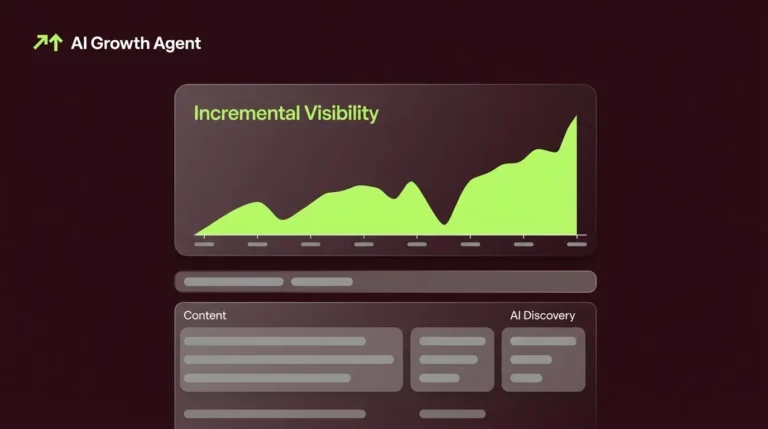
The core measurement problem in AI search is attribution. A brand that was already well-known cannot easily tell whether its AI citations come from new content or from model weights trained on years of prior coverage. Incremental visibility reporting solves this by publishing into a separate environment and reporting only what the new effort generated, week over week.
The proof stack combines four signals. Per-article bot tracking logs every crawl and citation sweep, including the bot ChatGPT uses to cite sources. Google Search Console acts as an independent audit of impressions and clicks. Citation counts are tracked across ChatGPT, Perplexity, and Google AI Mode. Branded search volume growth appears as a downstream indicator of compounding authority.
Client outcomes from the AI Growth Agent Company Manifesto show what incremental visibility looks like in practice. Leva Sleep became the most mentioned retailer for adjustable beds in Canada, with ChatGPT citing its content over 10,000 times per month and $40,000 to $50,000 in deals closed in under three weeks from AI-driven buyers. Breadless achieved a 30x lift in Google Search Console impressions over six months, from 387,000 to 12.3 million, and is now the most recommended healthy franchise in the US ahead of CAVA, Rush Bowls, and Sweetgreen. Bisutti saw AI Growth Agent drive 71% of its brand mention visibility and became the second most recommended events brand by AI in Brazil. Exceeds.ai sourced 55%-plus of its traffic from generated content and is consistently recommended across Perplexity, ChatGPT, and Google’s AI Mode. Across the first twelve weeks, AI Growth Agent clients average more than 12,000 additional AI citations and mentions, over 100,000 additional bot visits, and a 20%-plus lift in impressions.
Comparing Legacy SEO Suites, GEO Monitors, and Headless Marketing Engines
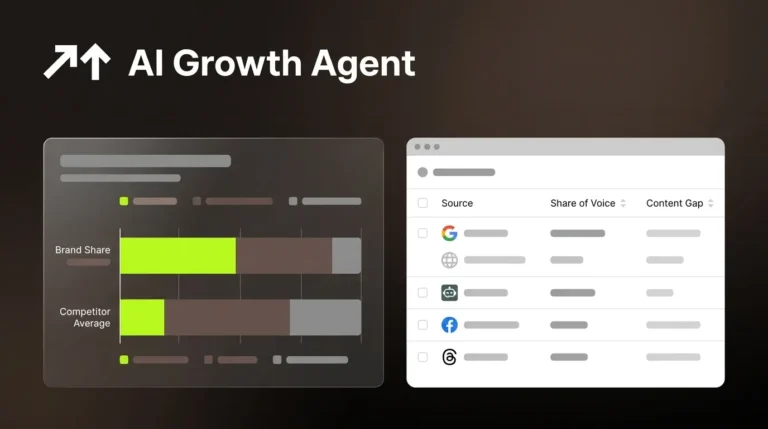
Three tool categories now shape how brands approach AI search. Speed reflects time from contract to first published, indexed asset. Scope reflects the breadth of the query universe covered. Ownership reflects whether the client controls the content and the site. Incremental visibility reflects whether the tool isolates the visibility it generated from prior brand equity.
| Category | Speed | Scope | Ownership | Incremental Visibility |
|---|---|---|---|---|
| Legacy SEO Suites (e.g., Semrush, Ahrefs) | Data available immediately, while content production requires a separate agency or team, typically 6-plus months to first assets via agency RFP | Keyword and rank data only, with no AI search coverage. AI Mode now drives a high zero-click rate on queries these tools track but cannot act on | Client owns data exports, while site and content remain with the agency or internal team | No isolation, with all visibility attributed to the brand’s existing footprint |
| GEO Monitors (e.g., Profound, Athena) | Monitoring begins immediately, with no content or site production capability | Capped prompt sets. Single-engine monitors miss most of the conversation due to the low overlap documented earlier | No owned site or content, so the client remains dependent on a separate publishing stack | Monitors existing visibility only and cannot isolate what new effort generated |
| Headless Marketing Engine (AI Growth Agent) | First article live within one week, with content indexing in as little as ten days | Full universe of 1,600-plus queries refreshed weekly across ChatGPT, Perplexity, and Google AI Mode, with prompt count never billed | Client owns the site and all content outright, with no agency dependency | Publishes into a separate environment and reports only the visibility it generated, cross-referenced with bot tracking and Search Console |
Measurement, Compounding Results, and Next Steps
The metrics that matter in 2026 are brand mention rate, citation rate, Google Search Console impressions, and bot traffic, tracked week over week against a baseline taken before the engine launched. The Search Console reports introduced in June now break out visibility by page, country, device, and date with hourly granularity, giving CMOs an independent audit that sits alongside AI Growth Agent’s own reporting.
The self-correcting loop works in a simple pattern. The engine doubles down on content that indexes well. It uses internal linking to lift content that does not. It self-heals articles that go stale before the next training sweep finds them. Tracking branded search growth, assisted conversions, and share-of-voice trends alongside AI visibility metrics connects zero-click exposure to business ROI, which is the number a CEO wants to see.
The standard pilot runs for three months, because indexing takes time and varies by industry. Most clients see movement in the first two weeks. The full compounding effect, including 12,000-plus additional citations and 100,000-plus additional bot visits, builds across the first twelve weeks and accelerates from there as the content universe expands.
Get your first article live within a week by scheduling your kickoff call now.
Conclusion: Make Your Brand the Default AI Answer
The shift from blue links to zero-click AI answers already affects every category. Semrush data showed a high zero-click rate for queries processed through Google AI Mode, and only a small percentage of users click through to verify what an AI answer says. Whatever the model says becomes, for most people, simply the answer. The brands cited in AI search this year are training the next generation of models with their own narrative. The brands that wait are training the next generation with whatever happens to be sitting on the open web.
A repeatable 2026-ready system requires five elements working together. You need a full universe map built from real-time AI data. You need entity authority across all four data pillars. You need living self-healing content in formats agents can extract. You need agentic technical SEO deployed end to end. You need incremental visibility reporting that proves what the effort actually generated. No legacy SEO suite does all five. No GEO monitor does any of them. A headless marketing engine does all five from week one.
Traditional search tools show you where your brand stands. AI Growth Agent makes your brand the answer. Book a kickoff and see your first article live within a week.
Frequently Asked Questions
What is the difference between AI search optimization and traditional SEO?
Traditional SEO focuses on rankings and click-through rates in a list of blue links. AI search optimization targets citation and mention in AI-generated answers across ChatGPT, Perplexity, and Google’s AI Mode, where the user receives the answer directly and often never visits the source. The content requirements differ. AI search requires structured, extractable formats with validated primary sources, full schema markup, and technical signals like llms.txt and Blog MCP that tell agents how to read and cite the brand. The measurement metrics differ too, shifting from organic sessions and CTR to brand mention rate, citation rate, bot traffic, and Search Console impressions from generative AI features. The strategic frame also differs. Traditional SEO defends a set of head terms, while AI search optimization maps the full query universe including the long tail where most AI-native queries actually occur.
How long does it take to see results from AI search optimization?
AI Growth Agent publishes the first article within approximately one week of kickoff, and content has indexed in as little as ten days. Most clients see initial citation movement within the first two weeks. The standard engagement is a three-month pilot because indexing timelines vary by industry and the compounding effect of a growing content universe takes time to build. The standard three-month pilot delivers the compounding effect described earlier: 12,000-plus additional citations, 100,000-plus bot visits, and a 20%-plus impression lift. Clients like Exceeds.ai received their first citation within two weeks, and Jota saw a 190%-plus traffic increase from generated content over three months. The key variable is the size of the query universe being attacked, because larger universes compound faster as internal linking amplifies authority across every article simultaneously.
What does headless marketing mean in practice for a CMO?
Headless marketing means the brand keeps its curated main site exactly as it is, while AI Growth Agent stands up a separate, fully optimized blog the brand owns, connected through a reverse proxy rewrite under a subdirectory or subdomain. The CMO does not manage a content team, an SEO agency, a web agency, a schema plugin, a GEO monitor, or a PR firm for this channel. The engine handles universe mapping, content production, technical SEO, schema, bot tracking, publishing, self-healing, and reporting. The internal team needs no technical skill. The CMO decides what to win in plain language, reviews finished articles, and watches incremental visibility reports week over week. The site and all content are owned by the brand outright, with no agency dependency and no lock-in. One flat-fee engine replaces the entire stack.
How does AI Growth Agent prove that the visibility it generates is actually new?
AI Growth Agent publishes into a separate environment, which means it can report only on the visibility that environment generates rather than taking credit for the brand’s existing footprint. Incremental visibility reporting cross-references three independent signals. Per-article bot tracking logs every crawl and citation sweep, including the specific bot ChatGPT uses to cite sources. Google Search Console acts as an independent audit of impressions and clicks from generative AI features. Citation counts are tracked across ChatGPT, Perplexity, and Google AI Mode. The reporting shows week-over-week movement in each signal, isolated to the content AI Growth Agent produced. Clients who measure best also capture traffic source at the conversion moment and consistently see a lift in organic leads after starting, which connects the citation data to business outcomes rather than leaving it as a vanity metric.
Why is the long tail more important than head terms for AI search optimization?
Head terms represent the queries a brand pre-decided to defend. The long tail represents the vast majority of the queries customers actually ask, and AI agents reason on top of user queries in ways that exponentially expand the surface area of relevant prompts. Real-time AI Overview and ChatGPT results reveal hundreds of ways a customer can ask the same question, and each variation creates a citation opportunity. Brands that only focus on head terms stay blind to most of their own market. The evidence-based long-tail approach uses real-time AI Overview and ChatGPT results as the objective function for identifying which long-tail queries deserve attention, then systematically produces authoritative content against each one. This is why AI Growth Agent’s universe maps start at three to four hundred queries and mature clients reach 1,600-plus, with the system running 3,000-plus searches every week to keep the snapshot current.