Written by: Mariana Fonseca, Editorial Team, AI Growth Agent
Key Takeaways
- Headless marketing separates brand content from traditional front ends so one autonomous engine can map queries, publish living content, and earn AI citations across ChatGPT, Perplexity, and Google AI Mode.
- Zero-click AI search now dominates discovery, with 83–93% of queries ending without clicks, so brands need authoritative content that AI surfaces can trust and cite.
- AI Growth Agent delivers measurable results in about one week instead of six months, reaching 1,600+ queries, 12,000+ new AI citations, and 20%+ impression lifts within the first twelve weeks.
- Living self-healing content and a complete technical SEO stack, including schema, llms.txt, and instant indexing, keep brand narratives current and trusted by AI models without extra headcount or agency coordination.
- Brands ready to control their AI-search narrative can book a demo with AI Growth Agent to confirm fit and get their first article live in about a week.
The Problem: AI Discovery Shift and Zero-Click Reality
Google AI Mode has grown quickly, with queries more than doubling every quarter since launch. It now acts as the primary discovery layer for a growing share of commercial intent.
The click economy that justified traditional content investment is collapsing. 83% of searches end without a click when AI Overviews are present, and that figure rises to 93% zero-click in Google AI Mode sessions. 94% of B2B buyers used generative AI tools during their purchase process in 2025. The buyer has already moved, while most marketing stacks still operate on a click-first model.
The structural problem centers on narrative control, not raw traffic loss. When a buyer asks ChatGPT which brand to trust, the model answers from whatever content it can find, trust, and cite. Monitoring tools highlight that gap but do not close it. Whoever supplies the content AI surfaces trust controls what the answer says. Traditional stacks, agency retainers, and GEO dashboards look backward. Headless marketing gives teams a steering wheel instead of a rearview mirror.
Headless Marketing vs. Headless Commerce for AI Surfaces
Headless commerce decouples the frontend presentation layer from the backend commerce engine, so each channel can select and present information through APIs. Its purpose is omnichannel shopping delivery and page-speed flexibility. Headless commerce still depends on a CMS to deliver content across channels and does not focus on controlling messaging across AI surfaces.
Headless marketing applies similar architecture to brand presence in AI search. The brand keeps its curated main site. A separate, fully tuned engine runs behind it, mapping the brand’s full universe of seed terms and long-tail queries, producing living content structured for AI crawlers, and earning citations across ChatGPT, Perplexity, and Google AI Mode. The frontend stays branded while the engine runs autonomously with no added headcount.
Benefit 1: Regain Narrative Control in AI Answers
Narrative control now means shaping the content AI surfaces use to describe a brand before a buyer forms an opinion. That requires an upstream solution that feeds the models directly.
AI Growth Agent’s Search Intelligence and AI Ranking pillars map every query in a brand’s universe, identify which domains win each result, and track citation context week over week. Order of mention and citation context replace the old ranking number. Bisutti saw AI Growth Agent drive 71% of its brand mention visibility and became the second most recommended events brand by AI in Brazil. That outcome comes from controlling what the models read, not just monitoring where the brand appears.
Benefit 2: Faster Path to First Article
An agency RFP often runs three months, followed by three more to produce the first assets. That timeline pushes nearly a year before anything goes live in a channel where the leaderboard is being written now.
AI Growth Agent moves from kickoff to the first published article in about one week, with content indexing in as little as ten days. A professional journalist interviews the client to build the brand manifesto. The keyword topology and first articles follow that foundation. By the end of week one, the engine generates content the client feels comfortable approving, and the site goes live under the brand’s own domain.
Benefit 3: Full-Universe Query Coverage
Most brands track a small set of head terms and lose the rest of the conversation by default. Robots search the long tail, where most buyer queries actually live, and that surface area expands further when an AI agent reasons on top of a user query.
Mature AI Growth Agent clients reach universes of 1,600+ queries, with the system running 3,000+ searches every week to refresh the snapshot. Real-time AI Overview and ChatGPT results define which long-tail queries deserve attention, so the topology rests on evidence instead of guesswork. Prompt count never appears as a billed metric.
Benefit 4: Living, Self-Healing Content
Static content decays after publish. When the year turns, every article in a sector needs refreshing. When a competitor moves, the content map needs updating. When a model’s training sweep runs, it reads what exists on the web at that moment, not what was accurate six months earlier.
Living content fixes this structurally. AI Growth Agent updates and self-heals articles over time, using Google Search Console signals and bot-traffic awareness to flag what needs refreshing. Every article’s relationships, performance, and indexing data sit in one place so authority compounds instead of fading. The brand’s current narrative becomes what the next training sweep finds.
Benefit 5: Clear Proof of Incremental Visibility
Leaders often hesitate to fund content because they cannot see what the new work actually generated. Blended reporting hides the incremental impact.
AI Growth Agent publishes into a separate environment and reports only what it generates. Across the first twelve weeks, clients average more than 12,000 additional AI citations and mentions, over 100,000 additional bot visits, and a 20%+ lift in impressions. Breadless achieved a 30x lift in Google Search Console impressions over six months, growing from 387,000 to 12.3 million, and is now the most recommended healthy franchise in the US ahead of CAVA, Rush Bowls, and Sweetgreen. Those numbers isolate what the engine produced instead of blending with existing brand presence.
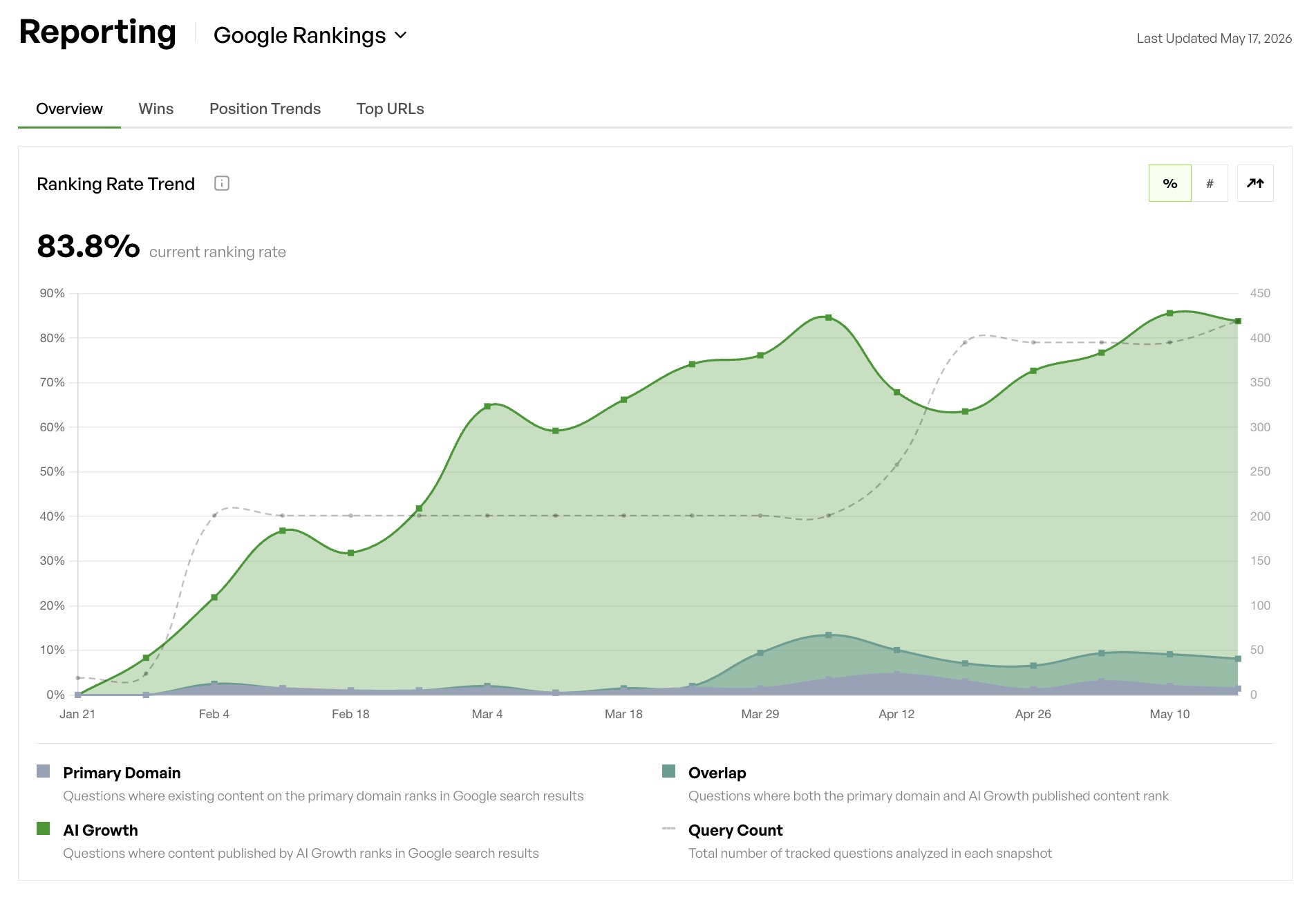
The following table summarizes how headless marketing with AI Growth Agent compares to traditional approaches across the metrics that matter most for AI search visibility.
Comparison Table: Traditional Stack vs. Headless Marketing Outcomes
| Metric | Traditional Agency Stack | DIY Chatbot | Headless Marketing with AI Growth Agent |
|---|---|---|---|
| Time to first published article | ~6 months (3-month RFP + 3-month production) | Days, but quality drifts by article two | About 1 week, as detailed above |
| AI citations earned (first 12 weeks) | Not tracked, no citation-optimized output | Zero citations reported after ~300 articles in one documented case | Results align with the +12,000 average cited in Benefit 5 |
| Bot visits (first 12 weeks) | Not isolated, no incremental reporting | Not tracked | Consistent with the +100,000 average reported earlier |
| Impression lift (first 12 weeks) | Not isolated, blended with existing brand presence | Not measured | Reflects the +20% average impression lift already established |
| Query universe coverage | Capped by agency retainer scope | Limited to prompts the user thinks to ask | 1,600+ queries at maturity and 3,000+ searches refreshed weekly |
| Technical SEO and agentic stack | Separate web agency required, schema often missing | None, client responsible for all technical setup | Full stack included: schema suite, Blog MCP, llms.txt, robots.txt, sitemaps, agent discovery, instant indexing |
| Content freshness | Stale on publish, refresh requires new retainer scope | Stale on publish, no self-healing | Living and self-healing, auto-refreshed on Search Console and bot signals |
The Two Wrong Doors for AI Search
CMOs and founders who decide to take AI search seriously usually see two options, and both create traps.
The first option is the agency RFP. Teams spend three months selecting a vendor and three more producing the first assets. Nearly a year passes before anything goes live. The agency controls the site, the briefing cycle never ends, and the output rarely arrives structured for AI surfaces. By the time the first article ships, the leaderboard has already shifted.
The second option is the DIY chatbot. Claude can write one strong article. The second requires running the entire process again, with more review rounds, schema maintenance, legal language checks, and quality that drifts from piece to piece. One company produced roughly 300 articles this way and did not earn a single citation. A chatbot functions as one step in a larger process that still needs a universe map, validated sources, full technical SEO, publishing infrastructure, and self-healing over time.
Both doors lead to the same outcome, which is content that goes stale the day it ships with no proof of what it generated.
What separates headless marketing from these failed approaches involves more than strategy. The underlying technical architecture makes AI surfaces trust and cite your content.
Technical Requirements for Headless Marketing Architecture
Headless marketing operates as an architecture, not just a content strategy. The technical layer determines whether AI surfaces can find, parse, trust, and cite the content. Pages that look polished to a human visitor but remain invisible to a bot do not function as assets. They function as decoration.
The core requirements as of 2026 include a reverse proxy that connects the blog to a subdirectory under the brand’s domain, a Blog MCP endpoint for direct agent interoperability, and structured data using Schema.org vocabulary across article, author, organization, product, review, local business, FAQ, and software application types. Google recommends JSON-LD format because it can be dynamically injected into pages via JavaScript, which suits decoupled content delivery systems.

Beyond schema, a complete headless marketing stack must address how AI agents discover and consume content. This starts with llms.txt and llms-full.txt files that present brand information in the format AI surfaces expect. To enable direct agent queries, the system needs agent discovery endpoints served via /.well-known/ and natural language query parameters at /?s={query} that return personalized, internally linked responses.
Supporting infrastructure includes Markdown rendering for agent crawlers, a proper sitemap.xml for indexing, and an advanced robots.txt that manages crawl traffic without blocking indexable content. Instant indexing, autoredirects, and 404 tracking complete the operational layer. For JavaScript-powered pages, Google recommends ensuring critical content is available without complex client-side execution. Server-side rendering or pre-rendering therefore becomes a baseline requirement for any headless marketing implementation.
AI Growth Agent provisions this entire stack automatically. Clients do not need technical skills, and every package includes the full architecture from day one.
Conclusion: Acting Before the Next Training Sweep
The discovery shift has already arrived. AI referral traffic to U.S. retail sites grew 693% year over year during the 2025 holiday season, and AI-referred visitors converted 31% better than non-AI traffic during the same period. The brands earning those citations do not reach them through monitoring alone. They control their narrative upstream, in the formats and structures AI surfaces trust, across the full universe of queries their buyers actually ask.
Headless marketing gives brands a way to control what AI surfaces say about them at scale, without extra headcount, without agency dependency, and without content that goes stale on publish. The leaderboard is being written now. Brands that establish authoritative content this year train the next generation of models with their own narrative. Brands that wait train those models with whatever happens to sit on the open web.
Frequently Asked Questions
What exactly is headless marketing?
Headless marketing is a brand presence architecture that decouples content production and AI-surface optimization from the human-facing main site. The brand keeps its curated storefront. A separate engine maps the brand’s full universe of seed terms and long-tail queries, produces authoritative living content structured for AI crawlers, and earns citations across ChatGPT, Perplexity, and Google AI Mode without requiring headcount or agency coordination. The term borrows from headless commerce, where the frontend is decoupled from the backend engine, and applies the same logic to narrative control in zero-click AI search.
How long does it take to see results from headless marketing?
As described in the speed-to-market section, the first article is typically live within one week of kickoff. Content has indexed in as little as ten days and often within two weeks. The standard engagement runs as a three-month pilot because indexing timelines vary by industry and domain authority, yet clients consistently see citation and impression movement early. Leva Sleep closed $40,000 to $50,000 in deals within three weeks of launch from buyers who discovered the brand through AI Growth Agent content. Jelly earned its first citation within three weeks and reached the number one cited position for restaurant inventory management in the UK within the same pilot window.
How does headless marketing handle brand voice and compliance requirements?
Brand voice lives in a manifesto built during a journalist-led kickoff interview. Style memories capture rules such as preferred terminology, words the brand never uses, and house conventions, and the engine applies them to every future generation without re-briefing. Legal disclaimers, claim prioritization for sensitive sectors, and anti-hallucination controls are configured once and applied automatically. Every claim, source, and quote is validated against evidence found online rather than a model’s training data, and post-draft claim re-extraction checks every assertion before an article moves further down the pipeline. Regulated industries such as finance and healthcare can specify which claim types receive the heaviest scrutiny.
How is headless marketing different from a GEO monitoring tool?
Monitoring tools track whether a brand appears for a capped set of prompts and then leave the client to close the gap. Headless marketing produces the content that closes it. AI Growth Agent maps the full universe of seed terms and long-tail queries, generates authoritative living content structured for AI surfaces, publishes with the complete technical and agentic SEO stack, and reports the incremental visibility it generates week over week. The four intelligence pillars, Search Intelligence, AI Analytics, Bot Tracking, and AI Ranking, feed the content engine rather than sitting in a separate dashboard. The differentiator is not data volume. It is that AI Growth Agent turns data into published, self-healing content and proves the incremental result.
Can headless marketing work alongside an existing SEO agency or internal team?
Headless marketing with AI Growth Agent does not require an existing agency and does not interfere with a brand’s curated main site. The engine connects through a reverse proxy rewrite or subdomain, leaving the existing site structure unchanged. Brands that retain an agency for paid media, PR, or other channels can run AI Growth Agent in parallel. The incremental visibility reporting isolates exactly what the engine generated, so attribution stays clear. For brands that want to consolidate, AI Growth Agent replaces the SEO agency, the content tool, the web agency, the GEO monitor, the schema plugin, the analytics stack, and the PR firm in a single flat-fee engine.
Who owns the content and the site?
The client owns the site and all content outright. AI Growth Agent stands up a fully optimized blog connected to the brand’s domain through a reverse proxy rewrite or subdomain. No agency sits in the loop, no site lock-in exists, and no dependency needs managing. The client can take the property and its content at any time. This structure differs from traditional agency arrangements where the vendor often controls the CMS, the hosting, and the publishing workflow.
What happens to the content if a brand stops using AI Growth Agent?
The client owns all content and the site outright, with no lock-in and no agency controlling the CMS or hosting. If a brand ends its engagement, it retains the full property, every published article, the technical SEO stack, and the domain configuration. Living content that was self-healing during the engagement will no longer update automatically, but the existing corpus remains indexed and continues to earn citations until it goes stale. In practice, brands that stay in the engine compound authority over time, while brands that exit retain what was built but stop accumulating new visibility.
What does headless marketing measure that traditional stacks cannot?
Traditional stacks blend new content performance with existing brand visibility, which makes it difficult to isolate what a new investment actually generated. Headless marketing with AI Growth Agent publishes into a separate environment and reports only the incremental visibility it produces. Metrics include additional AI citations and mentions, bot visits broken down by crawler type including the bot ChatGPT uses to cite sources, Google Search Console impressions isolated to AI Growth Agent content, and citation context that shows where the brand appears in AI answers and how that position evolves week over week. This four-pillar data foundation operates as a single reporting backbone instead of a set of disconnected dashboards.