Written by: Mariana Fonseca, Editorial Team, AI Growth Agent
Key Takeaways
- Agent-enabled sites serve AI agents through structured data, accessibility trees, WebMCP endpoints, and llms.txt files instead of traditional human-only UX.
- Most websites are not ready for AI agents, with only 4% declaring AI preferences and almost no MCP Server Cards or API Catalogs in place.
- Agent readiness depends on implementing discoverability protocols, semantic HTML, rich schema, Markdown delivery, and granular bot access controls at the same time.
- AI Growth Agent delivers this full agentic technical SEO stack automatically so clients see measurable movement within the first weeks.
- Traditional sites risk becoming invisible to AI-driven traffic; schedule a demo with AI Growth Agent to assess readiness and start the shift.
WebMCP: The Capability Map AI Agents Actually Read
WebMCP gives AI agents a structured, machine-readable interface to a website’s capabilities. Instead of forcing an agent to parse raw HTML or screenshots, WebMCP exposes a stateless MCP server at a .well-known endpoint, typically /.well-known/mcp.json, that advertises structured tool definitions an agent can call directly.
Cloudflare’s implementation on isitagentready.com shows this pattern in practice. The endpoint exposes tools such as scan_site via Streamable HTTP, and a companion Agent Skills index at /.well-known/agent-skills/index.json lets MCP-compatible agents discover what the site can do. An agent visiting a WebMCP-enabled site does not guess at navigation or scrape content. It reads the capability manifest and calls the right tool.
A complete discovery layer extends beyond the MCP Server Card. It includes OAuth server discovery per RFC 8414 and RFC 9728, an API Catalog per RFC 9727, and OpenAI discovery served via /.well-known/. Together these endpoints tell any compliant agent what the site offers, how to authenticate, and how to act. Cloudflare’s analysis found that very few sites expose MCP Server Cards or API Catalogs, so brands that implement this stack now gain a structural advantage that compounds as agent traffic grows.
AI Growth Agent provisions WebMCP, OpenAI discovery, and Agent Card guidance via /.well-known/ automatically for every client site. Schedule a demo to see the full agentic technical SEO stack working on a live property.
Agent Experience (AX): Designing Sites for AI Users
Agent Experience (AX) focuses on structuring a site so AI agents, not humans, can navigate it reliably. This shift from UX to AX changes what the site must do at a structural level.
Traditional UX focuses on visual hierarchy, emotional resonance, and conversion flows that a human eye follows. AX focuses on the accessibility tree, the hierarchical representation of page elements that agents parse instead of rendered pixels. Sarah Gibbons and Kate Moran of Nielsen Norman Group note that the accessibility tree provides agents with roles, labels, states, and relationships using only a few thousand tokens, versus tens of thousands for screenshots. That efficiency makes the accessibility tree the primary interface for most production agents.
Practical requirements follow from this reality. Google’s guidance recommends semantic HTML elements such as <button> and <a> so agents can recognize interactive elements, with ARIA roles and tabindex attributes as fallbacks when native HTML is not possible. OpenAI’s Publishers and Developers FAQ states that ChatGPT Atlas uses ARIA tags to interpret page structure and that making a website more accessible helps ChatGPT Agent understand it better.
Structured actions extend AX beyond passive reading. An agent must be able to submit a form, trigger a search, or retrieve a product detail. Google advises that all actions a human or agent must take should be clearly reflected in the interface, with stable layouts and properly labeled inputs connected via the for attribute. Schema.org JSON-LD adds explicit entity information that helps agents understand page meaning, with Organization, Product, FAQPage, and BreadcrumbList schemas providing particular value.
AX also shapes how content reaches AI crawlers. AI crawlers such as PerplexityBot, OAI-SearchBot, and ClaudeBot do not execute client-side JavaScript, so server-side rendering becomes a prerequisite for content visibility in AI search. Natural language query parameters at /?s={query} that return personalized, internally linked responses give agents a direct path to relevant content without multi-step navigation.
Are Today’s Websites Ready for AI Agents?
Given the technical requirements outlined above, most current websites are not ready for AI agents. Cloudflare’s analysis of the 200,000 most-visited domains concluded that current website readiness for AI agents is “not very.” Only 4% declare AI usage preferences and fewer than 15 sites expose MCP Server Cards or API Catalogs.
GEO Metrics reports that many websites score low on Protocol Discovery, which confirms that the infrastructure layer agents need to discover capabilities is often missing. Basic web hygiene exists, but the agentic layer rarely appears.
A CHI 2026 study tested AI agents on real-world web tasks and found task success rates decrease when agents encounter accessibility barriers. This performance drop connects directly to the structural gaps identified in the Cloudflare and GEO Metrics analyses.
Anti-bot friction compounds the problem. CAPTCHAs, aggressive bot-blocking rules, and JavaScript-gated content that were designed to stop malicious crawlers also block legitimate AI agents. Hard2bit identifies indiscriminate blocking of all AI bots without strategy as one of the five most common AI Agent Readiness mistakes. A site that blocks GPTBot, ClaudeBot, and PerplexityBot wholesale becomes invisible to the AI surfaces that drive citations and recommendations. The effective approach uses explicit, granular rules in robots.txt that permit trusted AI crawlers while preserving security controls for malicious traffic.
WebAIM’s 2025 Million analysis found that 94.8% of the top 1,000,000 websites have detectable WCAG failures, and the six most common error categories directly degrade the accessibility tree agents depend on. Most sites work for humans but remain structurally invisible to agents.
Seven Building Blocks of an Agent-Ready Site
An agent-ready site rests on two parallel stacks. Traditional technical SEO ensures crawlability and trust, while an agentic technical SEO layer exposes structured capabilities to AI agents. These seven building blocks work together and should be implemented as a unified system.
Discoverability and crawl access. Publish a valid robots.txt per RFC 9309 with explicit, granular rules for AI crawlers including GPTBot, ClaudeBot, and PerplexityBot. Maintain a current sitemap.xml. Add HTTP Link headers per RFC 8288 that point to the API Catalog and Agent Skills index. Avoid blanket AI bot blocking.
Content accessibility. Serve Markdown via Accept: text/markdown content negotiation. Cloudflare’s Markdown for Agents feature reduces token usage by about 80% (for example, 16,180 HTML tokens to 3,150 Markdown tokens for a blog post). Publish llms.txt and llms-full.txt at the root so AI surfaces can read the brand’s content in the format they require. Use server-side rendering so AI crawlers that do not execute JavaScript can index all content.
Semantic structure and accessibility tree. Use a single <h1> followed by properly ordered heading levels without skipping. Implement semantic landmarks such as <header>, <nav>, <main>, <aside>, and <footer>. Connect every form input to a <label> via the for attribute. Prefer native HTML elements before ARIA overrides. Ensure all interactive elements have a visible area larger than 8 square pixels to avoid being filtered out by visual analysis.
Structured data. Implement Schema.org JSON-LD for Article, Organization, Product, FAQPage, BreadcrumbList, Author, and any sector-relevant types. Rich schema clarifies entity relationships for agents and also powers rich results in traditional search.
Agent discovery and protocol layer. Expose a WebMCP endpoint at /.well-known/mcp.json with structured tool definitions. Publish an MCP Server Card and Agent Skills index. Serve OpenAI discovery and Agent Card guidance via /.well-known/. Implement OAuth server discovery per RFC 8414 and RFC 9728 when the site offers authenticated actions. Add natural language query parameters at /?s={query} that return personalized, internally linked responses.
Bot access control. Declare Content Signals in robots.txt. Implement Web Bot Auth per the current IETF draft for authenticated agent interactions. Maintain a JWKS directory at /.well-known/http-message-signatures-directory for signed bot verification.
Ongoing hygiene. Track bot visits per article type to understand which content AI crawlers prioritize. Monitor 404s and implement autoredirects. Refresh stale content in response to Google Search Console signals. Maintain a dedicated web-stories sitemap as an additional internal linking surface.
AI Growth Agent: Launch a Fully Agent-Enabled Site in One Week
Each item on that checklist usually requires a separate vendor relationship, integration, or engineering sprint. An SEO agency handles robots.txt and sitemaps. A web agency handles schema and rendering. A content team handles llms.txt and Markdown delivery. A monitoring tool handles bot tracking. These teams rarely coordinate, and they almost never ship the agentic layer because it did not exist in their original scope.
AI Growth Agent provisions the complete agentic technical SEO stack automatically for every client and every package, without requiring client-side technical staff. The WordPress plugin ships with Blog MCP, WebMCP compatibility for Chrome 146+ and other WebMCP-enabled browsers, OpenAI discovery, Agent Card guidance via /.well-known/, natural language query parameters, Markdown delivery to agent crawlers, llms.txt and llms-full.txt, advanced robots.txt, a proper sitemap.xml, a dedicated web-stories sitemap, instant indexing, autoredirects, and 404 tracking. Rich schema across Article, FAQ, Organization, Product, Author, and the broader schema suite is provisioned and kept current automatically. The only client integration step is the reverse proxy rewrite that connects the blog to a subdirectory under their domain.
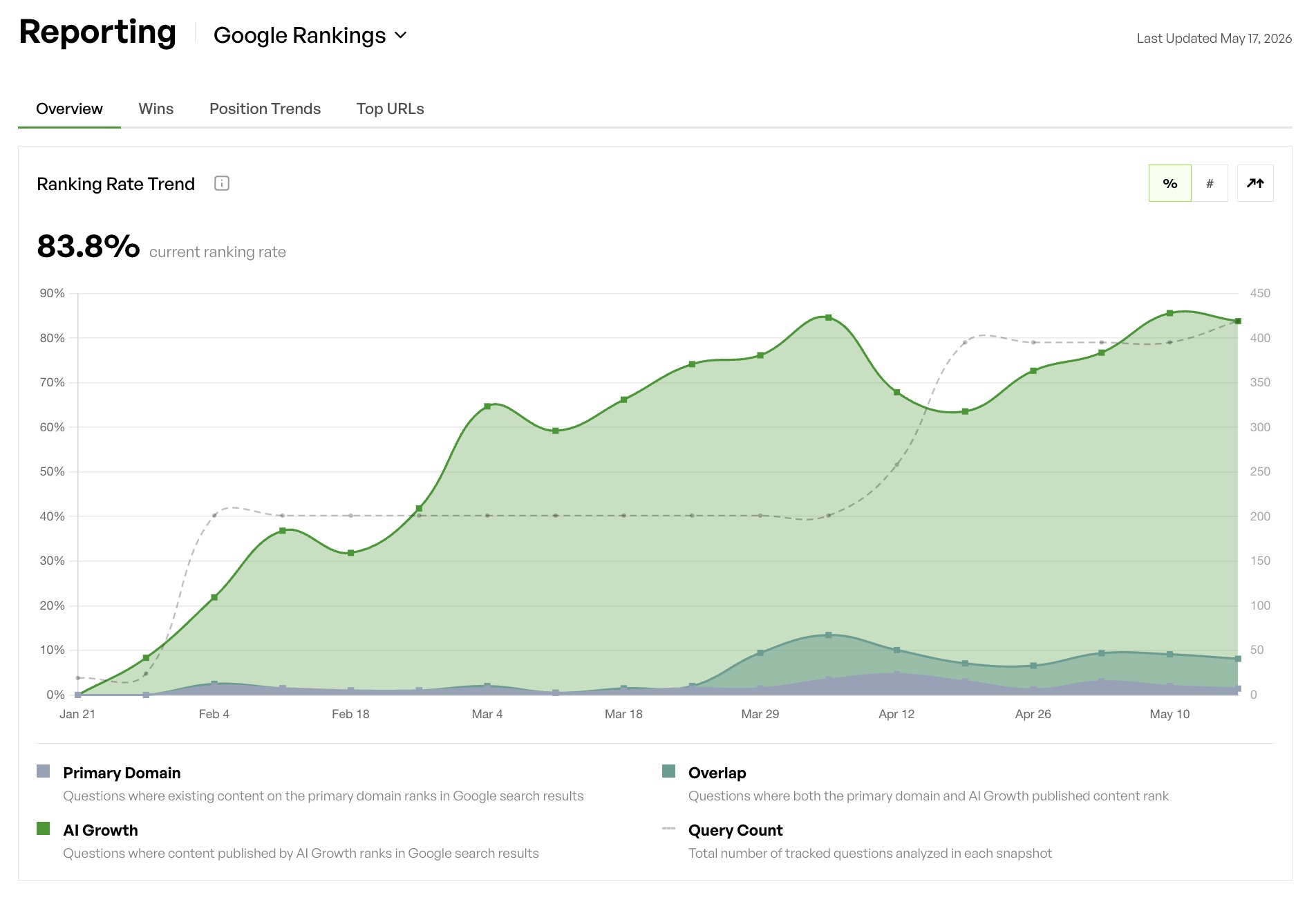
AI Growth Agent brought Blog MCP to market first, with clients running it in the summer of 2025, roughly a year before Google released WebMCP. That head start translates into measurable client results. Clients average more than 12,000 additional AI citations and mentions, over 100,000 additional bot visits, and a 20%+ lift in impressions across the first twelve weeks. Breadless grew from 387,000 to 12.3 million Google Search Console impressions in six months, with ChatGPT citing eatbreadless.com more than 45,000 times per month. Leva Sleep closed $40,000 to $50,000 in deals in under three weeks from buyers who discovered the brand through AI Growth Agent content.
The site stands up within the first week. Content indexes in as little as ten days. The engine maps the brand’s full universe of seed terms and long-tail queries, produces authoritative content validated against primary sources, and reports incremental visibility week over week, isolated from visibility the brand already had. There is no RFP, no year-long ramp, and no ongoing agency dependency. The client owns the site and all the content outright.
Schedule a demo to see if you are a good fit and watch the full agentic technical SEO stack run on a site that looks like yours.
Conclusion: Agent-Enabled Sites Decide Who Agents Trust
The agentic web has already arrived. Eighty percent of executives surveyed by Cisco and Omdia believe their company’s survival will depend on agentic AI by 2027, and many organizations expect full deployment of agentic AI by 2027 per an AWS IDC study. Gartner predicts that by 2028, one-third of interactions with generative AI services will use action models and autonomous agents for task completion. Agents already book travel, compare products, and act on behalf of users at scale.
Every one of those agents reads, cites, and acts on whatever it can find and trust. A site built only for human UX remains structurally invisible to that traffic. An agent-enabled site built for AX, with WebMCP endpoints, accessibility trees, structured actions, llms.txt, rich schema, and proper agent discovery, forms the foundation a brand needs before any other AI search strategy can work.
Brands that establish that foundation now train the next generation of models with their own narrative. Brands that wait cede that ground to whoever already appears on the open web.
Traditional search tools show where your brand stands. AI Growth Agent makes your brand the answer. Schedule a demo to see if you are a good fit and get your first article live within a week.
Frequently Asked Questions
What is the difference between a traditional website and an agent-enabled site?
A traditional website is designed for human visitors and focuses on visual hierarchy, emotional resonance, and conversion flows that a person navigates by clicking and scrolling. An agent-enabled site is designed for AI agents and exposes an accessibility tree with proper semantic HTML and ARIA roles, publishes structured tool definitions via WebMCP at a .well-known endpoint, serves content as Markdown to reduce token overhead, declares intent through llms.txt and llms-full.txt, and implements rich Schema.org JSON-LD so agents understand entity relationships without guessing. In practice, a traditional site may look excellent to a human visitor yet remain structurally invisible to the AI surfaces that now drive citations, recommendations, and agentic actions on behalf of users. Agent Experience (AX) is the discipline that closes that gap.
Do I need to rebuild my existing site to make it agent-ready?
No. The agent-ready layer sits alongside your existing site rather than replacing it. The standard architecture uses a fully optimized blog or content property connected to your domain through a reverse proxy rewrite, typically under a subdirectory, or through a subdomain. Your curated main site and its existing structure remain untouched. The agent-ready property handles the agentic technical SEO stack, including WebMCP endpoints, llms.txt, Markdown delivery, rich schema, proper robots.txt with granular AI crawler rules, sitemap.xml, and bot tracking. AI Growth Agent stands up this property within the first week of engagement, with no website agency, no RFP, and no engineering hours required from your team. The only integration step on your side is the reverse proxy rewrite that connects the blog to your domain.
Why does anti-bot friction hurt AI search visibility, and how should it be handled?
CAPTCHAs and aggressive bot-blocking rules were designed to stop malicious automated traffic, but they do not distinguish between harmful scrapers and legitimate AI crawlers such as GPTBot, ClaudeBot, and PerplexityBot. When those crawlers are blocked, the AI surfaces they feed cannot index your content, so your brand does not appear in citations, recommendations, or agentic actions. The effective approach uses granular, explicit rules in robots.txt that permit trusted AI crawlers by name while maintaining security controls for traffic you do not want. Content Signals in robots.txt let you declare AI usage preferences at a policy level. Web Bot Auth, currently an IETF draft, adds a cryptographic layer for authenticating agent requests. The goal is not to open the site to all bots, but to give legitimate AI agents a clear path to your content while preserving governance over how that content is used.
What is llms.txt and why does it matter for agent-enabled sites?
llms.txt is a plain-text file published at the root of a domain that tells AI language models and agent crawlers what the site contains, how it is organized, and which content is most relevant for citation and reasoning. It functions as a structured index that reduces the token cost of understanding a site’s scope, similar to how sitemap.xml helps traditional search crawlers prioritize pages. llms-full.txt is an extended version that includes the full text of key pages, allowing AI surfaces to read the brand’s content directly without additional crawl requests. Together, they form part of the discoverability layer that agent-enabled sites must publish. Sites that omit these files force AI surfaces to infer structure from raw HTML, which increases token usage, reduces accuracy, and lowers the probability of citation. Cloudflare’s documentation overhaul, which included per-directory llms.txt files alongside Markdown delivery, resulted in agents answering questions 66% faster than on non-optimized documentation sites.
How quickly can a brand expect to see results from an agent-enabled site?
The timeline depends on the technical stack, content quality, and the competitive density of the brand’s query universe. The pattern AI Growth Agent clients see consistently is site live within the first week of kickoff, first content indexed in as little as ten days, and measurable movement in bot visits, impressions, and AI citations within the first month. The agentic technical SEO stack, including WebMCP, llms.txt, rich schema, and proper bot access controls, accelerates indexing and citation because it removes structural barriers that slow AI crawlers and reduces the ambiguity that causes AI surfaces to skip a brand in favor of a competitor whose content is easier to parse and trust. The client results detailed earlier in this article, including the Breadless and Leva Sleep case studies, illustrate the range of outcomes brands achieve when the full stack is in place.