Written by: Mariana Fonseca, Editorial Team, AI Growth Agent
Key Takeaways
- Enterprise GEO implementation turns large language model optimization (LLMO) into a repeatable system across your full query universe so your brand becomes the cited answer on ChatGPT, Perplexity, and Google’s AI Mode.
- A complete agentic technical SEO stack, including semantic HTML, rich schema, llms.txt, Blog MCP, and agent discovery endpoints, gives AI systems what they need to find, parse, and trust your content.
- Conversational content architecture built on answer-first, evidence-backed long-tail queries with primary-source validation produces citable claims and strong citation context.
- Incremental visibility reporting separates new program impact from existing brand presence so enterprise teams can show defensible week-over-week results.
- Headless marketing architecture lets AI Growth Agent run the entire system autonomously so brands can book a kickoff and see their first article live within a week without adding headcount.
1. Technical and Semantic Foundation for AI Discovery
The technical foundation decides whether AI systems can find, parse, and trust a brand’s content. Without this layer, content stays invisible to the bots that generate and cite answers. The agentic technical SEO stack combines traditional technical SEO with a newer layer designed specifically for AI surfaces.
At the article level, this foundation uses highly structured semantic HTML, full Open Graph metadata, rich schema markup across article, author, product, organization, and review types, sanitized internal and external linking, and automatic content refreshes triggered by Google Search Console signals. These elements make each article individually discoverable and easy for models to interpret. At the site level, the same foundation scales through proper sitemaps, a detailed robots.txt, automated web stories with a dedicated sitemap, real-time bot tracking, instant indexing, autoredirects, and 404 tracking.
The agentic layer extends this infrastructure for AI agents. AI Growth Agent was the first to bring Blog MCP to market, with clients running it in the summer of 2025, roughly a year before Google released Web MCP. Every site also ships with OpenAI discovery and Agent Card guidance served via /.well-known/, natural language query parameters at /?s={query} that auto-trigger personalized internally linked responses, Markdown served to agent crawlers, and llms.txt and llms-full.txt so AI surfaces can read the brand the way they need to. Entity relationships are mapped through schema so models understand what a page is about and how it connects to the rest of the site.
2. Conversational Content Architecture That Wins Citations
Conversational content architecture gives AI systems a clear reason to cite your brand. AI surfaces do not rank pages the way a search engine does. They extract claims, validate those claims against available sources, and cite the sources they trust most. Content that wins citations stays answer-first, evidence-backed, and aligned with the long-tail queries customers actually ask instead of only the head terms a brand chose years ago.
The evidence-based long tail at scale drives this architecture. There are hundreds of ways a customer can ask the same question in an AI search space, and that surface area grows further when an agent reasons on top of a user query. Real-time AI Overview and ChatGPT search results act as the objective function for deciding which long-tail queries deserve coverage. Each article opens with a direct answer, follows with validated evidence drawn from primary sources, and closes with internal links that compound authority across the full universe.
That validation process is not optional. Primary-source validation is non-negotiable. Every claim, source, and quote is verified against evidence found online before anything ships. A cascade of anti-hallucination checks runs after drafting, re-extracting every claim and checking it against the brand manifesto, product pages, and verified external sources. Any claim that cannot be backed up is removed or softened before the article moves further down the pipeline.
3. Digital PR and Authority Signals for High-Stakes Queries
Authority signals determine which content gets cited and which content gets ignored. For enterprise brands, E-E-A-T, meaning Experience, Expertise, Authoritativeness, and Trustworthiness, functions as the structural reason a model chooses one source over another when answering a high-stakes query.
Citation context replaces the old idea of a ranking number. Where a brand appears in an AI answer, which other brands it appears beside, and which claim it is cited for now act as the new leaderboard metrics. To control those metrics, brands must build strong citation context by producing content that makes specific, verifiable claims about their category, backed by named authors with author schema, APA-format citations to external research, and legal disclaimers applied where the sector requires them.
The engine produces authoritative content that holds up under client, regulator, and LLM reviews, shaped by a founding-team journalist with more than ten years of experience who defines how journalistic rigor applies to every article. That rigor earns the citation. Monitoring tools can show a brand that it is missing from AI answers, but only content built to this standard changes that outcome.
4. Measurement and Analytics With Incremental Visibility
Incremental visibility reporting gives a clean line between real program impact and visibility the brand already owned. AI Growth Agent publishes into a separate environment, a headless blog connected through a reverse proxy rewrite or subdomain, so it can report only the visibility it actually generates, never the visibility the brand already had, week over week.
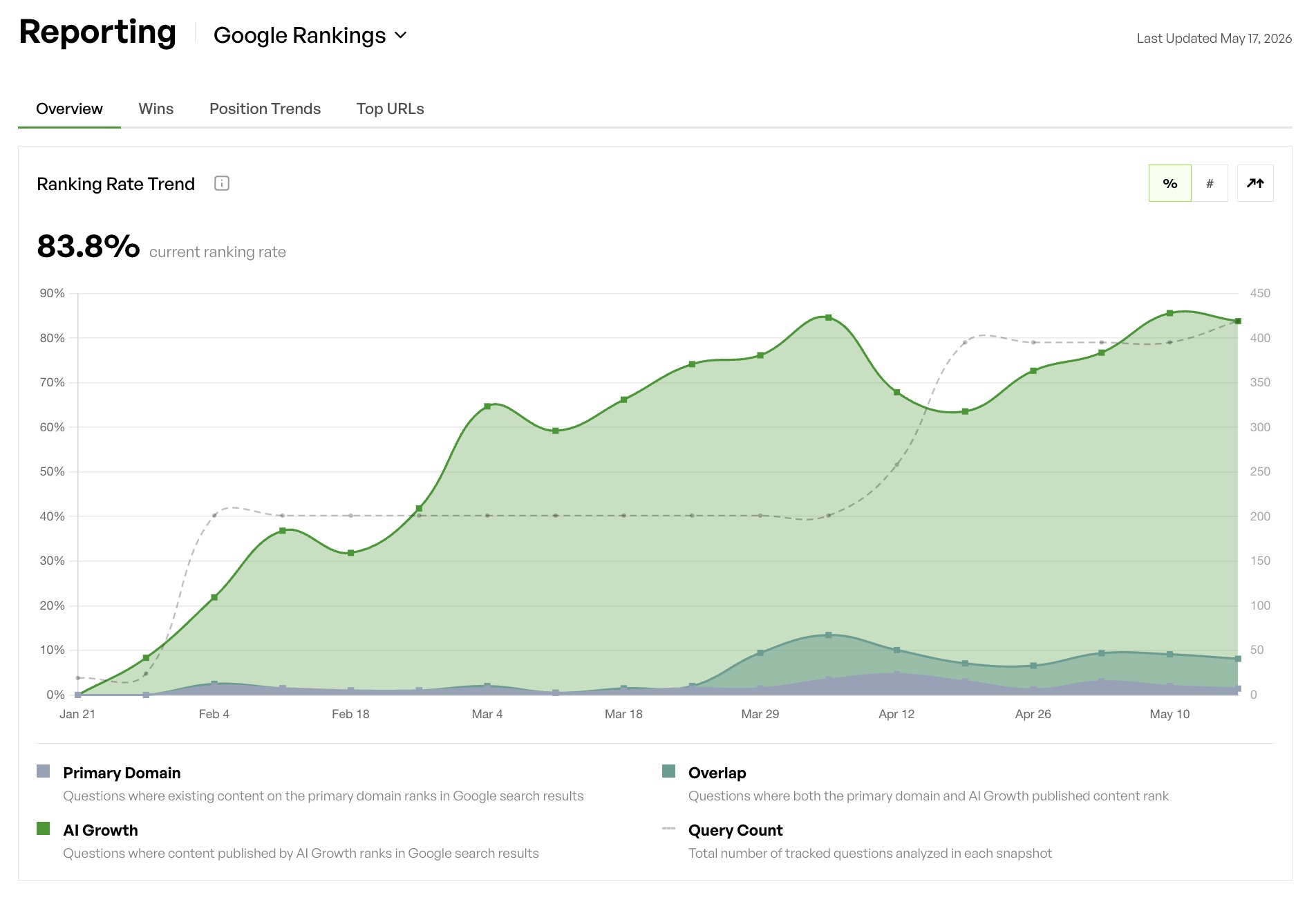
The four data pillars that feed this measurement are Search Intelligence, AI Analytics, Bot Tracking, and AI Ranking. Together, these pillars provide a complete view of content performance across traditional and AI search surfaces. Bot tracking is the layer most enterprise teams are missing entirely, and without it the other pillars cannot separate content that AI systems read from content they ignore. Every bot interaction, including traditional crawlers and AI training agents, is logged, covering each crawl, citation, and training sweep.
Google Search Console serves as an independent audit, cross-referenced against per-article bot analytics and citation data. AI Ranking tracks order of mention and citation context week over week, because AI answers do not use a static ordered list. The result is a single reporting view that shows what moved, what AI Growth Agent caused to move, and where to double down.
5. Headless Marketing Architecture Without Extra Headcount
Headless marketing architecture makes enterprise GEO implementation practical without expanding the team. It borrows from headless commerce so the brand keeps its curated main site, the storefront humans read, while a separate, fully optimized blog runs autonomously behind it. The blog connects through a reverse proxy rewrite, usually under a subdirectory, or through a subdomain, so nothing in the existing structure has to change.
The zero-headcount model solves the old operational burden. The traditional approach required an editor, an SEO specialist, a designer, an engineer, a content agency, a web agency, a PR firm, and a stack of monitoring tools. An agency RFP often runs about three months, then three more months to produce the first assets. Headless marketing eliminates that timeline and headcount by replacing the entire stack with one engine at a fixed price, with no per-article charges, credit limits, or per-prompt billing.
Isolation from existing brand presence sits at the core of this architecture. Because the blog operates in the separate environment described in the measurement section, incremental visibility can be reported cleanly. The brand owns the site outright, with no agency in the loop and no ongoing dependency to manage. The engine handles schema, the WordPress plugin, bot tracking, publishing, and self-healing so the internal team needs no technical skill.
6. From Kickoff to First Article in One Week
The kickoff week teaches the engine how to represent the brand. A professional journalist interviews the client to build the manifesto, the single source of truth that governs every future generation. The manifesto captures brand voice, factual references, deny lists, style memories, and the personalization needed to keep content compliant by default from day one.
The Content Topology grows from that manifesto. A new account typically starts with three to four hundred queries and expands as it goes after more of the universe, with mature clients reaching universes of 1,600 or more queries and the system running over 3,000 searches every week to refresh the snapshot. Real-time AI Overview and ChatGPT results again serve as the objective function for which long-tail queries are worth pursuing, so the topology stays evidence-based rather than guessed.
Single-shot generation keeps the client out of day-to-day production. The engine produces finished, ready-to-publish articles from the manifesto, validates every claim and source, and delivers the first article live within a week of kickoff, with content indexing in as little as ten days. Clients who want more control can use a Claude cowork-like studio experience to read each article, chat with it, and steer it before publish, with the engine saving every memory so the same correction is never needed twice.
7. Living, Self-Healing Content That Compounds
Living content gives brands a structural advantage that compounds over time instead of decaying. Most content strategies ship assets that stay accurate on launch day and drift out of date within months. When the year turns, every article in a sector refreshes automatically. Stale articles refresh in response to Google Search Console signals and bot-traffic awareness so nothing decays in place.
Every article’s relationships, performance, and bot and Search Console data sit in one organized system. The client manages hundreds of articles from a single view instead of a sprawl, with internal linking decisions guided by live performance data. Authority compounds because the engine doubles down on what indexes well and uses internal linking to lift content that has not yet broken through.
The self-healing layer also separates AI Growth Agent from monitoring tools and content factories. Monitoring tools tell a brand it is missing from AI answers and stop there. Content factories ship articles and move on. AI Growth Agent clients see measurable lifts in AI citations, bot visits, and impressions. Those gains do not appear as a one-time spike. They form a compounding baseline that grows as the content universe expands and self-heals.
Frequently Asked Questions
What is enterprise GEO implementation and how does it differ from traditional SEO?
Enterprise GEO implementation operationalizes large language model optimization at scale. Traditional SEO targets ranked positions on a search results page, while LLMO targets citation context inside AI-generated answers on surfaces like ChatGPT, Perplexity, and Google’s AI Mode. The technical requirements differ substantially. Traditional SEO focuses on keyword density, backlink volume, and page authority. LLMO requires answer-first content architecture, validated primary sources, rich schema, agentic technical SEO infrastructure including llms.txt, Blog MCP, and agent discovery endpoints, and incremental visibility reporting that isolates new results from existing brand presence. For enterprise teams, legacy CMS environments and non-technical marketing teams rarely match this stack, so a headless marketing architecture that runs autonomously becomes the practical path forward.
How long does it take to see measurable results from an enterprise LLMO program?
The first article typically goes live within one week of kickoff. Content has indexed in as little as ten days and often within two weeks. The standard engagement runs as a three-month pilot because indexing timelines vary by industry and the compounding effect of a growing content universe takes time to build. Clients see early movement in bot traffic and Google Search Console impressions within the first month. AI Growth Agent clients see measurable lifts in AI citations, bot visits, and impressions. Standout results include Breadless reaching a 30x lift in Google Search Console impressions over six months and Leva Sleep closing $40,000 to $50,000 in deals within three weeks from buyers who discovered the brand through AI Growth Agent content.
How does incremental visibility reporting work, and why does it matter for enterprise marketing leaders?
Incremental visibility reporting isolates the visibility a new content program actually generated from the visibility a brand already had before the program started. This matters because most reporting tools measure total brand presence, which can make a program look successful simply because the brand entered with strong organic equity. As explained in the measurement section, AI Growth Agent uses a separate headless environment so every impression, bot visit, and citation it generates can be attributed to the program rather than to pre-existing brand strength. The reporting view cross-references per-article bot tracking, Google Search Console, and AI Ranking data, giving enterprise marketing leaders a defensible week-over-week answer on whether the investment is working.
What does the agentic technical SEO stack include, and does it require engineering resources to implement?
The agentic technical SEO stack includes Blog MCP with schema, manifest, discovery, and capability guidance exposed to agents; OpenAI discovery and Agent Card guidance served via /.well-known/; natural language query parameters at /?s={query} that auto-trigger personalized internally linked responses; Markdown served to agent crawlers; and llms.txt and llms-full.txt so AI surfaces can read the brand the way they need to. On top of that, the traditional technical SEO stack covers highly structured semantic HTML, full metadata, rich schema markup across the complete schema suite, internal linking, sanitized external linking, proper sitemaps, a detailed robots.txt, automated web stories, real-time bot tracking, instant indexing, autoredirects, and 404 tracking. None of this requires action from the client. Every package includes the full stack, and the only integration step on the client side is the reverse proxy rewrite that connects the blog to a subdirectory under their domain.
How does AI Growth Agent handle brand consistency and compliance across a high volume of articles?
Brand consistency is enforced through the manifesto and a layered memory system. The manifesto, built during the kickoff interview, acts as the single source of truth that governs every future generation. On top of it, clients configure style memories that carry voice rules such as preferred terminology and words the brand never uses, general and factual memories that the engine treats as ground truth, and anti-hallucination steering that focuses validation checks on the claim types that matter most for the brand’s sector. Legal disclaimers and dynamic compliance language are configured once and applied to every future article. When a client gives feedback through the studio, the engine updates the article in place and saves a memory so the same correction is never needed twice. Output stays consistent at any volume because the system learns instead of requiring repeated re-briefing.
Conclusion
The discovery shift from blue links to AI answers has already arrived. Google’s AI Mode crossed 1 billion monthly users within its first year, and surfaces such as ChatGPT, Perplexity, and Google’s AI Mode read, cite, and act on whatever the model can find and trust. The seven steps in this playbook, technical and semantic foundation, conversational content architecture, digital PR and authority signals, measurement and analytics, headless marketing architecture, kickoff to first article in one week, and living self-healing content, work together as a complete enterprise GEO implementation system.
No single step works in isolation. A technically perfect site with no conversational content architecture earns no citations. A strong content program with no incremental visibility reporting cannot prove its results. A monitoring tool that tracks a capped set of prompts and stops there does not qualify as a system. The practical path to controlling the narrative in AI search is a single engine that maps the full universe, provisions the complete agentic technical SEO stack, produces authoritative living content, and reports incremental results week over week without adding headcount.