Written by: Mariana Fonseca, Editorial Team, AI Growth Agent
Key Takeaways
-
Google AI Mode now exceeds 1 billion monthly users, creating a zero-click reality where most people accept AI answers without checking sources.
-
Brand visibility in AI search depends on publishing citable, structured content, not on monitoring dashboards or traditional SEO alone.
-
Four intelligence pillars — Search Intelligence, AI Analytics, Bot Tracking, and AI Ranking — shape what AI surfaces say about a brand and demand active content production.
-
Traditional agency stacks and DIY chatbots both fail to deliver consistent, living content that stays current and earns citations at scale.
-
AI Growth Agent provides a headless production engine that maps your brand’s universe and starts publishing citable content within a week. Schedule a demo to see how it works for your brand.
The Four Intelligence Pillars Monitoring Tools Miss
Most teams trying to improve brand visibility in AI search results start with a monitoring dashboard. Those tools report on a capped set of prompts and stop there. They do not produce content, act on signals, or see the four kinds of intelligence that actually determine what an AI surface says about a brand.
Search Intelligence gives a complete portrait of the traditional search landscape. It covers positioning, competition, search volume, and who is already winning each result. It turns a raw situation into a clear diagnosis and a plan.
AI Analytics tracks brand value and consumer behavior across the whole journey. It spans external touchpoints like Google and AI-tool queries, content consumption, demographics, and sentiment. This broad view matters because perception drives conversion, and appearance alone means little if the surrounding context erodes trust or mispositions the brand.
Bot Tracking records every bot interaction, from traditional crawlers to AI training agents. It logs every crawl, citation, and training sweep. A team that cannot see who is reading its content cannot know whether it is being read at all.
AI Ranking replaces the old idea of a numbered position. AI answers do not use a static ordered list. Order of mention and citation context now function as the leaderboard. Where the brand appears in the answer, and how that position changes week over week against the content plan, becomes the metric that matters.
Teams that win this channel see all four pillars and act on them in the same week. Monitoring tools deliver, at best, a partial view of one pillar.
Why Agencies and DIY Chatbots Both Stall Out
When a CMO or founder decides to take AI search seriously, the market presents two options that promise to solve the visibility problem. Neither delivers the four-pillar intelligence or the production system required.
The first option is the agency stack. An RFP runs about three months, followed by three more months to produce the first assets. Nearly a year passes before anything meaningful is in motion. Most of that time goes into briefing, onboarding, and chasing. The agency often controls the site, so the brand owns little and every change becomes a dependency.
The second option is the DIY chatbot. Producing one strong article with Claude or a similar tool is realistic. Producing the second requires running the entire process again. Reviews multiply, schema needs maintenance, legal language must stay precise, and quality drifts from one article to the next. One company produced roughly 300 articles this way. None received a citation.
These two doors look like opposites yet create the same trap. Both depend on stitching together agencies, tools, and people. Both leave the brand with content that goes stale the day it ships. A headless production engine offers the missing third option. One autonomous system maps the universe, produces authoritative content, deploys the full technical stack, and self-heals over time, without new headcount or agency dependence.
The Agent-Ready Technical SEO Stack AI Surfaces Need
Traditional technical SEO remains table stakes. Sites still need structured HTML, full metadata, rich schema markup, internal linking, proper sitemaps, and a detailed robots.txt. AI surfaces, however, require an additional layer that most sites, and nearly all agency-built sites, lack.
Blog MCP exposes schema, manifest, discovery, and capability guidance directly to agents. AI Growth Agent first brought Blog MCP to market, with clients running it in the summer of 2025, about a year before Google released Web MCP. It also works with Chrome 146+ and other WebMCP-enabled browsers.

llms.txt and llms-full.txt give AI surfaces a structured, trustworthy summary of what the site contains and what claims it makes. These files help models read the brand the way they need to.
/.well-known/ discovery supports OpenAI discovery and Agent Card guidance. It makes the site findable and interpretable by the agents that power AI search surfaces.
Natural-language query parameters through /?s={query} trigger personalized, internally linked responses. An agent that passes a query directly into the URL receives a tailored answer instead of a generic page.
Markdown for agents is served to agent crawlers so content is easy to parse in the formats those systems prefer. Human visitors still see standard HTML.
Clients do not need to configure any of this. Every AI Growth Agent package ships with the full agentic technical SEO stack live on day one.
How Living, Self-Healing Content Works
Static content decays after publication. The world shifts, competitors publish, and the next model training sweep reads whatever sits on the open web, not the brand’s current narrative. Living content solves this problem at the system level.
At the start of each year, every article in a sector receives an automatic refresh. When Google Search Console shows that a page is losing ground, the engine detects the change and updates the content. Every article’s relationships, performance, and combined bot and Search Console data live in one place, so authority compounds instead of fragmenting across hundreds of isolated posts.
Internal linking stays current through dynamic updates. Pages that are not yet indexing well gain support from pages that already perform. The system lifts the whole network instead of leaving weaker pages behind.
The result is a brand presence that stays current without a content calendar, editorial team, or quarterly agency review. The engine manages the work, and the brand’s narrative stays aligned with what the models actually read.
Incremental Visibility Reporting for CMOs
AI Growth Agent publishes into a separate environment so it can claim credit only for the visibility it actually generates. It does not count visibility the brand already had. Reporting isolates new citations from existing brand equity week over week. It cross-references bot traffic, Google Search Console, and citation data that no single monitoring tool combines.
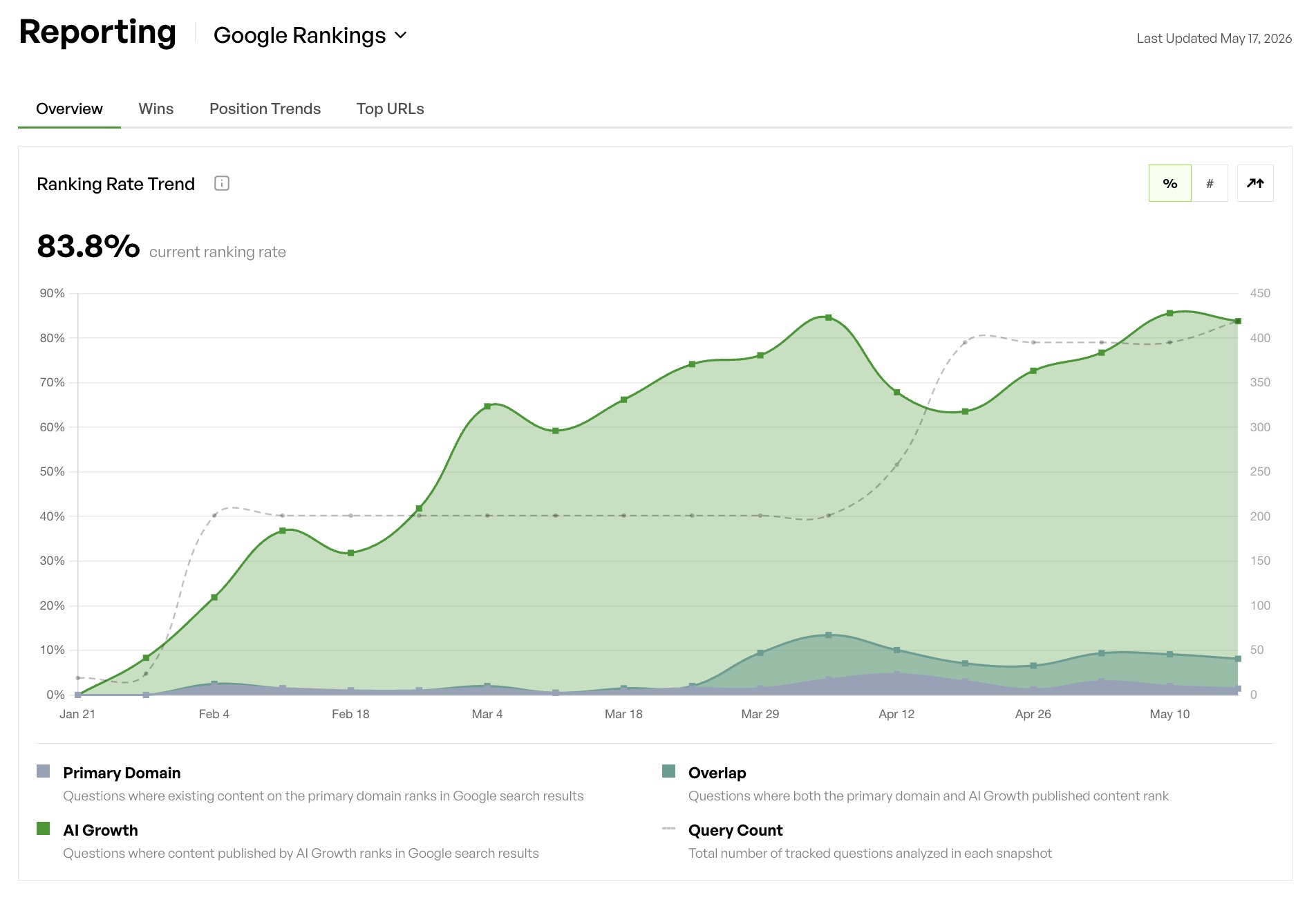
This structure prevents inflated claims based on existing momentum. Incremental reporting shows exactly what the production engine contributed. It reveals which queries moved, which bots visited, and which citations are new. For a CMO defending investment to a CEO, that clarity separates a defensible answer from a noisy dashboard.
How to Spot Drops in AI Brand Visibility
Teams track drops in AI visibility by watching bot activity, not only keyword rankings. When a brand’s citation rate falls, the first signal usually appears in bot tracking data. Agents that power AI surfaces crawl less often or shift to different pages. Google Search Console impressions confirm the trend, but they lag behind bot activity by days or weeks.
The practical approach is to monitor per-article bot traffic weekly and compare it with citation data from AI surfaces. Teams then watch for pages where bot visits decline before impressions drop. When a decline appears, the response focuses on content. The affected article is updated, internal links are strengthened, and the agentic technical SEO stack is checked for gaps. A monitoring tool that only reports the drop, without producing corrective content, leaves the brand to fix the problem by hand.
How to Fix Incorrect Mentions in AI Answers
Incorrect mentions in AI responses stem from content, not from a lack of complaints. Submitting feedback to an AI provider rarely changes model behavior at scale. The model responds to what it reads across the web, not to isolated corrections.
The effective path is to publish authoritative content that states the accurate claim clearly. That content must use validated primary sources and formats AI surfaces trust. During the next training sweep or retrieval pass, the model encounters the corrected content. The incorrect mention then loses ground to the accurate version.
The speed of correction depends on indexing speed and the authority of the structure. Living content mechanics, including automatic updates and strong internal linking, shorten that timeline.
How to Measure Brand Visibility in AI Content
Four metrics matter most for brand visibility in AI-generated content. These are citation rate, order of mention, citation context, and bot visit volume. Citation rate measures how often the brand appears in AI responses for a defined query set.
Order of mention tracks where the brand appears in the response, since position in an AI answer now functions as ranking. Citation context captures which claim the brand is cited for and which competitors appear nearby. Bot visit volume, tracked per article, shows which content AI systems actively read and how often.
Together, these four metrics, refreshed weekly, give a complete picture of AI search performance. Google Search Console impressions then serve as an independent audit of the underlying organic signal. The combination of bot tracking, citation data, and Search Console separates a real measurement system from a dashboard that only counts prompt appearances against a capped list.
Why AI Growth Agent Drives Measurable AI Visibility
Across the first twelve weeks, AI Growth Agent clients average more than 12,000 additional AI citations and mentions, over 100,000 additional bot visits, and a 20%+ lift in impressions. Content indexes quickly, and the first article goes live during the first week.
These results come from production, not theory. Leva Sleep became the most mentioned retailer for adjustable beds in Canada, with ChatGPT citing its content over 10,000 times per month. The company closed $40,000 to $50,000 in deals in under three weeks from buyers who found them through AI Growth Agent content.
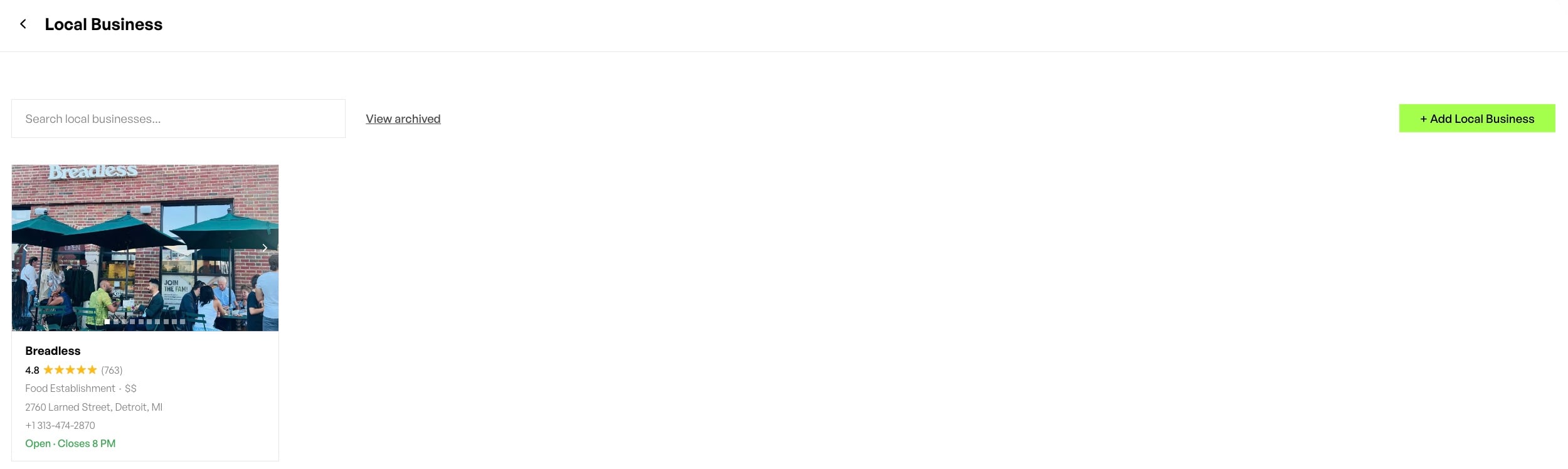
Breadless achieved a 30x lift in Google Search Console impressions over six months. It is now the most recommended healthy franchise in the United States, ahead of CAVA, Rush Bowls, and Sweetgreen. Bisutti saw AI Growth Agent drive 71% of its brand mention visibility and became the second most recommended events brand by AI in Brazil.
The engine stands up a fully optimized site the client owns within the first week. It then runs on autopilot with no added headcount. It replaces the SEO agency, content tool, web agency, GEO monitor, schema plugin, analytics stack, and PR firm at a flat fee, with no per-article charges, credit limits, or per-prompt billing.
Conclusion: Move From Monitoring to Production
Passive monitoring of brand visibility in AI search results does not change what AI says about a brand. It reports the gap and leaves the brand to fill it manually, often with the same agency stack and DIY tools that created the gap.
Brands cited in AI search this year train the next generation of models with their own narrative. Brands that wait train the next generation with whatever happens to sit on the open web.
Narrative control is a production problem, not a monitoring problem. The solution is a headless production engine that maps the full universe, generates living evidence-based content, deploys the complete agentic technical SEO stack, and isolates incremental results week over week, without extra headcount or per-prompt billing.
Schedule a consultation session with AI Growth Agent and see your first article live within a week.
Frequently Asked Questions
What is the difference between monitoring brand visibility and actively controlling it?
Monitoring tools track whether a brand appears for a capped set of prompts and report the result. They do not produce content, publish to any surface, or act on the signals they detect. Active control means producing the content AI surfaces use to describe the brand, in formats and structures those systems can read, with the validation that earns the citation.
The distinction resembles a rearview mirror versus a steering wheel. Monitoring shows where a brand stands. Active production changes where it stands. For a CMO or founder who must move the needle on brand visibility in AI search results, monitoring serves as a diagnostic tool at best and a distraction at worst if it is not paired with a production system that acts on what it finds.
How long does it take to see measurable improvements in AI search visibility?
The first article typically goes live within one week of kickoff. Content has indexed in as little as ten days and often within two weeks. Meaningful citation data, including bot visits from AI training agents and citation rate movement, usually appears within the first month.
The standard engagement runs as a three-month pilot because indexing timelines vary by industry and competitive density, although clients often see movement early. The key variable is the completeness of the agentic technical SEO stack. Sites with Blog MCP, llms.txt, llms-full.txt, and proper /.well-known/ discovery in place are readable by AI surfaces from day one, which accelerates the citation timeline compared with sites that rely on standard HTML alone.
Why do AI search surfaces cite some brands and not others on the same topic?
AI surfaces cite content they can find, trust, and parse. Finding depends on strong technical signals, including sitemaps, robots.txt, fast indexing, and agentic discovery files like llms.txt and /.well-known/ endpoints. Trust depends on validated claims backed by primary sources, not on assertions drawn only from a model’s training data.
Parsing depends on structured formats, such as Markdown served to agent crawlers, rich schema markup, and natural-language query parameters that return coherent, internally linked responses. A brand can publish extensively on a topic and still remain uncited if its content is technically invisible to agents, if its claims lack validation, or if it targets head terms while real customer queries live in the long tail. Brands that win citations structure content for the actual reader, which in 2026 is increasingly a bot, not a human.
What does headless marketing look like for mid-market and enterprise brands?
Headless marketing borrows its architecture from headless commerce. In headless commerce, the customer-facing storefront is decoupled from the engine that runs the business. The frontend stays branded and curated while the backend scales independently.
Headless marketing applies the same logic to brand presence in AI search. The brand keeps its curated main site, including marketing and product pages that humans read. AI Growth Agent then stands up a separate, fully optimized blog the brand owns, connected through a reverse proxy rewrite under a subdirectory or subdomain.
The engine writes, publishes, monitors, self-heals, and reports. The brand’s internal team needs no technical skill because the engine provisions schema, the WordPress plugin, robots.txt, sitemaps, Blog MCP, agent discovery, llms.txt, instant indexing, autoredirects, and 404 tracking automatically. A CMO with a non-technical team can stand up one of the most technically sophisticated organic surfaces in their market within a week, without an RFP, agency dependency, or added headcount.
How does AI Growth Agent prove that visibility gains come from its work?
AI Growth Agent publishes into a separate environment, which allows it to measure visibility from that environment independently from visibility the brand’s existing site already had. Incremental visibility reporting isolates new citations, new bot visits, and new Search Console impressions week over week. It cross-references per-article bot tracking, Google Search Console data, and citation signals from AI surfaces.
This structure differs from a monitoring tool that counts appearances against a preset prompt list. A production engine can show exactly which queries it moved, which articles drove bot visits, and which citations are new. In a zero-click world where a sale cannot always be traced to a single AI recommendation, brands that measure carefully capture source at the conversion moment and consistently see a lift in organic leads after starting with AI Growth Agent.