Written by: Mariana Fonseca, Editorial Team, AI Growth Agent
Key Takeaways
-
AI brand visibility in 2026 prioritizes LLM citations and entity consistency over traditional click-through rates and rankings.
-
Zero-click answers require brands to focus on being cited directly inside AI surfaces like ChatGPT and Perplexity rather than driving site traffic.
-
Success now depends on answer-first content structures, semantic entity resolution, and third-party mentions that build LLM trust.
-
Technical crawler access, including llms.txt, schema markup, and agent discovery protocols, has replaced traditional site-speed metrics as a core requirement.
-
Brands ready to dominate AI answers can schedule a consultation session to see how AI Growth Agent maps their full citation universe.
How This Comparison Works
Search behavior now centers on AI answers, not blue links. Users receive responses inside AI surfaces and often never visit the source. Because users no longer compare a list of results, citation context replaces rankings as the practical leaderboard. Where a brand appears in an AI answer, and which claim it supports, now defines competitive position.
This shift expands the playing field. The full query universe matters, not just the short keyword list in your rank tracker. AI surfaces answer the long tail of natural-language queries that traditional SEO rarely touched. Winning across that universe requires strong entity consistency. When an AI model reads conflicting claims about your brand, it loses confidence and stops citing you.
Evaluation Criteria for AI-Era Visibility
This comparison uses six criteria that determine whether a brand shows up inside AI answers and stays there over time. These dimensions highlight where traditional SEO, generic AI visibility tactics, and headless marketing diverge most clearly.
|
Criterion |
What It Measures |
|---|---|
|
Citation rate |
How often an AI surface names and cites the brand in a relevant answer |
|
Entity consistency |
Whether the brand’s facts, claims, and positioning are uniform across all indexed sources |
|
Answer-first structure |
Whether content is formatted so AI surfaces can extract and cite it directly |
|
Third-party mentions |
External validations that signal trust to LLMs during citation selection |
|
Crawler access |
Whether AI training and citation crawlers can read, parse, and act on the content |
|
Incremental visibility |
New citations and impressions generated by a specific effort, isolated from pre-existing brand visibility |
Traditional SEO vs AI Visibility vs Headless Marketing
The table below applies these criteria to three approaches. It shows how traditional SEO, general AI visibility tactics, and headless marketing differ in practice. The headless marketing column reflects AI Growth Agent performance data so you can see what these strategies deliver at scale.
|
Dimension |
Traditional SEO |
AI Brand Visibility |
Headless Marketing (AI Growth Agent) |
|---|---|---|---|
|
Primary metric |
Rankings and CTR |
Citation rate and mention position |
|
|
Content goal |
Rank for target keywords |
Earn citations across the full query universe |
Long-tail coverage driven by real-time query data from AI Overview and ChatGPT |
|
Traffic model |
Click-through to site |
Zero-click answer delivery |
|
|
Visibility proof |
Google Search Console impressions |
Citation context and mention rate |
Incremental visibility reporting isolates what AI Growth Agent generated, week over week |
The table summarizes the shift, but each dimension affects strategy in specific ways. The sections below unpack how measurement, content, authority, and technical setup change when AI answers sit between you and your buyer.
From Rankings and CTR to Citation Rate
Traditional SEO success depends on a brand’s position on a search results page and the percentage of users who click through. AI surfaces present a single synthesized answer with a short list of sources. Users see the brand, absorb the claim, and often never click.
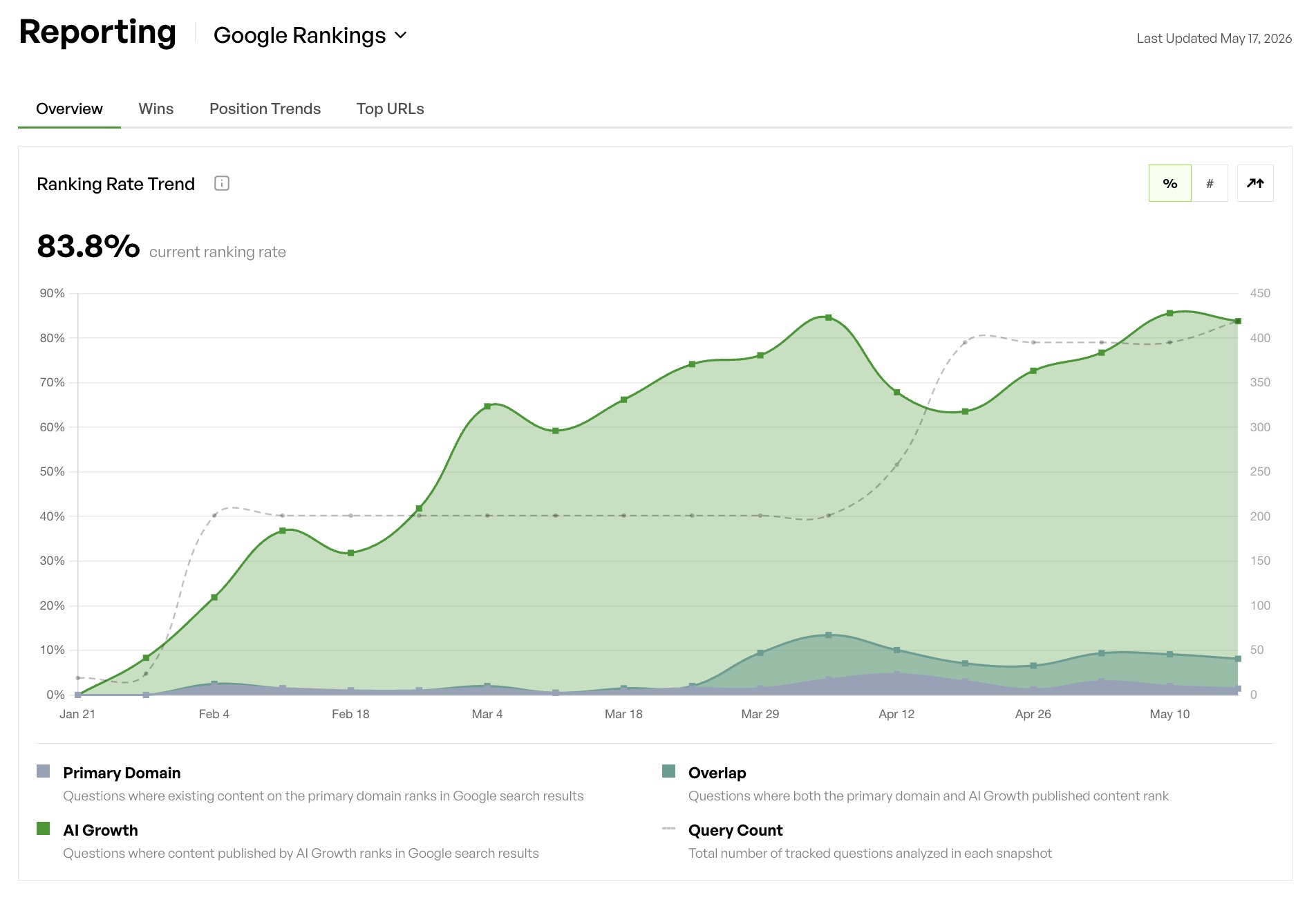
Breadless grew Google Search Console impressions roughly 30x in six months while simultaneously becoming one of the most recommended healthy franchises in the US ahead of CAVA, Rush Bowls, and Sweetgreen. This result shows that citation rate and ranking lift can move together when content supports both AI answers and traditional search.
From Keyword Placement to Semantic Entity Resolution
Traditional SEO focuses on placing target keywords in titles, headers, and body copy to signal relevance. LLM-focused work centers on semantic entity resolution. The model must recognize the brand as a single, trustworthy entity across every source it reads.
Keyword density loses value when the brand’s facts conflict across indexed pages. Entity consistency becomes the deciding signal. Brands that align claims, pricing, features, and positioning across owned and third-party sources earn more citations.
From Long-Form Articles to Answer-First Structure
Traditional long-form content often buries the answer in narrative. AI surfaces extract the answer first and cite the source second. Answer-first structure places the core claim in the opening lines, then supports it with evidence and detail.
This structure works best when paired with formats AI crawlers can parse. Structured HTML, complete schema markup, and Markdown served to agent crawlers make it easier for models to lift and reuse your claims accurately.
From Backlinks to Third-Party Mentions
Backlinks signal authority to Google’s PageRank algorithm. LLMs rely more on third-party mentions. These are external sources that name and describe the brand in context, even when they do not link.
Bisutti saw AI Growth Agent drive 71% of its brand mention visibility and became the second most recommended events brand by AI in Brazil. Authoritative content that earned external citation, not link-building campaigns, produced that outcome.
From Site Speed to a 2026 Crawler-Access Checklist
Traditional SEO prioritizes Core Web Vitals and page speed for human experience scores. AI brand visibility depends on whether crawlers can discover, interpret, and reuse your content. A modern crawler-access checklist now includes several specific elements.
-
Blog MCP with schema, manifest, discovery, and capability guidance exposed to agents
-
OpenAI discovery and Agent Card guidance served via
/.well-known/ -
Natural language query parameters via
/?s={query}returning personalized, internally linked responses to agents -
Markdown served to agent crawlers
-
llms.txtandllms-full.txtpublished so AI surfaces can read the brand the way they need to -
Proper
sitemap.xml, advancedrobots.txt, and instant indexing -
Full schema suite: article, FAQ, organization, author, product, and local business
Run a crawler-access review and see which of these elements your stack already supports.
Where Headless Marketing Fits Best
Headless marketing suits brands that need AI visibility at scale without building a large internal team. It works especially well when leadership pressure is high and timelines are short.
-
Mid-market and enterprise brands whose AI mentions are declining while paid spend holds steady
-
Founders who need organic presence without managing an agency or a content team
-
CMOs who cannot explain to their CEO why the brand is absent from ChatGPT and Perplexity answers
-
Agency owners who want to add AI search visibility as a high-margin service line without hiring engineers
-
Brands in competitive categories where entity consistency across hundreds of queries determines recommendation dominance
Operational and Long-Term Tradeoffs
|
Consideration |
Traditional SEO Approach |
Headless Marketing Approach |
|---|---|---|
|
Content freshness |
Manual updates when resources allow |
Living content that self-heals and refreshes automatically, including annual sector-wide updates |
|
Entity consistency at scale |
Requires editorial coordination across teams |
Brand manifesto and memory systems enforce consistency across every generated article |
|
Universe coverage |
Capped by tracked keyword lists |
Mature clients reach 1,600+ queries with 3,000+ searches run weekly to refresh the universe snapshot |
|
Reporting |
Google Search Console and rank trackers |
Incremental visibility isolated to what the engine generated, cross-referenced with bot tracking and Search Console |
Risks, Limitations, and Common Missteps
-
Monitoring-only tools (Profound, Athena, Peec AI, Scrunch AI) track whether a brand appears for a capped set of prompts but produce no content, own no publishing, and leave the brand to close the gap alone.
-
DIY AI content at scale produces inconsistent output with no universe map, no technical SEO, and no self-healing. One company produced roughly 300 articles this way and not one was cited.
-
Non-headless approaches (SEO agencies, internal teams) move slowly. An agency RFP often runs three months, then three more to produce the first assets, nearly a year before meaningful change.
-
Keyword-only strategies remain blind to the long tail where AI surfaces answer most natural-language queries.
Decision Framework for Your Next Step
-
Audit your current citation rate across ChatGPT, Perplexity, and Google’s AI Mode for your top 20 queries.
-
Check your 2026 crawler-access checklist:
llms.txt, Blog MCP, agent discovery, and schema completeness. -
Measure entity consistency by confirming that your brand’s facts, claims, and positioning match across every indexed source.
-
Identify your full query universe, not just the head terms you already track.
-
Deploy a headless marketing engine that covers content production, technical agentic SEO, living self-healing, and incremental visibility proof. AI Growth Agent is the only system built to do all four at enterprise scale.
Get your first AI-optimized article live within a week and start measuring incremental visibility.
Frequently Asked Questions
What is citation rate and why does it replace CTR as the primary metric?
Citation rate measures how often an AI surface names and cites a brand in a relevant answer. CTR measures how often a user clicks a blue link. In a zero-click environment, the user receives the answer without visiting the source, so CTR captures only a fraction of actual brand exposure. Citation rate captures the full scope of AI-driven brand presence, including answers where the brand is named but no click occurs.
What does entity consistency mean for LLM optimization?
Entity consistency means a brand’s facts, claims, product descriptions, and positioning remain uniform across every source an LLM can read during a citation pass. When sources contradict each other, the model loses confidence in the entity and becomes less likely to cite it. Consistent, validated content across owned and third-party sources forms the foundation of LLM trust and drives sustained citation rate.
What is the 2026 crawler-access checklist for AI brand visibility?
The checklist includes Blog MCP with agent discovery and capability guidance, OpenAI discovery and Agent Card guidance via /.well-known/, natural language query parameters at /?s={query}, Markdown served to agent crawlers, llms.txt and llms-full.txt, a full schema suite, proper sitemap.xml, advanced robots.txt, and instant indexing. Pages that pass human visual inspection but fail this checklist remain invisible to the AI surfaces doing the citing.
How is incremental visibility measured when running both traditional SEO and AI visibility programs?
Incremental visibility is measured by publishing AI-optimized content into a separate environment and reporting only the citations, bot visits, and impressions that environment generates, week over week. This approach isolates the contribution of the new program from pre-existing brand visibility. Cross-referencing per-article bot tracking, Google Search Console, and citation data produces a defensible proof of impact that neither a rank tracker nor a monitoring tool can provide alone.
Request an incremental visibility report based on your current AI citations and bot activity.
Conclusion: Competing for AI Answers Now
The shift from traditional SEO to AI brand visibility changes what the market rewards. Keyword placement and click-through rates now matter less than citation rate, entity consistency, answer-first structure, and crawler access at scale. Leva Sleep closed $40,000 to $50,000 in deals in under three weeks from buyers who found them through AI-cited content. Brands that build this presence now train the next generation of models with their own narrative.
Brands that wait leave that job to whatever happens to be on the open web. Headless marketing provides an architecture that delivers both traditional SEO and AI visibility without new headcount, at enterprise scale, with living content that compounds authority instead of going stale.
Talk with AI Growth Agent and position your brand as the answer inside AI surfaces.