Written by: Mariana Fonseca, Editorial Team, AI Growth Agent | Last updated: January 10, 2026
Key Takeaways
- AI search engines such as ChatGPT, Gemini, and Perplexity rely on precise metadata, structured data, and semantic tags to decide what to cite.
- Clear Article schema, author and date fields, and topic-focused semantic tags help Large Language Models understand credibility, context, and topical authority.
- Structured data, logical headings, internal links, and quantifiable claims with citations make content easier for AI to parse and reuse in answers.
- Programmatic SEO and automated metadata management are increasingly necessary to keep content fresh, consistent, and technically aligned with AI search requirements.
- AI Growth Agent provides programmatic SEO and metadata automation so marketing teams can scale AI-ready content and improve AI citation odds; schedule a demo with AI Growth Agent to see how it works in practice.
The New Reality: Why Accurate Metadata and Tags are Critical for AI Search
Marketing teams now compete in environments where AI search engines summarize, rank, and cite content instead of only listing links. Traditional SEO that focuses on manual keyword placement and on-page tweaks no longer covers the full set of signals AI systems use.
AI search engines prioritize highly structured and semantically rich content, so precise metadata and tagging have become core requirements for visibility and citation.
LLMs reward recency, depth, and structural consistency, which favors organizations that publish at scale with strong technical hygiene. Brands that lack enough clear, current data points give AI systems a reason to cite competitors instead.
AI Growth Agent focuses on this problem with an autonomous Programmatic SEO Agent that builds structured content architectures and technical optimizations designed for AI search visibility.
Step 1: Understanding AI-Driven Metadata Beyond Basic SEO
Metadata now acts as semantic instruction for Large Language Models, not just labeling for search engines. It guides how AI systems classify content, connect entities, and decide when a page is authoritative enough to cite.
AI systems analyze metadata to construct internal knowledge graphs and entity relationships. Modern AI-valued metadata includes semantic tags that indicate topical focus, structured data that clarifies content type and purpose, and entity information that links your content into broader knowledge networks.
Advanced implementations extend beyond standard tags. LLM.txt files and Model Context Protocol (MCP) give AI systems direct, machine-readable access to content structures. AI Growth Agent uses both an LLM.txt implementation and a blog-focused MCP so AI search engines can interpret blog content more reliably.
Effective AI-oriented metadata reflects how models process information: through context, relationships, and consistency across many pages rather than isolated keywords.
Step 2: Critical Metadata Fields for AI Visibility and Citation
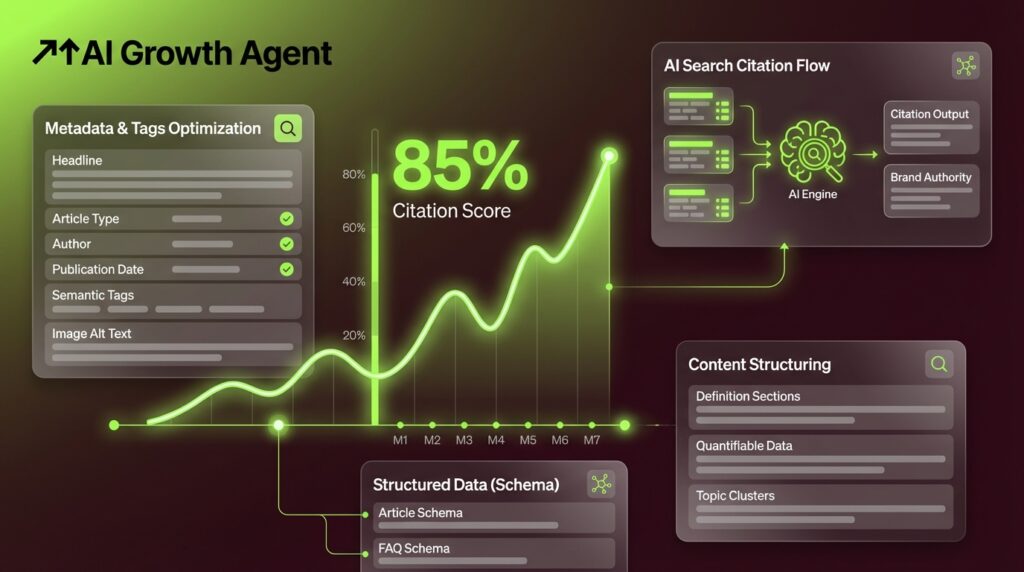
AI search engines evaluate specific metadata fields when assessing whether content is reliable, current, and relevant enough to cite. Key fields include article type, headline, author, publication date, and modification date, all clearly defined in Article schema.
Article Type, Headline, Author, Publication Dates
These baseline fields create context for AI systems. Article type should reflect the format, such as news article, how-to, or research overview. Headlines should be descriptive and aligned with the main topic rather than stuffed with keywords. Author metadata benefits from credentials and proof of experience, since AI Overviews prioritize content that demonstrates strong E-E-A-T (Experience, Expertise, Authoritativeness, Trustworthiness). Publication and updated dates signal freshness and maintenance.
Semantic Tags for Topic Authority
Search engines rely heavily on entity recognition and topic authority, using structured data and contextual signals to understand relationships between people, brands, products, and concepts. Semantic tags should group content into topic clusters and map it to recognizable entities, which helps AI systems place your pages inside larger knowledge structures.
Image Metadata
Image alt text, captions, and file names help AI understand how visuals support the page topic. Detailed, accurate descriptions increase the chance that AI will treat visuals as supporting evidence instead of generic decoration.
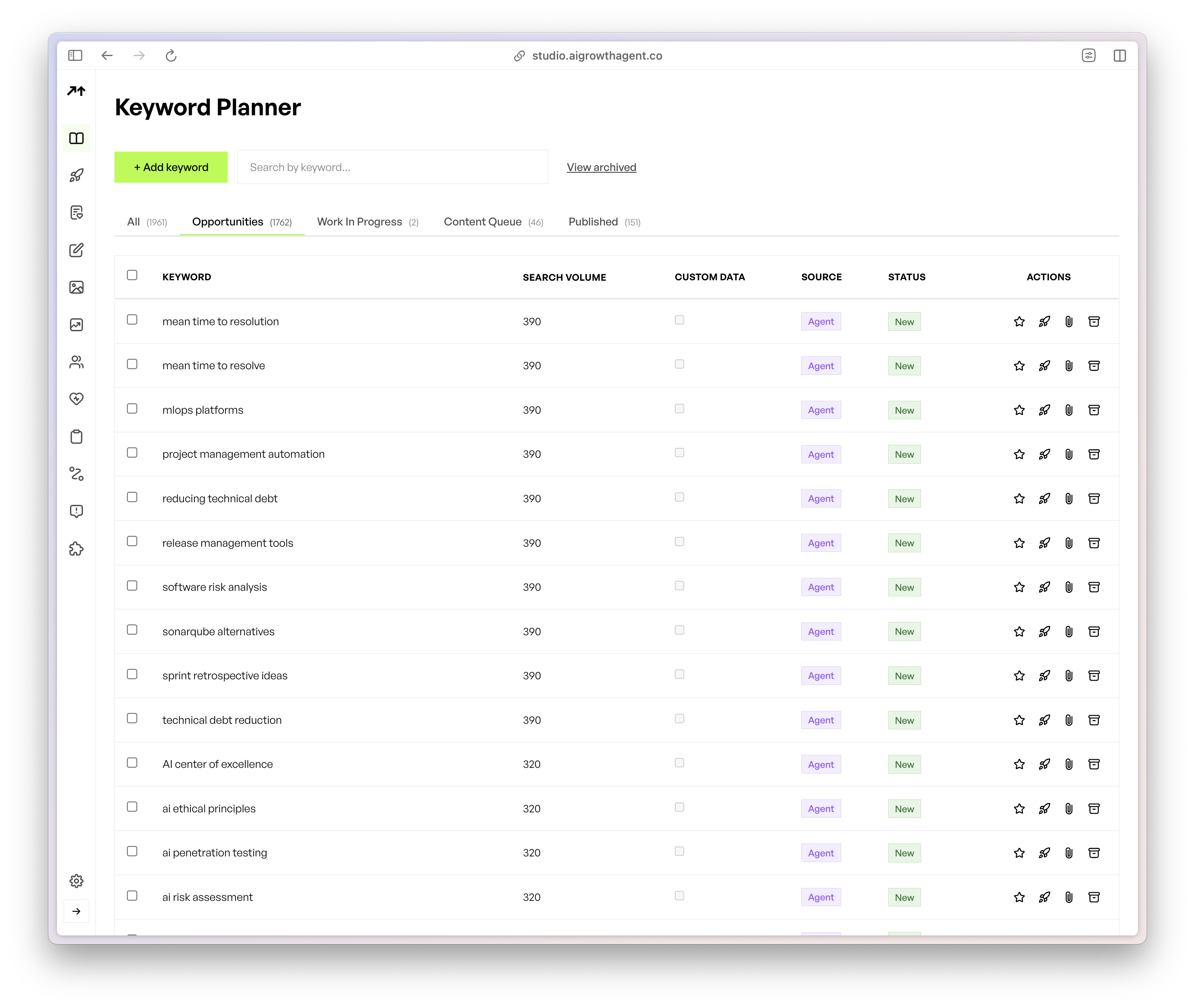
AI Growth Agent automates much of this work, applying schema markup, metadata fields, and image tags to every post so technical standards for AI citation are met consistently. Schedule a demo to see how we automate these optimizations at scale.
Step 3: Using Structured Data (Schema Markup) for AI Search
Structured data and schema markup are essential for AI visibility and contribute an estimated share of Perplexity’s ranking factors. Schema provides explicit, machine-readable meaning about content type, entities, and intent.
FAQ and HowTo schema align closely with question-answer and procedural intents that LLMs frequently synthesize, which makes them especially valuable for AI citations.
Implementing Key Schema Types
Core schema types for AI search include:
- Article schema for defining content type and authority signals
- FAQPage and HowTo schema for structured Q&A and step-by-step content
- Product schema for commercial and ecommerce pages
- Organization and Person schema for brand and author entities
Multiple schema types provide mechanisms to add machine-readable meaning that improves inclusion odds in AI search results.
Structured data must accurately reflect visible content. Mismatched schema increases the risk of reduced rankings and exclusion from AI Overviews. Manual implementation often introduces errors, especially at scale.
AI Growth Agent generates schema programmatically for each content type and validates alignment between markup and on-page content to support consistent AI comprehension.
Step 4: Structuring Content and Semantics for AI Citations
Clear structure helps AI segment pages into answer-ready blocks. Logical heading hierarchies and concise sections in a moderate word range improve how AI maps passages to specific questions.
Definition Sections
Short definition blocks that clearly explain key terms help models build knowledge graphs and entity relationships. These sections function as semantic anchors that clarify how your content fits within a topic.
Quantifiable Content and Citations
Content that includes statistics, dates, and referenced research tends to earn more AI citations because LLMs favor verifiable, concrete information. Clear sourcing and precise numbers give AI systems material they can safely reuse.
Internal Linking and Topic Clusters
Sites that build interlinked topic clusters around core themes usually perform better in AI-driven environments. Strategic internal links show breadth and depth on a subject, helping AI view the site as a topical authority rather than a collection of isolated articles.
AI Growth Agent designs content architectures as clusters, connecting related topics so AI systems can interpret your site as a coherent resource for specific subjects.
Step 5: Advanced Programmatic SEO Strategies for AI Citation
Modern AI search favors publishers that sustain high-quality, technically sound content output. To reach that level, many teams adopt programmatic SEO approaches that handle scale and precision more reliably than manual workflows.
Multi-Tenant Programmatic Deployment
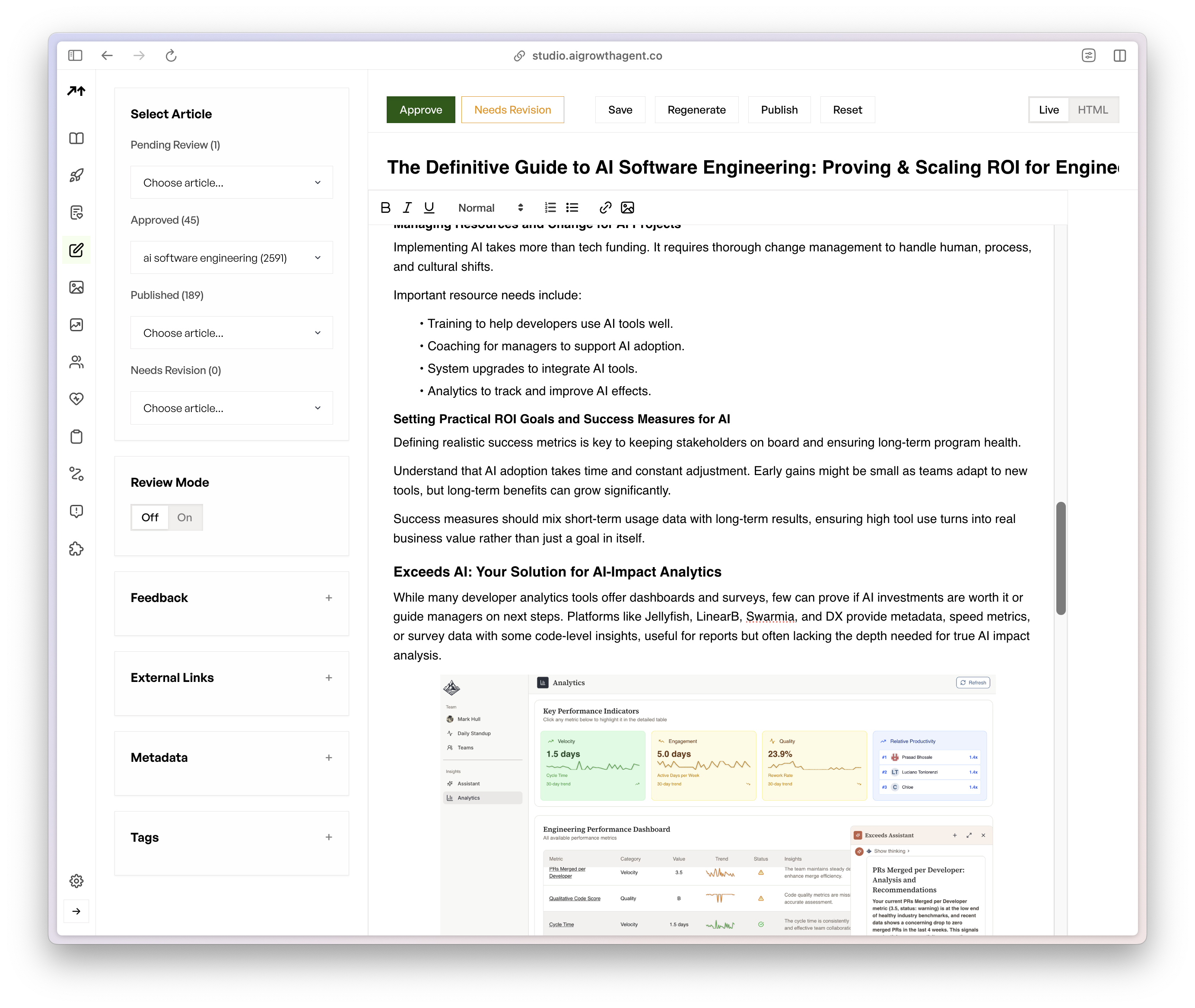
AI Growth Agent supports multi-tenant deployment so teams can run multiple Programmatic SEO Content Agents from one interface. Each agent can maintain its own brand voice, keyword focus, and publishing destinations across domains or subdomains, which is useful for enterprises with several brands or product lines.
Real-Time Content Injection
Freshness and updated timestamps act as important metadata signals for AI systems. The Real-Time Programmatic SEO Content Injection feature in AI Growth Agent lets teams input trending sources and rapidly generate optimized articles to keep coverage current.
Common Pitfalls to Avoid
Overly promotional copy, thin coverage, missing or inconsistent schema, weak structure, and lack of external corroboration often limit AI visibility. Addressing these issues requires both strong editorial standards and reliable technical implementation.
The AI Growth Agent Difference: Programmatic Support for AI Search
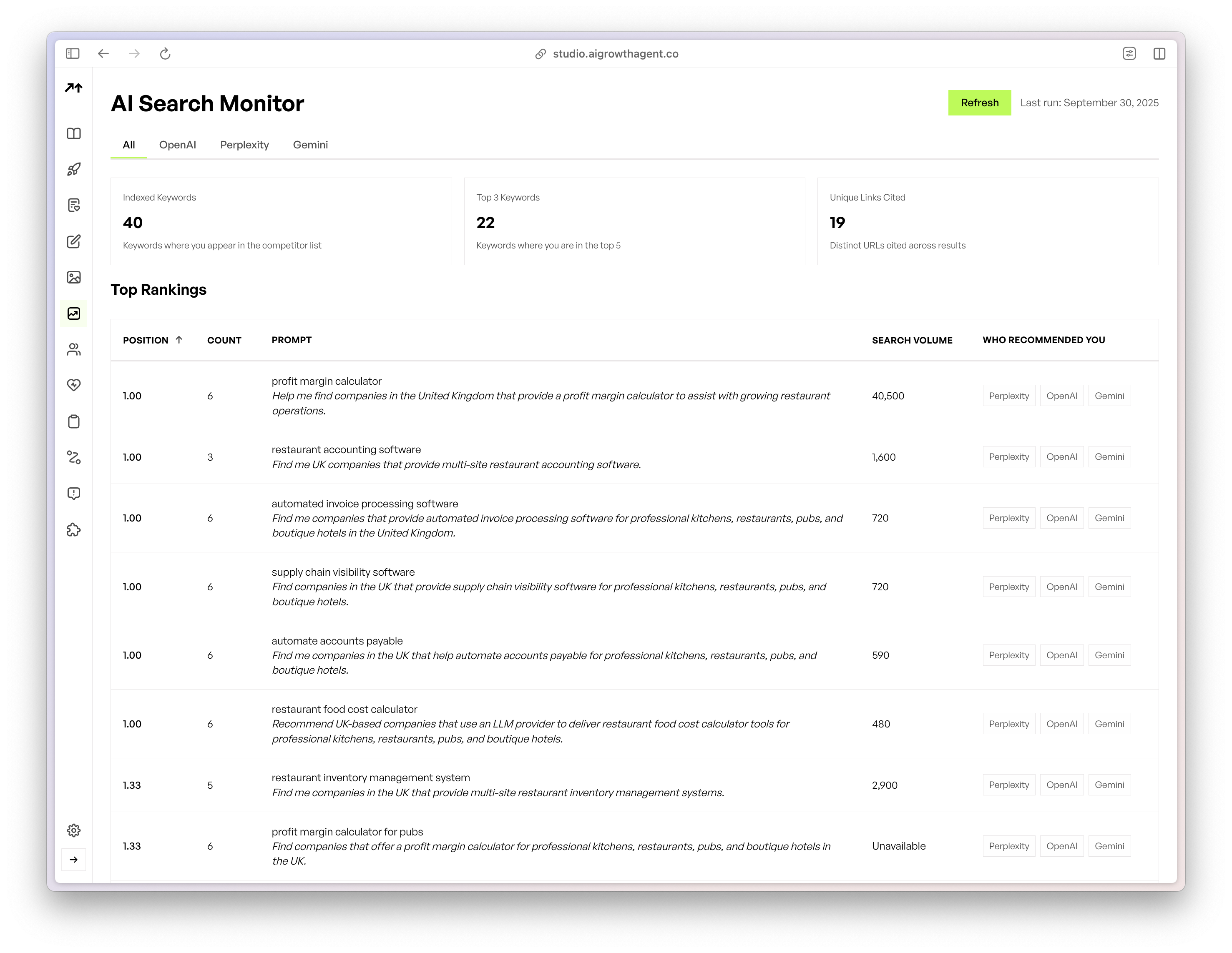
AI Growth Agent offers an autonomous system that connects strategy, content generation, and technical SEO for AI search environments. Capabilities include Multi-Tenant Programmatic Deployment, Real-Time Programmatic SEO Content Injection, Database-to-Content Automation, and automated image and asset placement with optimized metadata.
Client implementations such as Exceeds AI, BeConfident, Bucked Up, and Gitar illustrate how programmatic content engineering can improve AI search visibility in markets ranging from language learning to CI/CD automation.
These outcomes reflect the role of AI Growth Agent as a technical partner that handles the engineering layer behind AI-ready content. Schedule a consultation to see how AI Growth Agent can support your brand’s AI search strategy with programmatic SEO.
Frequently Asked Questions (FAQ)
What is the difference between traditional SEO metadata and AI search metadata?
Traditional SEO metadata mainly described pages for human search behavior and basic crawling. AI search metadata acts as semantic guidance for LLMs, covering structure, entities, and context. It extends beyond titles and descriptions to include semantic tags, entity relationships, structured data, and protocols such as LLM.txt that help AI place content inside knowledge graphs and evaluate citation potential.
How does structured data (Schema.org) specifically help with AI search engine citation?
Structured data gives AI systems a clear map of content types, relationships, and intent. Schema markup helps classify whether a page is an article, FAQ, how-to guide, or product listing and identifies organizations and people tied to each asset. This clarity increases the likelihood that AI will treat the content as a reliable source for answers, especially for formats like Article, FAQ, HowTo, and Organization schemas that align directly with common AI use cases.
Can AI search engines detect and penalize misleading metadata or schema?
AI search engines can compare schema and metadata against visible content to detect mismatches. When structured data overstates claims or mislabels content type, systems may reduce rankings or avoid citing that page. Consistent alignment between metadata and on-page material is a requirement for long-term AI visibility.
How can AI Growth Agent help my team implement these advanced metadata strategies at scale?
AI Growth Agent automates metadata and schema creation through its Programmatic SEO Agent. The platform generates appropriate schema for each content type, manages LLM.txt and related protocols, and optimizes semantic tags and entity relationships across large content libraries. Multi-tenant deployment allows teams to apply these practices across multiple brands while maintaining technical accuracy.
What makes metadata optimization for AI search different from traditional technical SEO?
Metadata for AI search focuses on how models interpret meaning, not just how users scan search results. AI systems evaluate semantic relationships, entity hierarchies, and contextual depth across many pages. Effective optimization therefore includes advanced schema, consistent topic clustering, and machine-oriented signals such as LLM.txt that support reliable citation.
Conclusion: Secure Your Brand’s Authority in the AI Search Era
Strong metadata, schema, and semantic structure now sit at the center of AI search visibility. Manual, article-by-article optimization rarely delivers the scale, consistency, or technical precision that AI citation requires in 2026.
AI Growth Agent offers a programmatic approach that connects LLM.txt, Model Context Protocol, schema, and content architecture into one system. For brands with a solid foundation that want to strengthen category presence in AI search, schedule a demo with AI Growth Agent today to evaluate how programmatic SEO can support your position in AI-generated answers.