Written by: Mariana Fonseca, Editorial Team, AI Growth Agent
Key Takeaways
- Traditional SEO underperforms in 2026 as AI search like ChatGPT and Perplexity cuts organic traffic by 25%, so brands need autonomous content at scale.
- Programmatic SEO with AI agents automates keyword clustering, content creation, schema markup, and AI-focused tuning, driving 300-700% traffic growth as seen with Zapier.
- AI Growth Agent’s 6-step workflow delivers AI citations in weeks through MCP, LLM.txt, and full pipeline automation from research to publishing.
- Case studies show rapid wins: Gitar.ai topped ChatGPT for AI pipelines in 2 months, Bucked Up became the #1 protein soda citation in 3 weeks.
- Teams can deploy autonomous pSEO today with AI Growth Agent’s demo to secure AI search rankings and outperform manual agencies.
Why Autonomous pSEO Matters in the 2026 AI Search Landscape
Autonomous content generation for programmatic SEO uses AI agents to run the entire content lifecycle. Agents handle keyword clustering, content creation, schema injection, and technical tuning for AI search engines like ChatGPT, Perplexity, and Google AI Overviews.
The 2026 landscape rewards this approach. Programmatic SEO generates 300-700% more organic traffic within the first year when foundations are built correctly. Leading examples include Zapier reaching 16.2 million monthly organic visitors and ranking for over 1.3 million keywords with 50,000+ landing pages.
Key 2026 trends include Generative Engine Optimization (GEO) tools, real-time content injection, and database-to-content automation. Human checkpoints at topic approval, key claim validation, and final brand review keep strategy aligned without slowing the system.
AI Growth Agent operates as a multi-tenant autonomous programmatic SEO agent built for this new reality where manual content teams cannot match AI-driven scale.
Six Phases to Build an Autonomous pSEO Pipeline
A reliable autonomous content pipeline follows six clear phases from research to live pages.
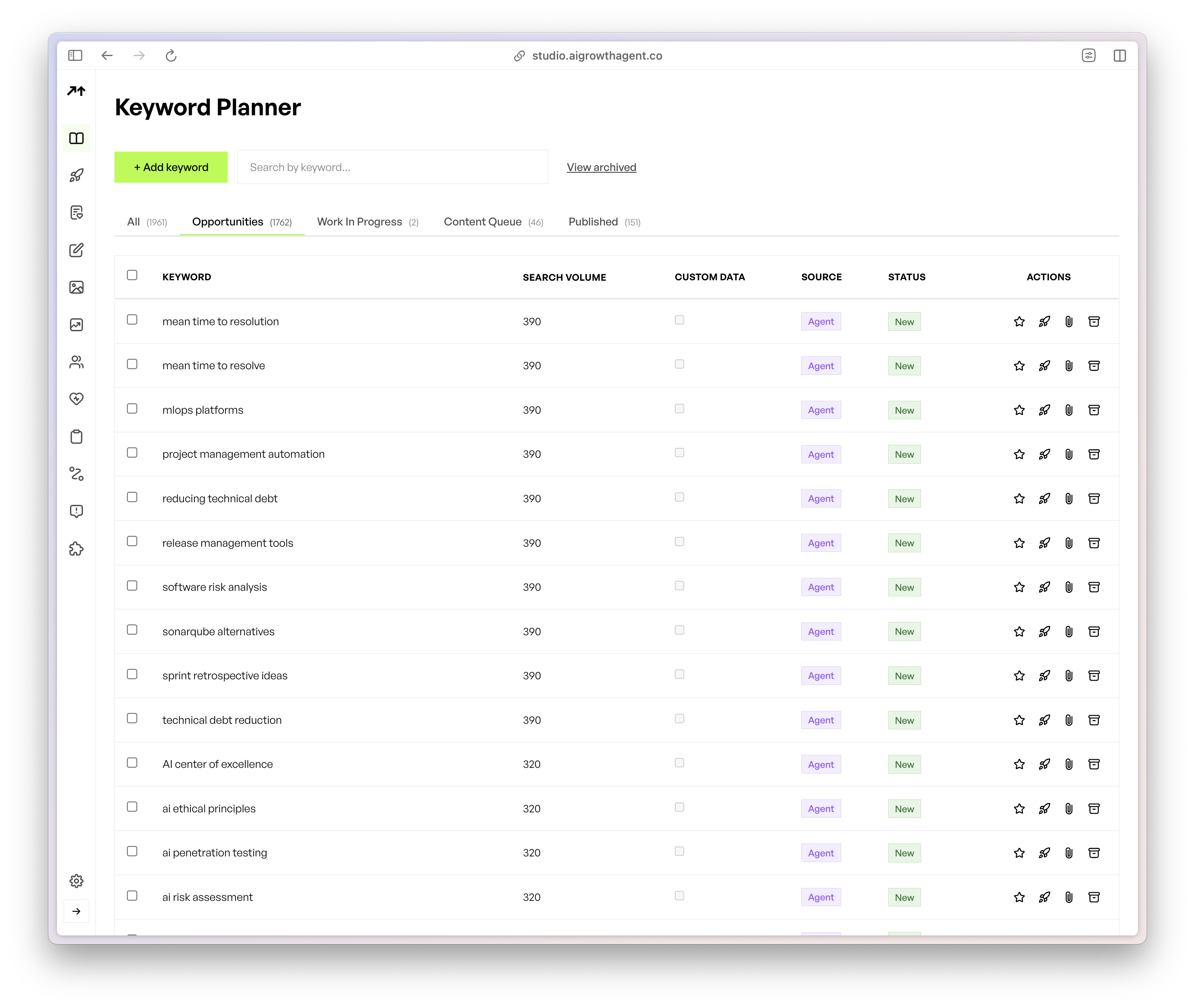
1. Program Keyword Clustering and Company Manifesto
Teams ingest thousands of relevant search queries for their domain. The system converts these into content pillars and clusters tailored to query-driven search behavior. A Company Manifesto then defines brand voice, boundaries, and positioning so the agent stays consistent at scale.
2. Technical Infrastructure Setup
Teams deploy schema markup, LLM.txt files, and Model Context Protocol (MCP) integration. This setup lets AI search engines interface directly with the content database. Most successful teams use hosted subdomains such as blog.yourcompany.com for tighter technical control.
3. Content Generation Agent Activation
Autonomous agents handle strategy, research, drafting, fact-checking, and publishing. Teams start with narrow content types and expand once results prove stable. This staged rollout reduces risk while the agent learns.
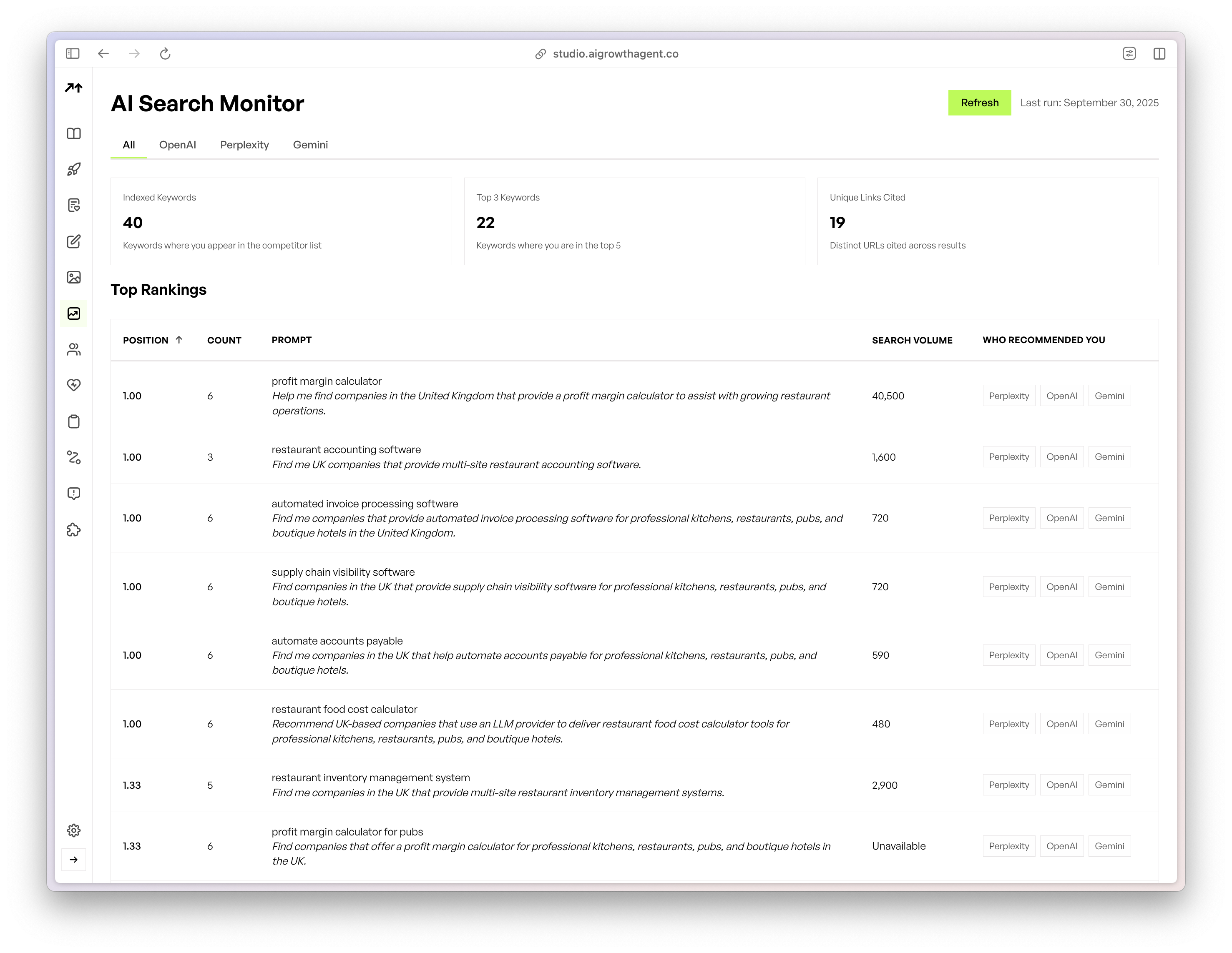
4. Studio Dashboard for Human Control
A central dashboard gives teams direct editing, feedback tools, and approval workflows. Auto-Pilot mode becomes safe once the agent has enough feedback to mirror brand preferences.
5. AI Citation and Performance Monitoring
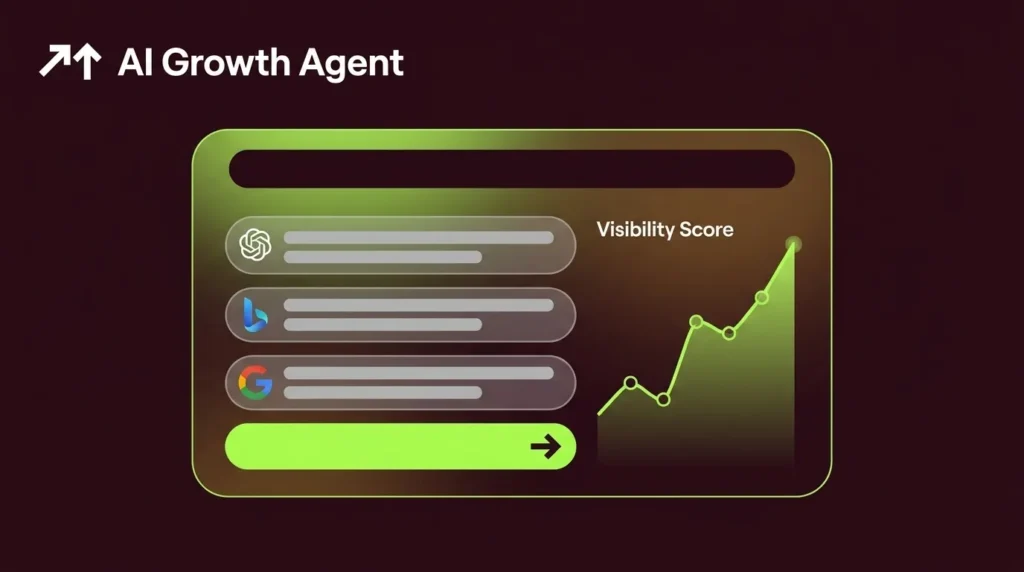
Teams track citation frequency across ChatGPT, Perplexity, and Google AI Overviews. AI referrals convert twice as well as organic search traffic, so citation tracking becomes a core ROI metric.
This structured approach removes engineering friction while keeping quality high. Schedule a demo for autonomous content generation to see this pipeline running end to end.
Inside AI Growth Agent’s 6-Step Autonomous Workflow
AI Growth Agent follows a proprietary 6-step workflow that delivers AI citations and traffic in weeks instead of months.
White-Glove Onboarding: A one-hour data transfer session with a resident journalist programs the agent’s “brain” and produces your Company Manifesto.
Programmatic Research: The agent evaluates tens of thousands of search queries and outputs a full content strategy organized into pillars and clusters.
Technical Infrastructure: The system deploys a schema-optimized blog architecture on a subdomain such as blog.yourcompany.com. It also supports WordPress, Hashnode, Webflow, Framer, Sanity, and HubSpot, although most clients choose the hosted option for smoother performance. Advanced LLM.txt and the first blog-focused Model Context Protocol (MCP) implementation complete the setup.
Content Agent Activation: The agent executes strategy, research, drafting, fact-checking, and publishing while applying advanced technical SEO decoration.
Studio Control: A transparent dashboard provides editing tools, feedback systems, and Auto-Pilot mode for near hands-free operation once trust is established.
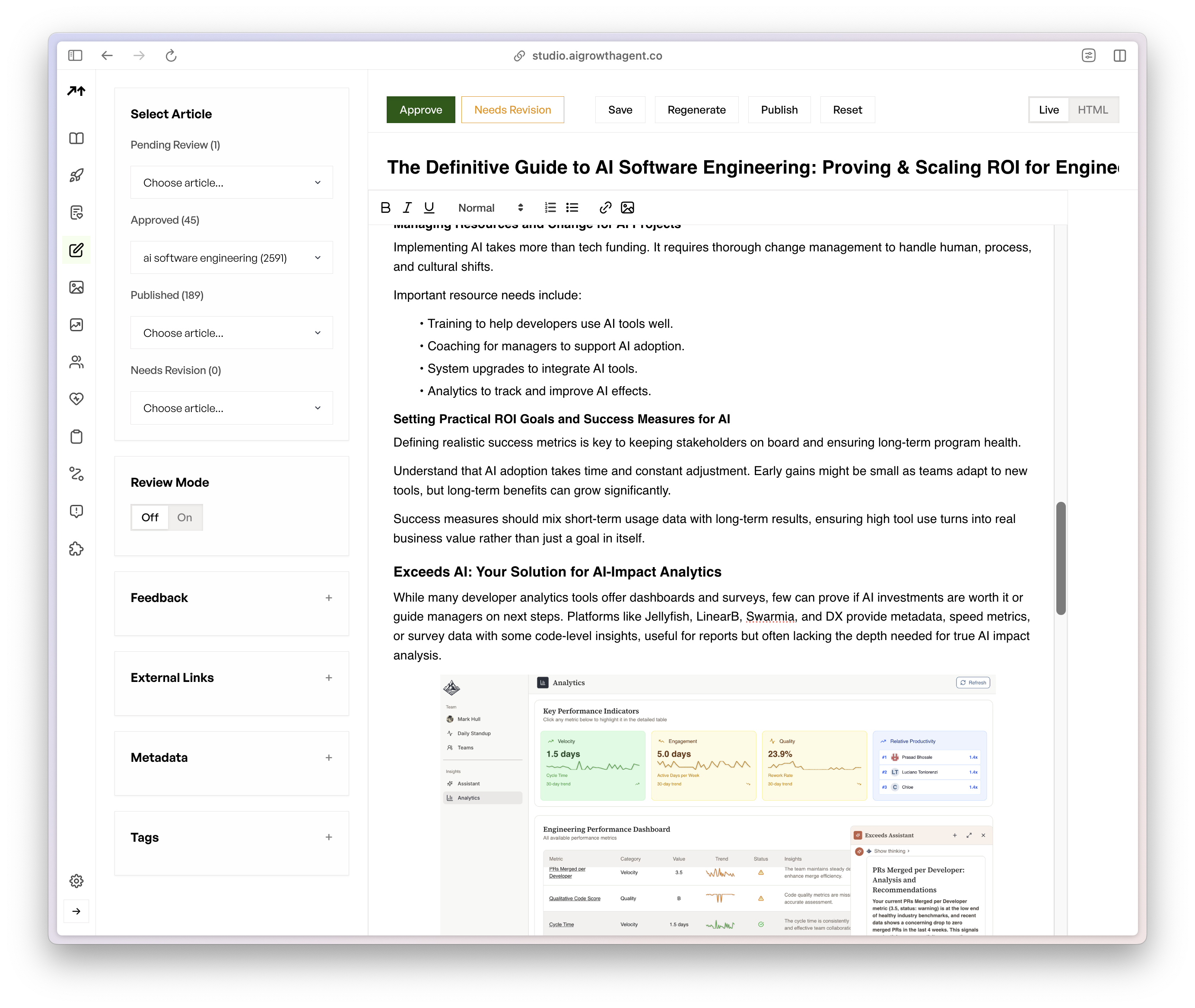
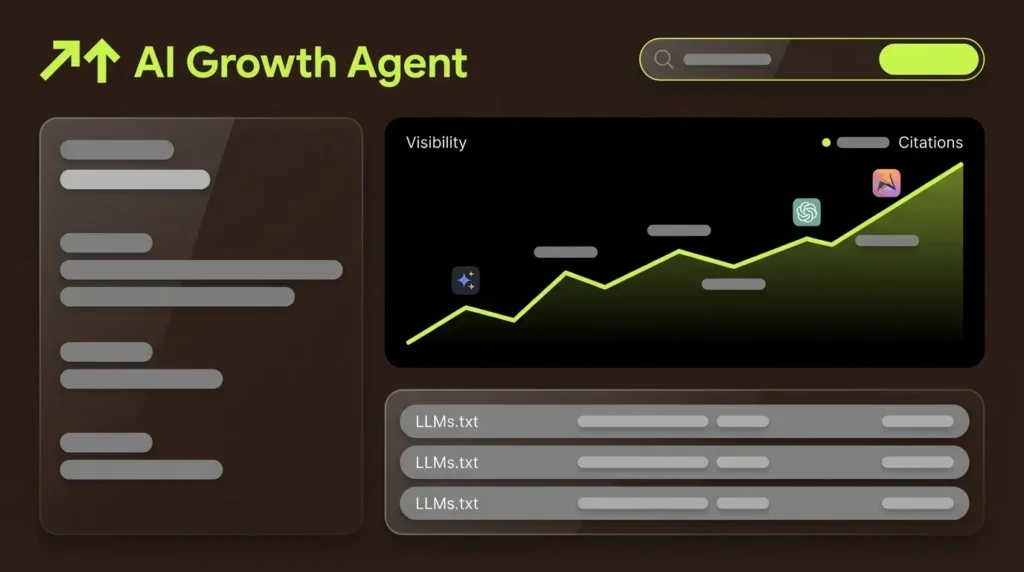
AI Search Monitoring: Real-time tracking covers ChatGPT citations, Perplexity rankings, and Google AI Overview appearances, visualized through performance heatmaps.
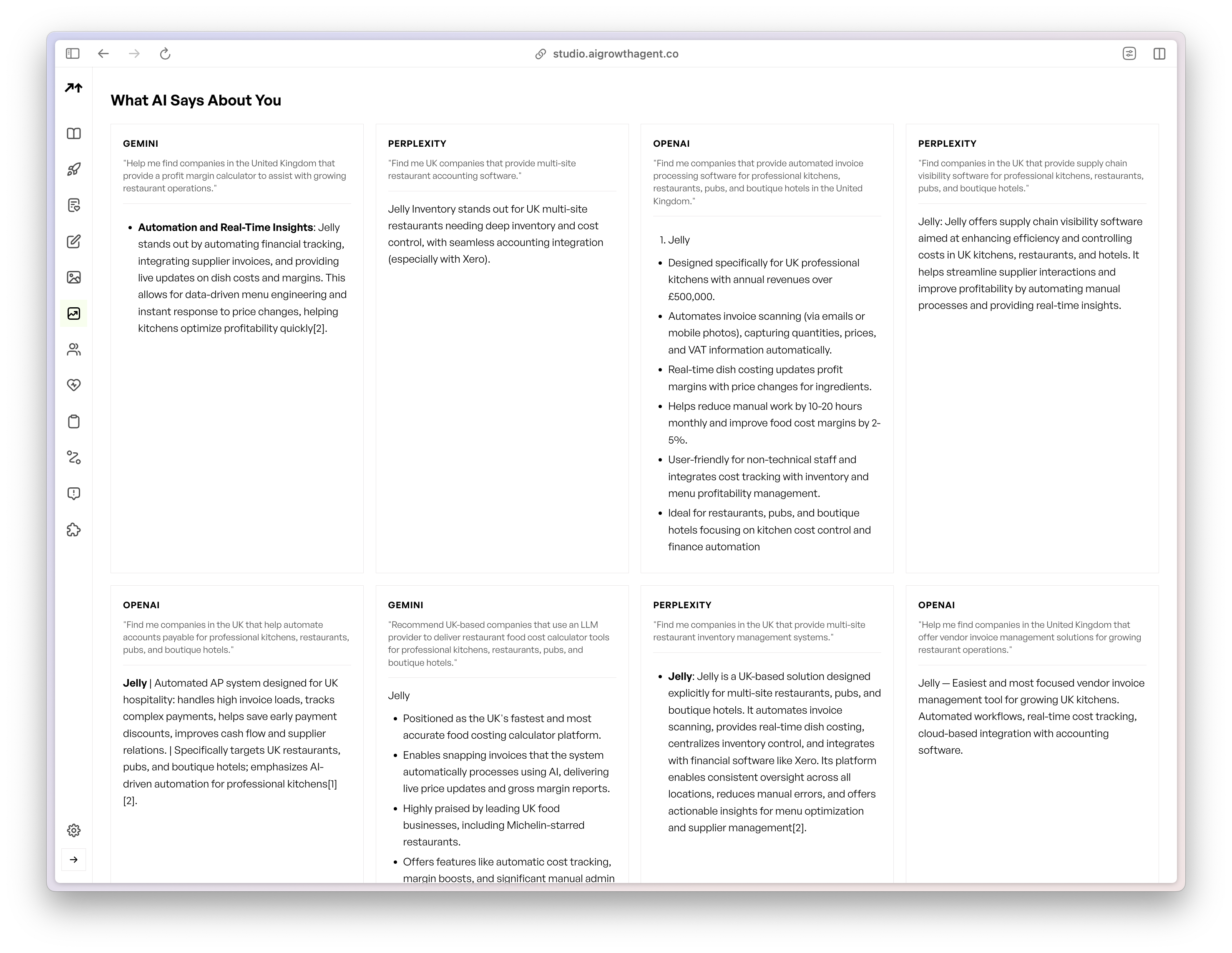
This workflow combines MCP for direct AI database access with real-time content injection. Schedule a demo to deploy your agent today and scale content with confidence.
How AI Growth Agent Compares to Agencies and Jasper
|
Feature |
AI Growth Agent |
Traditional Agencies |
Jasper |
|
Autonomous Scale |
Yes (Unlimited) |
No (Manual, slow) |
Partial (Text-only) |
|
AI Citations/GEO |
Built-in MCP |
None |
None |
|
Schema/Technical SEO |
Auto |
Manual |
Manual |
|
ROI Timeline |
Weeks |
Months |
Unproven |
AI Growth Agent defines a new category of programmatic SEO technology that delivers engineered authority at scale instead of manual services or basic text output.
Case Studies: Fast AI Citations and Rankings
Gitar.ai: Reached top ChatGPT citations in 2 months for “AI self-healing pipelines” and became a reference brand for AI-powered CI/CD automation across Google AI Overview, ChatGPT, and Perplexity.
Exceeds AI: Secured the #1 Perplexity recommendation in 2 weeks and appeared in Google AI Overview snapshots for core performance review keywords within 3 weeks.
Bucked Up: Earned the #1 protein soda citation from ChatGPT within 3 weeks and appeared as the top result for the high-intent query “best protein soda.”
BeConfident: Became the #1 recommended app in Brazil to learn English through Google AI Overview within weeks of programmatic publishing, competing directly with Duolingo and Busuu.
These outcomes show how autonomous content generation can move brands quickly. Zapier’s 16.2 million monthly organic visitors highlight the long-term upside of programmatic SEO at scale.
Solving Common Challenges in Autonomous pSEO
Teams often face unstructured output, weak data quality, and indexing failures when they first attempt autonomous content. Google penalizes thin, duplicative, or auto-generated content that adds no value, so quality control becomes non-negotiable.
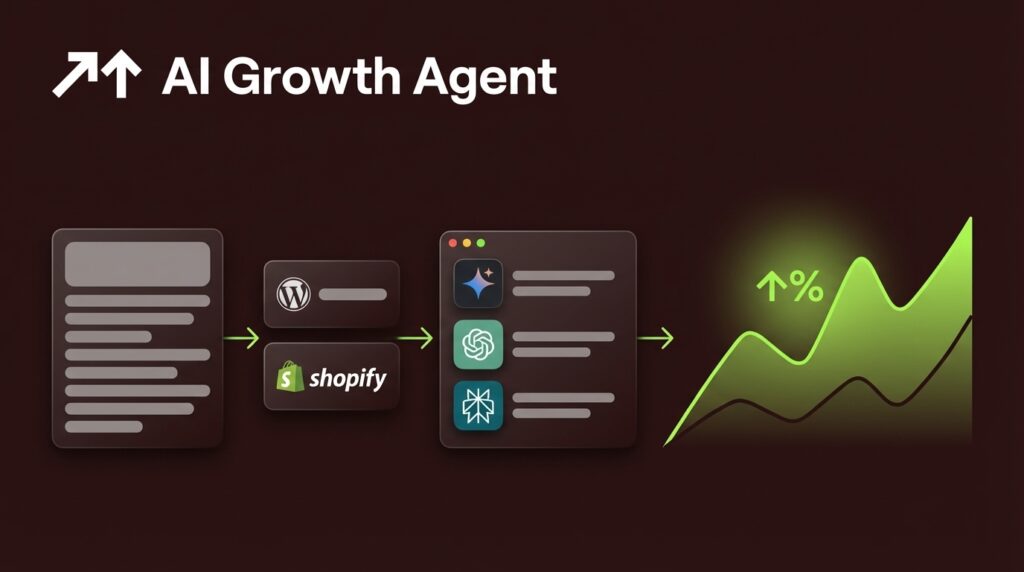
Effective solutions include guardrails with clear objectives, content boundaries, human verification steps, and specific brand message formats. Strong deployments also rely on smooth Shopify and WordPress integrations, automated schema injection, and monitoring systems for performance tracking.
Teams see the best results when they start from structured data sources and use templates that mix dynamic data with static expert content. Each page then targets a clear user intent and avoids thin duplication.
Preparing Your pSEO Strategy for Multimodal AI
The 2026 environment pushes teams toward multimodal AI and agentic workflows. Multimodal AI connects text, image, video, and audio into cohesive outputs, while autonomous workflows handle complex multi-step tasks from a single request.
Teams should monitor performance through Google Search Console and AI heatmaps that track citation frequency across major AI search platforms.
Frequently Asked Questions
How does autonomous content generation integrate with Shopify and WordPress?
AI Growth Agent integrates with WordPress, Hashnode, Webflow, Framer, Sanity, and HubSpot through hosted subdomains or direct connections. The system auto-publishes schema-optimized pages that match your existing design and maintain brand consistency. For self-hosted setups, a dedicated WordPress instance is strongly recommended so teams can use the full technical SEO stack, although most clients still choose the hosted option for stronger control.
What is the ROI timeline for programmatic SEO in AI search?
AI citations usually appear within weeks of deployment, and meaningful traffic growth often arrives within the first year. Case studies show 300-700% traffic increases when the foundation is set up correctly. The monitoring dashboard tracks real-time performance across ChatGPT, Perplexity, and Google AI Overviews, tying ROI to citation frequency and AI-referred traffic quality.
Is autonomous content generation effective for both AI SaaS and ecommerce stores?
The same technology works for both AI SaaS and ecommerce brands. Ecommerce teams use database-to-content automation that turns product catalogs into SEO-rich landing pages. AI SaaS companies focus on keyword clustering and technical content that builds thought leadership. Structured data and clear user intent for each content type drive success in both cases.
How does programmatic SEO support ChatGPT and Perplexity rankings?
The Model Context Protocol (MCP) and LLM.txt implementation allow AI search engines to connect directly with your content database. This foundation, combined with schema markup and structured data, improves AI indexing quality. Teams then monitor citation frequency across platforms and adjust content strategy based on performance data.
What makes autonomous content generation different from traditional AI writing tools?
Traditional tools generate raw text that still needs manual technical work. Autonomous content generation manages the full pipeline, including strategy, research, writing, technical SEO, schema injection, and publishing. The system learns brand voice through feedback and can run in Auto-Pilot mode once trained, producing consistent authority at scale instead of one-off drafts.
Conclusion: Move to Autonomous pSEO Before Competitors Do
The 2026 AI search landscape rewards brands that adopt autonomous content generation for programmatic SEO. This blueprint, combined with AI Growth Agent’s technology, delivers measurable AI dominance through systematic content engineering at scale.
Manual SEO cannot match autonomous systems that drive 300-700% traffic growth and secure AI citations within weeks. Schedule a demo to build your autonomous agent and reclaim visibility in the AI search era.