Written by: Mariana Fonseca, Editorial Team, AI Growth Agent
Key Takeaways
- AI search competitive analysis tracks citation context, order-of-mention, and narrative positioning across answer engines instead of traditional SERP rankings.
- Traditional SERP tools are now incomplete because most users never click through to verify AI-generated answers, which breaks the old attribution model.
- A four-pillar intelligence framework, built on Search Intelligence, AI Analytics, Bot Tracking, and AI Ranking, gives teams the full picture needed to win citations.
- Winning brands turn weekly snapshots into living, self-healing content that stays current and compounds authority over time.
- Book a kickoff with AI Growth Agent to see your first article live within a week and start controlling your brand narrative in AI search.
What AI Search Competitive Analysis Actually Measures
Traditional competitive analysis measures rank position, which URL appears at which position for a given keyword. AI search competitive analysis measures something structurally different. When a customer asks ChatGPT which adjustable bed retailer to trust, there is no position one through ten. There is a narrative, and within that narrative there is an order of mention, a set of grouped competitors, and a claim attributed to each brand. In 2026, competitive analysis must answer what the AI says about the brand, who it groups the brand with, and which claim it cites that brand for.
Why Traditional SERP Competitive Analysis Is Now Incomplete
Traditional SERP analysis is now structurally incomplete, not just slightly outdated. Roughly 83% of people report skepticism toward AI-generated answers, yet only about 8% ever click through to verify them. For most users, whatever the AI surface says functions as the answer. The click that would have registered in Google Search Console, confirmed a ranking, and fed an attribution model never happens.
This zero-click dynamic breaks the feedback loop that traditional SERP analysis depends on. Rank trackers measure position, and click-through rate models assume a visit. Both assume the user leaves the search surface. In AI Mode, Perplexity, and ChatGPT, the user increasingly stays on the surface. Google’s AI Mode crossed 1 billion monthly users within its first year, with queries more than doubling every quarter since launch. The volume of decisions happening inside AI surfaces without a subsequent click now represents the majority of the market.
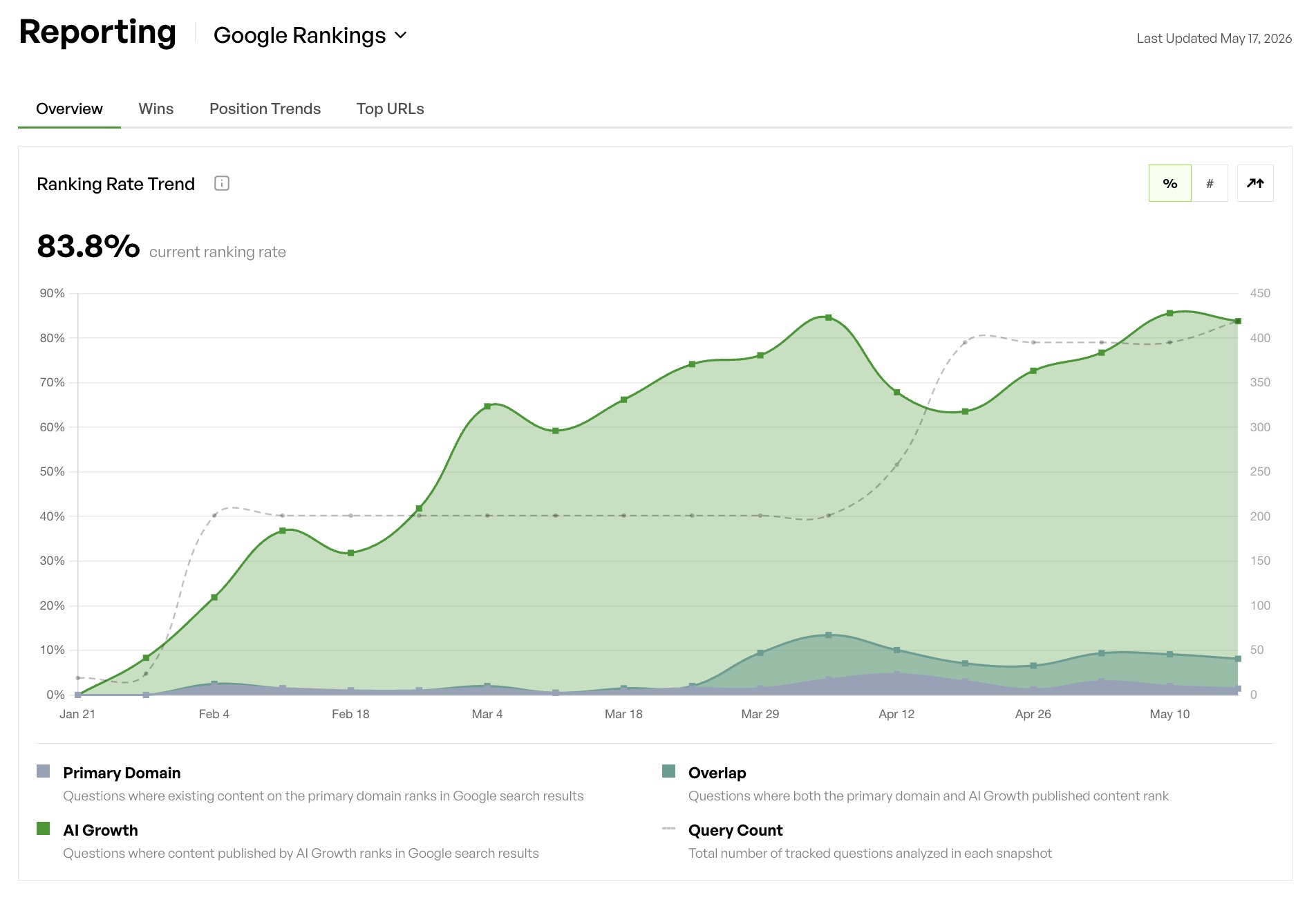
Teams need incremental visibility reporting as the new standard. This measurement model isolates what a brand’s content effort actually generated in AI citations, bot visits, and impressions, separate from the visibility the brand already held before the effort began.
The Four-Pillar Intelligence Framework for AI Citations
Winning in AI search requires seeing four distinct categories of signal at the same time. Any team operating on fewer than all four makes decisions with an incomplete picture. The framework below acts as the diagnostic model that converts raw market data into specific, citation-winning content decisions.
Pillar 1: Search Intelligence
Search Intelligence captures the competitive landscape across traditional and AI search surfaces. The table below shows the specific data points that reveal which content formats and structures are already winning citations.
| Data Captured | What It Shows | Why It Matters for Citations |
|---|---|---|
| Competitor domain rankings and top URLs | Who is winning each query and which pages are doing it | Reveals the content formats and structures AI surfaces are already pulling from |
| Query fan-out and “people also ask” clusters | How a seed term expands into long-tail queries | Identifies the full surface area where citations are being awarded |
| Forum threads, YouTube videos, Reddit discussions | Which community sources the AI surfaces are treating as authoritative | Shows where earned-media and owned-content gaps exist |
| Weekly universe refresh across 3,000+ searches | How the competitive landscape shifts week over week | Enables response before competitors consolidate a position |
Action step only a headless engine can execute at scale: AI Growth Agent runs hundreds of real searches weekly and has agents process every signal, refreshing the full universe snapshot so the brand can act on the sector faster than anyone using traditional tools.
Pillar 2: AI Analytics
AI Analytics reveals how answer engines currently describe the brand and its category. The table below explains which signals expose narrative gaps and new demand language that content should address.
| Data Captured | What It Shows | Why It Matters for Citations |
|---|---|---|
| Brand mentions across ChatGPT, Perplexity, and Google AI Overviews | Where the brand appears in AI-generated answers | Establishes baseline citation rate before content investment |
| Sentiment and claim attribution per mention | What the AI says about the brand and in what context | Identifies narrative gaps and incorrect claims to correct through owned content |
| Consumer behavior signals from AI-tool queries | How buyers are phrasing questions at the top of the funnel | Aligns content production to the actual language of demand |
Action step only a headless engine can execute at scale: A headless engine maps brand value and consumer behavior across the entire journey and converts those signals directly into a content topology. This removes the translation step that would otherwise sit with a human analyst.
Pillar 3: Bot Tracking
Bot Tracking shows whether the systems that award citations are actually reading the content you publish. The table below outlines the bot signals that prove which pages influence current and future AI answers.
| Data Captured | What It Shows | Why It Matters for Citations |
|---|---|---|
| Every crawl by traditional and AI training bots | Which pages are being read and by whom | Confirms whether published content is reaching the systems that award citations |
| Citation sweeps by ChatGPT’s source bot | When and how often ChatGPT pulls from specific pages | Provides direct evidence of citation activity, not inferred from traffic |
| Training agent visits | Which content is entering model training pipelines | Shapes what future model generations say about the brand |
Action step only a headless engine can execute at scale: AI Growth Agent tracks every bot interaction, including every crawl, citation, and training sweep, and cross-references that data with Google Search Console to isolate what the engine actually generated.
Pillar 4: AI Ranking
AI Ranking replaces static position numbers with a dynamic view of narrative placement. The table below shows how order-of-mention and peer grouping define the new leaderboard for brand visibility.
| Data Captured | What It Shows | Why It Matters for Citations |
|---|---|---|
| Order of mention within AI answers | Whether the brand leads, follows, or is absent from the narrative | First-mentioned brands receive disproportionate recall and trust |
| Grouped competitors per answer | Which brands the AI treats as peers | Defines the competitive set the brand must outperform in citation context |
| Week-over-week position evolution | Whether citation position is improving or eroding | Provides the new leaderboard in a world without static rank numbers |
Action step only a headless engine can execute at scale: AI answers have no static ordered list, so tracking order-of-mention across hundreds of queries weekly and turning that data into a content plan requires automation that no manual analyst or capped monitoring tool can sustain.
2026 AI Search Engine Positioning Comparison
The three dominant AI answer surfaces each behave differently in how they source, cite, and present brand information. Content strategy must account for all three rather than focusing on a single engine. The table below shows how each engine’s citation behavior drives a different content approach, which separates brands that win on one platform from brands that win across all three.
| Engine | Citation Behavior | Content Strategy Implication | Key 2026 Characteristic |
|---|---|---|---|
| Google AI Overviews and AI Mode | Pulls from indexed web content, favors structured, schema-marked pages with established domain authority | Technical SEO and schema markup remain prerequisites, and long-tail content under an owned subdirectory compounds fastest | Agentic booking now extends to local services in 2026, expanding beyond the initial search-only interface |
| ChatGPT | Cites sources via a dedicated source bot, favors authoritative, claim-validated content with clear authorship and primary-source backing | Anti-hallucination rigor and validated external sourcing increase citation frequency, and llms.txt plus llms-full.txt improve discoverability | Conversational follow-ups hold context across sessions, and information agents monitoring the web 24/7 are rolling out for premium users |
| Perplexity | Surfaces sources inline with answers, rewards content that directly answers specific long-tail queries with structured, scannable formatting | Long-tail query coverage and direct-answer formatting drive citation rate, and brands absent from the long tail are absent from Perplexity answers | Operates as a real-time web search layer, and citation behavior rewards freshness and specificity over domain age alone |
Extracting Citation Context at Scale
Citation context is a composite signal, not a single data point. It combines where the brand appears in an answer, which competitors it is grouped with, and what specific claim the AI attributes to it. Extracting that composite at scale requires a structured weekly process.
Weekly Competitive Snapshot Checklist
- Run the full query universe across ChatGPT, Perplexity, and Google AI Overviews, and record every brand mention.
- Log order of mention for each brand per query, noting whether the brand leads, appears mid-answer, or is absent.
- Identify which competitor groupings appear most frequently and whether the brand is included in the relevant peer set.
- Extract the specific claim each AI surface attributes to the brand and flag any inaccurate or missing claims.
- Record which URLs the AI surfaces cite as sources and confirm those pages are indexed and bot-accessible.
- Compare this week’s snapshot against the prior week to identify position gains, losses, and new competitor entries.
- Flag queries where competitors appear and the brand does not, and add those to the content production queue.
Mature AI Growth Agent clients operate universes of 1,600 or more queries, with the system running over 3,000 searches every week to refresh the snapshot. That volume is not achievable through manual prompt-by-prompt monitoring. It requires an engine.
Turning Analysis Into Living Content
The main gap between most competitive analysis programs and actual citation wins is the gap between observation and execution. Monitoring tools identify where a brand is absent, but they do not produce the content that closes the absence. Most brands stall in that gap.
Closing this gap requires a publishing system, not just a reporting dashboard. The content that wins citations in 2026 must be structured for bot parsing, backed by validated primary sources, formatted for the specific answer surface, and refreshed often enough that the next training sweep finds the current narrative rather than a stale one. AI Growth Agent’s content is living: it updates and self-heals over time instead of going stale, with every article’s relationships, performance, and bot and Search Console data centralized so authority compounds rather than decays.
Pricing structure shapes how much of the market a team can actually see. Tools that bill per prompt create a structural incentive to track fewer queries and produce less content. AI Growth Agent operates on a flat fee with no per-article charges, credit limits, or per-prompt billing, so clients see their entire universe instead of a capped handful of tracked terms. The universe is the competitive advantage, and capping it means capping the brand’s reach.
The impact of this approach is measurable and repeatable. Across the first twelve weeks, AI Growth Agent clients average more than 12,000 additional AI citations and mentions, over 100,000 additional bot visits, and a 20% or greater lift in impressions. These aggregate numbers translate to category leadership in practice. Breadless achieved a 30x lift in Google Search Console impressions over six months and is now the most recommended healthy franchise in the US, ahead of CAVA, Rush Bowls, and Sweetgreen. In a different vertical, Leva Sleep became the most mentioned adjustable bed retailer in Canada, with ChatGPT citing its content over 10,000 times per month and $40,000 to $50,000 in deals closed in under three weeks from buyers who discovered the brand through AI Growth Agent content.
Analysis without owned publishing functions as a rearview mirror. The brands cited in AI search this year are training the next generation of models with their own story. The brands that wait are training those models with whatever happens to be sitting on the open web.
Conclusion and Next Steps
AI search competitive analysis in 2026 operates as a different discipline from SERP monitoring, not a more sophisticated version of it. It measures citation context and order-of-mention across answer engines where the majority of users never click through to verify the answer. It relies on the four-pillar intelligence framework to show the full picture, across Search Intelligence, AI Analytics, Bot Tracking, and AI Ranking. It also depends on a publishing system that turns weekly snapshots into owned, self-healing content, because analysis that stops at observation leaves space for a competitor to define the story.
The brands winning this channel are not the ones with the most advanced monitoring dashboards. They are the ones whose content is what the AI finds, trusts, and cites when a customer asks.
Frequently Asked Questions
The questions below address the most common concerns teams raise when they evaluate AI search competitive analysis for the first time.
What is the difference between AI search competitive analysis and traditional SERP competitive analysis?
Traditional SERP competitive analysis tracks URL positions for a defined set of keywords on Google and measures click-through rates against those positions. AI search competitive analysis tracks citation context across answer engines, including which brands appear in AI-generated answers, in what order, grouped with which competitors, and attributed to which specific claims. The core difference is that AI surfaces deliver answers without requiring a click, so position numbers and click-through rates no longer capture where brands actually win or lose visibility. The relevant metrics are order-of-mention, citation frequency, claim attribution, and how those signals evolve week over week across ChatGPT, Perplexity, and Google AI Overviews.
How does the four-pillar intelligence framework connect to content production?
Each pillar generates a distinct category of signal that feeds the content decision. Search Intelligence identifies which queries competitors are winning and which long-tail queries still lack an authoritative answer. AI Analytics reveals what the AI surfaces are currently saying about the brand and where the narrative is inaccurate or incomplete. Bot Tracking confirms which published pages are actually being read by the systems that award citations, and which remain invisible to them. AI Ranking shows where the brand appears in the answer and whether that position is improving or eroding. Together, the four pillars convert a market snapshot into a prioritized content queue, where the queries missing the brand become the articles that need to exist, and the claims the AI gets wrong become the corrections that need to be published and validated.
Why is per-prompt billing a structural problem for AI search competitive analysis?
Per-prompt billing creates an incentive to track fewer queries. A brand’s actual market is not the handful of head terms it pre-decided to monitor. It is the full universe of queries a customer might ask, including hundreds of long-tail variations that individually have modest volume but collectively represent most of the places where AI citations are awarded. When a tool charges per prompt, the practical result is that the brand sees a small slice of its own market and makes content decisions based on incomplete data. A flat-fee model removes that constraint and allows the full universe to be refreshed weekly, which is the only way to catch competitive movements before they harden into entrenched citation patterns.
What does “living content” mean in the context of AI citation wins?
Living content is content that updates and self-heals over time rather than being published once and left to decay. In AI search, this matters because the models that award citations are retrained and updated continuously. A page that accurately described a product category in early 2025 may contain outdated claims by mid-2026, and an AI surface that detects stale or inaccurate content will deprioritize it in favor of fresher sources. Living content addresses this by automatically refreshing articles when the year turns, when Google Search Console signals indicate declining performance, or when bot-tracking data shows reduced crawl frequency. The practical effect is that the brand’s citation position does not decay between content production cycles, and authority compounds rather than eroding as the market changes.
How should a CMO measure whether an AI search content investment is actually working?
The measurement model must isolate incremental visibility, meaning the citations, bot visits, and impressions generated by the new content effort, separate from the visibility the brand already held before the effort began. This requires publishing into a separate environment so the baseline remains clean, then tracking week-over-week changes in AI citation frequency, bot traffic to the new content, Google Search Console impressions attributed to the new pages, and order-of-mention position across the target query universe. In a zero-click environment, full attribution from AI recommendation to closed sale is not always possible, but brands that capture source at the conversion moment consistently see a lift in organic leads that correlates with citation gains. The combination of bot tracking, Search Console data, and citation frequency across the four pillars provides a defensible weekly report that separates what the content investment generated from what the brand already had.