Written by: Mariana Fonseca, Editorial Team, AI Growth Agent
Key Takeaways
- Replacing a fragmented marketing stack with one autonomous engine is the fastest way to grow organic traffic without an agency in 2026.
- Agencies and DIY chatbots stall on slow timelines and limited scale, while the autonomous system delivers measurable visibility from week one with no RFPs or constant prompting.
- The seven-step framework covers search-intent mapping, Content Topology, content refresh, internal linking, traditional and agentic technical SEO, long-tail harvesting, and incremental visibility tracking.
- Clients typically see first articles live within one week, indexing in as little as ten days, and average more than 12,000 additional AI citations plus 20%+ impression lifts within twelve weeks.
- Schedule a consultation session to see how AI Growth Agent maps your full search and AI universe and delivers measurable incremental visibility from week one.
What You Need in Place Before the Engine Starts
Three inputs create the foundation for the system. First, a brand manifesto acts as the source of truth. It is a structured document that captures voice, factual references, deny lists, and the strategic anchors that define what the brand is and what it is not. This manifesto keeps every generated article on-brand and prevents off-message claims.
Second, you need a domain that supports a reverse proxy rewrite under a subdirectory or subdomain. This setup lets the optimized blog live at a path like yourbrand.com/blog while leaving your curated main site untouched. The engine publishes into that attached environment so you gain organic reach without redesigning your core site.
Third, connect Google Search Console as an independent audit layer. Search Console data cross-checks incremental visibility reports and confirms that new content is indexing and earning impressions.
No in-house technical team is required. The engine provisions schema, robots.txt, and sitemaps, then adds Blog MCP, llms.txt, and llms-full.txt so AI agents can read your brand correctly. It also handles instant indexing, autoredirects, and 404 tracking to keep the environment healthy as it grows. The only integration step for your team is the reverse proxy rewrite, and every other technical element ships with each package.
How the 7 Steps Fit into 5 Phases
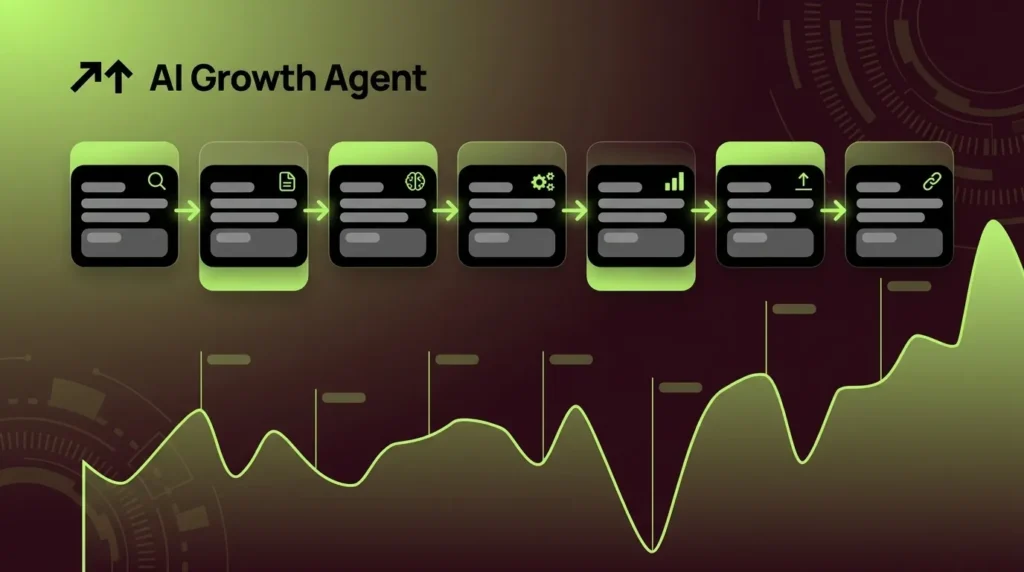
The system moves through seven steps organized into five logical phases, and each phase builds on the last. Phase one is universe mapping, which corresponds to Step 1. It identifies every seed term and long-tail query that describes the brand’s market so you stop guessing what to publish.
Phase two is Content Topology, which aligns with Step 2. It turns that raw query list into a hierarchy that sets production priorities and defines pillar and supporting articles. Phase three covers content creation and deployment, which includes Steps 3, 4, and 5. In this phase the engine refreshes existing content, publishes new articles, and applies both traditional and agentic technical SEO from day one.
Phase four focuses on internal linking and authority compounding, which Step 4 expands in detail. Articles connect to each other so authority flows across the cluster instead of sitting in isolated posts. Phase five is measurement and self-healing, which includes Steps 6 and 7. Bot tracking, Google Search Console, and incremental visibility reporting guide refreshes, long-tail expansion, and ongoing improvements.
Step-by-Step Guide to the Autonomous SEO Engine
Step 1: Search-Intent Mapping. Start by mapping every query your ideal customer actually asks, not just the head terms a brand once decided to defend. Robots and AI surfaces live in the long tail, where questions are specific and conversational. There are hundreds of ways a customer can ask the same question in an AI search space, and that surface area exponentiates when an agent reasons on top of a user query. Use real-time AI Overview and ChatGPT search results as the objective function to decide which long-tail queries deserve coverage. A new account usually starts with 300 to 400 queries, then expands as the engine claims more of the universe.
Step 2: Topic-Cluster Architecture (Content Topology). Once you have the universe of queries, organize it into a hierarchy of seed terms with long-tail questions beneath each one. This structure is Content Topology, a strategic map of where to win rather than a flat keyword list. Each cluster receives a pillar article that earns authority and passes it down through internal links to supporting pieces. The topology comes from real-time data, not guesswork, so every article has a clear role in the cluster.
Step 3: Content Refresh Before New Creation. Before publishing new material, review what already exists on your domain. Stale content drags down domain authority and confuses AI surfaces about what the brand currently claims. Refresh existing articles first by updating facts, adding current data, and tightening internal links. Living content updates and self-heals over time so the brand’s presence does not decay as the world changes. When the year turns, the engine refreshes every article in a sector automatically so nothing ages quietly in the background.
Step 4: Internal-Linking Blueprint. Every article follows a simple linking rule. It links to at least two topically related articles in the same cluster and one pillar article above it. Outbound links to external domains are sanitized and marked noindex and nofollow so authority stays inside your universe instead of leaking away. Internal links become the engine for compounding authority. When a new article indexes well, it lifts adjacent pieces through link equity, and bot-traffic data highlights which pages need extra internal-link support.
Step 5: Technical Basics Checklist for Humans and Agents. Traditional technical SEO still forms the baseline. The engine produces highly structured HTML, complete metadata including Open Graph titles and descriptions, and rich schema markup across article, author, review, product, and local business types. It maintains proper sitemaps, a detailed robots.txt, automated web stories, real-time bot tracking, instant indexing, autoredirects, and 404 tracking. On top of that, agentic technical SEO targets the systems that now do most of the reading. Every deployment includes Blog MCP with schema, manifest, discovery, and capability guidance exposed to agents. It serves OpenAI discovery and Agent Card guidance via /.well-known/, supports natural language query parameters at /?s={query} that trigger personalized, internally linked responses, delivers Markdown to agent crawlers, and publishes llms.txt and llms-full.txt so AI surfaces can parse the brand correctly.
Step 6: Long-Tail Keyword Harvesting. The 30-day execution plan runs on weekly milestones that build on each other. Week one covers the manifesto, topology, and first articles going live. Week two surfaces the first indexing signals in Google Search Console while bot tracking confirms crawler activity. Week three brings an internal-linking audit across all published articles and flags underperforming pages for refresh. Week four expands the universe by 50 to 100 additional long-tail queries based on which topics indexed fastest. Content has indexed in as little as ten days and often within two weeks. Mature clients reach universes of 1,600+ queries, with the system running more than 3,000 searches every week to keep the snapshot current.
Step 7: Tracking with Search Console and Incremental Visibility. Incremental visibility reporting isolates the impact of the engine from the visibility the brand already had. The engine publishes into a separate environment and tracks only what it created, week over week. Bot analytics record every bot that touches the blog, including the crawler ChatGPT uses to gather sources. Google Search Console acts as an independent audit and confirms which queries and pages are gaining ground. The engine then doubles down on content that indexes well and uses internal linking plus refreshes to lift pages that lag. Across the first twelve weeks, clients average more than 12,000 additional AI citations and mentions, over 100,000 additional bot visits, and a 20%+ lift in impressions.
How SEO Is Evolving in 2026
SEO has not died in 2026, but it has split into two tracks. Traditional SEO, which tuned pages for a static ranked list of blue links, is losing surface area to AI experiences that answer questions directly without a click. The core discipline of making content findable, trustworthy, and citable has become more important than ever because the primary reader is now a machine.
Large language model optimization represents the evolved form of SEO. It works in natural language, relies on validated primary sources instead of keyword density, and aims for citation context rather than a ranking number. The tactics that survive every AI search change remain the same: authoritative content, clean technical structure, and a coherent topic architecture. What changed is the required speed and scale, which now match an autonomous engine rather than a quarterly agency sprint.
Brands that treat 2026 as a pause year and wait for clarity allow the next generation of models to train on whatever happens to be on the open web. Brands that establish authoritative content now teach those models to use their narrative as the default answer.
The 80/20 Rule for SEO in an AI World
In an AI-influenced search environment, the 80/20 rule concentrates around long-tail coverage and agentic technical SEO. Roughly 80% of your organic visibility will come from 20% of your content decisions, and that critical slice usually involves specific, intent-rich questions combined with infrastructure that AI agents can read.
The highest-return tactics in 2026 are clear. Use evidence-based long-tail harvesting guided by real-time AI Overview and ChatGPT data. Maintain living content that self-heals instead of going stale. Build internal linking that compounds authority across each cluster instead of isolating it. Implement agentic technical SEO so the systems doing the citing can parse your brand. Social amplification, backlink outreach, and paid distribution still help, but they sit downstream from getting these four elements right.
The Golden Rule of SEO: Control the Narrative
The golden rule of SEO in 2026 is narrative control. A brand that does not publish the content models use to describe it will be defined by whatever those models find, often a competitor, a review site, or an outdated press mention. Narrative control starts upstream. It means publishing content in formats and structures models can read, with validation that earns citations, before customers ask their questions.
Large language model optimization provides the mechanism for that control. It outperforms legacy SEO because it works in natural language and feeds the AI surfaces where customers now decide whom to trust. The goal is no longer to rank for a single keyword. The goal is to be the answer when a model is asked about your category, your competitors, your use cases, and your brand by name.
Common Mistakes and How to Fix Them
Many teams treat traditional technical SEO as a one-time setup. They configure schema once and never revisit it. Sitemaps drift out of date. Internal links break as URLs change, and 404s quietly accumulate. The site still looks healthy in a dashboard, yet it becomes harder for important bots to crawl and understand.
Agentic technical SEO introduces another layer of risk when pieces are missing. Brands that deploy Blog MCP without llms.txt and llms-full.txt give agents a door with no key, because the agent can see the blog but cannot read its contents. Even when that gap is closed, serving structured content only to human visitors and not to agent crawlers leaves the brand invisible to the systems doing the citing. Without tracking AI training agents alongside traditional crawlers, teams cannot tell whether any of these fixes are working.
Start troubleshooting with bot tracking. If bot traffic does not appear in the first two weeks, the technical stack is incomplete. If bots arrive but citations do not show up in AI surfaces within four to six weeks, the content likely fails the trust test. Claims may lack validation, sources may be thin, or the topic cluster may be too shallow to establish authority.
How to Verify Outcomes and Measure Results
Incremental visibility reporting separates a true organic growth engine from a generic agency dashboard. The engine publishes into a distinct environment and reports only the visibility it generated, not the visibility the brand already owned. Week-over-week reports show where new content is indexing, where bot traffic is growing, and how citation context improves across AI surfaces.
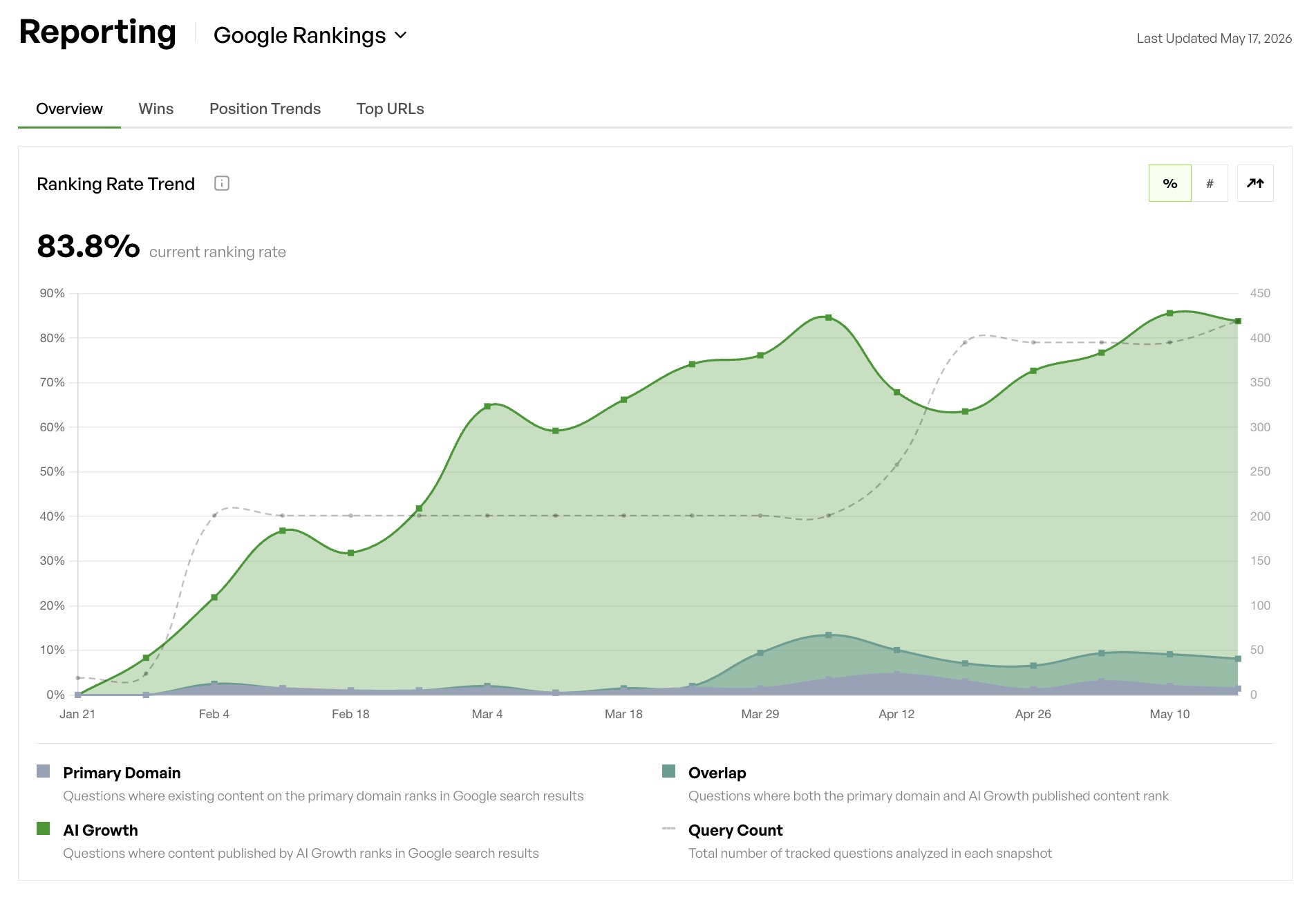
Google Search Console acts as the independent audit for this picture. Breadless grew Google Search Console impressions roughly 30x in six months, from 387,000 to 12.3 million, with a 7x+ increase in clicks and average organic rank moving from 25 to front-page 7.6. Bot tracking cross-references every crawl, citation, and training sweep. The four pillars, Search Intelligence, AI Analytics, Bot Tracking, and AI Ranking, feed a single data backbone that turns the market into a diagnosis and that diagnosis into specific content decisions.
Scaling the System and Planning Next Moves
Scaling to a universe of 1,600+ queries uses the same architecture at greater depth. Each seed term spawns more long-tail questions as the topology matures and the engine discovers new angles. Community answers, original data, video SEO, and technical fixes become the five main levers for targeting AI Overview citations at scale alongside ongoing long-tail harvesting.
Leva Sleep achieved an 88% ranking rate in target queries and a 61% AI Overview mention rate, with ChatGPT citations topping 10,000 per month. Breadless is now cited by ChatGPT over 45,000 times per month. Both brands used the same system: evidence-based long-tail harvesting, living content, agentic technical SEO, and incremental visibility reporting running on autopilot.
After completing the 30-day plan, the next move is expansion. The engine identifies seed terms where competitors currently win and highlights gaps. Your team then commissions authoritative content for each gap while Search Intelligence refreshes the competitive picture every week. The brand always knows which domains and URLs lead each result and where new white space is opening.
Frequently Asked Questions
How long does it take to see results when building organic traffic without an agency?
The first article usually goes live within one week of kickoff. Content has indexed in as little as ten days and often within two weeks. For brands with a solid topic cluster and complete agentic technical SEO, the first refreshed passages can appear on the fastest AI surfaces within four to eight weeks, while durable citation share typically takes three to six months. The standard engagement runs as a three-month pilot because indexing timelines vary by industry, but early movement shows up in bot tracking and Google Search Console before the first month ends.
What is the difference between traditional technical SEO and agentic technical SEO?
Traditional technical SEO covers the foundation. It includes structured HTML, full metadata, rich schema markup, internal linking, proper sitemaps, robots.txt, automated web stories, instant indexing, autoredirects, and 404 tracking. Agentic technical SEO adds a layer for the systems that now do most of the reading. It includes Blog MCP with schema, manifest, discovery, and capability guidance exposed to agents, OpenAI discovery and Agent Card guidance served via /.well-known/, natural language query parameters that trigger personalized responses for agents, Markdown served to agent crawlers, and llms.txt plus llms-full.txt so AI surfaces can read the brand correctly. Both layers work together, and neither delivers full results alone.
Can a non-technical marketing team run this system without engineering support?
Yes. The engine provisions every technical element automatically. The only task for the brand’s team is the reverse proxy rewrite that connects the blog to a subdirectory under the main domain. Setup documentation is generated for the brand’s specific host, whether Cloudflare, Vercel, or another provider. After that, the marketing team gives feedback in plain language, the engine learns from it, and every future generation reflects those rules without repeated re-briefing.
How does the system prevent content from going stale or producing inaccurate claims?
Content behaves as a living asset that self-heals and updates over time. The engine refreshes every article in a sector automatically when the year turns or when Google Search Console signals show decay. Accuracy comes from a cascade of anti-hallucination checks. Every claim, source, and quote is validated against evidence found online before publication, and the engine never relies on a model’s training data alone. After drafting, it re-extracts every claim and checks it against product pages, the manifesto, primary sources, and verified external references. Any claim that lacks support is removed or softened before the article moves forward.
Conclusion: One Engine Instead of an Entire Stack
The 7-step system, which includes search-intent mapping, Content Topology, content refresh before new creation, an internal-linking blueprint, traditional and agentic technical SEO, long-tail keyword harvesting, and incremental visibility tracking, forms a repeatable organic growth engine that replaces the agency stack. It operates as a single autonomous system that maps the full search and AI universe, produces living and self-healing content, manages every technical requirement from schema to llms.txt and llms-full.txt, and reports the incremental visibility it generates each week.
The outcomes described throughout this article, including 12,000+ additional AI citations, over 100,000 extra bot visits, and 20%+ impression lifts within twelve weeks, come from a single autonomous engine running the 7-step system. One engine replaces the SEO agency, the content tool, the web agency, the GEO monitor, the schema plugin, the analytics stack, and the PR firm at a flat fee with no per-article charges, credit limits, or per-prompt billing.
Traditional search tools show you where your brand stands. AI Growth Agent focuses on making your brand the answer.