Written by: Mariana Fonseca, Editorial Team, AI Growth Agent
Key Takeaways
- SEO agencies face four main bottlenecks: ineffective processes, talent constraints, SEO misalignment, and measurement gaps that cap output at 1–2 pieces per month while AI content floods search.
- Manual workflows create delays from multiple handoffs, schema drift erodes trust, and traditional metrics ignore AI visibility drops like 34.5% to 58% CTR losses in AI Overviews.
- Programmatic SEO automation with AI agents, programmed through company manifestos, supports 50+ high-quality pieces per month while preserving E-E-A-T and brand authority.
- Examples such as Flyhomes’ 10,737% traffic growth and clients winning top AI citations show 10x scaling without quality loss or spam penalties.
- Agencies can overcome scaling challenges with AI Growth Agent’s demo for end-to-end programmatic SEO that builds authority at superhuman scale.
Why SEO Agencies Struggle To Scale Quality Content
1. Inefficient Production Processes Block Scale
Multiple handoffs between writers, editors, and strategists slow execution, stretching turnaround times to weeks per deliverable. Manual editorial workflows demand repeated revisions that keep output stuck at low volumes. Lack of repeatable workflows from keyword research through publishing prevents scaling without adding headcount. Without automation for daily publishing, agencies remain locked in artisanal production models.
2. Talent Bottlenecks Limit Expertise Signals
Heavy reliance on manual creation without AI co-pilot support slows production, making it difficult to exceed 50 pieces per month while protecting E-E-A-T. Junior writers weaken expertise signals, while subject matter experts burn out managing quality control across growing volumes. Templated approaches create generic content that blurs brand voice across teams, which undermines the authority signals AI search engines reward.
3. SEO Misalignment With Post-HCU Reality
Post-HCU algorithms demand consistent technical precision that manual workflows rarely deliver. Schema drift, or mismatches between JSON-LD schema and visible page content, erodes trust and attracts heavy penalties from Google. Traditional broad informational content underperforms in the dark funnel of AI chats and untrackable channels. Many agencies also skip LLM.txt, which blocks AI citation optimization.
4. Measurement Gaps Hide AI Visibility Losses
Agencies often chase output metrics instead of AI visibility outcomes. Organic CTR drops by up to 58% for queries with AI Overviews, yet teams still focus on classic ranking positions. Google’s content effort metric uses LLMs to score pages on perceived creation effort and push back on low-effort AI floods. Thin content at scale triggers algorithmic penalties instead of building authority.
Scale content without compromising quality with an AI Growth Agent demo and see how programmatic SEO automation removes these bottlenecks.
Building High Quality SEO Content In The AI Era
High quality SEO content now requires subject matter expertise combined with technical precision at scale. Systematic processes for scaling SEO content protect quality and rankings as volume grows beyond manual limits. The practical path uses AI agents programmed with company manifestos that act as guardrails so every piece reflects brand voice and expertise signals. Teams should replace generic ChatGPT prompts with structured briefing systems that inject niche context and search intent for differentiated content.
Costly SEO Mistakes When Scaling Content
The most damaging mistake involves using non-engineering tools that output unstructured text instead of fully engineered web pages. Skipping keyword grouping into topic clusters and ignoring editorial calendars creates inconsistent, non-scalable output. Lack of programmatic content and automation keeps production stuck at low levels or sacrifices quality. Effective scaling relies on keyword clustering, template-based production with AI oversight, and automated internal linking that manual teams cannot maintain consistently.
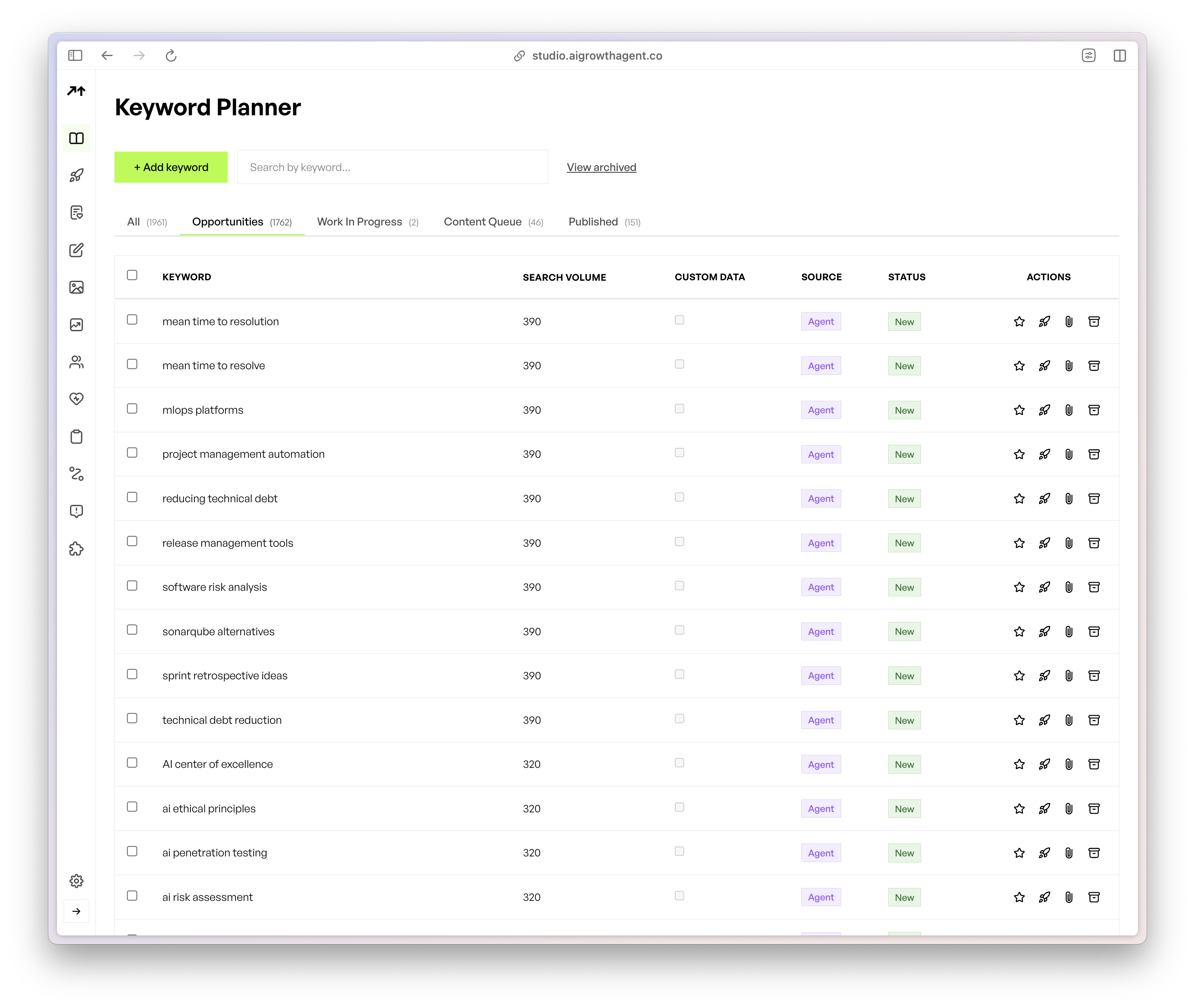
Modern SEO Agency Content Workflow Blueprint
Modern content workflows remove handoffs through end-to-end automation. A streamlined research-to-publish pipeline includes automated briefing, AI-assisted drafting with manifesto guardrails, fact-checking protocols, technical SEO decoration, and direct publishing. Heavy dependence on manual steps creates capacity ceilings that keep production well below 50 pieces per month. Programmatic workflows replace bottlenecks with predictable execution that scales without degrading quality.
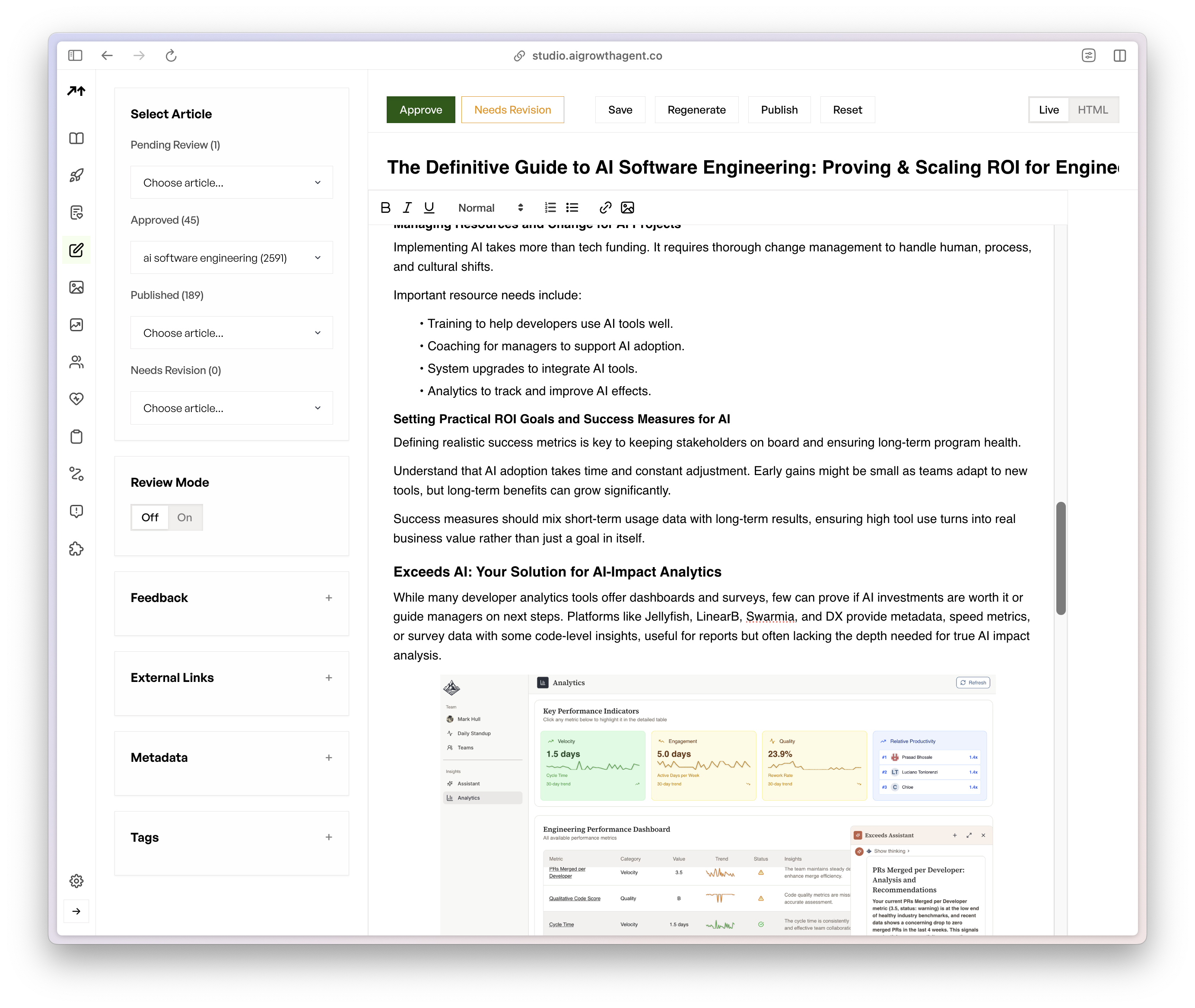
Fix your SEO agency content workflow with a live demo and watch automated content engineering in action.
Programmatic SEO With AI Growth Agent
Manual content creation no longer keeps pace with AI search. More than 56% of marketers already use generative AI in SEO workflows and report an average 45% uplift in organic traffic. AI Growth Agent delivers end-to-end programmatic SEO automation through manifesto programming, automated keyword clustering, schema implementation, LLM.txt optimization, and direct publishing control through the Studio interface.
Our programmatic approach removes headcount limits and unlocks near-unlimited capacity. Companies with over 200 employees report more than 83% measurable SEO gains after adopting AI, while traditional agencies still rely on templates that weaken brand authority. Our autonomous content agents preserve expertise signals with company-specific manifestos and execute technical SEO at superhuman scale.
The system includes multi-tenant deployment for portfolio companies, real-time content injection for trending topics, database-to-content automation for proprietary data, and intelligent asset placement with metadata optimization. This integrated approach finally resolves the scale versus quality tradeoff that manual workflows cannot overcome.
2026 Case Studies Proving Programmatic SEO Impact
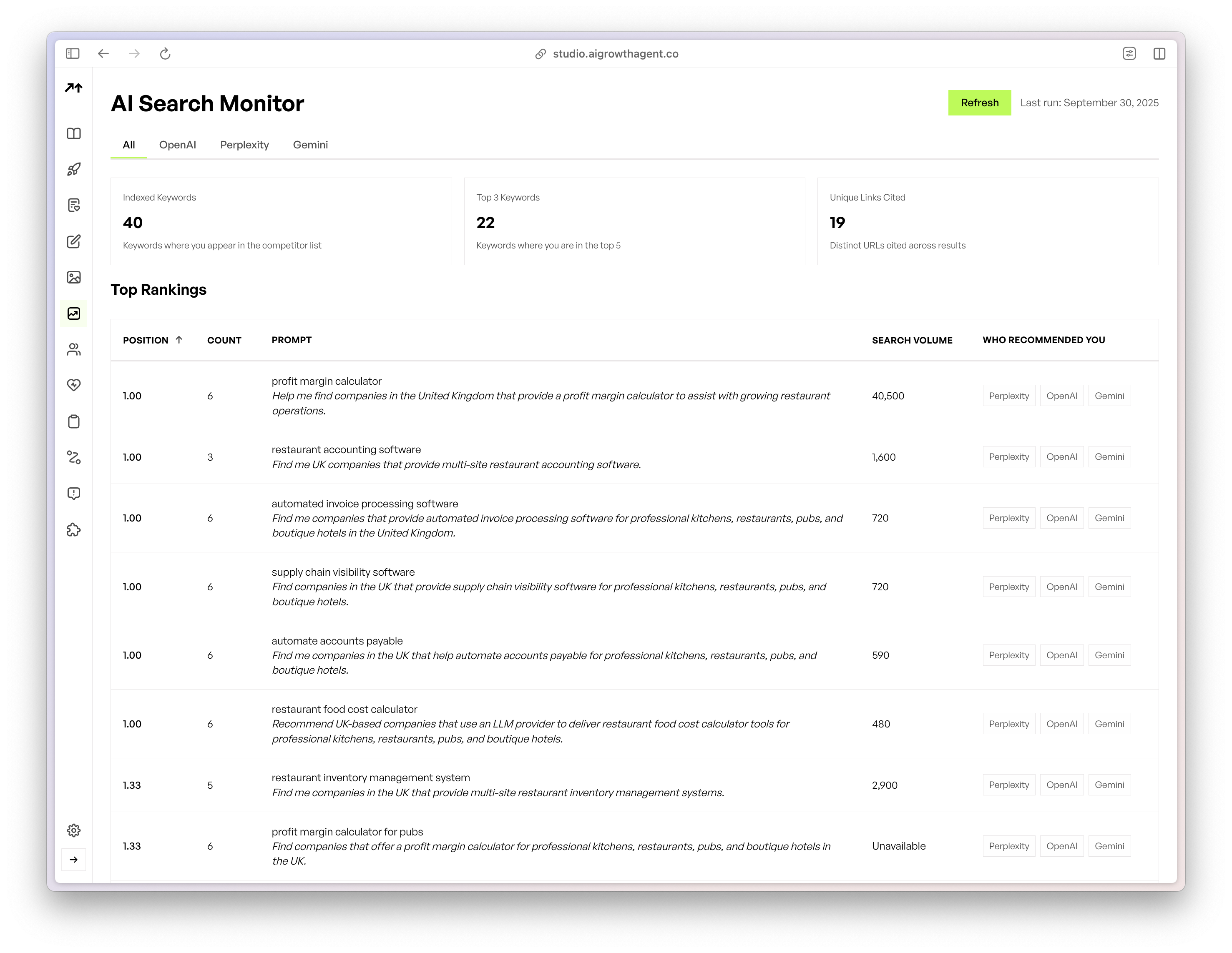
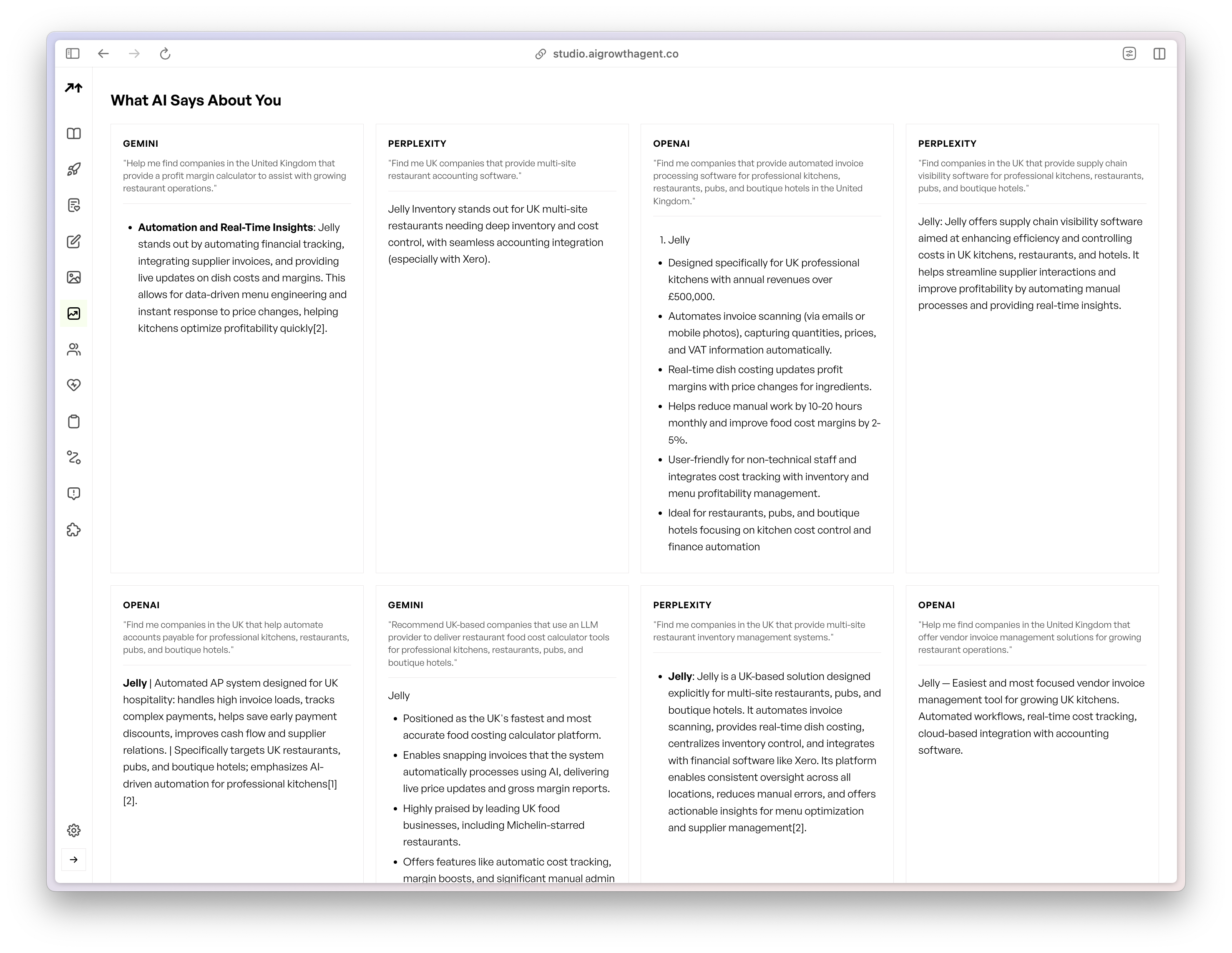
Flyhomes achieved 10,737% traffic growth by scaling from 10,000 to 425,000 pages in three months using programmatic SEO, while Zapier created more than 70,000 integration pages that drive 16.2 million monthly organic visitors. Our clients see similar outcomes. Bucked Up secured the #1 ChatGPT citation for “best protein soda” in three weeks, and Gitar dominates AI search results for “self-healing pipelines” across ChatGPT, Google AI Overviews, and Perplexity. These examples show 10x production velocity paired with authority wins instead of content spam.
FAQ
Can AI tools scale agency content production effectively?
Generic AI writing tools cannot scale agency content effectively because they output unstructured text instead of fully engineered web pages. They also lack technical SEO automation, schema implementation, and brand manifesto programming, which are required for quality at scale.
Effective scaling uses programmatic SEO systems like AI Growth Agent that manage the full content engineering lifecycle from strategy through optimization and publishing.
What is programmatic SEO and how does it differ from traditional content creation?
Programmatic SEO uses autonomous content engineering to build authority at scale through systematic automation. Traditional content creation relies on human handoffs and manual optimization, which limits volume and consistency.
Programmatic SEO uses AI agents, guided by company manifestos, to handle research, writing, fact-checking, technical SEO decoration, and publishing automatically. This approach supports 50+ high-quality pieces per month while maintaining E-E-A-T standards that manual workflows cannot match at scale.
How can SEO agencies scale content creation without compromising quality?
Agencies scale content without losing quality by adopting programmatic SEO workflows that replace manual bottlenecks with automation.
This approach programs AI agents with company-specific manifestos, automates keyword clustering and content templates, enforces fact-checking protocols, and manages technical SEO tasks such as schema markup and metadata. The shift moves teams from artisanal content creation to engineered systems that keep expertise signals strong while production reaches superhuman levels.
What are the main bottlenecks preventing agencies from scaling quality content?
Four bottlenecks block scale. Ineffective processes with multiple handoffs slow delivery. Talent constraints mean junior writers dilute expertise while experts become overloaded. SEO misalignment, including schema drift and missing AI optimization, weakens performance.
Measurement pitfalls focus on output instead of AI visibility outcomes. Together these issues cap production well below 50 pieces per month while programmatic competitors achieve 10x scale without losing quality.
Why do traditional SEO strategies fail in the AI search era?
Traditional SEO strategies fail because they optimize for blue link rankings while AI search engines prioritize content for citations and direct answers. Manual content creation cannot reach the necessary volume or technical precision for AI visibility, and broad informational content underperforms in the dark funnel of AI chats.
These approaches also lack structured data, LLM.txt implementation, and programmatic freshness, which AI search engines reward, so visibility drops as AI-generated content floods results.
Conclusion: Move From Manual To Programmatic SEO
Manual content workflows break down in the AI search era, where analysts predict a 25% drop in traditional search volume by 2026 as AI chatbots gain share. Agency survival now depends on programmatic SEO automation that delivers 10x content velocity without diluting quality. AI Growth Agent provides an autonomous content engineering system that replaces manual bottlenecks with systematic authority building at superhuman scale.
Schedule a demo to confirm fit for programmatic SEO automation that positions your agency as the definitive authority in your category while competitors stay stuck in manual production.