Written by: Mariana Fonseca, Editorial Team, AI Growth Agent
Key Takeaways
- Traditional SEO agencies move too slowly for the AI era, working in 3–6 month cycles while AI rewards daily publishing.
- Key limitations include ignoring AI visibility metrics, rigid volume-based pricing, and backlink-first tactics that rarely drive AI citations.
- AI search now prioritizes citations in ChatGPT, Perplexity, and Google AI Overviews, with up to 88% of searches triggering AI responses.
- Brands using AI Growth Agent earn AI citations within weeks, as shown in case studies like Exceeds AI, BeConfident, Bucked Up, and Gitar.
- Switch to AI Growth Agent for programmatic SEO that delivers week-1 results; schedule a demo today to dominate AI search.
Why Traditional SEO Agencies Are Too Slow in the AI Era
Traditional SEO agencies struggle in the AI era because they rely on manual headcount, outdated metrics, and legacy tactics. They face three critical limitations: manual production constraints, blindness to AI citations, and a lack of generative engine optimization (GEO) expertise. Most still track only keyword rankings, backlinks, and organic traffic instead of AI visibility metrics like brand mentions in ChatGPT, Perplexity, and Google AI Overviews.
These limitations create a velocity gap that makes traditional agencies incompatible with AI-era demands. The numbers are staggering. Companies using AI in their content process publish a median of 17 articles per month, 42% more than the 12 articles published monthly by companies creating content manually.
Meanwhile, SEO still functions as a long-term strategy, typically requiring 4–6 months to see significant results, with maximum impact often taking 12–18 months. The following comparison shows how programmatic SEO compresses every milestone on this timeline.
|
Timeline Milestone |
Traditional Agencies |
AI Growth Agent (Programmatic) |
|
Onboarding |
2-4 weeks |
1 week |
|
First Article |
1-3 months |
1 week |
|
Scale to 10 Articles |
3-6 months |
Week 2–3 typical |
|
AI Citations |
6-12 months |
2-4 weeks (per case studies) |
Five warning signs show your agency is too slow for AI-driven search.
1. No AI Visibility Metrics in Monthly Reports
Many traditional SEO agencies never mention AI visibility in their reporting. They still focus on keyword rankings, backlinks, and organic traffic instead of tracking brand mentions in ChatGPT, Perplexity, and Google AI Overviews.
2. Rigid Package Pricing Based on Volume
Fixed SEO packages based on keyword counts or blog post volumes reveal a production-only mindset. Offers like “50 keywords tracked” or “10 blog posts per month” ignore the strategic and technical shifts required for AI search.
3. No Clear Explanation of Generative Engine Optimization
Agencies that cannot clearly explain generative engine optimization (GEO) treat it as a buzzword instead of a core discipline. This gap signals no real investment in understanding how AI systems evaluate, structure, and cite content.
4. Backlink-First Strategies in an AI-First World
Backlinks account for only 2.8% of AI citations. Agencies that still push backlink-first strategies chase a signal that barely moves the needle in AI environments.
5. No Strategy Updates in the Last 12 Months
Agencies that have not updated their approach in the last 12 months operate on pre-2026 assumptions. The SEO landscape in 2026 differs sharply from 2024, especially around AI Overviews and LLM-driven discovery.
If your agency shows any of these warning signs, it is time to explore a programmatic alternative. Book a demo with AI Growth Agent to see how week-1 results become realistic.
How AI Search Reshapes the SEO Playbook
AI search now rewards different signals than traditional Google rankings and compresses user journeys into zero-click experiences. SparkToro’s zero-click study found that up to 58.5% of U.S. Google searches and 59.7% of EU searches now end without a click to any external website. The prevalence of AI Overviews mentioned earlier varies by industry, with informational searches showing the highest trigger rates.
This shift continues to accelerate as both buyers and publishers adopt AI tools. Wynter’s B2B buyer research shows that 24% of CMOs now use AI tools like ChatGPT and Perplexity to research vendors, up from zero mentions just a year earlier. At the same time, about 74% of all new online content now involves generative AI, which floods search with AI-written pages competing for the same queries.
AI SEO and traditional SEO now differ across speed, focus, and measurement.
AI SEO Advantages:
- Daily content velocity that keeps pace with AI index updates
- Citation-focused strategies that target how LLMs select and reference sources
- Schema markup and structured data that improve machine readability
- Real-time monitoring of trends and rapid content deployment
Traditional SEO Limitations:
- Monthly or quarterly content cycles that lag behind AI refresh rates
- Traffic-focused metrics that ignore AI visibility and citations
- Manual workflows that cannot scale across hundreds of pages
- Reactive strategies that follow trends instead of anticipating them
Teams that adapt to this AI-first model gain compounding visibility advantages. Request a live walkthrough to see how programmatic SEO can reset your content velocity.
Real-World Proof: Brands Capturing AI Citations Fast
Brands using AI Growth Agent already capture AI citations and visibility that traditional methods miss. These case studies show a consistent pattern of week-1 publishing and week-2 to week-4 AI mentions.
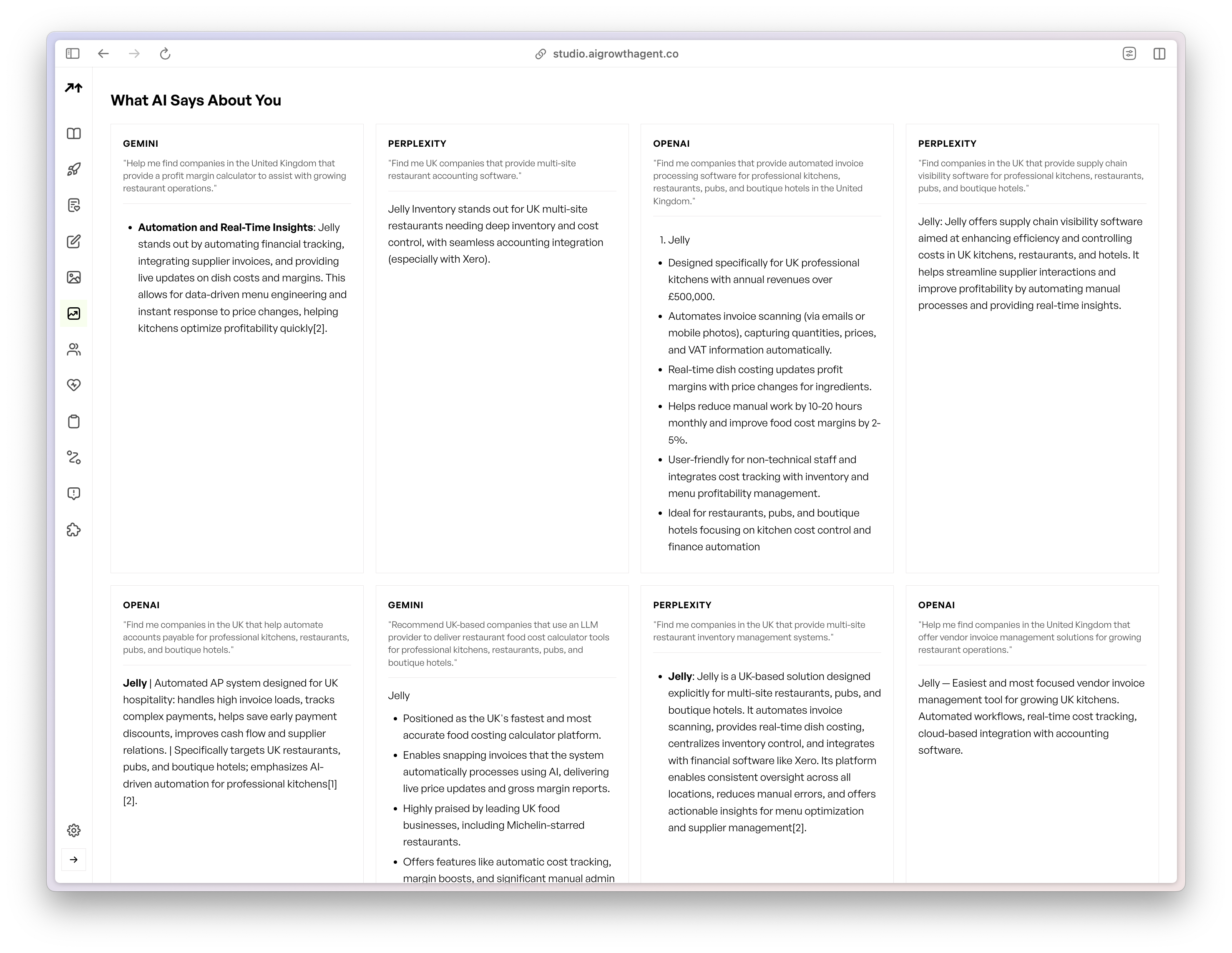
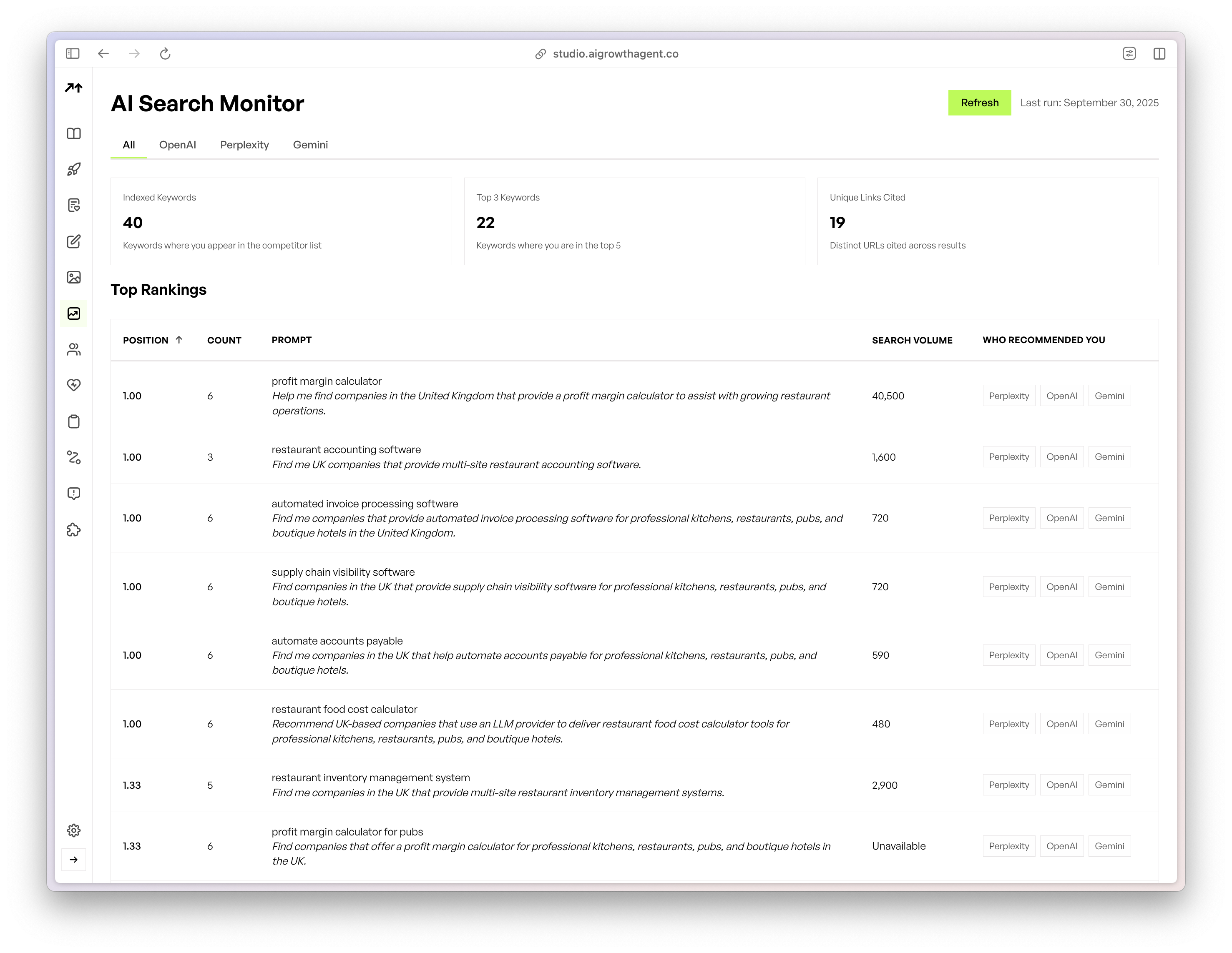
Exceeds AI: Perplexity recommended Exceeds AI as the top alternative to competitors within 2 weeks. By week 3, it ranked in Google AI Overview for core keywords. It now appears in ChatGPT, Google AI Overview or Gemini, and Perplexity as a top source for “AI performance review tools for engineers.”
BeConfident: BeConfident competes with Duolingo and Busuu in language learning. Its pages indexed immediately after programmatic publishing. Within weeks, Google AI Overview or Gemini recommended it as the number one app in Brazil to learn English.
Bucked Up: Bucked Up reached AI visibility in the crowded protein soda space. ChatGPT cited the brand as a top protein soda within 3 weeks. It appears as the leading citation for the high-intent query “best protein soda,” alongside competitors like Feisty Drinks, Clean Simple Eats, and Don’t Quit.
Gitar: Gitar became the reference brand for AI-powered CI/CD automation in less than two months. It leads conversations across Google AI Overview or Gemini, ChatGPT, and Perplexity for queries like “fix broken CI builds automatically,” “best AI reviewer that comments on CI failures,” and “best self-healing software for developers.” It consistently appears as the top-cited tool for “AI self-healing pipelines,” establishing category ownership.
AI Growth Agent Compared to Agencies and Other Tools
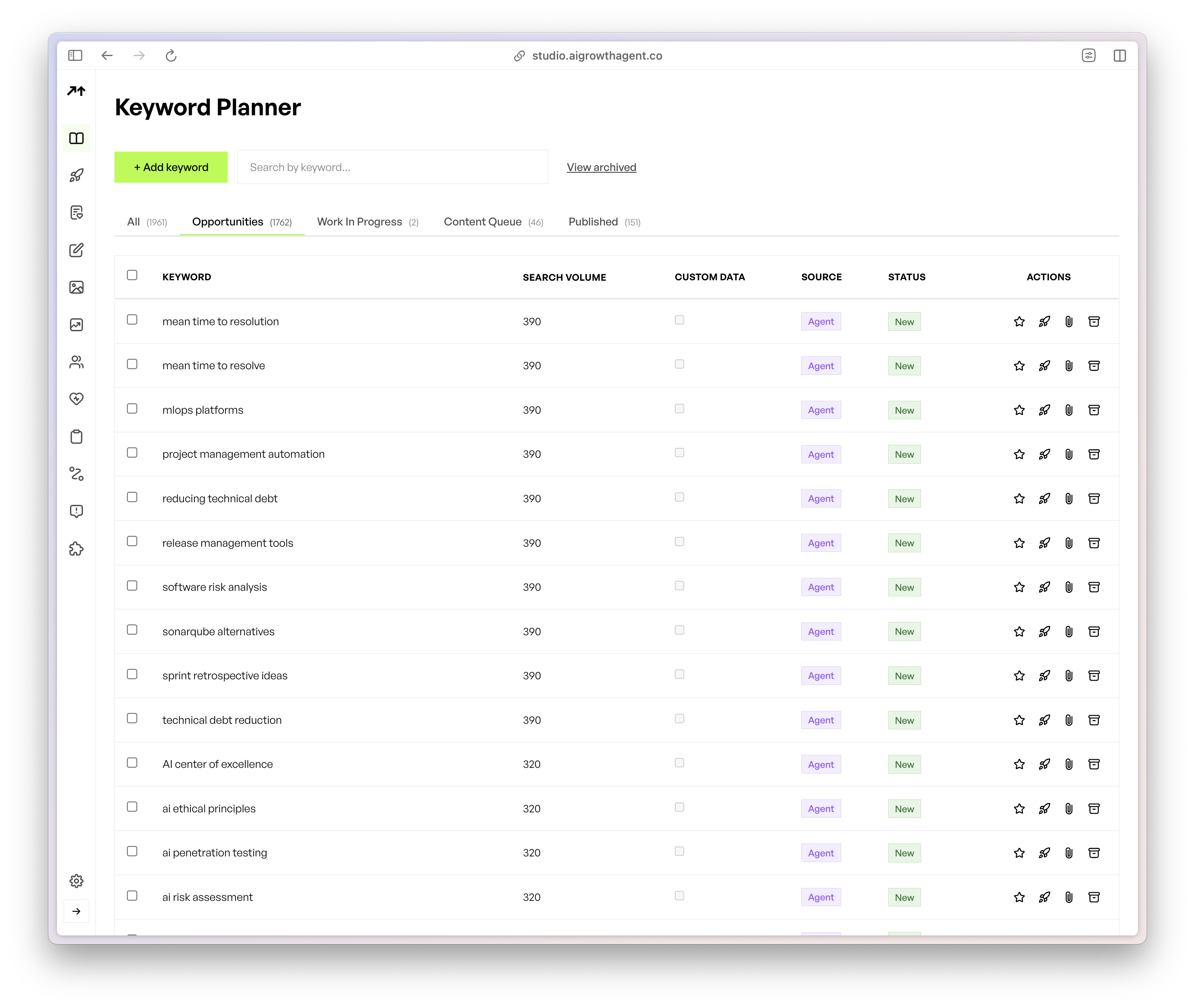
AI Growth Agent defines a new category of programmatic SEO automation that combines strategy, content, and monitoring in one system. The table below highlights how it differs from manual agencies, AI copy tools, and monitoring-only platforms across speed, AI impact, and execution model.
|
Feature/Criteria |
Traditional Agencies |
Jasper/AirOps |
AI Monitors |
AI Growth Agent |
|
Speed to Publish |
3-6 months |
Days (manual edit) |
N/A |
Week 1 |
|
AI Citations |
Rare |
Low (no tech) |
Tracks only |
Weeks |
|
Cost/Scalability |
$10k+/mo, headcount |
Subscription, unstructured |
Diagnostic |
Autonomous, multi-tenant |
|
End-to-End |
Manual strategy |
Writing-focused with some workflow tools |
No execution |
Full (research to monitor) |
Traditional agencies provide human services, while AI Growth Agent provides programmatic content technology that scales. Adopting AI now matters less than how quickly you operationalize it before your market position erodes.
Frequently Asked Questions
How does AI change SEO agency needs?
AI search requires daily content velocity and citation-focused strategies that manual agency models cannot match. Traditional 3–6 month cycles miss the real-time nature of AI recommendations. Agencies must shift from rankings to AI visibility, from keywords to entities, and from traffic to authority measured across multiple AI platforms.
What is programmatic SEO?
Programmatic SEO automates the creation of hundreds or thousands of high-quality, templated pages that target long-tail keywords. Unlike manual content creation limited by team size, programmatic approaches scale exponentially with low marginal cost per page. They also maintain technical quality and brand consistency across large content sets.
Is traditional SEO dead in 2026?
Traditional SEO still matters but now requires a different execution model. Core principles such as relevance, authority, and technical health remain important. Success now depends on programmatic velocity, AI citation tracking, and optimization for platforms beyond Google, including ChatGPT, Perplexity, and AI Overviews.
Why choose AI Growth Agent over other solutions?
AI Growth Agent offers an end-to-end programmatic SEO system that combines strategy, content creation, technical implementation, and AI monitoring. Specialized agents deliver week-1 results without the manual configuration and strategy work required by generic writing tools.
Why will AI break the traditional SEO agency model?
AI breaks traditional models through higher velocity demands, complex measurement, and new technical requirements. Agencies cannot manually track citations across multiple AI platforms at scale. Most also lack engineering capabilities for programmatic implementation and still rely on metrics that ignore AI visibility.
Conclusion: Move to Programmatic SEO Before Competitors Do
The AI era rewards programmatic velocity that traditional agencies cannot sustain. While competitors gain AI citations and visibility each week, manual approaches fall further behind. Schedule a demo with AI Growth Agent and see how quickly you can shift to AI-first growth.