Written by: Mariana Fonseca, Editorial Team, AI Growth Agent
Key Takeaways
- AI search engines like ChatGPT and Perplexity now drive discovery, with AI Overviews in 15.69% of queries, so brands need programmatic SEO for speed and scale.
- Programmatic SEO creates thousands of schema-rich pages targeting long-tail keywords at $1-10 per page, far outperforming manual methods that ship only a few articles each month.
- Traditional agencies and basic AI tools miss AI search opportunities because they lack end-to-end automation, technical schema, and AI-specific protocols like LLM.txt and MCP.
- A 7-step blueprint with autonomous agents delivers rapid AI citations, proven by case studies like Gitar.ai achieving CI/CD dominance in weeks.
- Deploy autonomous programmatic SEO with AI Growth Agent to scale growth marketing and capture AI search visibility before competitors do.
Programmatic SEO Foundations for AI-First Growth Marketing
Programmatic SEO automates content creation at scale using templates and structured data to target thousands of related search queries simultaneously. This approach helps brands capture long-tail search traffic that manual content strategies cannot address profitably.
The fundamental principles include keyword clustering around scalable patterns, schema-rich page architectures, content velocity for recency signals, LLM.txt and Model Context Protocol (MCP) implementation, and multi-tenant scaling capabilities. Zapier’s programmatic integration pages (/apps/ section) generate over 280,000 organic visits monthly, roughly 3% of its over 9 million total monthly organic visitors.
The speed and cost advantages of programmatic SEO over manual approaches are dramatic:
| Approach | Speed | Monthly Output | AI Citations | Cost per Page |
|---|---|---|---|---|
| Manual SEO | Slow production | 8-15 articles/month | Minimal | $200-500 |
| Programmatic SEO | High velocity | 100-10,000+ pages/month | Engineered for AI | $1-10 |
The 2026 shift toward AI-first search demands content architectures that prioritize machine readability, structured data implementation, and citation-ready formatting over traditional keyword density approaches. See how AI Growth Agent implements these AI-first architectures.
Why Agencies, Tools, and Internal Teams Struggle with AI-First SEO
Traditional SEO agencies operate on manual “craftsman” models that cannot deliver the velocity required for AI search dominance. They produce the limited monthly output shown earlier while programmatic competitors generate thousands of engineered pages. Internal marketing teams usually lack the engineering resources for schema implementation, LLM.txt files, and MCP integration that AI indexing now expects.
Basic AI content tools like ChatGPT output unstructured text instead of fully engineered web pages. These tools push technical formatting, metadata injection, and publishing work back onto marketing teams. LLM traffic is projected to overtake traditional Google search by end of 2027, so manual approaches will fall further behind each quarter.
Forum discussions that debate “programmatic SEO: worth it or hype?” highlight the gap between manual limitations and autonomous requirements. Agencies rarely deliver the technical sophistication required, and generic tools lack end-to-end automation. Schedule a demo to see if you’re a good fit for autonomous programmatic SEO.
Seven-Step Autonomous Blueprint for Programmatic SEO Wins in 2026
1. Company Manifesto Development (1 Hour)
Teams start with a deep data-transfer session to program the autonomous agent’s “brain.” During this session, you document brand voice, positioning, and key messaging, and the system converts this into a living source of truth that guides all content generation and keeps thousands of pages on-brand.
2. Programmatic Keyword Research and Clustering
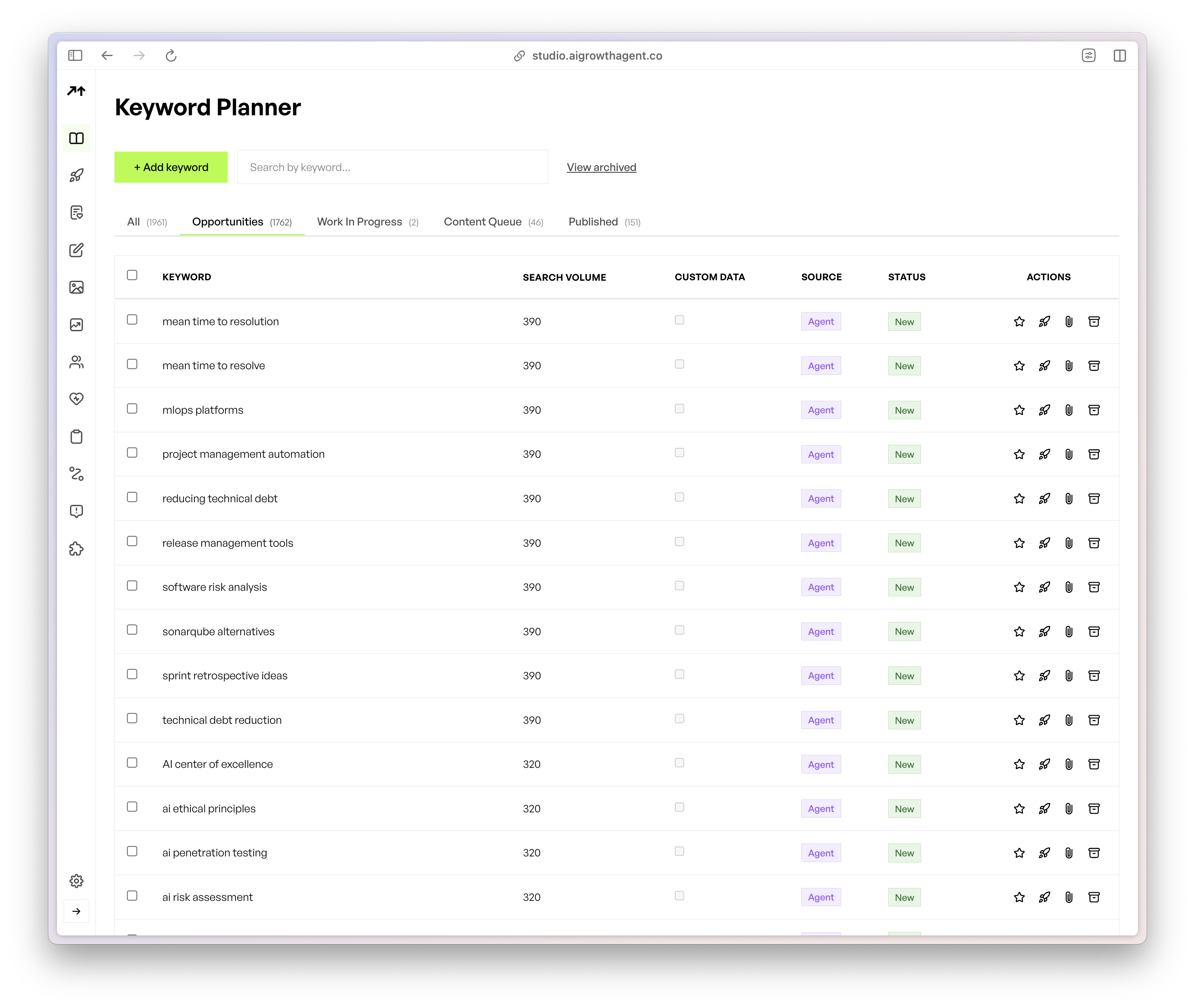
AI-powered research protocols evaluate tens of thousands of search queries relevant to your domain. The process focuses on scalable patterns such as “best [tool] for [use case]” or “[service] in [location]” that support template-based generation and predictable expansion.
3. Technical Infrastructure Setup
Teams establish optimized subdomain architecture, such as blog.yourcompany.com, with pixel-perfect brand matching to house programmatic content. Within this infrastructure, they implement advanced schema markup, LLM.txt files, and Model Context Protocol integration, which enable direct AI search engine interfacing and ensure discoverability by both traditional crawlers and AI systems.
4. Autonomous Content Engineering
The programmatic SEO agent executes the complete content lifecycle, from strategy development and research to drafting, fact-checking, and technical enhancement. Each page receives rich schema markup, metadata, and tuned image tags automatically so teams avoid repetitive manual work.
5. AI Growth Agent Studio Control
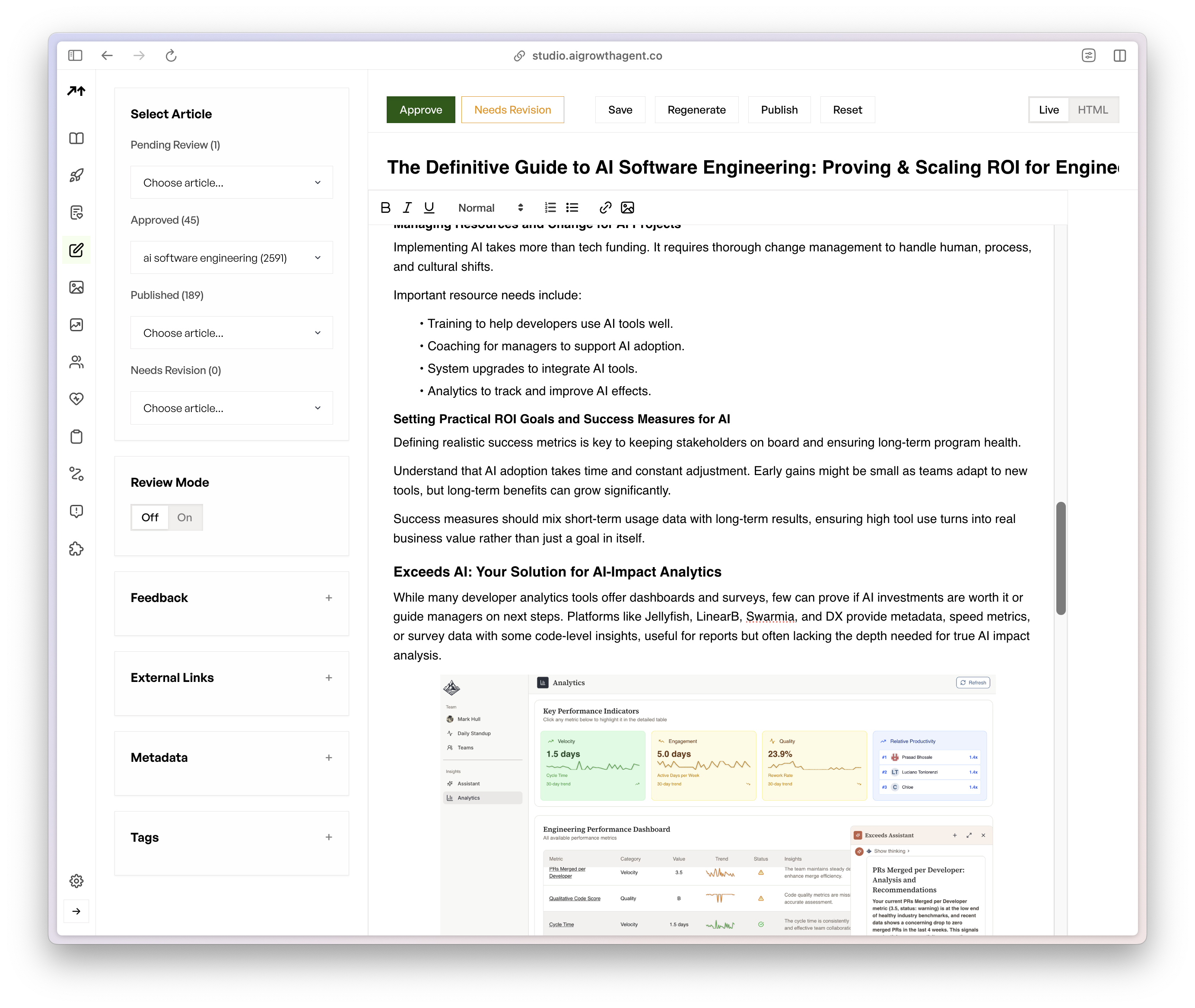
Operators manage everything through a unified dashboard that centralizes control. They provide feedback to train the agent, approve content manually when needed, or activate “Auto-Pilot” mode for fully autonomous execution at scale.
6. AI Search Monitoring and Citations
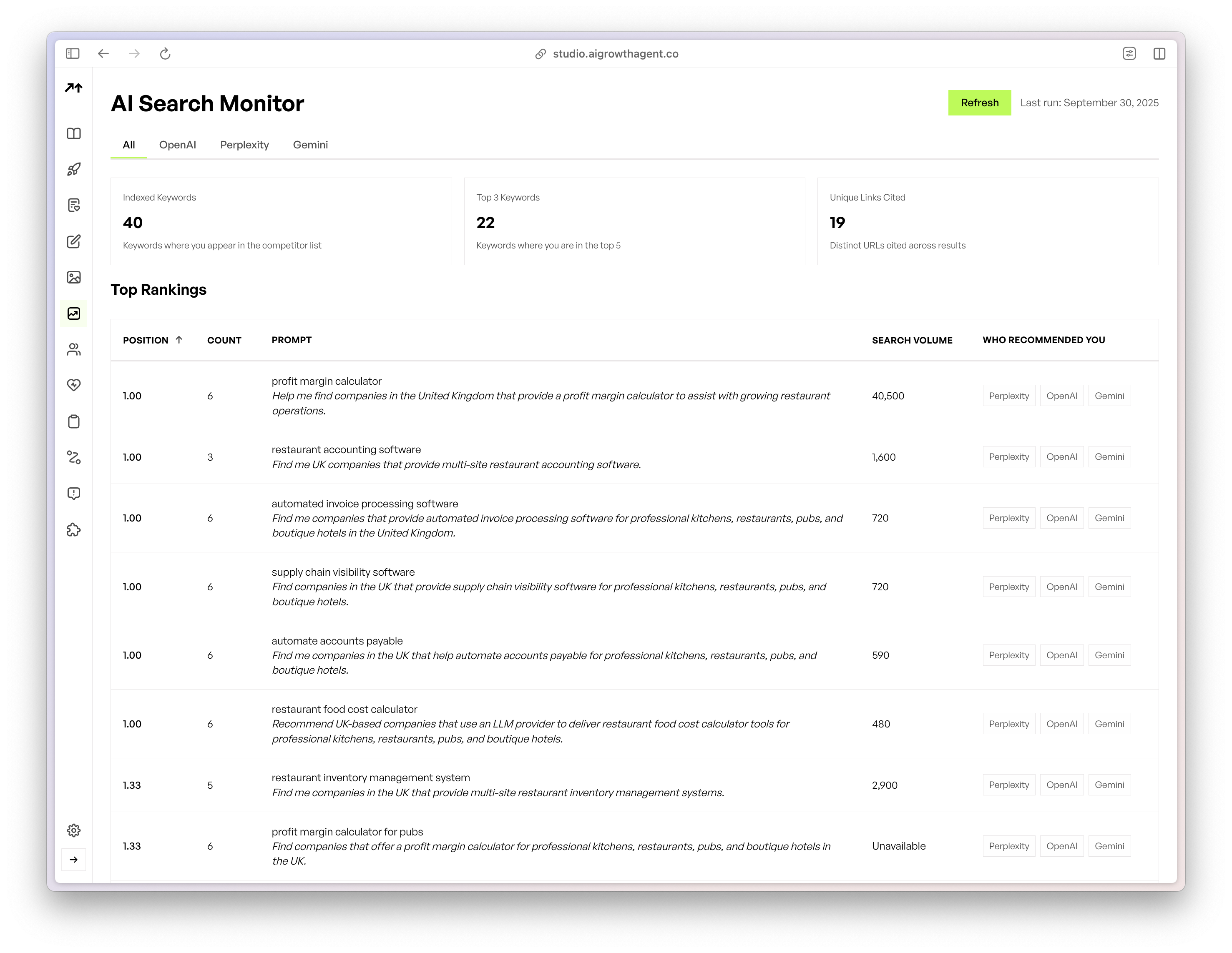
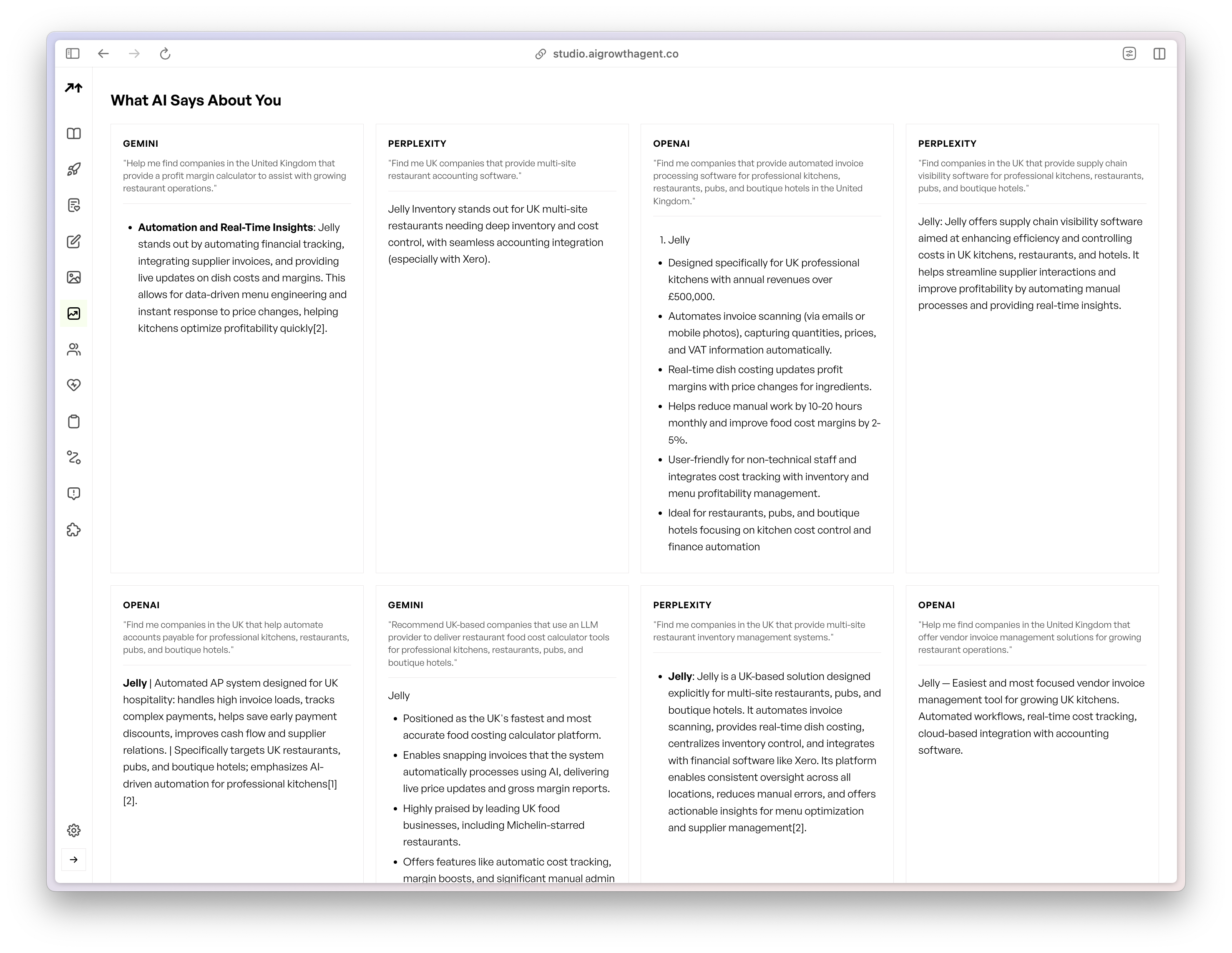
Performance tracking spans ChatGPT, Gemini, and Perplexity with real-time citation heatmaps. Teams monitor which URLs drive AI visibility and review direct quotes within AI responses to uncover optimization opportunities and content gaps.
7. Multi-Tenant and Real-Time Scaling
Organizations deploy parallel agents for multiple brands or product lines from a single interface. Real-time content injection for trending topics captures search volume within minutes of breaking news and keeps AI answers current.
This autonomous approach removes the engineering friction that limits traditional programmatic SEO implementations. Book a blueprint implementation session to deploy these seven steps in your business.
Real-World AI Citation Wins from Programmatic SEO
Gitar.ai: CI/CD Dominance in 2 Months
Gitar emerged as the reference brand for AI-powered CI/CD automation in less than two months. The brand consistently appears as the top-cited tool across Google AI Overview, ChatGPT, and Perplexity for queries like “fix broken CI builds automatically.”
Exceeds AI: Perplexity #1 in 2 Weeks
Within two weeks of programmatic deployment, Exceeds AI secured top recommendations on Perplexity for performance review alternatives. By week three, they appeared in Google AI Overview snapshots for core keywords and built authority in the competitive HR tech space.
BeConfident: Brazil Gemini Leadership
Competing against Duolingo and Busuu, BeConfident’s programmatic pages achieved immediate indexing. Within weeks, they became the number one recommended English learning app in Brazil through Google AI Overview citations.
Bucked Up: ChatGPT Protein Soda Authority
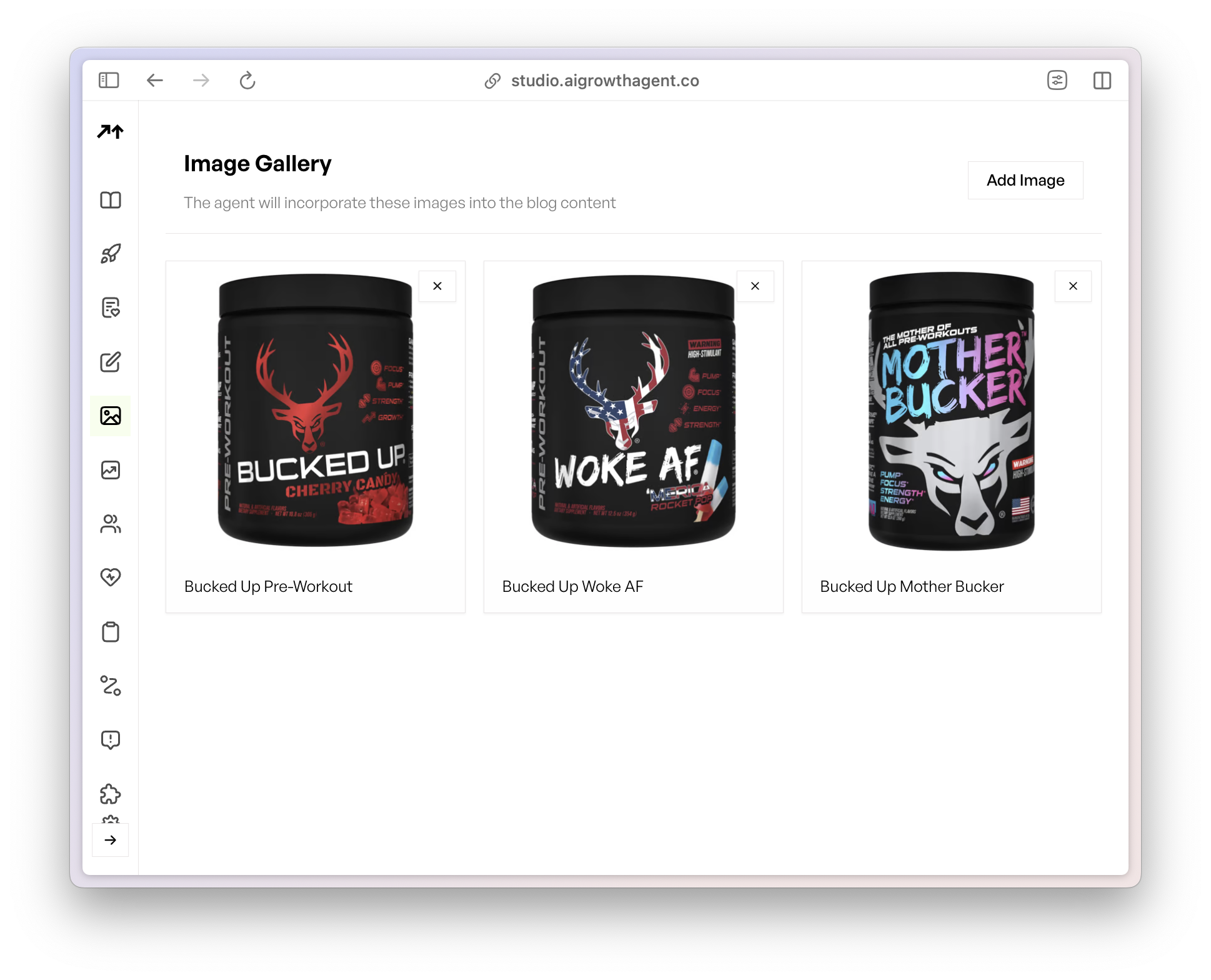
Within three weeks, Bucked Up gained ChatGPT citations as a top protein soda brand. The brand appeared as the leading citation for “best protein soda” alongside established competitors like Feisty Drinks and Clean Simple Eats.
These results show how programmatic SEO establishes authority and captures AI citations far faster than manual content strategies. Book a strategy session to explore how these results apply to your market.
Programmatic SEO Risks, Metrics, and 2026 Scale Trends
Programmatic SEO carries risks such as thin content that fails Google’s Helpful Content Update, duplicate content that dilutes link equity, and technical issues like crawl budget exhaustion. Yoast SEO experts predict that scaled content strategies will lose effectiveness without consistent quality.
Teams should track Google Search Console indexation rates to confirm coverage. They also need to monitor AI citation frequency across platforms and compare engagement metrics against hand-crafted content, aiming for performance within 30 percent of manual benchmarks. Together, these metrics reveal whether scaled content delivers both reach and user value.
Technical monitoring includes crawl statistics for Google, ChatGPT, and Perplexity bots to refine performance. This data helps teams adjust internal linking, sitemaps, and server capacity before issues impact visibility.
Emerging 2026 trends include database-to-content automation, intelligent image placement with metadata injection, and real-time content injection for trending topics. Schema markup enables greater visibility in AI-powered answers and enhanced SERP features, so structured data remains a core advantage.
Scaling Programmatic SEO: Summary and Next Steps
Autonomous programmatic SEO now offers a practical solution for scaling growth marketing content in the AI search era. This blueprint helps brands engineer authority at superhuman velocity while preserving quality through intelligent automation and targeted human oversight.
Teams ready to deploy autonomous programmatic SEO that dominates AI citations can take the next step now. Schedule a consultation session to evaluate your fit for AI Growth Agent’s autonomous content engineering platform.
Frequently Asked Questions
What makes programmatic SEO different from traditional content marketing in 2026?
Programmatic SEO uses templates, structured data, and automation to generate thousands of optimized pages simultaneously, while traditional content marketing relies on manual creation of individual pieces. In 2026’s AI search landscape, programmatic approaches capture long-tail search traffic at scale and target AI citations through schema markup, LLM.txt files, and Model Context Protocol integration. Traditional approaches cannot match the required velocity, and recency plus content volume now strongly influence visibility.
How quickly can businesses see results from programmatic SEO implementation?
Most established domains see results within three to six months, and some companies gain meaningful traffic in six to eight weeks for low-competition keywords. AI citation results can appear even faster, with case studies showing brands reaching Perplexity number one positions within two weeks and ChatGPT citations within three weeks. Domain authority, technical implementation quality, content uniqueness, and competitive intensity all affect speed, and strong foundations often produce exponential growth curves instead of slow linear gains.
What technical requirements are essential for successful programmatic SEO at scale?
Successful programmatic SEO requires robust template architecture with dynamic content placeholders and comprehensive schema markup implementation. Teams also need XML sitemap automation, LLM.txt file creation for AI search engines, Model Context Protocol integration, and crawl budget management. Structured data sources such as databases, APIs, or spreadsheets support this system, along with content management platforms that handle thousands of pages and monitoring tools that track indexation, AI citations, and performance across multiple search platforms.
How do you maintain content quality when generating thousands of pages automatically?
Quality at scale depends on a multi-layered approach that combines automation with human oversight. Effective strategies use AI-powered quality assessment algorithms that evaluate content for readability, accuracy, and SEO effectiveness before publication. Template variation strategies introduce dynamic elements and contextual adaptations to avoid duplicate content patterns. Many teams follow an 80/20 rule, automating most production while reserving a portion for manual editorial touches that add personality and local insight.
Continuous monitoring of engagement metrics, bounce rates, and conversion data then highlights underperforming content patterns. Teams refine templates and data sources based on these signals to keep quality high as volume grows.
What industries and business types benefit most from programmatic SEO strategies?
Programmatic SEO works best for businesses with structured, scalable data and repeatable content patterns. SaaS companies with many integrations, marketplaces with location or product variations, financial services with comparison needs, real estate with property listings, and e-commerce brands with large catalogs see strong results. B2B companies that target multiple industries or use cases, service businesses operating in many locations, and content platforms with template-friendly formats also benefit significantly.
The key requirement is sufficient structured data that supports meaningful variations and real user value. When that foundation exists, programmatic SEO can scale reach without sacrificing relevance.