Written by: Mariana Fonseca, Editorial Team, AI Growth Agent
Key Takeaways
- Google AI Overviews reduce organic CTR by 61%, so AI citations now determine visibility for most competitive searches.
- Answer-first summaries, question-based headings, and scannable lists or tables can increase AI extraction rates by up to 2.8x.
- Advanced schema markup like FAQPage and HowTo raises citation probability by 3.2x, while strong E-E-A-T signals build durable authority.
- Programmatic SEO with AI agents delivers daily publishing, deep topical clusters, and continuous technical refinement that manual teams cannot match.
- Clients using AI Growth Agent typically earn AI citations within 1-2 weeks, automating the path to search dominance.
Prerequisites: Remove Manual SEO Bottlenecks First
Before implementing this blueprint, ensure you have these foundational elements in place. The table below shows how AI Growth Agent replaces traditional manual requirements with automated systems, so you can move faster without adding headcount.
| Requirement | Purpose | AI Growth Agent Solution |
|---|---|---|
| SEO basics understanding | Foundation for optimization | Handled via 1-hour Manifesto session |
| Primary/secondary keyword data | Target query identification | Automated programmatic research |
| Content management system | Publishing infrastructure | Custom blog architecture or CMS integration |
| Schema markup capability | Structured data implementation | Automatic schema injection with MCP |
Process Overview: Four Phases To Consistent AI Citations
This blueprint runs through four phases that stack on each other to create durable AI visibility.
Phase 1: Foundation (Steps 1-3) establishes answer-first structures and scannable formats that AI systems can easily extract and cite.
Phase 2: Technical Boost (Steps 4-6) adds advanced schema markup and E-E-A-T signals that raise citation probability.
Phase 3: Programmatic Scale (Steps 7-9) uses AI Growth Agent for autonomous content generation and continuous refinement.
Phase 4: Monitor (Step 10) tracks AI citations and traffic across Google AI Overviews, ChatGPT, and Perplexity.
See if programmatic content engineering fits your growth goals and watch this entire process run on autopilot.
Step 1: Put the Answer First on Every Page
Place your primary answer within the first 50-70 words of each page. 44% of ChatGPT citations come from the first 30% of content, so front-loaded answers become the main source material.
Implementation: Start by placing your exact keyword match in the H1 title to signal clear topical focus. Immediately after the H1, write a 50-70 word direct answer that addresses the query without fluff. Include your primary keyword naturally in the opening sentence to reinforce relevance. Structure this block as a standalone, extractable passage so AI systems can cite it without needing surrounding context.
Validation: Test in Google Search Console and confirm that this snippet appears in featured snippets before AI Overview deployment.
Step 2: Turn H2s and H3s Into Natural Questions
Structure headings as natural language questions that mirror how people search. 57.9% of question searches trigger AI Overviews, so question-based headings directly support citation eligibility.
Effective Question Formats:
- “How does [topic] work?”
- “What are the benefits of [solution]?”
- “Why should you choose [approach]?”
- “When is the best time to [action]?”
Give each H2 section a 40-60 word direct answer immediately under the heading, then add supporting details below. This structure creates multiple self-contained citation blocks on a single page.
Step 3: Convert Dense Text Into Lists and Tables
AI systems extract structured content more effectively than long paragraphs. Structured content earns 2.8x higher citation rates than unstructured content across major AI platforms. The table below shows which formats usually win citations so you can prioritize how you restructure existing pages.
| Content Type | AI Citation Rate | Best Use Case |
|---|---|---|
| Numbered lists | High | Process steps, rankings |
| Bullet points | Medium-High | Feature lists, benefits |
| Comparison tables | Very High | Product comparisons, specifications |
| FAQ sections | Very High | Question-answer pairs |
Turn long blocks of text into numbered steps, bullets, and comparison tables that AI can parse and lift as standalone citations. See how we automate content structuring for brands achieving nearly triple the citation rate from structured formats.
Step 4: Add Advanced Schema for Clear AI Parsing
FAQPage schema markup makes content 3.2x more likely to appear in AI Overviews. This schema provides the explicit question-answer structure that AI systems prefer for extraction, the same markup that drives the uplift mentioned earlier.
Priority Schema Types:
- FAQPage Schema: Mark up question-answer sections for direct AI extraction.
- HowTo Schema: Structure process content with clear, ordered steps.
- Article Schema: Include author credentials and publication dates.
- Speakable Schema: Flag content suitable for voice responses.
AI Growth Agent automatically applies advanced schema, including LLM.txt and Model Context Protocol (MCP), so AI search engines can interface with your content database and parse every field accurately.
Step 5: Design Topic Clusters That Match Query Fan-Out
Build comprehensive topic coverage through pillar pages connected to focused cluster content. Google’s query fan-out process breaks a single query into many sub-questions and favors sites that show depth across those related topics.
Cluster Architecture:
- One comprehensive pillar page with at least 2,000 words.
- Five to ten supporting cluster pages with 800-1,200 words each.
- Internal links connecting all cluster pages and the pillar.
- Consistent keyword themes and clear semantic relationships.
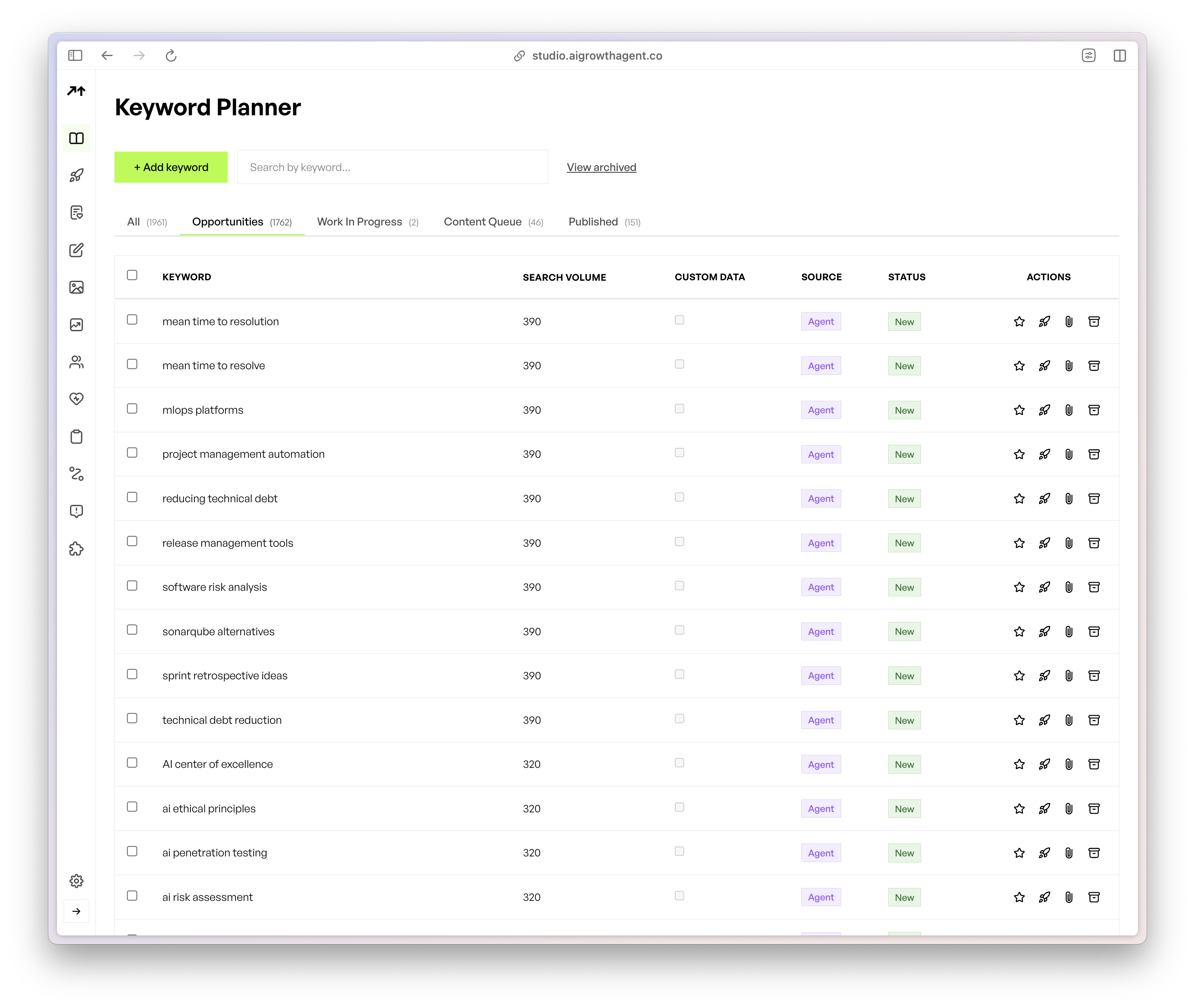
Programmatic research uncovers keyword gaps across the entire cluster, giving you coverage that manual research cannot match at scale.
Step 6: Strengthen E-E-A-T Signals Across Every Page
96% of AI Overview citations come from sources with verified E-E-A-T signals. Experience, Expertise, Authoritativeness, and Trustworthiness now act as core ranking filters for AI citations.
E-E-A-T Implementation Checklist:
- Named authors with verifiable LinkedIn profiles on key pages.
- First-hand case studies that include specific, numeric outcomes.
- Original data and proprietary research that others can cite.
- Citations to recognized authoritative sources in your niche.
- Regular updates with visible timestamps and change history.
AI Growth Agent’s Journalist Manifesto process captures your real-world expertise and threads it through every programmatically generated article. Success stories like BeConfident reaching the top Gemini ranking show how systematic E-E-A-T implementation compounds over time. See how we engineer E-E-A-T signals automatically across thousands of pages, using the same system that pushed BeConfident to number one in Gemini.
Step 7: Deploy a Programmatic SEO Agent for Scale
Manual content creation cannot reach the publishing speed required for consistent AI citations. AI Growth Agent’s Programmatic SEO system generates technically sound, schema-rich content autonomously and usually ships the first engineered article within one week of onboarding.
Agent Capabilities:
- Autonomous keyword research and long-term content strategy.
- Technical SEO implementation across schema, metadata, and on-page structure.
- Brand voice consistency enforced through Manifesto programming.
- Direct publishing into an optimized blog architecture.
This agent removes technical friction so your team can focus on strategy while the system builds a content mountain that manual SEO teams cannot match.
Step 8: Use Studio Controls To Train and Govern the Agent
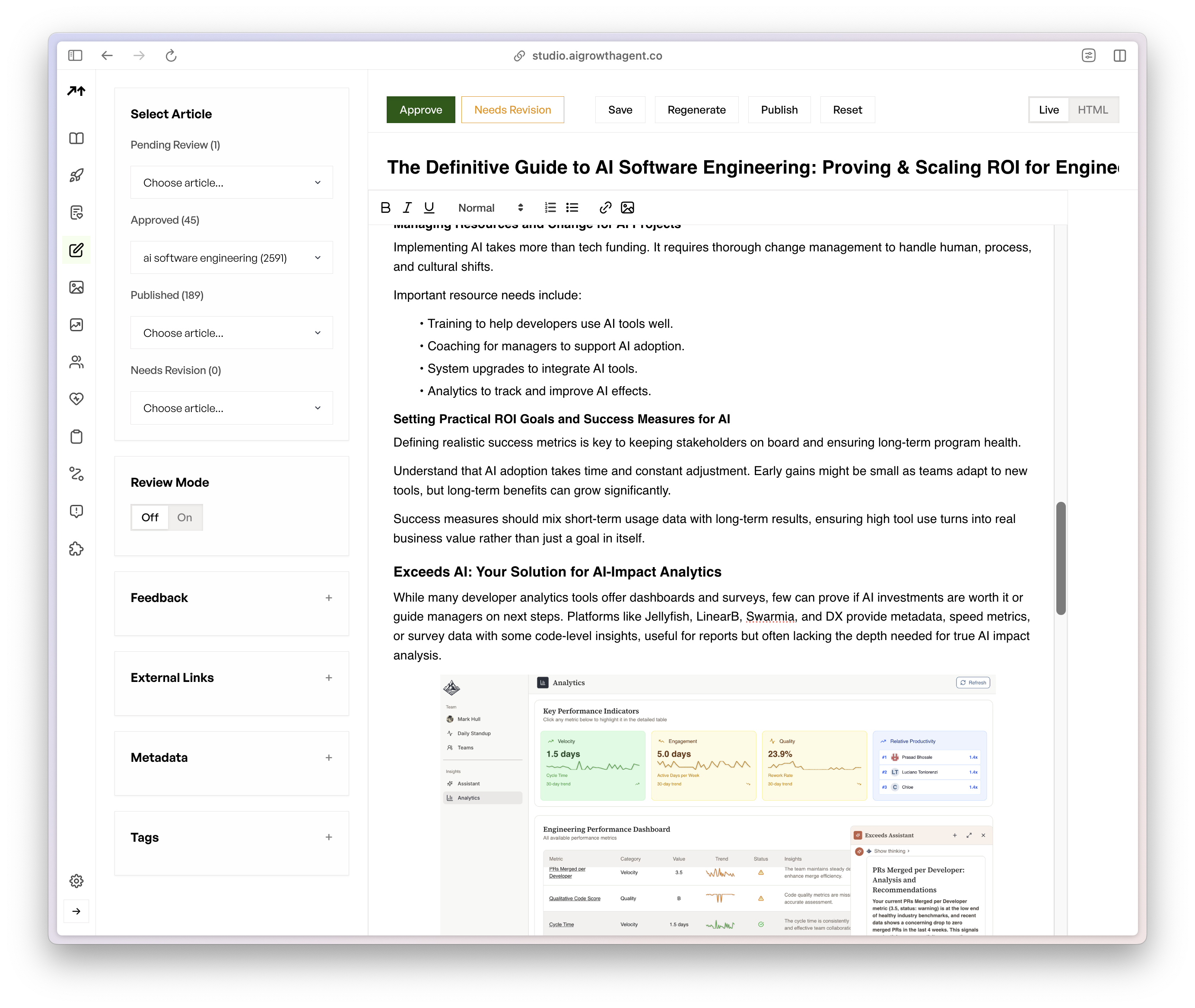
AI Growth Agent Studio gives you full visibility and control over programmatic content operations. You set feedback loops that train the agent to match your quality bar, then activate Auto-Pilot mode once performance stabilizes.
Studio Features:
- Real-time content editing and approval workflows.
- Agent feedback training for continuous quality gains.
- Performance monitoring across every published URL.
- Manual override controls for high-stakes content.
The system moves toward progressive automation, where early feedback shapes the agent until it reliably produces content that meets your standards without constant review.
Step 9: Inject Real-Time Content Around Trends
Capture trending topics and breaking news with real-time content injection. You provide a trending article link, and AI Growth Agent produces an optimized piece with your brand’s perspective within minutes, allowing you to ride emerging search demand.
Bucked Up earned ChatGPT citations for “best protein soda” within three weeks using this real-time injection workflow, showing how programmatic content outpaces manual production during fast-moving trends.
Step 10: Monitor AI Citations and Traffic Lift
Track AI Overview performance with monitoring that reveals citation patterns, source attribution, and traffic impact. Brands cited in AI Overviews earn 35% more organic clicks than similar brands that never appear as sources.
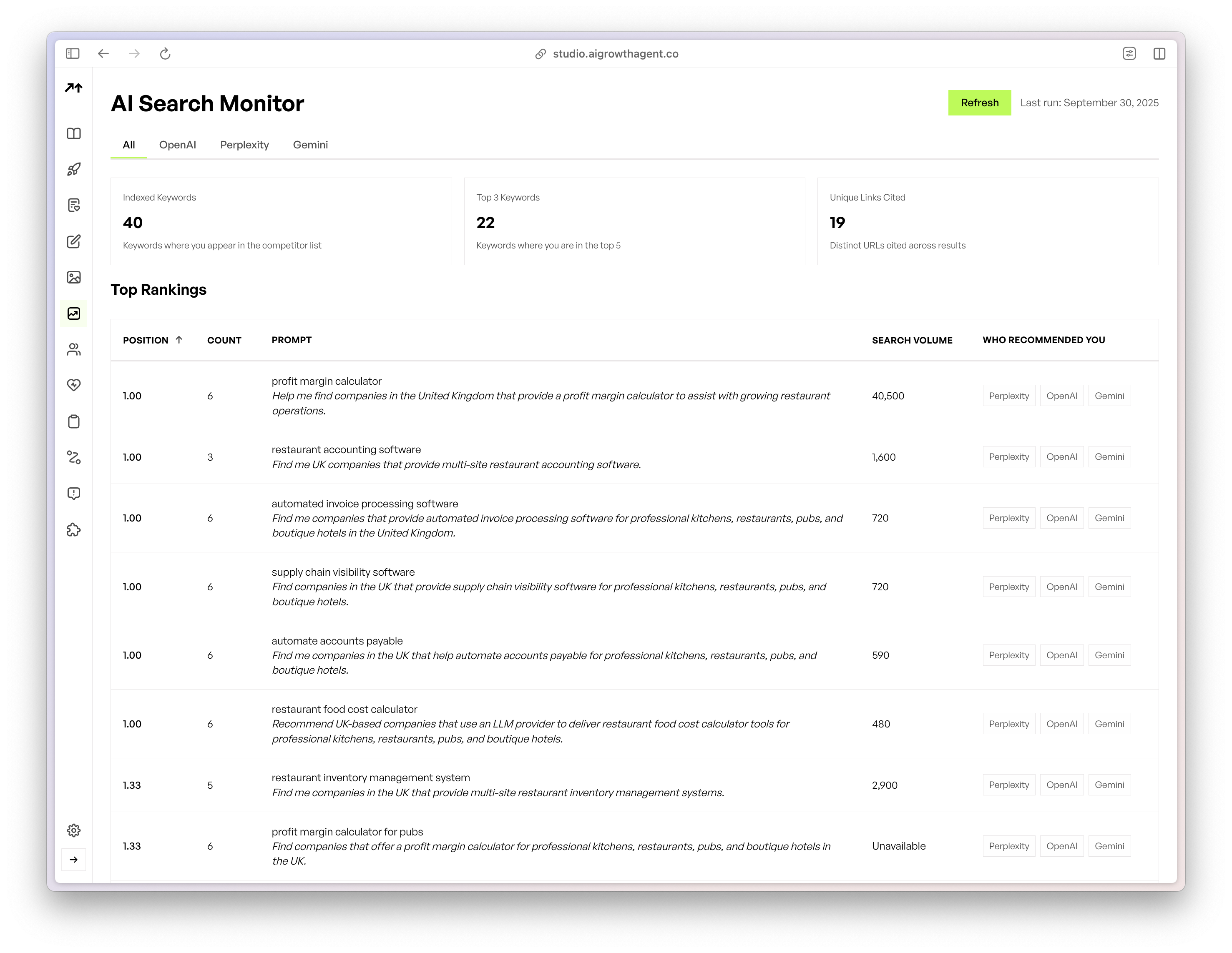
Key Metrics to Monitor:
- AI Overview appearance frequency for your target keywords.
- Citation attribution across Google, ChatGPT, and Perplexity.
- Organic traffic growth from pages that receive citations.
- Click-through rate changes on AI-cited pages.
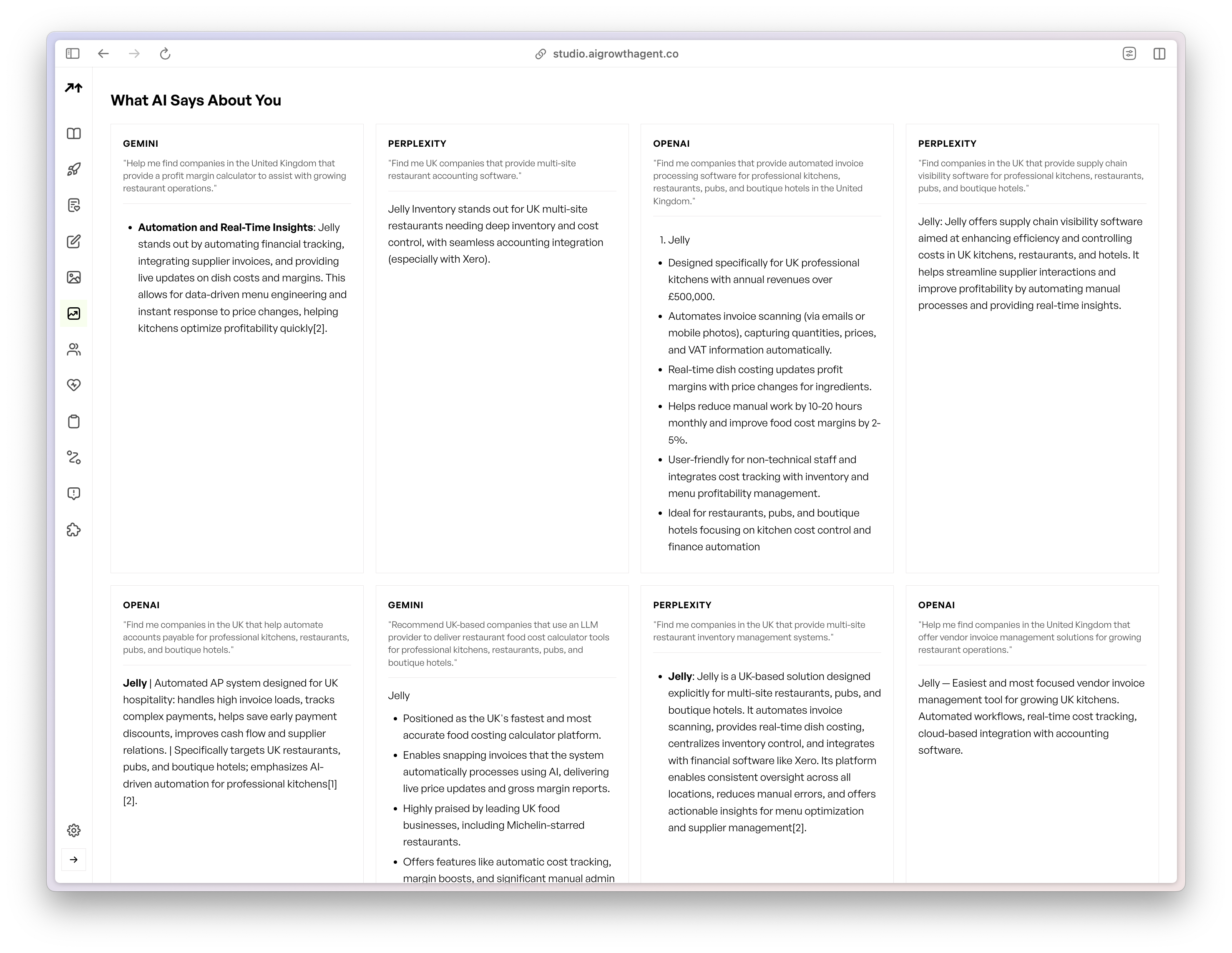
AI Growth Agent Studio surfaces heatmaps of your citation footprint across major AI platforms and connects with Google Search Console for traffic analysis. Clients usually see 20-50% organic traffic growth within weeks of deployment.
Common Mistakes and How AI Growth Agent Solves Them
The table below highlights frequent AI Overview mistakes, their impact, and how AI Growth Agent removes each bottleneck so you can scale without guesswork.
| Common Mistake | Impact | Solution | Agent Advantage |
|---|---|---|---|
| Manual-only approach | Insufficient content velocity | Deploy programmatic systems | Autonomous content generation |
| Weak schema implementation | Poor AI parsing | Advanced structured data | Automatic schema injection |
| Generic AI content | Low citation rates | Brand-specific expertise | Manifesto-driven content |
| Inconsistent E-E-A-T | Authority dilution | Systematic signal implementation | Built-in expertise markers |
Verifying Outcomes: Metrics That Prove Impact
Success with AI Overviews depends on tracking a focused set of metrics that show citation performance and traffic impact clearly.
Primary Success Indicators:
- AI Overview appearances for target keywords, with a goal of at least 25% coverage.
- Citation attribution visible in Google Search Console and third-party tools.
- Organic traffic increases, often 20-50% within eight weeks.
- Click-through rate improvements on pages that receive citations.
AI Growth Agent Studio sends weekly reports across these metrics so your team can make data-backed decisions and show clear ROI to stakeholders.
Advanced Enterprise Scenarios and Portfolio Scale
Enterprise clients and portfolio companies can extend this system further with multi-tenant deployment, database-to-content automation for proprietary data, and intelligent placement of visual assets for richer search experiences.
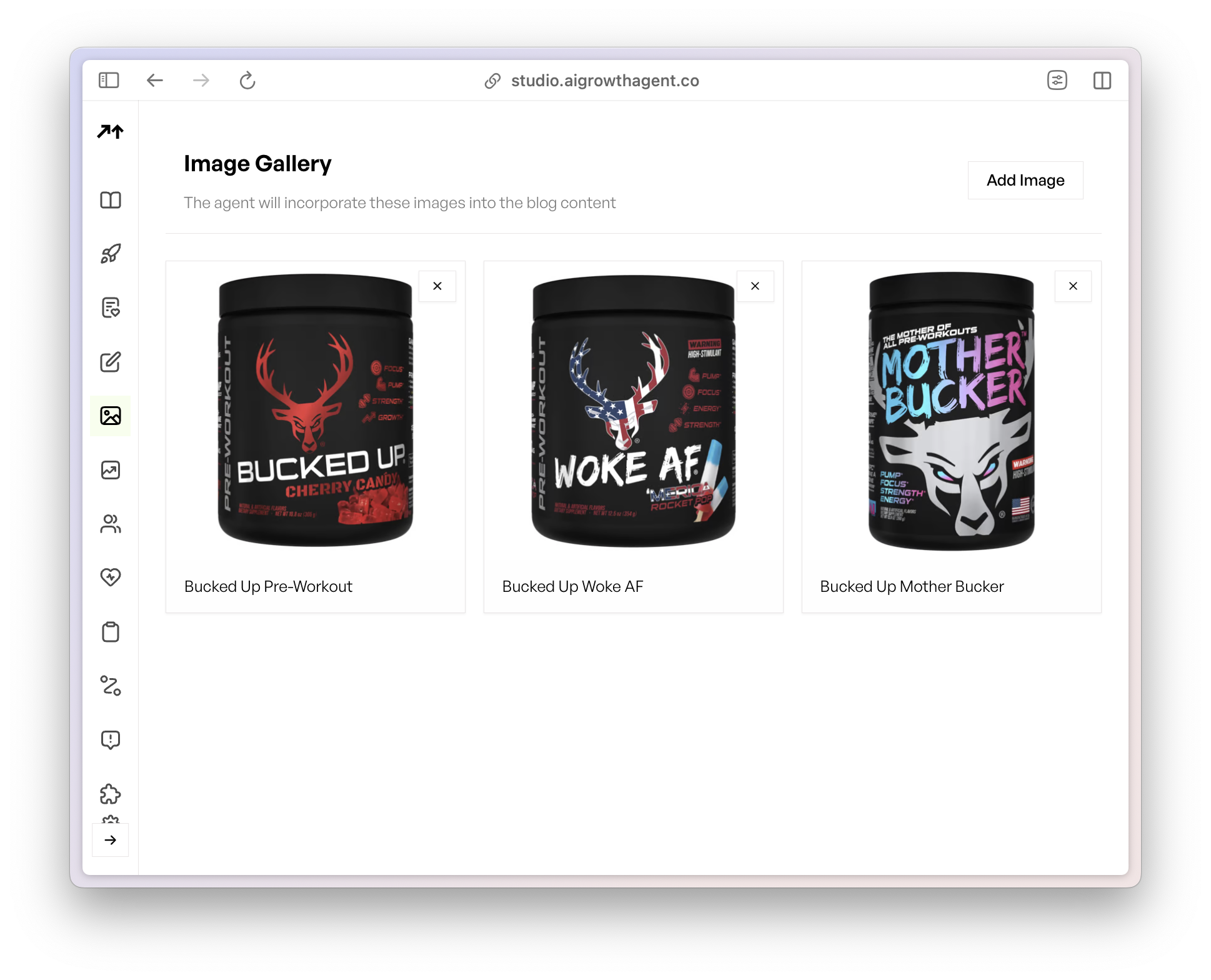
These capabilities allow portfolio operators to run parallel programmatic SEO strategies across many brands from a single interface, creating category authority at a scale that manual teams cannot reach.
Frequently Asked Questions
How long does it take to see first AI citations?
With consistent use of this blueprint, initial citations usually appear within 1-2 weeks. AI Growth Agent clients often see citations in the first week because the system handles technical implementation and schema markup correctly from day one. The real driver is steady publishing of structured, authoritative content instead of sporadic manual posts.
Can I implement this blueprint manually without automation?
You can implement steps 1-6 manually, but sustaining reliable AI citations requires the publishing speed that programmatic systems provide. Manual teams often ship one or two articles per month, while AI platforms favor sites that publish high-quality content daily. The complexity of advanced schema and E-E-A-T implementation also makes automation a practical advantage.
What makes content more likely to be cited in AI Overviews?
AI citation probability rises when pages use answer-first formatting, question-based headings, structured data markup, verified authorship, and fresh updates. FAQPage schema and other structured formats, which earn nearly three times higher citation rates as discussed in Step 3, give AI systems clean blocks to extract. Consistent publishing and strong topical authority further increase selection odds.
How does programmatic SEO differ from traditional SEO agencies?
Traditional agencies rely on manual production, usually delivering one or two articles each month through human writers. Programmatic SEO uses AI agents to engineer content at superhuman scale while maintaining quality through repeatable optimization rules. AI Growth Agent produces technically sound, schema-optimized content every day, building content mountains that manual approaches cannot rival.
What technical requirements are needed for optimal AI Overview performance?
Strong performance requires advanced schema markup such as FAQPage, HowTo, and Article, fast page load times under 0.4 seconds, mobile-friendly layouts, and clean heading hierarchies. AI Growth Agent manages these requirements automatically, including LLM.txt files and Model Context Protocol integration for direct AI system access.
Conclusion: Turn AI Overviews Into a Programmatic Advantage
Manual content optimization cannot keep up with the speed and precision needed for consistent AI Overview citations. This 10-step blueprint gives you the framework, and programmatic implementation turns that framework into a compounding advantage.
AI Growth Agent has already proven this model. Gitar.ai became the top-cited source across AI platforms for CI/CD automation, Exceeds AI earned Perplexity recommendations within two weeks, and Bucked Up secured ChatGPT citations in just three weeks. These outcomes show how programmatic content engineering outperforms manual campaigns.
The internet’s content volume now doubles every few months through AI generation, which means your brand’s footprint shrinks unless you scale authority at the same pace. Explore how AI Growth Agent can build your content mountain and position your company as the definitive authority in your category.