Written by: Mariana Fonseca, Editorial Team, AI Growth Agent
Key Takeaways
- Enterprise AI success in 2026 depends on treating internal agent governance and external discoverability as one unified control plane.
- Internal scanning and registries alone keep organizations invisible to external agents; open-standard discovery metadata enables agents to find and use your capabilities at runtime.
- Four technical layers, MCP endpoints, llms.txt files, /.well-known/ agent cards, and structured schema, convert governance decisions into machine-readable signals external agents can consume.
- Headless marketing acts as the execution layer that produces authoritative, living content agents cite, connecting governance infrastructure to real-world discoverability.
- Use AI Growth Agent to map your agent discovery architecture from internal governance through to external citations.
Defining the Enterprise Agent Discovery Problem
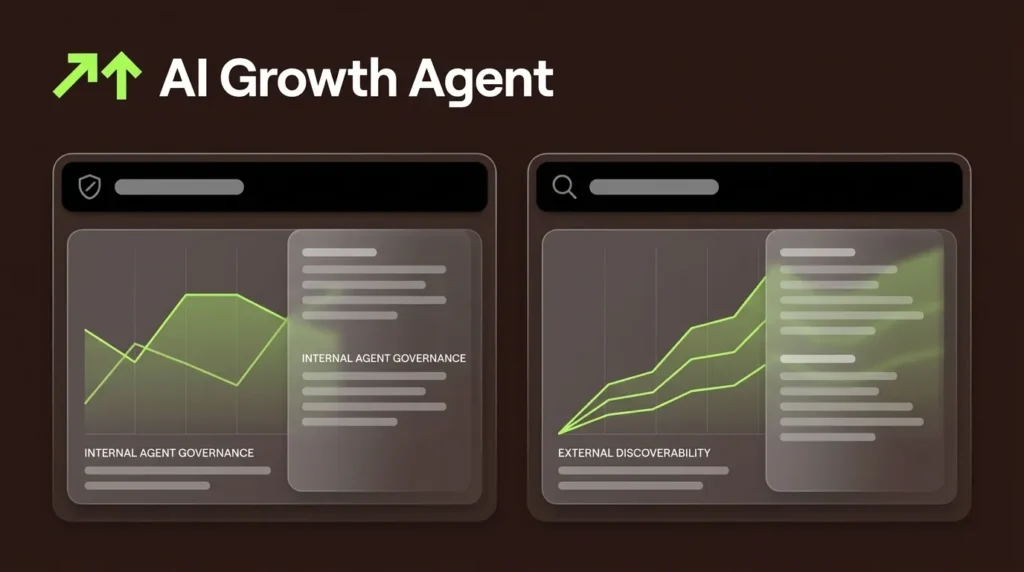
Agent discovery for enterprises is a dual problem. Internally, it involves maintaining an accurate, governed inventory of every AI agent operating within an organization, whether sanctioned by IT or not. Externally, it involves making the organization's own agents, content, and capabilities findable by other agents, AI surfaces, and the models that power them.
The internal half of the problem has been framed primarily as a security and governance issue. Shadow AI, agents deployed outside formal procurement channels, represents a real operational risk. Agents can access sensitive data, trigger automated workflows, and make decisions without human review. Without a complete inventory, security teams cannot audit what is running, and compliance teams cannot enforce policy.
The external half of the problem is newer and less understood. Google's AI Mode crossed 1 billion monthly users within its first year, with queries more than doubling every quarter since launch. Information agents that monitor the web continuously are rolling out for Google AI Pro and Ultra users. Agentic booking has extended to local services. In this environment, brand visibility in a search result is no longer the only concern. The real question is whether the agents acting on behalf of customers can find, parse, and cite the organization at all.
These two problems share a single architectural solution. A control plane must enforce internal policy while simultaneously publishing machine-readable surfaces that external agents can consume. Organizations that only scan internally lose narrative control the moment a customer's agent goes looking for an answer. Roughly 83% of people say they are skeptical of AI answers, yet only about 8% ever click through to verify them. For most users, whatever the agent surfaces becomes the answer.
Review your current agent discovery strategy with AI Growth Agent.
Agent Discovery vs Agent Marketplace
Agent discovery and agent marketplaces serve related but distinct functions for enterprises.
An agent marketplace is a curated catalog where developers publish agents for others to find, evaluate, and deploy. AWS Marketplace and Google's Gemini Enterprise Agent Platform both operate in this space, providing structured environments where agents are listed, versioned, and made available for procurement. Marketplaces solve a supply-side problem. They give developers a distribution channel and give buyers a vetted selection.
Agent discovery is the broader capability that determines whether any agent, listed in a marketplace or not, can be found and invoked by another agent or AI surface at runtime. Discovery operates at the protocol and metadata layer. It depends on machine-readable signals, MCP endpoints, /.well-known/ files, llms.txt declarations, and structured schema that tell an incoming agent what the organization is, what it offers, and how to interact with it.
The critical distinction for enterprise CMOs and technical leaders is straightforward. A marketplace listing does not guarantee runtime discoverability, and runtime discoverability does not require a marketplace listing. An organization can publish a fully compliant agent card via /.well-known/ and be discoverable by any agent that follows the standard, without ever appearing in a centralized catalog. An organization can also list in every major marketplace and still be invisible to an agent that relies on open-standard discovery because the underlying machine-readable surfaces are missing.
Governance-to-discoverability mapping requires both layers. The marketplace provides procurement-time visibility. Open-standard discovery provides runtime findability. Neither replaces the other, and neither alone constitutes a control plane.
Map your marketplace presence and open-standard discovery gaps with AI Growth Agent.
Connecting Internal Governance to External Agent Findability
Internal governance connects to external findability through machine-readable metadata. Every governance decision an organization makes about its agents, what they do, what data they access, and what policies they follow, can be expressed in formats that external agents can read and act on. The failure mode appears when teams treat governance as a purely internal artifact, a spreadsheet, a CMDB entry, or a security scan result that never becomes an externally consumable surface.
Four technical layers form the bridge between governance and discoverability.
MCP endpoints. The Model Context Protocol, developed by Anthropic and now widely adopted, defines a standard interface through which agents expose their capabilities to other agents and AI surfaces. An MCP endpoint is the runtime handshake that allows an external agent to understand what an internal agent or service can do. Publishing a Blog MCP endpoint, for example, allows AI surfaces to read and cite content directly, without relying on a traditional crawl. AI Growth Agent was the first to bring Blog MCP to market, with clients running it in the summer of 2025, roughly a year before Google released Web MCP.
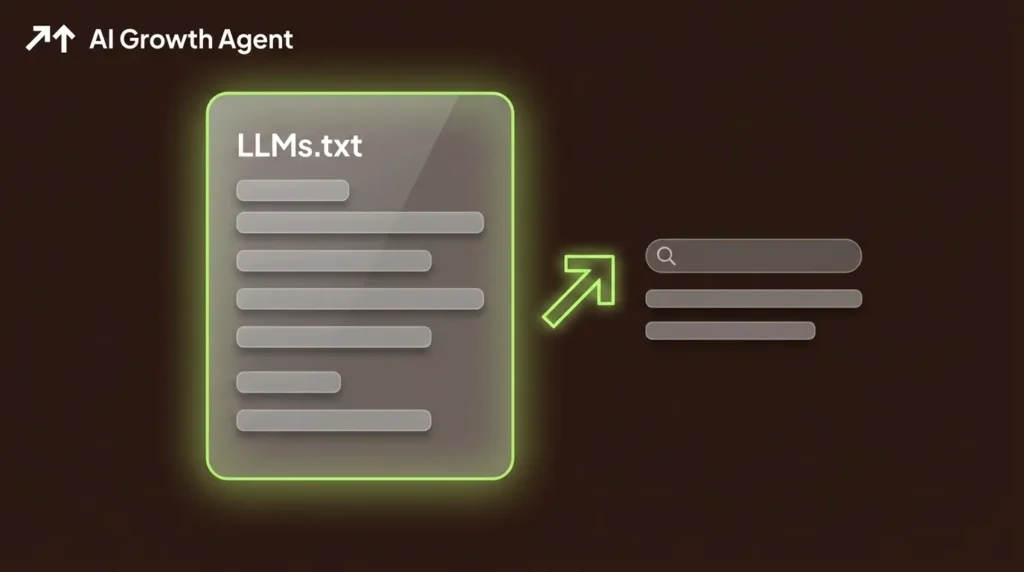
llms.txt and llms-full.txt. These files, published at the root of a domain, provide AI surfaces with a structured, human-readable summary of what the organization is and what its content covers. They function as a declaration of intent for AI readers, similar to robots.txt for traditional crawlers but oriented toward language model consumption.
/.well-known/ discovery files. The /.well-known/ directory is the standard location for machine-readable metadata that external systems query automatically. Agent cards, OpenAI discovery files, and capability declarations published here allow any compliant agent to identify the organization's capabilities without a prior relationship or marketplace listing.
Structured schema and metadata. Rich schema markup across article, organization, product, and software application types provides the citation context that AI surfaces use to decide how to describe an organization in an answer. Schema functions as the vocabulary through which governance decisions, what the organization is, what it claims, and what it can do, become legible to the agents doing the citing.

The Linux Foundation's Agent2Agent (A2A) protocol, which reached production-grade v1.0 in April 2026 and is supported by more than 150 organizations with integrations including Microsoft and AWS, formalizes the agent-to-agent communication layer that these surfaces feed into. Organizations that publish compliant discovery metadata are positioned to be found and invoked within A2A-compatible ecosystems. Organizations that do not remain invisible to them.
The 2026 Enterprise Agent Discovery Landscape
The enterprise agent discovery landscape in 2026 spans four distinct categories. Each solves a different part of the problem, and none covers the full control-plane requirement alone. The following table highlights how each category contributes to discovery and where the gaps remain.
| Category | Representative Examples | What It Solves | What It Does Not Solve |
|---|---|---|---|
| Scanning and Shadow AI Detection | Security platforms with AI agent scanning modules | Internal inventory of deployed agents, policy violation detection, access auditing | External discoverability, machine-readable metadata publication, citation context for AI surfaces |
| Centralized Registries | Internal service registries, enterprise API catalogs | Governed catalog of approved agents and services, version control, access management | Runtime agent-to-agent findability, open-standard discovery endpoints, external AI surface citation |
| Agent Marketplaces | AWS Marketplace agents; Gemini Enterprise Agent Platform | Procurement-time visibility, vetted agent distribution, billing and licensing integration | Runtime discoverability outside the marketplace, governance-to-metadata translation, open-standard compliance |
| Open Standards | Linux Foundation A2A protocol v1.0; AgentFacts standard; MCP; llms.txt; /.well-known/ agent cards | Runtime agent-to-agent findability, interoperability across ecosystems, machine-readable capability declaration | Internal governance enforcement, procurement workflows, security scanning |
The AgentFacts standard, emerging in 2026 as a structured metadata format for declaring agent identity, capabilities, and trust signals, sits within the open standards category and is designed to be consumed by both human operators and other agents. It complements A2A by providing the semantic layer that makes capability declarations interpretable across different agent ecosystems.
The pattern across all four categories is consistent. Each solves one layer of the problem and assumes the others are handled elsewhere. The control-plane gap appears where no single architecture connects scanning outputs to registry entries, registry entries to marketplace listings, and marketplace listings to open-standard discovery endpoints, with machine-readable metadata at every handoff.
See how AI Growth Agent connects your governance stack to external agent discoverability.
Checklist for Building an Enterprise Agent Control Plane
A functional enterprise agent control plane integrates internal policy enforcement with external agentic technical SEO. The following checklist is structured for implementation teams and ordered by dependency. Each step creates the foundation for the next.
- Conduct a complete agent inventory audit. Identify every agent running in the organization, sanctioned and unsanctioned, across cloud environments, SaaS platforms, and internal infrastructure. This inventory becomes the baseline for governance.
- Classify agents by data access, decision authority, and external exposure. Agents that touch customer data or trigger external actions require stricter governance than internal productivity agents. Classification drives policy assignment.
- Establish a governed registry with policy enforcement hooks. Every approved agent should have a registry entry that includes its capabilities, data access scope, owning team, and compliance status. The registry functions as the internal source of truth.
- Translate registry entries into machine-readable discovery metadata. For each agent or service the organization wants to be externally discoverable, publish an agent card via /.well-known/, an MCP endpoint, and capability declarations in formats compliant with A2A v1.0 and the AgentFacts standard.
- Publish llms.txt and llms-full.txt at the domain root. These files give AI surfaces a structured entry point for understanding the organization's content and capabilities. They provide a fast way to signal intent to language model crawlers.
- Deploy rich schema markup across all externally facing content. Organization, product, article, and software application schema provide the citation context that AI surfaces use when generating answers. Schema acts as the vocabulary of external discoverability.
- Implement bot tracking across all published surfaces. Without visibility into which AI crawlers and training agents are reading the organization's content, teams cannot know whether discovery metadata is working or where gaps exist.
- Establish incremental visibility reporting. Track citation context, order of mention in AI answers, and bot traffic week over week. These are the new ranking signals. AI Growth Agent clients average more than 12,000 additional AI citations and mentions across the first twelve weeks, alongside a 20%+ lift in impressions.
- Implement living content with automatic self-healing. Static content decays. Discovery metadata that references stale content undermines trust signals. Content must update in response to changes in the organization, the market, and the AI surfaces consuming it.
- Connect the control plane to a headless marketing execution layer. Governance decisions and discovery metadata are necessary but not sufficient. The content that agents cite must exist, be authoritative, and be structured for machine consumption. Headless marketing fills this execution gap.
Walk through this control-plane checklist against your current architecture with AI Growth Agent.
Headless Marketing as the Execution Engine for Agent Discovery
Internal governance and open-standard discovery metadata create the conditions for external findability. They do not create the content that agents actually cite. That gap is where many enterprise control-plane implementations stall. The technical infrastructure exists, but the machine-readable content surfaces that give agents something authoritative to return are absent or inadequate.
Headless marketing provides the execution architecture that fills this gap. The term borrows from headless commerce, where the customer-facing storefront is decoupled from the engine running the business. In headless marketing, the brand's curated main site remains intact while a separate, fully tuned content engine operates behind it, producing and publishing authoritative content structured for AI consumption rather than human browsing.
This distinction matters for enterprise CMOs because traditional content production is too slow and too human-dependent to keep pace with the discovery landscape. An agency RFP runs about three months, then three more months to produce the first assets, which means close to a year before anything is in motion. AI surfaces are being trained and updated continuously. The content that exists when a model is trained or when an agent runs a citation pass is the content that shapes the answer. Organizations that cannot produce authoritative, machine-readable content at scale hand that narrative to whatever happens to be on the open web.
Headless marketing as implemented by AI Growth Agent operates across the full technical stack required for agent discoverability. Every published surface ships with Blog MCP endpoints compatible with Chrome 146+ and other WebMCP-enabled browsers, OpenAI discovery and agent card guidance via /.well-known/, natural language query parameters at /?s={query} that return personalized and internally linked responses to agents, Markdown served to agent crawlers, and llms.txt and llms-full.txt published at the domain root. Traditional technical SEO, including rich schema markup, proper sitemaps, advanced robots.txt, automated web stories, instant indexing, autoredirects, and 404 tracking, ships automatically with every article and every site.
The content itself behaves as living content. It self-heals and updates over time rather than going stale, which means the discovery metadata and the content it points to remain aligned as the organization evolves. Breadless achieved a 30x lift in Google Search Console impressions over six months and is now the most recommended healthy franchise in the US ahead of CAVA, Rush Bowls, and Sweetgreen, with ChatGPT citing eatbreadless.com over 45,000 times per month. Bisutti saw AI Growth Agent drive 71% of its brand mention visibility, becoming the second most recommended events brand by AI in Brazil.
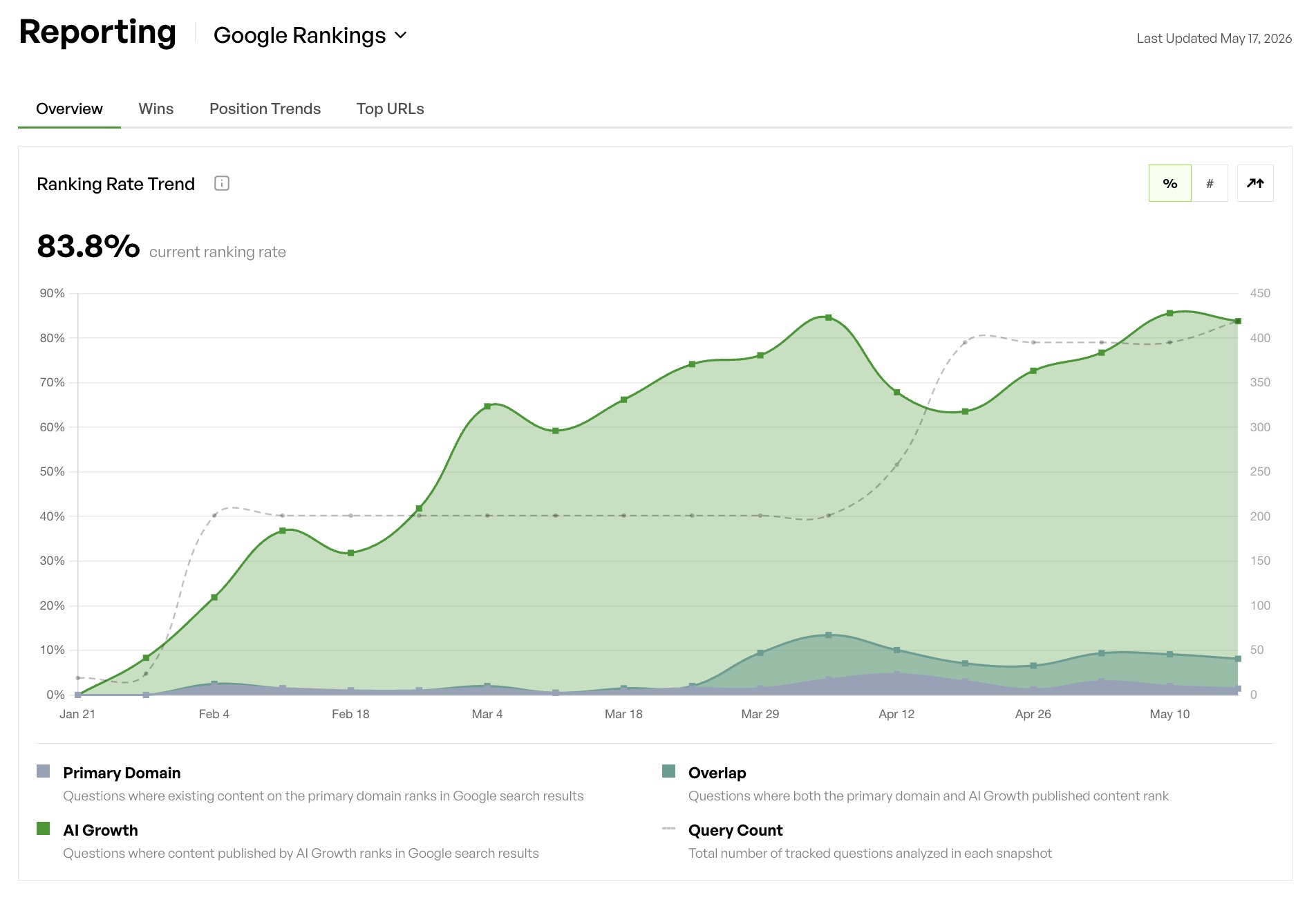
The enterprise CMO's role in this architecture remains strategic rather than operational. The organization decides what narrative to own, in plain language, and the engine produces the authoritative content that makes that narrative the answer agents cite. No technical team is required on the brand's side. No agency RFP. No year-long ramp.
Traditional search tools show you where your brand stands. AI Growth Agent makes your brand the answer. See the headless marketing execution layer in action.
Frequently Asked Questions
What is the difference between agent discovery and AI search optimization?
Agent discovery refers to the technical mechanisms through which AI agents and AI surfaces locate, identify, and invoke other agents or organizational resources at runtime. It operates at the protocol and metadata layer through MCP endpoints, /.well-known/ files, llms.txt declarations, and structured schema. AI search optimization, or large language model optimization, refers to the practice of structuring content so that AI surfaces find it, trust it, and cite it when generating answers. The two disciplines are complementary. Agent discovery ensures the organization's surfaces are technically findable. AI search optimization ensures the content those surfaces expose is authoritative enough to be cited. A complete enterprise control plane requires both the machine-readable discovery infrastructure and the authoritative content that agents return when they find it.
Why do enterprise agent marketplaces not solve the governance-to-discoverability problem?
Agent marketplaces like AWS Marketplace and Google's Gemini Enterprise Agent Platform solve procurement-time visibility. They provide a vetted catalog where agents can be found, evaluated, and deployed through formal channels. They do not solve runtime discoverability, which is the ability of an external agent or AI surface to find and invoke an organization's capabilities during an active session without a prior marketplace relationship. Runtime discoverability depends on open-standard protocols like A2A v1.0, MCP endpoints, and /.well-known/ agent cards. An organization can be listed in every major marketplace and still be invisible to an agent that relies on these open standards because the underlying machine-readable surfaces are missing. The governance-to-discoverability gap exists precisely because marketplace listing and open-standard compliance are separate requirements that most organizations address independently, if at all.
What machine-readable formats should enterprises prioritize for external agent discoverability in 2026?
Four formats form the foundation of external agent discoverability in 2026. First, llms.txt and llms-full.txt, published at the domain root, provide AI surfaces with a structured declaration of the organization's content and capabilities. Second, agent cards and OpenAI discovery files served via /.well-known/ allow any compliant agent to identify the organization's capabilities without a prior relationship. Third, MCP endpoints expose the organization's agents and services to other agents at runtime, enabling direct interoperability within A2A-compatible ecosystems. Fourth, rich schema markup across organization, product, article, and software application types provides the citation context that AI surfaces use when generating answers. These formats work best when deployed together as a coherent discovery stack rather than implemented piecemeal.
How does headless marketing differ from traditional content marketing for enterprise agent discovery?
Traditional content marketing produces assets optimized for human readers and traditional search crawlers. Headless marketing produces content optimized for the AI surfaces, agent crawlers, and language models that now determine what gets cited in AI answers. The architectural difference is significant. Traditional content marketing depends on human teams, agency relationships, and production cycles that operate on timescales of months. Headless marketing operates as an autonomous engine that produces living, self-healing content at scale, with the full technical and agentic SEO stack, including MCP endpoints, llms.txt, /.well-known/ discovery files, and rich schema, deployed automatically on every published surface. For enterprise agent discovery specifically, headless marketing acts as the execution layer that translates internal governance decisions into the externally consumable content surfaces that agents actually cite. Without it, governance metadata points to content that either does not exist, is not structured for machine consumption, or goes stale between training sweeps.
Conclusion: Turning Discovery into Narrative Control
The agent discovery problem functions as the enterprise control plane of 2026. Organizations that treat it as a security scanning exercise solve half the problem and lose the other half to competitors whose content is already being cited by the agents their customers use. Organizations that treat it as a marketplace listing exercise solve procurement-time visibility without addressing runtime discoverability. The organizations that win connect internal governance to external findability through a coherent architecture, machine-readable metadata, open-standard discovery endpoints, and authoritative, living content that gives agents something worth citing.
The incremental visibility gains from this architecture are measurable and compounding. Citation context, order of mention in AI answers, and bot traffic are the new ranking signals, and they respond to the same inputs that have always driven authority, structured, validated, authoritative content published at scale with the technical infrastructure that makes it findable. The difference in 2026 is that the infrastructure now includes MCP endpoints, llms.txt, /.well-known/ agent cards, and the A2A protocol, alongside the traditional technical SEO stack that remains table stakes.
Headless marketing provides the execution layer that makes this architecture operational for enterprise teams without requiring a technical build-out, an agency RFP, or a year-long ramp. The engine handles the full stack. The organization controls the narrative.
As this control-plane approach shows, moving from visibility tracking to answer ownership requires both the technical infrastructure and the execution layer working together. Get a working session with AI Growth Agent and launch your first article within a week.