Written by: Mariana Fonseca, Editorial Team, AI Growth Agent
Key Takeaways
- MCP agentic optimization applies schema constraints, batching, caching, transport selection, and deterministic backends to cut latency and token usage while improving reliability in production agent workflows.
- Single-source-of-truth typed schemas and field-level constraints prevent schema drift, invalid tool calls, and retries while improving accuracy on benchmarks like SWE-bench-Verified.
- Agent loop optimization with persistent memory (DynamoDB) and batched tool calls (10–25 per batch) sharply reduces token consumption and cumulative latency in multi-turn sessions.
- Deterministic backends, S3-backed caching with clear TTL policies, and namespace isolation prevent non-deterministic failures and stale data issues in production MCP deployments.
- AI Growth Agent delivers a production-ready Blog MCP and agentic technical SEO stack that ties these seven techniques to measurable citation gains, so schedule a demo to review the impact on your properties.
1. Anthropic MCP Schema Foundations for Reliable Agents
Anthropic’s MCP specification defines the contract between a host, a client, and a server, and every optimization technique in this guide builds on that contract. Violations of it, such as schema drift between discovery time and runtime, create the most common silent failures in production agent loops.
The foundational pattern uses a single-source-of-truth schema definition. Typed Rust structs annotated with serde and schemars generate both the JSON Schema exposed to the model at discovery time and the server-side runtime validation. This approach removes duplication and drift that cause invalid tool calls and retries. The same annotation that constrains a field for the model also enforces it at the handler.
A recent audit found that the majority of MCP tool descriptions contain at least one quality issue, with many carrying unclear purpose statements. Because these schema issues propagate to every tool call the model makes, fixing them at the schema level before any runtime optimization eliminates entire classes of failures at their source and becomes the highest-leverage starting point for any production MCP deployment.
2. MCP Agent Loop Optimization with Persistent Memory
Agent loop design directly affects token cost and latency because the observe, plan, act, and evaluate cycle accumulates overhead at every turn. Without memory persistence, each turn re-ingests the full session history, and that cost compounds nonlinearly as sessions grow. The FAME paper (arXiv:2601.14735) reports that combining agent memory persistence via DynamoDB with MCP caching yields substantial reduction in input tokens while improving workflow completion rates for multi-turn sessions.
The mechanism uses DynamoDB to store structured memory records keyed by session and entity, and the agent retrieves only the relevant slice at each turn rather than replaying the full transcript. Cloudflare’s Agent Memory ingestion pipeline performs deterministic ID generation via SHA-256 hashing, parallel extraction passes on large character chunks, and multiple verification checks before classifying memories into facts, events, instructions, and tasks. This multi-stage processing shows that production memory systems need deterministic deduplication, parallel processing for scale, and semantic classification, not just a simple key-value store.
AIMultiple’s MCP memory benchmark identified context separation failures as the primary production risk, specifically the retrieval of stale or overlapping project contexts when similar entities share a memory namespace. Namespace isolation and write-before-read sequencing are the two implementation controls that prevent this failure mode in DynamoDB-backed loops.
3. MCP Tool Schema Design that Reduces Errors
Tool count and schema quality drive agent accuracy more than any other controllable variables. GitHub Copilot reduced its MCP tool count from 40 to 13 and observed 2 to 5 percentage point gains on SWE-Lancer and SWE-bench-Verified benchmarks plus a 400 ms latency reduction. Task success often collapses with high tool counts but remains strong when large models use smaller, well-designed toolsets.
Field-level constraints provide the practical lever for this improvement. Annotations such as #[schemars(length(max = 16))] and #[schemars(range(min = 1, max = 10000))] expose allowed ranges and formats to the model at discovery time, which reduces invalid calls and retries while the server enforces the same rules at runtime. Output structs, not just input structs, should be defined. Typed output schemas such as InventoryResult or OrderTrackingResult tell the model exactly what fields to expect and reduce hallucinated response fields in downstream consumers.

Error messages follow a three-part template that keeps retries low without expanding the context window. State what went wrong, what was expected, and provide one or two concrete examples, for instance “Invalid date format… Use ISO 8601… Example: ‘2026-04-15′”.
4. Batching MCP Tool Calls to Cut Round Trips
Batching MCP tool calls removes avoidable latency by reducing the number of round trips between the agent and the MCP server. Each round trip carries fixed overhead from connection setup, serialization, and the model’s planning step to interpret the result before issuing the next call. Aggregating calls into batches of 10 to 25 removes most of that overhead for suitable workloads.
The FAME paper reports that batching combined with function fusion of multiple MCP servers into consolidated Lambda functions can reduce latency. Function fusion acts as the server-side complement to client-side batching. Instead of routing each tool call to a separate MCP server process, fused functions consolidate related tools into a single Lambda handler and remove inter-process communication overhead.
Query pushdown applies the same idea to data-intensive tools by moving work closer to the data. Rather than retrieving a full dataset and filtering in the agent loop, the tool schema should expose filter parameters that push predicate evaluation to the backend. Dremio’s MCP Server guidance recommends exposing filter and projection parameters directly in the tool schema so the data lakehouse executes the predicate rather than returning full result sets to the agent. With schema design optimized to reduce invalid calls, batching then addresses latency for valid calls that still need to execute.
5. MCP Caching Strategies that Eliminate Repeat Work
MCP invocation caching removes repeated work by storing the result of a tool call keyed by its input hash and returning the cached result on subsequent identical calls. The common implementation in serverless deployments uses S3. Caching via S3 can reduce latency and token usage. Batching reduces the number of round trips, and caching removes them entirely for repeated calls.
Cache key design controls hit rate and correctness. Keys must include every input field that affects the output, including implicit fields such as the caller’s locale or the effective date of a lookup. Keys that are too coarse produce stale results, and keys that are too granular produce a near-zero hit rate. A content-addressable hash of the normalized input struct, computed before the tool call is dispatched, provides a reliable pattern.
TTL policy acts as the second design variable. Static reference data, such as product catalogs or schema definitions, tolerates long TTLs measured in hours because it changes infrequently. Dynamic data, such as inventory levels or pricing, requires short TTLs or event-driven invalidation because stale values cause incorrect agent decisions. Mixing these two TTL policies within a single cache namespace, such as applying a long TTL to dynamic data, is the most common implementation error and the primary cause of stale-data incidents in production MCP deployments. Caching improves performance and cost, but it cannot correct deeper reliability issues that originate in non-deterministic backends.
6. Deterministic Backends for Stable MCP Agents
Deterministic backends turn fragile MCP agents into stable systems by isolating where randomness occurs. Non-deterministic behavior in production MCP agents almost always originates in one of two places: the LLM front-end that makes planning decisions, or the backend tool that executes side effects. Separating these concerns and placing all non-deterministic reasoning in the LLM layer while keeping side-effecting operations in deterministic microservices creates a predictable architecture.
The same FAME research described earlier shows that decomposing the ReAct pattern into separate FaaS functions orchestrated via AWS Step Functions isolates non-deterministic planning from deterministic execution and evaluation. Each function receives a defined input contract, returns a defined output contract, and exposes a defined failure mode. The system becomes observable and testable at each function boundary rather than only at the workflow boundary.
Speakeasy’s benchmarking found that tool schemas often represent a substantial portion of token usage in static toolsets for MCP-based systems. Deterministic backends with narrow, well-typed schemas therefore reduce token consumption by shrinking schema surface area. Reliability and cost improvements reinforce each other rather than acting as separate goals.
7. Discoverability and Blog MCP for AI Citations
Discoverability completes the optimization stack by connecting tuned MCP endpoints to the AI surfaces that need to find and cite them. The lastmile-ai/mcp-agent repository provides a production reference architecture that implements the ACP (Agent Communication Protocol) on top of MCP, demonstrating how multi-server tool aggregation, parallel tool execution, and structured memory compose into a single deployable agent. The patterns in that repository map directly to techniques 1 through 6 above, including typed schemas, batched calls, S3-backed caching, and FaaS-style decomposition of the ReAct loop. However, these GitHub examples focus on protocol optimization in isolation and do not address the seventh technique, which is making those optimized endpoints discoverable to AI surfaces that need to consume them.
A production MCP agent that cannot be found by AI surfaces, crawlers, or other agents remains invisible to the ecosystem it should serve. AI Growth Agent was the first to bring Blog MCP to market, with clients running it in the summer of 2025, roughly a year before Google released Web MCP. The full agentic technical SEO stack includes Blog MCP compatible with Chrome 146+ and other WebMCP-enabled browsers, OpenAI discovery and Agent Card guidance served via /.well-known/, llms.txt and llms-full.txt published for AI surface readability, and natural language query parameters via /?s={query} that return personalized, internally linked responses to agents.
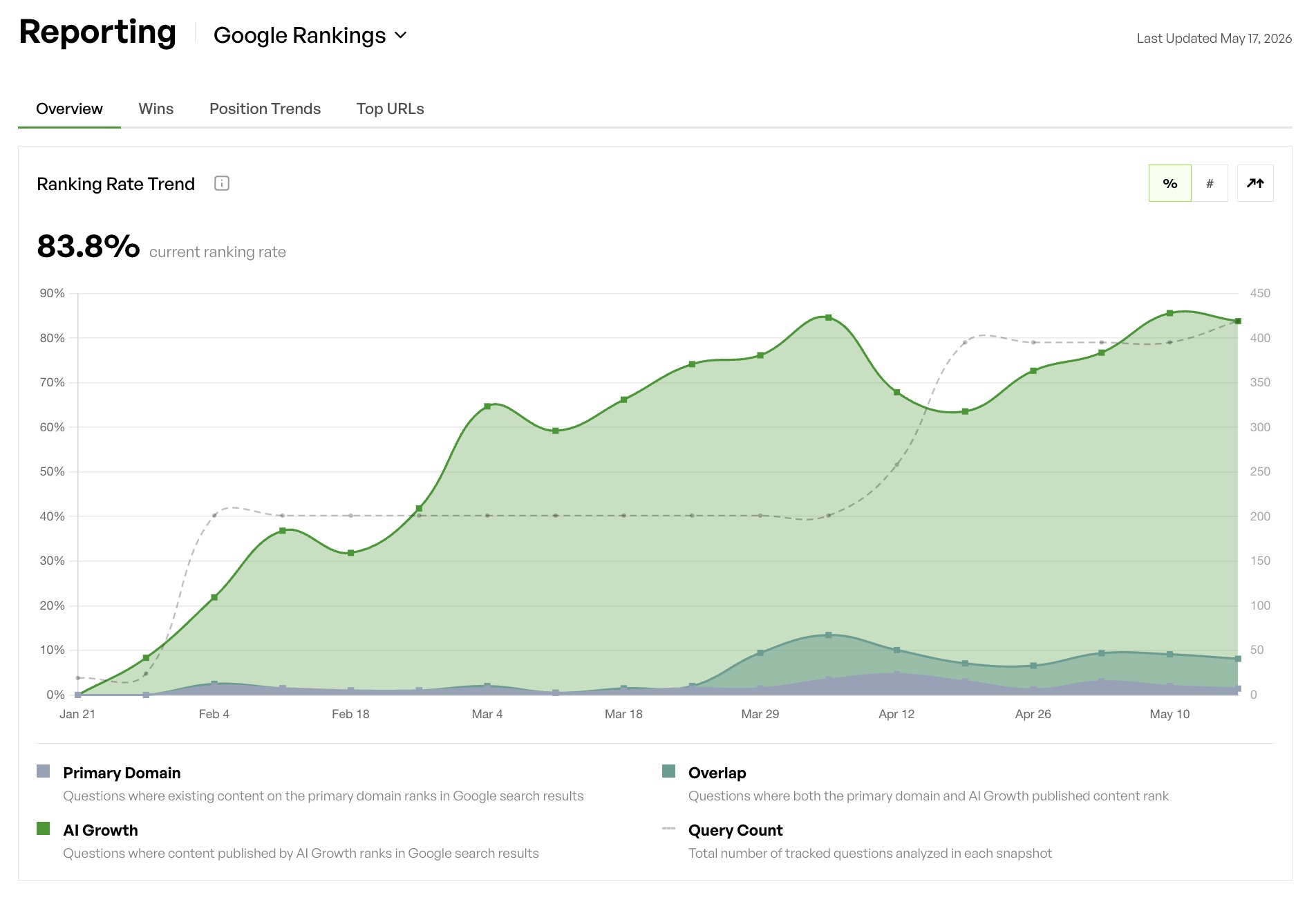
Clients using AI Growth Agent’s full agentic technical SEO stack average thousands of additional AI citations and mentions and tens of thousands of additional bot visits in the first twelve weeks. Breadless achieved a 30x lift in Google Search Console impressions over six months and is now the most recommended healthy franchise in the US ahead of CAVA, Rush Bowls, and Sweetgreen. These outcomes require the discoverability layer that connects optimized MCP endpoints to the AI surfaces doing the citing, not protocol tuning alone.
Transport Layer Decision Matrix
| Transport | Concurrency | Latency Added | Production Fit |
|---|---|---|---|
| Stdio | One subprocess per client, 100 clients require 100 processes | <1 ms per tool call | Local development and single-client tools only |
| SSE | Half-duplex, requires sticky sessions behind a load balancer | 1–10 ms | Avoid in new deployments, technical debt risk |
| Streamable HTTP | Full-duplex multiplexing, horizontal scaling without sticky sessions | 5–50 ms depending on region co-location | Suitable for production deployments |
| Direct HTTP (no MCP) | Standard HTTP concurrency | Eliminates MCP hop, recommended for sub-100 ms budgets | Real-time voice agents and strict latency SLAs only |
7-Technique Optimization Comparison
| Technique | Latency Impact | Token Impact | Reliability Impact |
|---|---|---|---|
| Anthropic MCP Schema Foundations | 400 ms reduction (GitHub Copilot, 40→13 tools) | Schemas often represent a substantial portion of token usage in static toolsets | 2–5 pp accuracy gain on SWE-bench-Verified |
| Agent Loop Optimization | Reduced turn count lowers cumulative latency | Substantially fewer input tokens via DynamoDB memory persistence | Improved workflow completion rates for multi-turn sessions |
| Tool Schema Design | Fewer retries reduce round-trip latency | Narrower schemas reduce discovery-time token overhead | Task success improves with smaller toolsets |
| Batching MCP Tool Calls | Significant latency reductions in some workloads via batching and function fusion | Fewer round trips reduce per-call overhead tokens | Removes partial-failure states from interleaved unbatched calls |
| MCP Caching Strategies | Latency and MCP time reductions via caching | Token reduction via caching | Deterministic cache hits eliminate non-deterministic tool re-execution |
| Deterministic Backends | FaaS decomposition avoids Lambda timeout failures that force full retries | Narrow typed schemas reduce schema surface area and token overhead | Isolates non-deterministic LLM layer from deterministic execution layer |
| Discoverability and Blog MCP | Not applicable to runtime latency | Not applicable to runtime token consumption | Client averages detailed in Section 7 |
Frequently Asked Questions
What is MCP agentic optimization and why does it matter in 2026?
MCP agentic optimization is the systematic application of schema constraints, batching, caching, transport selection, and deterministic backend design to Model Context Protocol workflows. It matters because MCP deployments that skip these techniques accumulate hidden latency and token costs that compound with every tool call and every session turn. At production scale, those costs translate directly into slower agent responses, higher inference bills, and lower task completion rates. Generic tutorials cover individual techniques in isolation, and production systems require all of them applied in sequence, from schema foundations through discoverability.
Which MCP optimization technique delivers the largest latency reduction?
Batching MCP tool calls produces the largest single latency reduction in compute-intensive workloads, with significant reductions when combined with function fusion. For multi-turn conversational workloads, agent loop optimization via persistent memory delivers substantial token reduction, which indirectly reduces latency by shrinking the context the model must process at each turn. The two techniques address different bottlenecks and are not mutually exclusive, so production systems benefit from applying both.
How does Blog MCP differ from standard MCP server implementations?
A standard MCP server exposes tools to a single connected client over a defined transport. Blog MCP extends that pattern to the open web, exposing schema, manifest, discovery metadata, and capability guidance so that any AI surface, crawler, or WebMCP-enabled browser can discover and interact with the content endpoint without a pre-configured client connection. As noted in Section 7, AI Growth Agent pioneered Blog MCP in summer 2025, a year ahead of Google’s Web MCP release. Blog MCP turns a content property into a citable, agent-readable endpoint, which is why it belongs in an agentic technical SEO stack alongside llms.txt, llms-full.txt, and agent discovery via /.well-known/.
What transport should a production MCP deployment use in 2026?
The MCP specification defines both stdio and Streamable HTTP transports but states only that clients SHOULD support stdio whenever possible. Streamable HTTP supports full-duplex multiplexing, horizontal scaling without sticky sessions, and standard HTTP observability, authentication, and audit logging. SSE transport should be avoided in new deployments because it is half-duplex, requires sticky sessions behind a load balancer, and accumulates technical debt. Stdio fits local development and single-client tools. Real-time voice agents with strict sub-100 ms tool-call budgets form the main exception, where removing the MCP layer entirely and calling backends over direct HTTP eliminates the extra hop.
How do I measure whether my MCP optimizations are working in production?
Four metrics cover the full optimization surface: end-to-end workflow latency per task type, input token count per session turn, task completion rate across multi-turn sessions, and tool call error rate by tool. Latency and token count act as leading indicators, and completion rate and error rate act as lagging indicators that confirm whether schema and backend changes hold under real workloads. For agentic technical SEO specifically, the additional metrics are bot visit volume, AI citation count, and Google Search Console impressions, which measure whether the optimized MCP endpoints are being discovered and cited by AI surfaces. AI Growth Agent’s reporting stack cross-references all of these signals weekly, isolating the incremental visibility generated by each change rather than attributing pre-existing brand visibility to new work.
From Protocol to Production Results
The seven techniques above form a complete optimization stack. Schema foundations eliminate invalid calls, loop optimization cuts token accumulation, schema design reduces tool count and error rates, batching and caching address latency at the call and session level, deterministic backends isolate failure modes, and discoverability via Blog MCP and agent discovery endpoints connects the optimized system to the AI surfaces that cite and act on it. Applied together, they deliver the latency, token, and reliability gains that isolated tutorials cannot match. AI Growth Agent’s agentic technical SEO stack is a production implementation that ties all seven to measurable citation and visibility outcomes, with clients averaging thousands of additional AI citations in the first twelve weeks and content indexing in as little as ten days.