Written by: Mariana Fonseca, Editorial Team, AI Growth Agent
Key Takeaways
- LLMs.txt is an optional Markdown file at a domain’s root that gives AI crawlers a concise site summary. Studies show it has no measurable impact on AI citations when used on its own.
- Major AI providers including Google, OpenAI, and Anthropic do not officially support or crawl llms.txt. Their crawlers usually skip the file and go straight to HTML content.
- The file adds value only when it sits inside a complete headless marketing system that includes structured content, full schema markup, bot tracking, and agentic signals.
- Effective implementation depends on correct placement at the domain root, alignment with robots.txt, full schema deployment, Blog MCP integration, and bot tracking that ties the file to broader AI visibility work.
- AI Growth Agent automates the full technical stack, including llms.txt deployment. Schedule a demo to see how the complete system drives AI citations and visibility.
Structuring an LLMs.txt File for AI Agents
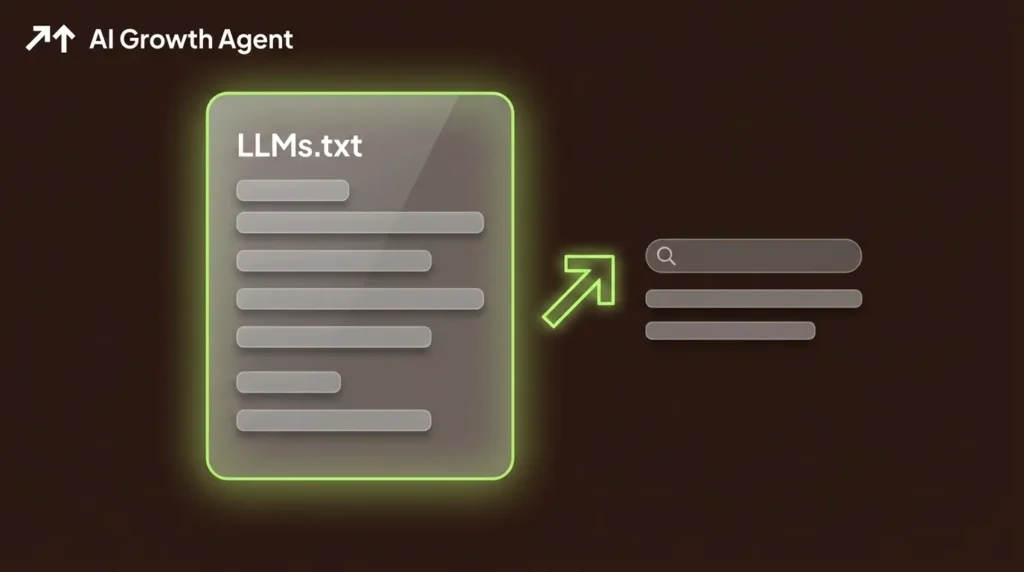
Google Chrome developer documentation describes the llms.txt file as an emerging convention that should contain a concise Markdown summary of the site’s purpose and key links, placed at the root directory. The practical pattern across implementations is a concise index file with page titles, one-sentence descriptions, and URLs, tuned for AI tools with limited context windows, plus an optional llms-full.txt containing complete documentation in machine-readable format.
The following template covers every section a well-formed llms.txt file needs. Replace bracketed placeholders with brand-specific values before deployment.
# [Brand Name] > [One-sentence description of what the brand does and who it serves.] [Two-to-four sentence summary of the brand's core value proposition, primary products or services, and the audience it addresses. Write in plain prose. Avoid marketing language.] ## Key Pages - [Page Title 1]: [One-sentence description] - [https://example.com/page-1] - [Page Title 2]: [One-sentence description] - [https://example.com/page-2] - [Page Title 3]: [One-sentence description] - [https://example.com/page-3] ## Content Library - [Topic Cluster 1 Title]: [One-sentence description] - [https://example.com/blog/topic-1] - [Topic Cluster 2 Title]: [One-sentence description] - [https://example.com/blog/topic-2] - [Topic Cluster 3 Title]: [One-sentence description] - [https://example.com/blog/topic-3] ## Optional: Full Documentation - Full content index: [https://example.com/llms-full.txt]
Each section serves a distinct function. The headline and summary give AI agents a fast orientation to the brand’s identity and scope. The Key Pages section highlights the highest-authority destinations on the domain. The Content Library section points crawlers toward the topic clusters with the strongest citation potential.
The optional llms-full.txt link, when present, provides a complete machine-readable content dump for agents that can handle larger context windows. llms-full.txt files receive more visits than standard llms.txt indexes according to Profound data reported by Mintlify, which makes the companion file worth publishing for content-heavy sites.
When LLMs.txt Belongs in Your Stack
Search Engine Land tracked llms.txt implementation across 10 sites in finance, B2B SaaS, ecommerce, insurance, and pet care for 90 days before and after upload, measuring AI crawl frequency and traffic from ChatGPT, Claude, Perplexity, and Gemini. Eight of the 10 sites saw no measurable change in AI traffic or crawl frequency after implementing llms.txt. The two sites that recorded AI traffic increases had concurrent marketing campaigns and SEO improvements running at the same time. The file did not cause the lift. The surrounding system did.
Of approximately 38,000 domains with a valid llms.txt in Ahrefs’ study of 137,000 domains, 97% received zero requests for the file in May 2026. In July 2025, Google’s Gary Illyes confirmed Google does not support llms.txt and has no plans to support it. John Mueller, Search Advocate at Google, compared llms.txt to the keywords meta tag, noting that no AI services have said they are using it.
The file did not cause the lift. The surrounding system did. To understand exactly what llms.txt contributes in isolation versus as part of a complete technical stack, compare the capabilities side by side in the table below.
| Capability | LLMs.txt Alone | LLMs.txt Inside a Headless Marketing Stack |
|---|---|---|
| AI crawler discovery signal | Present but ignored by major providers as of May 2026 | Present and reinforced by robots.txt, schema, Blog MCP, and agent discovery via /.well-known/ |
| Structured data for citation context | None | Full schema suite: article, FAQ, organization, product, author, and more, provisioned automatically |
| Bot traffic visibility | None | Per-article bot tracking across every crawler type, including the bot ChatGPT uses to cite sources |
| Incremental citation reporting | None | Week-over-week AI Ranking data isolating new citations from existing brand visibility |
| Content authority signals | None | Living, self-healing content validated against primary sources with anti-hallucination controls |
| Agentic interoperability | Partial: file exists but MCP, agent card, and query endpoints are absent | Blog MCP, OpenAI discovery, Agent Card guidance, and natural language query parameters at /?s={query} |
The file should be treated as a low-cost, low-risk bet rather than a proven ranking lever. For documentation-heavy sites, software companies, and publishers with large content libraries, it adds marginal clarity for AI agents at negligible cost. For every other site, the implementation effort is better directed at the signals that demonstrably move citation context: structured content, full schema, Bot Tracking, and Search Intelligence across the four pillars.
Implementation Steps for LLMs.txt Inside an Agentic Stack
Some sites will still choose to implement llms.txt as one layer of a broader agentic SEO strategy. For those teams, effective deployment requires integration with the surrounding technical stack rather than a standalone file. Deploying llms.txt correctly involves five steps, and each step connects the file to the broader system.
Step 1: Create and place the file. The file must be deployed at the domain root as https://example.com/llms.txt, served with status 200 as text/plain or text/markdown, with no authentication wall. The /.well-known/llms.txt mirror is supported but the root location is canonical. Use the template above and populate every placeholder with accurate, brand-specific content.
Step 2: Align robots.txt. robots.txt remains the established mechanism that LLM crawlers use to manage access and crawl behavior. Audit robots.txt to confirm that retrieval bots including OAI-SearchBot, GPTBot, ClaudeBot, and PerplexityBot are not inadvertently blocked. robots.txt and llms.txt operate alongside each other. robots.txt controls access, and llms.txt shapes comprehension after access is granted.
Step 3: Deploy full schema markup. Schema helps bots understand the content and powers rich results, which makes it a prerequisite for llms.txt. Article, FAQ, organization, product, and author schema should be present on every relevant page before llms.txt is published. Without this structured data foundation, a file pointing crawlers to pages produces no citation advantage, because llms.txt can only guide crawlers to content, not explain what that content means.
Step 4: Integrate Blog MCP and agent discovery. The Model Context Protocol is an open protocol that enables seamless integration between LLM applications and external data sources and tools. Blog MCP exposes schema, manifest, discovery, and capability guidance to agents. OpenAI discovery and Agent Card guidance served via /.well-known/ complete the agentic surface. These signals give AI agents a structured entry point that llms.txt alone cannot provide.
Step 5: Activate bot tracking. Per-article bot tracking confirms whether any crawler has read the content that the llms.txt file references. Bot Tracking, one of the four pillars of AI search intelligence, records every crawl, citation, and training sweep so the measurement framework has a reliable baseline.
AI Growth Agent automates every step in this stack. The WordPress plugin ships with advanced robots.txt, a proper sitemap.xml, Blog MCP, OpenAI discovery, Agent Card guidance, natural language query parameters, Markdown served to agent crawlers, and llms.txt and llms-full.txt published automatically. No technical skill is required from the client, and every package includes the full stack from day one.
Measuring LLMs.txt Impact on AI Visibility
Accurate measurement depends on isolating the variable. Because llms.txt is deployed alongside other changes in nearly every real-world case, attributing citation movement to the file specifically requires a controlled baseline established before deployment.
The measurement framework ties to the four pillars. Search Intelligence establishes the pre-deployment competitive landscape, including which domains win each query, what citation context looks like for the brand, and where white space exists. AI Analytics tracks brand value and consumer behavior across the full journey, from external AI-tool queries through content consumption and sentiment, giving a pre and post comparison that spans the whole funnel.
Bot Tracking records every crawler interaction before and after the file goes live, which makes it possible to see whether any AI training agent or citation crawler changed behavior in response. AI Ranking monitors order of mention and citation context week over week. That ranking view becomes the new leaderboard in a world where AI answers carry no static ordered list.
To isolate incremental visibility, publish llms.txt on a defined date, record the baseline across all four pillars for the two weeks prior, and compare the same metrics for the four weeks following. As the Search Engine Land study demonstrated, any measurement framework that does not control for concurrent changes will misattribute results.
AI Growth Agent clients average more than 12,000 additional AI citations and mentions, over 100,000 additional bot visits, and a 20%+ lift in impressions across the first twelve weeks. Those results come from the complete headless marketing system, not from any single file. The engine publishes into a separate environment and reports incremental visibility week over week, isolating exactly what it generated rather than taking credit for visibility the brand already had.
Frequently Asked Questions
Does llms.txt improve AI search rankings or citation rates on its own?
No. Evidence from multiple 2025 and 2026 analyses is consistent. No major AI provider including OpenAI, Google, Anthropic, or Meta has publicly committed to using llms.txt as a production signal in search or answer surfaces. Server log data shows that AI crawlers usually skip the file and crawl HTML directly. Citation outcomes are driven by structured content, schema markup, authoritative primary sources, and agentic signals, not by the presence of a Markdown index file at the domain root.
Which sites benefit most from implementing llms.txt?
Documentation-heavy sites, software companies, and API publishers gain the most because they maintain large content libraries where a curated Markdown map adds genuine clarity for AI agents navigating hundreds of pages. IDE agents including Cursor, Windsurf, Claude Code, GitHub Copilot, and Aider routinely fetch llms.txt and llms-full.txt when pointed at documentation sites to identify dependencies and pull relevant content. For general marketing sites, ecommerce properties, and B2B brands, the file adds negligible value without the surrounding technical stack.
How does llms.txt relate to robots.txt and schema markup?
The three signals operate at different layers. robots.txt controls which crawlers can access the site and which paths are off-limits. Schema markup tells bots what the content means, which powers rich results and citation context. llms.txt provides a curated Markdown map of the most important content after access is granted. None of the three replaces the others, and llms.txt is the only one that major AI providers have not formally adopted. A complete agentic technical SEO stack deploys all three alongside Blog MCP, agent discovery via /.well-known/, and per-article bot tracking.
How long does it take for llms.txt to produce measurable results?
Isolated llms.txt files have not produced measurable citation results in controlled studies. The file is low-cost and low-risk to deploy, so implementation is reasonable as one layer of a broader strategy. Measurable AI citation and bot traffic results, by contrast, come from the complete system: authoritative content, full schema, Bot Tracking, and Search Intelligence working together. AI Growth Agent clients see content indexed in as little as ten days and first citation movement within the first few weeks of the full stack going live.
Can publishing llms.txt create any risks?
One documented risk is competitive exposure. A well-structured llms.txt file maps the most important pages and content clusters on a domain in a format that is easy to parse programmatically, which can make it easier for competitors to scrape structured site content. For brands with proprietary content architecture or unique topic coverage, this is worth weighing before publishing a detailed llms-full.txt companion file.
Conclusion: Where LLMs.txt Fits in Agentic SEO
LLMs.txt is experimental infrastructure. It costs little to deploy, carries no confirmed ranking signal from any major AI provider, and produces no measurable citation difference when used in isolation. The file belongs in a complete headless marketing system alongside schema, robots.txt alignment, Blog MCP, agent discovery, and per-article bot tracking, where it functions as one tactical layer rather than a standalone solution.
The brands earning AI citations and bot traffic at scale are not winning because of a single file. They are winning because they mapped their full universe of queries, produced authoritative living content validated against primary sources, deployed the complete agentic technical SEO stack, and measured incremental visibility week over week across the four pillars: Search Intelligence, AI Analytics, Bot Tracking, and AI Ranking. That system moves citation context. Periodic review of llms.txt is reasonable as the standard matures, but the investment priority remains the surrounding architecture.