Written by: Mariana Fonseca, Editorial Team, AI Growth Agent
AI Search Authority: What Matters Most
- Brand authority in AI search depends on how often engines like ChatGPT and Perplexity cite your brand across its full query universe, not on domain age or backlinks.
- Strong AI visibility comes from moving beyond monitoring tools and actively engineering citations through structured content and technical execution.
- The seven-phase framework starts by assessing current AI visibility, mapping the complete query universe, and building a prioritized content topology with schema and question-based headings.
- AI Growth Agent clients achieve measurable results including over 12,000 additional AI citations, 100,000+ bot visits, and 20%+ impression lifts within the first twelve weeks through living, self-healing content.
- Get your baseline gap map built in week one with AI Growth Agent and start engineering citations that position your brand as the answer in AI search.
Phase 1: Assess Your Current AI Visibility
Goal: Establish a baseline across all four intelligence pillars before any content is produced.
The sequence begins with a structured audit. First, pull Google Search Console data to set your traditional search baseline. Next, run a sample of head-term and long-tail queries through ChatGPT and Perplexity and record where the brand appears, in what position, and alongside which competitors. This step reveals your current AI citation footprint. Then check bot tracking logs to see whether AI training agents are crawling existing pages at all. These three data sources combine into a gap map that shows queries where the brand is cited, where a competitor holds the slot, and where no brand is cited yet.
Roles involved are the CMO or founder for strategic direction and the AI Growth Agent onboarding team for data collection and diagnosis. The validation point is coverage. The gap map must include at least three seed-term clusters before Phase 2 begins.
Get your baseline gap map built in week one by booking a working session.
Phase 2: Map the Full Query Universe with Search Intelligence
Goal: Replace the capped prompt list with a complete picture of every query that describes the brand's market.
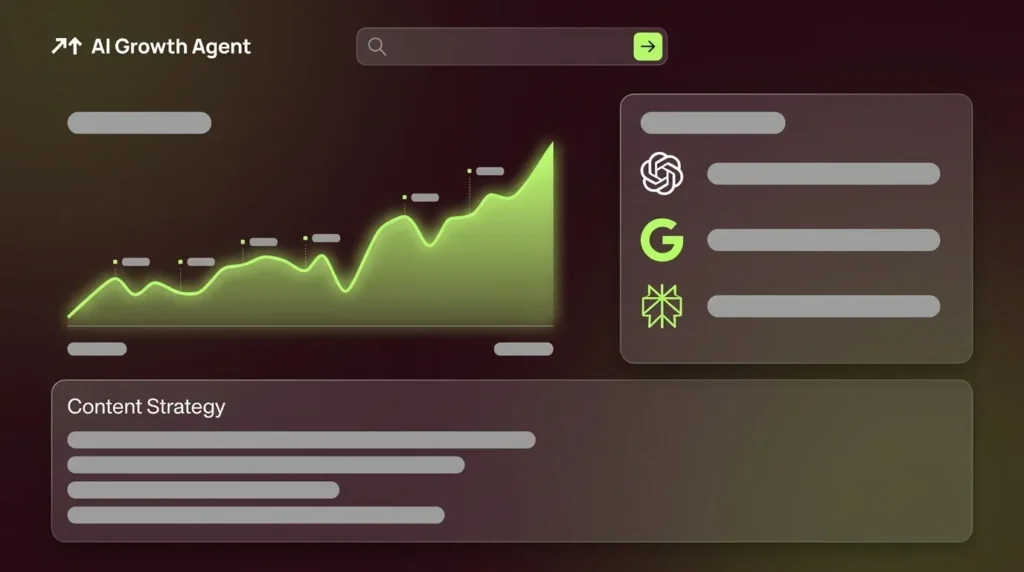
Search Intelligence runs hundreds of real searches across the brand's space and processes signals such as title structures, forum discussions, People Also Ask expansions, query fan-out, and competitor domain rankings. The output is a topology of seed terms, each with dozens of long-tail queries beneath it, refreshed weekly. Appearance in AI answers and citation as a source function as leading indicators that precede measurable traffic, so the universe map must cover the long tail where those indicators accumulate, not only the head terms a brand already tracks.
In practice, this approach scales rapidly. Mature AI Growth Agent clients reach universes of more than 1,600 queries, with the system running over 3,000 searches every week to refresh the snapshot. Prompt count never appears as a billed metric. The validation point is evidence. The topology uses real-time AI Overview and ChatGPT results as the objective function for which queries deserve pursuit.
See your full query universe mapped live during a real-time demo.
Phase 3: Turn the Universe Map into a Content Topology
Goal: Convert the universe map into a strategic content plan with clear prioritization.
The Content Topology organizes seed terms into a hierarchy and assigns content types to each long-tail query, such as guide, listicle, comparison, FAQ, or a combination. Each content type requires specific structural elements to increase AI citation potential. Pages with Schema.org structured data have a higher likelihood of being cited by AI engines, so schema assignment happens at the topology stage, not after publication. AI models prioritize structured content with question-based H2 and H3 headings followed immediately by a concise one-to-two sentence direct answer. Heading architecture therefore becomes a topology decision rather than a copywriting tweak.
The Content Planner surfaces white space the brand is missing and lets the client choose which seed terms to attack first. The validation point is alignment. Every planned article must map to at least one gap identified in Phase 1 and one query cluster from Phase 2.
Phase 4: Produce Authoritative Living Content at Scale
Goal: Publish content that AI surfaces can find, trust, and cite at a scale no editorial team can match manually.
Content production uses a multi-agent orchestration across OpenAI, Anthropic, Gemini, Grok, Perplexity, Exa, and Firecrawl. Parallel research agents gather primary-source evidence and validate every claim and quote against material found online. A cascade of anti-hallucination checks runs before anything ships. Nearly 65% of AI bot hits target content published within the past year, and AI-cited content tends to be about 25.7% fresher than content appearing in traditional Google search results. This freshness bias means living content that self-heals over time outperforms static pages that start to decay the day they ship.
LLMO-optimized content benchmarks include improved AI conversion rates and strong growth in AI-driven traffic. The impact shows in the numbers. Clients see the citation and traffic benchmarks outlined earlier, driven by content that stays current rather than fading after publication.
Watch your first AI-ready article go live within seven days by starting the program.
Phase 5: Ship Agent-Ready Technical SEO
Goal: Make every published page readable, trustworthy, and actionable for AI agents, not only for human visitors.
Every article and site AI Growth Agent publishes ships with the full traditional technical SEO stack. The stack includes highly structured HTML, Open Graph metadata, rich schema markup across article, author, FAQ, product, and organization types, internal linking, sanitized external linking, proper sitemaps, a detailed robots.txt, automated web stories, instant indexing, autoredirects, and 404 tracking. Well-structured schema can be an important factor for whether a page appears in a Google AI Overview.
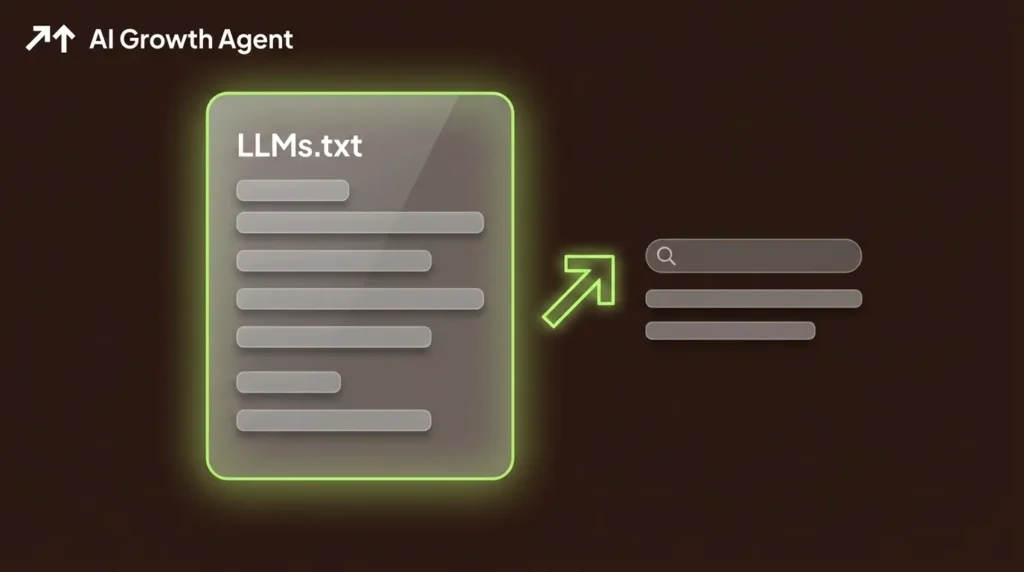
On top of that foundation, agentic technical SEO deploys Blog MCP, compatible with Chrome 146-plus and other WebMCP-enabled browsers, with schema, manifest, discovery, and capability guidance exposed to agents. OpenAI discovery and Agent Card guidance are served via /.well-known/. Natural language query parameters via /?s={query} auto-trigger personalized, internally linked responses. Markdown is served to agent crawlers. The system publishes llms.txt and llms-full.txt so AI surfaces can read the brand in the format they need. The client provides no technical resources for this work. Every package includes the full stack.
Phase 6: Measure Incremental AI Visibility
Goal: Isolate exactly what the content program generated, separate from visibility the brand already had.
AI Growth Agent publishes into a separate environment and reports week over week where its content drives new visibility versus where the brand's existing presence was already performing. Bot analytics track every agent that touches the blog, including the bot ChatGPT uses to cite sources. Google Search Console serves as an independent audit. Citation performance reveals whether content is relied upon as a source, whereas visibility alone only shows participation in AI-generated answers, so the reporting separates citation rate from raw mention frequency.
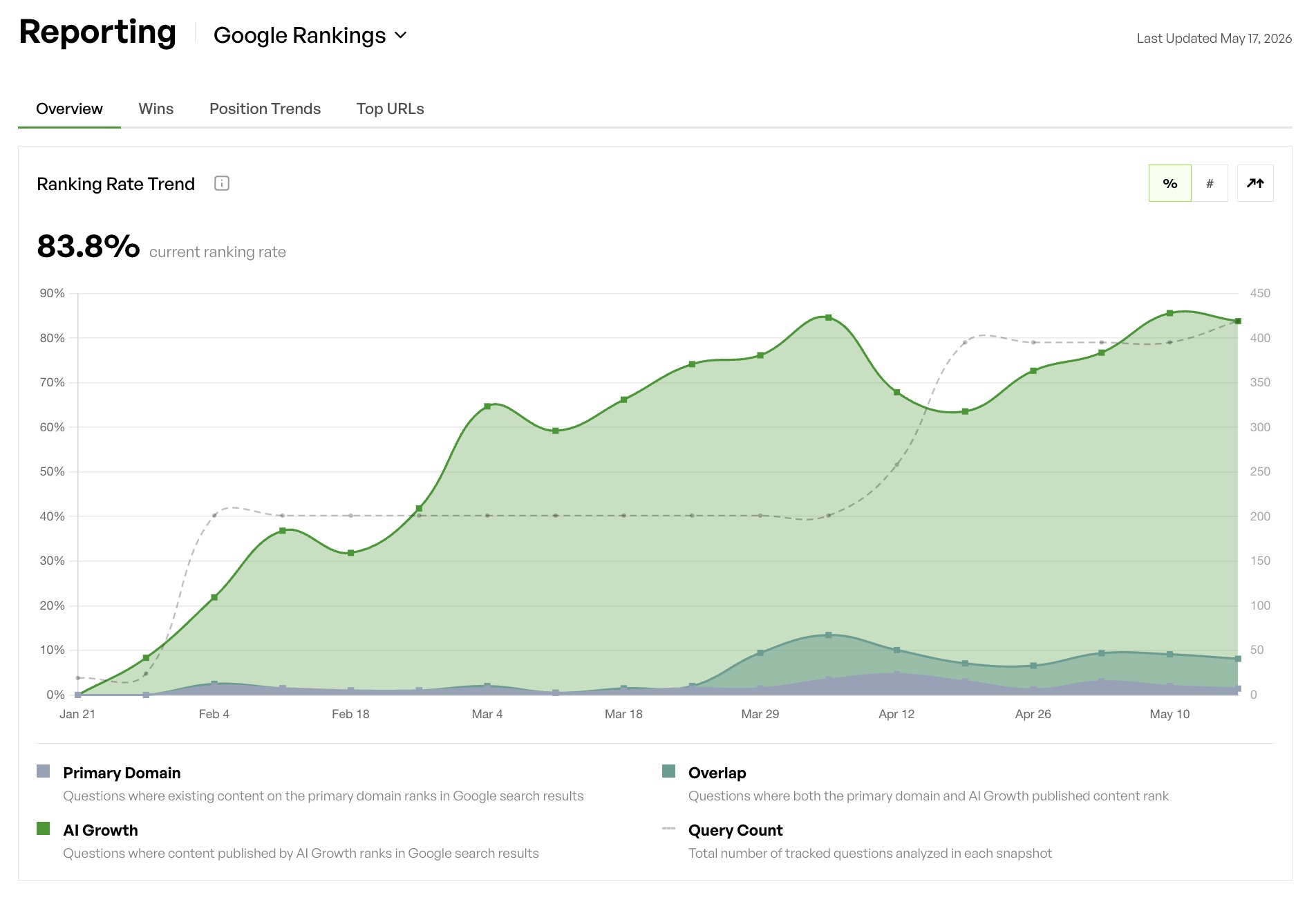
The validation point is movement. Incremental visibility reporting must show week-over-week gains in bot visits, AI citations, and Search Console impressions attributed to AI Growth Agent content, not to the brand's pre-existing domain authority.
Review a live incremental visibility report that shows exactly what the program adds.
Phase 7: Keep Authority Fresh with Self-Healing Content
Goal: Prevent authority decay as the market, competitors, and AI model training data evolve.
Living content updates automatically. When the year turns, every article in a sector receives a refresh. Google Search Console signals and bot-traffic data trigger targeted updates on articles showing indexing decay. Every article's relationships, performance data, and bot signals are centralized so internal linking compounds authority instead of fragmenting it. To maintain the freshness advantage discussed in Phase 4, the self-healing engine enforces a 90-day update cadence automatically across hundreds of articles without requiring a content team to manage the queue.
The validation point is recency. No article in the active universe should carry a last-updated timestamp older than 90 days without a triggered review.
How Profound Tracks Authority and Where It Stops
How Profound measures brand authority: Profound tracks whether a brand appears in AI-generated answers for a defined set of prompts. It records mention frequency, response positioning, and share of voice against competitors within that prompt set. The data is accurate for the prompts it covers.
What AI share-of-voice benchmarks mean: A common benchmark suggests that a brand should appear in a substantial share of relevant AI-generated answers in its category to maintain meaningful share of voice. This benchmark functions as a monitoring threshold, not a production target. Reaching that level requires engineering the content that earns those citations, which monitoring tools do not create.
How far Profound AI goes: Profound is a legitimate monitoring platform. It tracks a capped set of prompts and reports where a brand appears. The limitation is scope. It remains blind to per-article bot tracking, centralized Google Search Console signals, and the cross-referenced data that determine what content to produce next. Traditional analytics frameworks create an attribution gap because they only capture website interactions and miss the upstream AI-mediated discovery phase. Monitoring tools sit inside that same gap. They record the rearview mirror and never touch the steering wheel.
The differentiator is not data volume. AI Growth Agent turns data into published, self-healing content and proves the incremental result. Monitoring tells a brand it is not showing up. AI Growth Agent changes what shows up.
Frequently Asked Questions
How long does it take to see results from an AI citation engineering program? The first article is typically live within one week of kickoff. Content has indexed in as little as ten days and often within two weeks. The standard engagement is a three-month pilot because indexing timelines vary by industry, but clients consistently see bot traffic and citation movement early in that window.
Does AI Growth Agent replace the existing website or blog? No. AI Growth Agent stands up a separate, fully optimized blog the client owns. It connects to the brand's domain through a reverse proxy rewrite under a subdirectory or a subdomain. The existing main site and its structure remain untouched.
What technical resources does the client need to provide? The only integration step on the client's side is the reverse proxy rewrite that connects the blog to a subdirectory under their domain. Everything else, including schema, the WordPress plugin, robots.txt, sitemaps, Blog MCP, agent discovery, llms.txt, and the full agentic technical SEO stack, is included in every package and requires no engineering hours from the client.
How is incremental visibility measured separately from existing brand authority? AI Growth Agent publishes into a separate environment and reports only the visibility its content generates, cross-referenced against bot traffic, Google Search Console, and citation data. This approach isolates the program's contribution from the brand's pre-existing domain authority and gives the CMO a defensible number to present to a CEO each week.
What happens to content quality at scale? A multi-agent orchestration produces content single-shot from the client's manifesto and validates every claim and source against evidence found online. The system saves memories so feedback is never repeated. Output stays consistent whether the engine produces two articles per day or fifty. The brand manifesto and journalist-led layer create differentiation that generic AI tools cannot match.
Take Control of Your Narrative in AI Search
Monitoring tools act as a rearview mirror and show where a brand stood the last time someone checked. The seven phases above act as the steering wheel. They assess the baseline, map the full universe, build the content topology, produce authoritative living content, deploy agentic technical SEO, measure incremental visibility, and enable self-healing. Each phase feeds the next, and the system compounds over time instead of decaying.
94% of B2B buyers now use AI (including generative AI) in their buying process, per Forrester's 2026 survey, and one in four relies on AI chatbots more than traditional search engines. The brands cited in AI search this year are training the next generation of models with their own narrative. The brands that wait are training the next generation with whatever happens to be sitting on the open web.
Traditional search tools show you where your brand stands. AI Growth Agent makes your brand the answer. Take the first step and book a consultation to see how AI Growth Agent can position your brand as the answer in AI search.